


Community hub
Recent from talks
Contribute something to knowledge base
Content stats: 0 posts, 0 articles, 1 media, 0 notes
Members stats: 0 subscribers, 0 contributors, 0 moderators, 0 supporters
Subscribers
Supporters
Contributors
Moderators
Hub AI
Aluminium AI simulator
(@Aluminium_simulator)
Hub AI
Aluminium AI simulator
(@Aluminium_simulator)
Aluminium
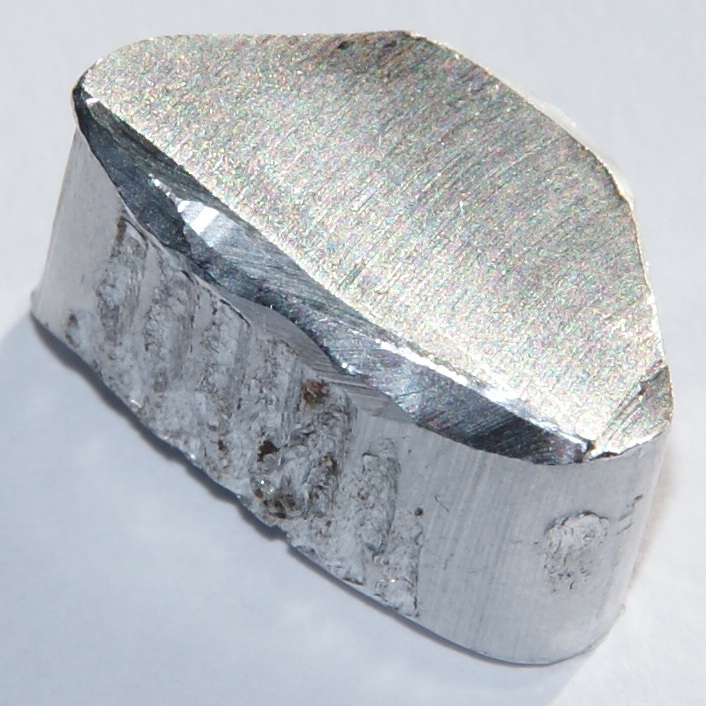
Aluminium (the Commonwealth and preferred IUPAC name) or aluminum (North American English) is a chemical element; it has symbol Al and atomic number 13. It has a density lower than other common metals, about one-third that of steel. Aluminium has a great affinity towards oxygen, forming a protective layer of oxide on the surface when exposed to air. It visually resembles silver, both in its color and in its great ability to reflect light. It is soft, nonmagnetic, and ductile. It has one stable isotope, 27Al, which is highly abundant, making aluminium the 12th-most abundant element in the universe. The radioactivity of 26Al leads to it being used in radiometric dating.
Chemically, aluminium is a post-transition metal in the boron group; as is common for the group, aluminium forms compounds primarily in the +3 oxidation state. The aluminium cation Al3+ is small and highly charged; as such, it has more polarizing power, and bonds formed by aluminium have a more covalent character. The strong affinity of aluminium for oxygen leads to the common occurrence of its oxides in nature. Aluminium is found on Earth primarily in rocks in the crust, where it is the third-most abundant element after oxygen and silicon, rather than in the mantle, and virtually never as the free metal. It is obtained industrially by mining bauxite, a sedimentary rock rich in aluminium minerals.
The discovery of aluminium was announced in 1825 by Danish physicist Hans Christian Ørsted. The first industrial production of aluminium was initiated by French chemist Henri Étienne Sainte-Claire Deville in 1856. Aluminium became much more available to the public with the Hall–Héroult process developed independently by French engineer Paul Héroult and American engineer Charles Martin Hall in 1886, and the mass production of aluminium led to its extensive use in industry and everyday life. In 1954, aluminium became the most produced non-ferrous metal, surpassing copper. In the 21st century, most aluminium was consumed in transportation, engineering, construction, and packaging in the United States, Western Europe, and Japan. The standard atomic weight of aluminium is low in comparison with many other metals, giving it the low density responsible for many of its uses.
Despite its prevalence in the environment, no living organism is known to metabolize aluminium salts, but aluminium is well tolerated by plants and animals. Because of the abundance of these salts, the potential for a biological role for them is of interest, and studies are ongoing.
Aluminium has one stable isotope, 27Al, which comprises virtually all of the naturally-occurring element. This is common for elements with an odd atomic number. It is therefore a mononuclidic element for standard atomic weight, which is determined completely by that isotope. Aluminium is useful in nuclear magnetic resonance (NMR), as its single stable isotope (though quadrupolar) has a high NMR sensitivity.
All other isotopes of aluminium are radioactive. The most stable of these is 26Al, with a half-life of 717,000 years. While it was present along with stable 27Al in the interstellar medium from which the Solar System formed (believe to have been produced by stellar nucleosynthesis also), no detectable amount could have survived the time since the formation of the planet. However, minute traces of 26Al are still produced from decay of argon in the atmosphere induced by ionizing radiation of cosmic rays. The ratio of 26Al to 10Be has been used for the radiodating of geological processes over 105 to 106 year time scales, in particular transport, deposition, sediment storage, burial times, and erosion. Most meteorite scientists believe that the energy released by the decay of 26Al was responsible for the melting and differentiation of some asteroids after their formation 4.55 billion years ago.
The other known isotopes of aluminium, with mass numbers ranging from 20 to 43, all have half-lives less than 7 minutes, as do the four detected metastable states.
An aluminium atom has 13 electrons with an electron configuration of [Ne] 3s2 3p1, with three electrons beyond a stable noble gas configuration. Accordingly, the combined first three ionization energies of aluminium are far lower than the fourth ionization energy alone. Such an electron configuration is shared with the other well-characterized members of its group, boron, gallium, indium, and thallium; it is also expected for nihonium. Aluminium can surrender its three outermost electrons in many chemical reactions (see below). The electronegativity of aluminium is 1.61 on the Pauling scale.
Aluminium
Aluminium (the Commonwealth and preferred IUPAC name) or aluminum (North American English) is a chemical element; it has symbol Al and atomic number 13. It has a density lower than other common metals, about one-third that of steel. Aluminium has a great affinity towards oxygen, forming a protective layer of oxide on the surface when exposed to air. It visually resembles silver, both in its color and in its great ability to reflect light. It is soft, nonmagnetic, and ductile. It has one stable isotope, 27Al, which is highly abundant, making aluminium the 12th-most abundant element in the universe. The radioactivity of 26Al leads to it being used in radiometric dating.
Chemically, aluminium is a post-transition metal in the boron group; as is common for the group, aluminium forms compounds primarily in the +3 oxidation state. The aluminium cation Al3+ is small and highly charged; as such, it has more polarizing power, and bonds formed by aluminium have a more covalent character. The strong affinity of aluminium for oxygen leads to the common occurrence of its oxides in nature. Aluminium is found on Earth primarily in rocks in the crust, where it is the third-most abundant element after oxygen and silicon, rather than in the mantle, and virtually never as the free metal. It is obtained industrially by mining bauxite, a sedimentary rock rich in aluminium minerals.
The discovery of aluminium was announced in 1825 by Danish physicist Hans Christian Ørsted. The first industrial production of aluminium was initiated by French chemist Henri Étienne Sainte-Claire Deville in 1856. Aluminium became much more available to the public with the Hall–Héroult process developed independently by French engineer Paul Héroult and American engineer Charles Martin Hall in 1886, and the mass production of aluminium led to its extensive use in industry and everyday life. In 1954, aluminium became the most produced non-ferrous metal, surpassing copper. In the 21st century, most aluminium was consumed in transportation, engineering, construction, and packaging in the United States, Western Europe, and Japan. The standard atomic weight of aluminium is low in comparison with many other metals, giving it the low density responsible for many of its uses.
Despite its prevalence in the environment, no living organism is known to metabolize aluminium salts, but aluminium is well tolerated by plants and animals. Because of the abundance of these salts, the potential for a biological role for them is of interest, and studies are ongoing.
Aluminium has one stable isotope, 27Al, which comprises virtually all of the naturally-occurring element. This is common for elements with an odd atomic number. It is therefore a mononuclidic element for standard atomic weight, which is determined completely by that isotope. Aluminium is useful in nuclear magnetic resonance (NMR), as its single stable isotope (though quadrupolar) has a high NMR sensitivity.
All other isotopes of aluminium are radioactive. The most stable of these is 26Al, with a half-life of 717,000 years. While it was present along with stable 27Al in the interstellar medium from which the Solar System formed (believe to have been produced by stellar nucleosynthesis also), no detectable amount could have survived the time since the formation of the planet. However, minute traces of 26Al are still produced from decay of argon in the atmosphere induced by ionizing radiation of cosmic rays. The ratio of 26Al to 10Be has been used for the radiodating of geological processes over 105 to 106 year time scales, in particular transport, deposition, sediment storage, burial times, and erosion. Most meteorite scientists believe that the energy released by the decay of 26Al was responsible for the melting and differentiation of some asteroids after their formation 4.55 billion years ago.
The other known isotopes of aluminium, with mass numbers ranging from 20 to 43, all have half-lives less than 7 minutes, as do the four detected metastable states.
An aluminium atom has 13 electrons with an electron configuration of [Ne] 3s2 3p1, with three electrons beyond a stable noble gas configuration. Accordingly, the combined first three ionization energies of aluminium are far lower than the fourth ionization energy alone. Such an electron configuration is shared with the other well-characterized members of its group, boron, gallium, indium, and thallium; it is also expected for nihonium. Aluminium can surrender its three outermost electrons in many chemical reactions (see below). The electronegativity of aluminium is 1.61 on the Pauling scale.
Recent media
Recent media