


Community hub
Recent from talks
Contribute something to knowledge base
Content stats: 0 posts, 0 articles, 1 media, 0 notes
Members stats: 0 subscribers, 0 contributors, 0 moderators, 0 supporters
Subscribers
Supporters
Contributors
Moderators
Hub AI
Alternatives to Darwinian evolution AI simulator
(@Alternatives to Darwinian evolution_simulator)
Hub AI
Alternatives to Darwinian evolution AI simulator
(@Alternatives to Darwinian evolution_simulator)
Alternatives to Darwinian evolution
Alternatives to Darwinian evolution have been proposed by scholars investigating biology to explain signs of evolution and the relatedness of different groups of living things. The alternatives in question do not deny that evolutionary changes over time are the origin of the diversity of life, nor that the organisms alive today share a common ancestor from the distant past (or ancestors, in some proposals); rather, they propose alternative mechanisms of evolutionary change over time, arguing against mutations acted on by natural selection as the most important driver of evolutionary change.
This distinguishes them from certain other kinds of arguments that deny that large-scale evolution of any sort has taken place, as in some forms of creationism, which do not propose alternative mechanisms of evolutionary change but instead deny that evolutionary change has taken place at all. Not all forms of creationism deny that evolutionary change takes place; notably, proponents of theistic evolution, such as the biologist Asa Gray, assert that evolutionary change does occur and is responsible for the history of life on Earth, with the proviso that this process has been influenced by a god or gods in some meaningful sense.
Where the fact of evolutionary change was accepted but the mechanism proposed by Charles Darwin, natural selection, was denied, explanations of evolution such as Lamarckism, catastrophism, orthogenesis, vitalism, structuralism and mutationism (called saltationism before 1900) were entertained. Different factors motivated people to propose non-Darwinian mechanisms of evolution. Natural selection, with its emphasis on death and competition, did not appeal to some naturalists because they felt it immoral, leaving little room for teleology or the concept of progress (orthogenesis) in the development of life. Some who came to accept evolution, but disliked natural selection, raised religious objections. Others felt that evolution was an inherently progressive process that natural selection alone was insufficient to explain. Still others felt that nature, including the development of life, followed orderly patterns that natural selection could not explain.
By the start of the 20th century, evolution was generally accepted by biologists but natural selection was in eclipse. Many alternative theories were proposed, but biologists were quick to discount theories such as orthogenesis, vitalism and Lamarckism which offered no mechanism for evolution. Mutationism did propose a mechanism, but it was not generally accepted. The modern synthesis a generation later claimed to sweep away all the alternatives to Darwinian evolution, though some have been revived as molecular mechanisms for them have been discovered.
Aristotle did not embrace either divine creation or evolution, instead arguing in his biology that each species (eidos) was immutable, breeding true to its ideal eternal form (not the same as Plato's theory of forms). Aristotle's suggestion in De Generatione Animalium of a fixed hierarchy in nature - a scala naturae ("ladder of nature") provided an early explanation of the continuity of living things. Aristotle saw that animals were teleological (functionally end-directed), and had parts that were homologous with those of other animals, but he did not connect these ideas into a concept of evolutionary progress.
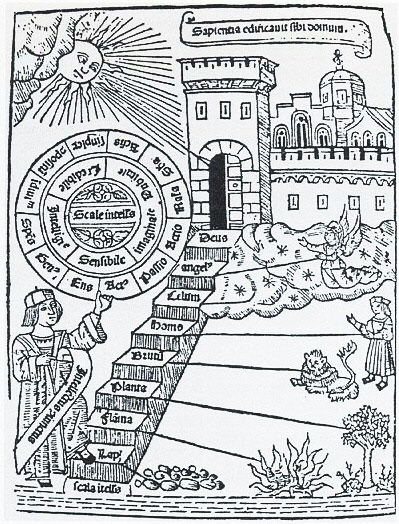
In the Middle Ages, Scholasticism developed Aristotle's view into the idea of a great chain of being. The image of a ladder inherently suggests the possibility of climbing, but both the ancient Greeks and mediaeval scholastics such as Ramon Llull maintained that each species remained fixed from the moment of its creation.
By 1818, however, Étienne Geoffroy Saint-Hilaire argued in his Philosophie anatomique that the chain was "a progressive series", where animals like molluscs low on the chain could "rise, by addition of parts, from the simplicity of the first formations to the complication of the creatures at the head of the scale", given sufficient time. Accordingly, Geoffroy and later biologists looked for explanations of such evolutionary change.
Georges Cuvier's 1812 Recherches sur les Ossements Fossiles set out his doctrine of the correlation of parts, namely that since an organism was a whole system, all its parts mutually corresponded, contributing to the function of the whole. So, from a single bone the zoologist could often tell what class or even genus the animal belonged to. And if an animal had teeth adapted for cutting meat, the zoologist could be sure without even looking that its sense organs would be those of a predator and its intestines those of a carnivore. A species had an irreducible functional complexity, and "none of its parts can change without the others changing too". Evolutionists expected one part to change at a time, one change to follow another. In Cuvier's view, evolution was impossible, as any one change would unbalance the whole delicate system.
Alternatives to Darwinian evolution
Alternatives to Darwinian evolution have been proposed by scholars investigating biology to explain signs of evolution and the relatedness of different groups of living things. The alternatives in question do not deny that evolutionary changes over time are the origin of the diversity of life, nor that the organisms alive today share a common ancestor from the distant past (or ancestors, in some proposals); rather, they propose alternative mechanisms of evolutionary change over time, arguing against mutations acted on by natural selection as the most important driver of evolutionary change.
This distinguishes them from certain other kinds of arguments that deny that large-scale evolution of any sort has taken place, as in some forms of creationism, which do not propose alternative mechanisms of evolutionary change but instead deny that evolutionary change has taken place at all. Not all forms of creationism deny that evolutionary change takes place; notably, proponents of theistic evolution, such as the biologist Asa Gray, assert that evolutionary change does occur and is responsible for the history of life on Earth, with the proviso that this process has been influenced by a god or gods in some meaningful sense.
Where the fact of evolutionary change was accepted but the mechanism proposed by Charles Darwin, natural selection, was denied, explanations of evolution such as Lamarckism, catastrophism, orthogenesis, vitalism, structuralism and mutationism (called saltationism before 1900) were entertained. Different factors motivated people to propose non-Darwinian mechanisms of evolution. Natural selection, with its emphasis on death and competition, did not appeal to some naturalists because they felt it immoral, leaving little room for teleology or the concept of progress (orthogenesis) in the development of life. Some who came to accept evolution, but disliked natural selection, raised religious objections. Others felt that evolution was an inherently progressive process that natural selection alone was insufficient to explain. Still others felt that nature, including the development of life, followed orderly patterns that natural selection could not explain.
By the start of the 20th century, evolution was generally accepted by biologists but natural selection was in eclipse. Many alternative theories were proposed, but biologists were quick to discount theories such as orthogenesis, vitalism and Lamarckism which offered no mechanism for evolution. Mutationism did propose a mechanism, but it was not generally accepted. The modern synthesis a generation later claimed to sweep away all the alternatives to Darwinian evolution, though some have been revived as molecular mechanisms for them have been discovered.
Aristotle did not embrace either divine creation or evolution, instead arguing in his biology that each species (eidos) was immutable, breeding true to its ideal eternal form (not the same as Plato's theory of forms). Aristotle's suggestion in De Generatione Animalium of a fixed hierarchy in nature - a scala naturae ("ladder of nature") provided an early explanation of the continuity of living things. Aristotle saw that animals were teleological (functionally end-directed), and had parts that were homologous with those of other animals, but he did not connect these ideas into a concept of evolutionary progress.
In the Middle Ages, Scholasticism developed Aristotle's view into the idea of a great chain of being. The image of a ladder inherently suggests the possibility of climbing, but both the ancient Greeks and mediaeval scholastics such as Ramon Llull maintained that each species remained fixed from the moment of its creation.
By 1818, however, Étienne Geoffroy Saint-Hilaire argued in his Philosophie anatomique that the chain was "a progressive series", where animals like molluscs low on the chain could "rise, by addition of parts, from the simplicity of the first formations to the complication of the creatures at the head of the scale", given sufficient time. Accordingly, Geoffroy and later biologists looked for explanations of such evolutionary change.
Georges Cuvier's 1812 Recherches sur les Ossements Fossiles set out his doctrine of the correlation of parts, namely that since an organism was a whole system, all its parts mutually corresponded, contributing to the function of the whole. So, from a single bone the zoologist could often tell what class or even genus the animal belonged to. And if an animal had teeth adapted for cutting meat, the zoologist could be sure without even looking that its sense organs would be those of a predator and its intestines those of a carnivore. A species had an irreducible functional complexity, and "none of its parts can change without the others changing too". Evolutionists expected one part to change at a time, one change to follow another. In Cuvier's view, evolution was impossible, as any one change would unbalance the whole delicate system.
Recent media
Recent media