
Recent from talks
Aluminium hydride
Knowledge base stats:
Talk channels stats:
Members stats:
Aluminium hydride
Aluminium hydride (also known as alane and alumane) refers to a collection of inorganic compounds with the formula AlH3. As a gas, alane is a planar molecule. When generated in ether solutions, it exists as an ether adduct. Solutions of alane polymerize to solids, which exist in several crystallographically distinguishable forms.
Alane can adopt 3-, 4-, or 6-coordination, depending on conditions.
Monomeric AlH3 has been isolated at low temperature in a solid noble gas matrix. It was shown to be planar. The dimeric form, Al2H6, has been isolated in solid hydrogen. It is isostructural with diborane (B2H6) and digallane (Ga2H6).
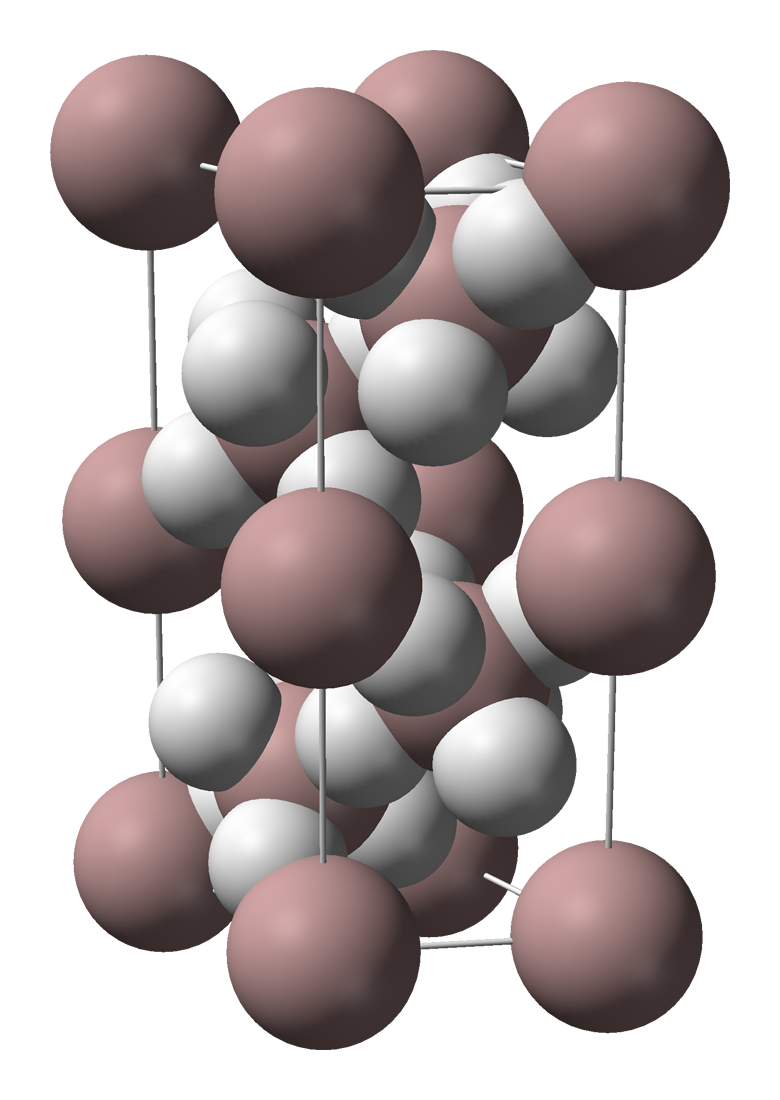
Solid alane, which is colorless and nonvolatile, precipitates from ethereal solutions over the course of hours at room temperature. Numerous polymorphs can be obtained, which have been labeled α-, α'-, β-, γ-, ε-, and ζ-alanes. The best characterized solid alane is α-alane. According to X-ray crystallography, adopts a cubic or rhombohedral morphology. It features octahedral AlH6 centers interconnected by Al-H-Al bridges. The Al-H distances are all equivalent (172 pm) and the Al-H-Al angles are 141°. α'-Alane forms needle-like crystals, and γ-alane forms bundles of fused needles.[citation needed]
Alane is not spontaneously flammable. Even so, it should be handled like Li[AlH4] (the chemical reagent, lithium aluminium hydride) as its reactivity is comparable to this related reducing reagent. For these reagents, both preparations in solutions and isolated solids are "highly flammable and must be stored in the absence of moisture". Laboratory guides recommend alane use inside a fume hood.[why?] Solids of this reagent type carry recommendations of handling "in a glove bag or dry box". After use, solution containers are typically sealed tightly with concomitant flushing with inert gas to exclude the oxygen and moisture of ambient air.
Passivation[clarification needed] greatly diminishes the decomposition rate associated with alane preparations.[citation needed] Passivated alane nevertheless retains a hazard classification of 4.3 (chemicals which in contact with water, emit flammable gases).
Alane reductions are believed to proceed via an intermediate coordination complex, with aluminum attached to the partially reduced functional group, and liberated when the reaction undergoes protic quenching. If the substrate is also fluorinated, the intermediate may explode if exposed to a hot spot above 60 °C.
In 1964, a lab explosion was reported during the reduction of perfluorosuccinimide using lithium aluminum hydride, which produces similar aluminum hydride complexes. Following the explosion, the lab tested various LAH complexes containing perfluorinated substrates, each of which were found to be explosive.
Hub AI
Aluminium hydride AI simulator
(@Aluminium hydride_simulator)
Aluminium hydride
Aluminium hydride (also known as alane and alumane) refers to a collection of inorganic compounds with the formula AlH3. As a gas, alane is a planar molecule. When generated in ether solutions, it exists as an ether adduct. Solutions of alane polymerize to solids, which exist in several crystallographically distinguishable forms.
Alane can adopt 3-, 4-, or 6-coordination, depending on conditions.
Monomeric AlH3 has been isolated at low temperature in a solid noble gas matrix. It was shown to be planar. The dimeric form, Al2H6, has been isolated in solid hydrogen. It is isostructural with diborane (B2H6) and digallane (Ga2H6).
Solid alane, which is colorless and nonvolatile, precipitates from ethereal solutions over the course of hours at room temperature. Numerous polymorphs can be obtained, which have been labeled α-, α'-, β-, γ-, ε-, and ζ-alanes. The best characterized solid alane is α-alane. According to X-ray crystallography, adopts a cubic or rhombohedral morphology. It features octahedral AlH6 centers interconnected by Al-H-Al bridges. The Al-H distances are all equivalent (172 pm) and the Al-H-Al angles are 141°. α'-Alane forms needle-like crystals, and γ-alane forms bundles of fused needles.[citation needed]
Alane is not spontaneously flammable. Even so, it should be handled like Li[AlH4] (the chemical reagent, lithium aluminium hydride) as its reactivity is comparable to this related reducing reagent. For these reagents, both preparations in solutions and isolated solids are "highly flammable and must be stored in the absence of moisture". Laboratory guides recommend alane use inside a fume hood.[why?] Solids of this reagent type carry recommendations of handling "in a glove bag or dry box". After use, solution containers are typically sealed tightly with concomitant flushing with inert gas to exclude the oxygen and moisture of ambient air.
Passivation[clarification needed] greatly diminishes the decomposition rate associated with alane preparations.[citation needed] Passivated alane nevertheless retains a hazard classification of 4.3 (chemicals which in contact with water, emit flammable gases).
Alane reductions are believed to proceed via an intermediate coordination complex, with aluminum attached to the partially reduced functional group, and liberated when the reaction undergoes protic quenching. If the substrate is also fluorinated, the intermediate may explode if exposed to a hot spot above 60 °C.
In 1964, a lab explosion was reported during the reduction of perfluorosuccinimide using lithium aluminum hydride, which produces similar aluminum hydride complexes. Following the explosion, the lab tested various LAH complexes containing perfluorinated substrates, each of which were found to be explosive.
Recent media