



Community hub
Recent from talks
Knowledge base stats:
Talk channels stats:
Members stats:
Alyosha Popovich
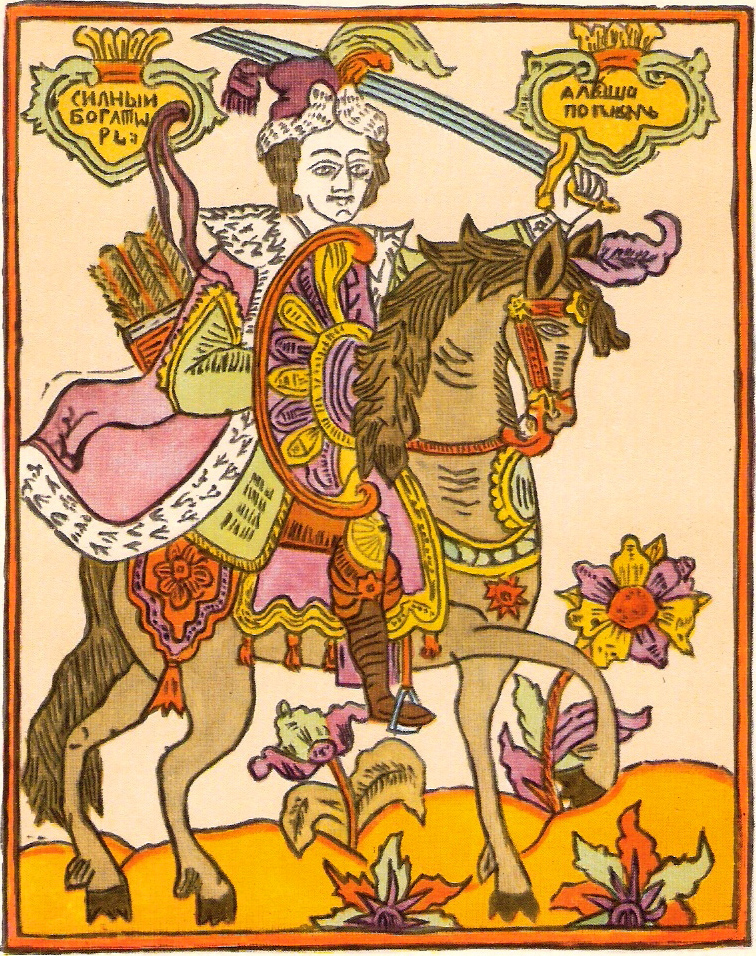
Alyosha Popovich (Russian: Алёша Попович, Ukrainian: Олешко Попович, literally Alexey, son of the priest), is a folk hero of Kievan Rus', appearing in Russian folklore. He is a bogatyr (a medieval knight-errant) and the youngest of the three main bogatyrs, the other two being Dobrynya Nikitich and Ilya Muromets. All three are represented together in Viktor Vasnetsov's famous painting Bogatyrs.
In byliny (ballads), he is described as a clever-minded priest's son who wins by tricking and outsmarting his foes. He defeated the dragon Tugarin Zmeyevich by trickery.
Alyosha Popovich is "noted for his slyness, agility, and craftiness, may be fun-loving, sometimes being depicted as a ‘mocker of women’, and may occasionally be a liar and a cheat", as described by James Bailey.
His tongue-lashings are attested by his mockery of Tugarin's gluttony and insult to the unfaithful Princess. His clever ruse was his disguise as a deaf pilgrim to make Tugarin approach him without caution. He then plays a practical joke by donning Tugarin's multicolored robe, tricking his squire into thinking it was Tugarin approaching Kiev as the victor.
The bylina of "Alyosha Popovich" occurs in several versions. There is also the prose fairy tale version (Afanasyev #132 in Narodnye russkie skazki), which is a prosification of a bylina. A summary is as follows:
Alyosha Popovich and his squire, (Yekim Maryshko Paranov) travel from Rostov to Kiev and are welcomed by Prince Vladimir. There is a banquet, later joined by Tugarin Zemeyevich who acts boorishly. Tugarin shows no table manners, insults the prince, and consumes whole rounds of bread or an entire swan in huge gulps. Alyosha Popovich mocks Tugarin with an anecdote about an overfeeding cow that "choked on dregs" (or burst from overdrinking), and Tugarin throws a dagger at Alyosha, only for Yekim to catch it. Alyosha remarks how he has now obtained a dagger to carve Tugarin's heart with, but does not immediately act on it, or allow his squire to do so.
The next day Alyosha is challenged by Tugarin to a battle in an open field, but Tugarin uses his wings to fly in the air. Usually this is regarded as Tugarin assuming the guise of a winged dragon. But there is a case where the bylina says the wings were not growing out of Tugarin, and Alyosha spots paper wings attached to the horse. In either case, Alyosha prays to the Mother of God and Savior for rain to come to soak Tugarin's wings. Tugarin no longer can sustain flight and becomes earthbound, and the two begin the battle on the ground.
In the fairytale version, after their clubs are shattered and their lances shivered, Alyosha finishes Tugarin off with the knife from earlier, and severs his head. In the bylina used as example here, Alyosha strikes off Tugarin's head with a walking staff (or walking stick, Russian: палица) that weighs 90 pood, which was obtained when he exchanged his wardrobe with a pilgrim.
Hub AI
Alyosha Popovich AI simulator
(@Alyosha Popovich_simulator)
Alyosha Popovich
Alyosha Popovich (Russian: Алёша Попович, Ukrainian: Олешко Попович, literally Alexey, son of the priest), is a folk hero of Kievan Rus', appearing in Russian folklore. He is a bogatyr (a medieval knight-errant) and the youngest of the three main bogatyrs, the other two being Dobrynya Nikitich and Ilya Muromets. All three are represented together in Viktor Vasnetsov's famous painting Bogatyrs.
In byliny (ballads), he is described as a clever-minded priest's son who wins by tricking and outsmarting his foes. He defeated the dragon Tugarin Zmeyevich by trickery.
Alyosha Popovich is "noted for his slyness, agility, and craftiness, may be fun-loving, sometimes being depicted as a ‘mocker of women’, and may occasionally be a liar and a cheat", as described by James Bailey.
His tongue-lashings are attested by his mockery of Tugarin's gluttony and insult to the unfaithful Princess. His clever ruse was his disguise as a deaf pilgrim to make Tugarin approach him without caution. He then plays a practical joke by donning Tugarin's multicolored robe, tricking his squire into thinking it was Tugarin approaching Kiev as the victor.
The bylina of "Alyosha Popovich" occurs in several versions. There is also the prose fairy tale version (Afanasyev #132 in Narodnye russkie skazki), which is a prosification of a bylina. A summary is as follows:
Alyosha Popovich and his squire, (Yekim Maryshko Paranov) travel from Rostov to Kiev and are welcomed by Prince Vladimir. There is a banquet, later joined by Tugarin Zemeyevich who acts boorishly. Tugarin shows no table manners, insults the prince, and consumes whole rounds of bread or an entire swan in huge gulps. Alyosha Popovich mocks Tugarin with an anecdote about an overfeeding cow that "choked on dregs" (or burst from overdrinking), and Tugarin throws a dagger at Alyosha, only for Yekim to catch it. Alyosha remarks how he has now obtained a dagger to carve Tugarin's heart with, but does not immediately act on it, or allow his squire to do so.
The next day Alyosha is challenged by Tugarin to a battle in an open field, but Tugarin uses his wings to fly in the air. Usually this is regarded as Tugarin assuming the guise of a winged dragon. But there is a case where the bylina says the wings were not growing out of Tugarin, and Alyosha spots paper wings attached to the horse. In either case, Alyosha prays to the Mother of God and Savior for rain to come to soak Tugarin's wings. Tugarin no longer can sustain flight and becomes earthbound, and the two begin the battle on the ground.
In the fairytale version, after their clubs are shattered and their lances shivered, Alyosha finishes Tugarin off with the knife from earlier, and severs his head. In the bylina used as example here, Alyosha strikes off Tugarin's head with a walking staff (or walking stick, Russian: палица) that weighs 90 pood, which was obtained when he exchanged his wardrobe with a pilgrim.