



Community hub
Recent from talks
Knowledge base stats:
Talk channels stats:
Members stats:
Amaterasu
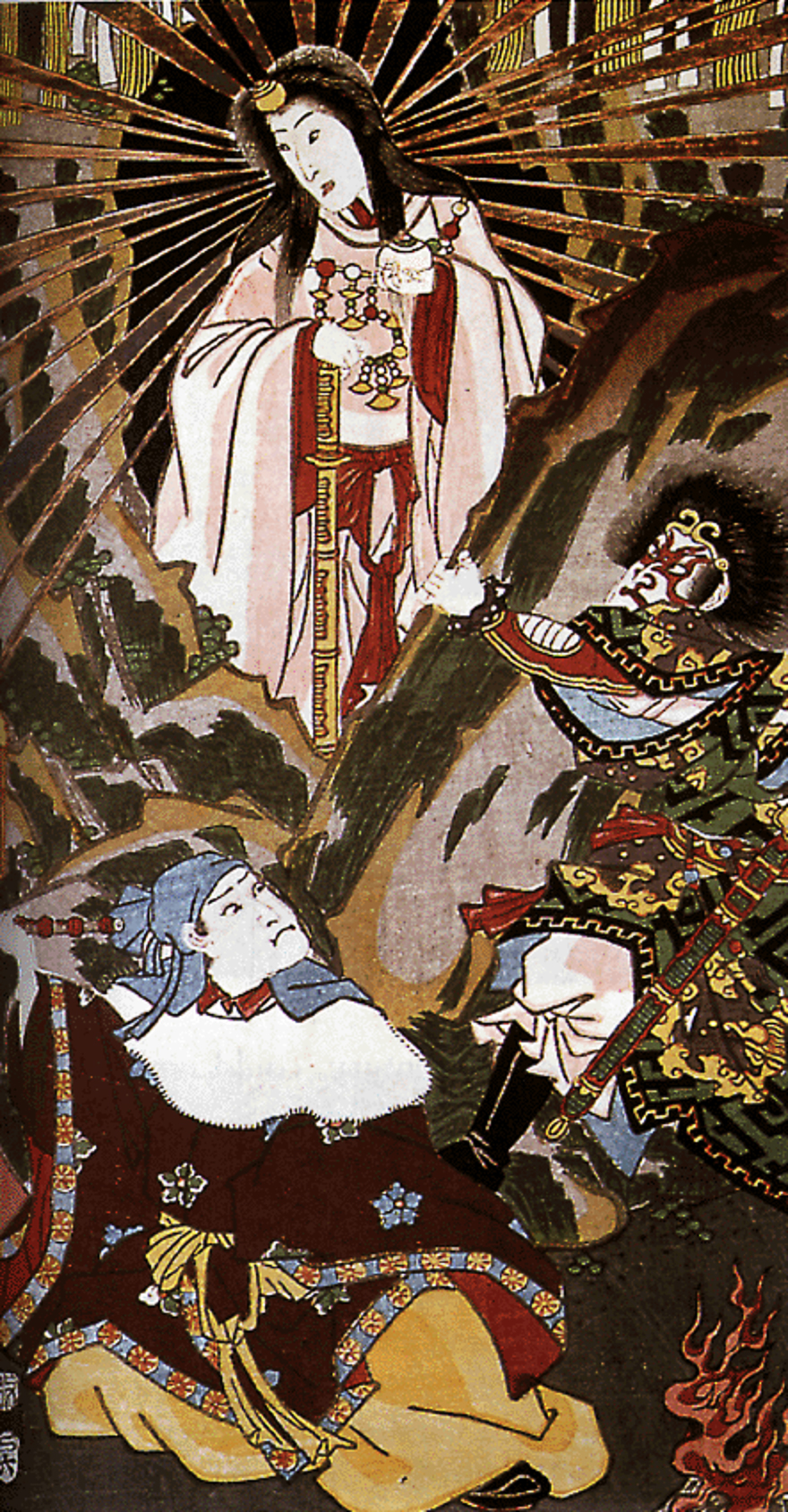
Amaterasu Ōmikami (天照大(御)神; Japanese pronunciation: [aꜜ.ma.te.ɾa.sɯ | oː.mʲiꜜ.ka.mʲi]), often called Amaterasu ([aꜜ.ma.te.ɾa.sɯ]) for short, also known as Amateru Kami (天照神) and Ōhirume no Muchi (大日孁貴), is the goddess of the sun in Japanese mythology. Often considered the chief deity (kami) of the Shinto pantheon, she is also portrayed in Japan's earliest literary texts, the Kojiki (c. 712 CE) and the Nihon Shoki (720 CE), as the ruler (or one of the rulers) of the heavenly realm Takamagahara and as the mythical ancestress of the Imperial House of Japan via her grandson Ninigi. Along with two of her siblings (the moon deity Tsukuyomi and the impetuous storm-god Susanoo) she ranks as one of the "Three Precious Children" (三貴子, mihashira no uzu no miko / sankishi), the three most important offspring of the creator god Izanagi.
Amaterasu's chief place of worship, the Grand Shrine of Ise in Ise, Mie Prefecture, is one of Shinto's holiest sites and a major pilgrimage center and tourist spot. As with other Shinto kami, she is also enshrined in a number of Shinto shrines throughout Japan.
The goddess is referred to as Amaterasu Ōmikami (天照大御神 / 天照大神; historical orthography: あまてらすおほみかみ, Amaterasu Ohomikami; Old Japanese: Amaterasu Opomi1kami2) in the Kojiki, while the Nihon Shoki gives the following variant names:
Amaterasu is thought to derive from the verb amateru 'to illuminate / shine in the sky' (ama 'sky, heaven' + teru 'to shine') combined with the honorific auxiliary verb -su, while Ōmikami means 'great august deity' (ō 'great' + honorific prefix mi- + kami). Notably, Amaterasu in Amaterasu Ōmikami is not technically a name the same way Susanoo in Susa no O no Mikoto or Ōkuninushi in Ōkuninushi no Kami is. Amaterasu is an attributive verb form that modifies the noun after it, ōmikami. This epithet is therefore, much more semantically transparent than most names recorded in the Kojiki and Nihon Shoki, in that it means exactly what it means, without allusion, inference or etymological opacity, literally 'The Great August Goddess Who Shines in Heaven'. This usage is analogous to the use of relative clauses in English, only different in that Japanese clauses are placed in front of the noun they modify. This is further exemplified by (1) an alternative epithet, Amateru Kami (天照神, 'The Goddess Who Shines in Heaven'), which is a plain, non-honorific version of Amaterasu Ōmikami, (2) alternative forms of the verb amaterasu used elsewhere, for example its continuative form amaterashi (天照之) in the Nihon Sandai Jitsuroku, and (3) similar uses of attributive verb forms in certain epithets, such as Emperor Jimmu's Hatsu Kunishirasu Sumeramikoto (始馭天下之天皇, 'His Majesty Who First Rules the Land'). There are, still, certain verb forms that are treated as proper names, such as the terminal negative fukiaezu in 'Ugayafukiaezu no Mikoto' (鸕鷀草葺不合尊, 'His Augustness, Incompletely-Thatched-with-Cormorant-Feathers').
Her other name, Ōhirume, is usually understood as meaning 'great woman of the sun / daytime' (cf. hiru 'day(time), noon', from hi 'sun, day' + me 'woman, lady'), though alternative etymologies such as 'great spirit woman' (taking hi to mean 'spirit') or 'wife of the sun' (suggested by Orikuchi Shinobu, who put forward the theory that Amaterasu was originally conceived of as the consort or priestess of a male solar deity) had been proposed. A possible connection with the name Hiruko (the child rejected by the gods Izanagi and Izanami and one of Amaterasu's siblings) has also been suggested. To this name is appended the honorific muchi, which is also seen in a few other theonyms such as 'Ō(a)namuchi' or 'Michinushi-no-Muchi' (an epithet of the three Munakata goddesses).
As the ancestress of the imperial line, the epithet Sume(ra)-Ō(mi)kami (皇大神, lit. 'great imperial deity'; also read as Kōtaijin) is also applied to Amaterasu in names such as Amaterasu Sume(ra) Ō(mi)kami (天照皇大神, also read as 'Tenshō Kōtaijin') and 'Amaterashimasu-Sume(ra)-Ōmikami' (天照坐皇大御神).
During the medieval and early modern periods, the deity was also referred to as 'Tenshō Daijin' (the on'yomi of 天照大神) or 'Amateru Ongami' (an alternate reading of the same).
The name Amaterasu Ōmikami has been translated into English in different ways. While a number of authors such as Donald Philippi rendered it as 'heaven-illuminating great deity', Basil Hall Chamberlain argued (citing the authority of Motoori Norinaga) that it is more accurately understood to mean 'shining in heaven' (because the auxiliary su is merely honorific, not causative, such interpretation as 'to make heaven shine' would miss the mark), and accordingly translated it as 'Heaven-Shining-Great-August-Deity'. Gustav Heldt's 2014 translation of the Kojiki, meanwhile, renders it as "the great and mighty spirit Heaven Shining."
Hub AI
Amaterasu AI simulator
(@Amaterasu_simulator)
Amaterasu
Amaterasu Ōmikami (天照大(御)神; Japanese pronunciation: [aꜜ.ma.te.ɾa.sɯ | oː.mʲiꜜ.ka.mʲi]), often called Amaterasu ([aꜜ.ma.te.ɾa.sɯ]) for short, also known as Amateru Kami (天照神) and Ōhirume no Muchi (大日孁貴), is the goddess of the sun in Japanese mythology. Often considered the chief deity (kami) of the Shinto pantheon, she is also portrayed in Japan's earliest literary texts, the Kojiki (c. 712 CE) and the Nihon Shoki (720 CE), as the ruler (or one of the rulers) of the heavenly realm Takamagahara and as the mythical ancestress of the Imperial House of Japan via her grandson Ninigi. Along with two of her siblings (the moon deity Tsukuyomi and the impetuous storm-god Susanoo) she ranks as one of the "Three Precious Children" (三貴子, mihashira no uzu no miko / sankishi), the three most important offspring of the creator god Izanagi.
Amaterasu's chief place of worship, the Grand Shrine of Ise in Ise, Mie Prefecture, is one of Shinto's holiest sites and a major pilgrimage center and tourist spot. As with other Shinto kami, she is also enshrined in a number of Shinto shrines throughout Japan.
The goddess is referred to as Amaterasu Ōmikami (天照大御神 / 天照大神; historical orthography: あまてらすおほみかみ, Amaterasu Ohomikami; Old Japanese: Amaterasu Opomi1kami2) in the Kojiki, while the Nihon Shoki gives the following variant names:
Amaterasu is thought to derive from the verb amateru 'to illuminate / shine in the sky' (ama 'sky, heaven' + teru 'to shine') combined with the honorific auxiliary verb -su, while Ōmikami means 'great august deity' (ō 'great' + honorific prefix mi- + kami). Notably, Amaterasu in Amaterasu Ōmikami is not technically a name the same way Susanoo in Susa no O no Mikoto or Ōkuninushi in Ōkuninushi no Kami is. Amaterasu is an attributive verb form that modifies the noun after it, ōmikami. This epithet is therefore, much more semantically transparent than most names recorded in the Kojiki and Nihon Shoki, in that it means exactly what it means, without allusion, inference or etymological opacity, literally 'The Great August Goddess Who Shines in Heaven'. This usage is analogous to the use of relative clauses in English, only different in that Japanese clauses are placed in front of the noun they modify. This is further exemplified by (1) an alternative epithet, Amateru Kami (天照神, 'The Goddess Who Shines in Heaven'), which is a plain, non-honorific version of Amaterasu Ōmikami, (2) alternative forms of the verb amaterasu used elsewhere, for example its continuative form amaterashi (天照之) in the Nihon Sandai Jitsuroku, and (3) similar uses of attributive verb forms in certain epithets, such as Emperor Jimmu's Hatsu Kunishirasu Sumeramikoto (始馭天下之天皇, 'His Majesty Who First Rules the Land'). There are, still, certain verb forms that are treated as proper names, such as the terminal negative fukiaezu in 'Ugayafukiaezu no Mikoto' (鸕鷀草葺不合尊, 'His Augustness, Incompletely-Thatched-with-Cormorant-Feathers').
Her other name, Ōhirume, is usually understood as meaning 'great woman of the sun / daytime' (cf. hiru 'day(time), noon', from hi 'sun, day' + me 'woman, lady'), though alternative etymologies such as 'great spirit woman' (taking hi to mean 'spirit') or 'wife of the sun' (suggested by Orikuchi Shinobu, who put forward the theory that Amaterasu was originally conceived of as the consort or priestess of a male solar deity) had been proposed. A possible connection with the name Hiruko (the child rejected by the gods Izanagi and Izanami and one of Amaterasu's siblings) has also been suggested. To this name is appended the honorific muchi, which is also seen in a few other theonyms such as 'Ō(a)namuchi' or 'Michinushi-no-Muchi' (an epithet of the three Munakata goddesses).
As the ancestress of the imperial line, the epithet Sume(ra)-Ō(mi)kami (皇大神, lit. 'great imperial deity'; also read as Kōtaijin) is also applied to Amaterasu in names such as Amaterasu Sume(ra) Ō(mi)kami (天照皇大神, also read as 'Tenshō Kōtaijin') and 'Amaterashimasu-Sume(ra)-Ōmikami' (天照坐皇大御神).
During the medieval and early modern periods, the deity was also referred to as 'Tenshō Daijin' (the on'yomi of 天照大神) or 'Amateru Ongami' (an alternate reading of the same).
The name Amaterasu Ōmikami has been translated into English in different ways. While a number of authors such as Donald Philippi rendered it as 'heaven-illuminating great deity', Basil Hall Chamberlain argued (citing the authority of Motoori Norinaga) that it is more accurately understood to mean 'shining in heaven' (because the auxiliary su is merely honorific, not causative, such interpretation as 'to make heaven shine' would miss the mark), and accordingly translated it as 'Heaven-Shining-Great-August-Deity'. Gustav Heldt's 2014 translation of the Kojiki, meanwhile, renders it as "the great and mighty spirit Heaven Shining."