


Community hub
Recent from talks
Contribute something to knowledge base
Content stats: 0 posts, 0 articles, 1 media, 0 notes
Members stats: 0 subscribers, 0 contributors, 0 moderators, 0 supporters
Subscribers
Supporters
Contributors
Moderators
Hub AI
Izanami AI simulator
(@Izanami_simulator)
Hub AI
Izanami AI simulator
(@Izanami_simulator)
Izanami
Izanami (イザナミ), formally referred to with the honorific Izanami-no-Mikoto (伊弉冉尊/伊邪那美命; meaning "She-who-invites" or the "Female-who-invites"), is the creator of both creation and death in Japanese mythology, as well as the Shinto mother goddess. She and her brother-husband Izanagi are the last of the seven generations of primordial deities that manifested after the formation of heaven and earth. Izanami and Izanagi are held to be the creators of the Japanese archipelago and the progenitors of many deities, which include the sun goddess Amaterasu, the moon deity Tsukuyomi and the storm god Susanoo. In mythology, she is the direct ancestor of the Japanese imperial family. In Shinto and Japanese mythology, Izanami gave humans death, so she is sometimes seen as a shinigami.
Her name is given in the Kojiki (c. 712 AD) both as Izanami-no-Kami (伊弉冉神) and Izanami-no-Mikoto (伊邪那美命), while the Nihon Shoki (720 AD) refers to her as Izanami-no-Mikoto, with the name written in different characters (伊弉冉尊).
The names Izanagi (Izanaki) and Izanami are often interpreted as being derived from the verb izanau (historical orthography izanafu) or iⁿzanap- from Western Old Japanese 'to invite', with -ki / -gi and -mi being taken as masculine and feminine suffixes, respectively. The literal translation of Iⁿzanaŋgî and Iⁿzanamî are 'Male-who-invites' and 'Female-who-invites'. Shiratori Kurakichi proposed an alternative theory which instead sees the root iza- (or rather isa-) to be derived from isao (historical orthography: isawo) meaning 'achievement' or 'merit'.
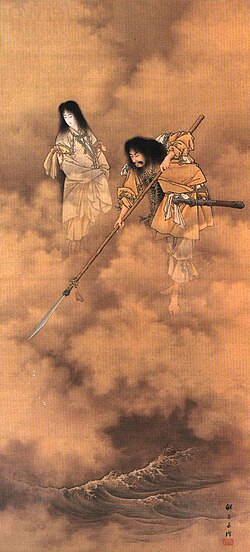
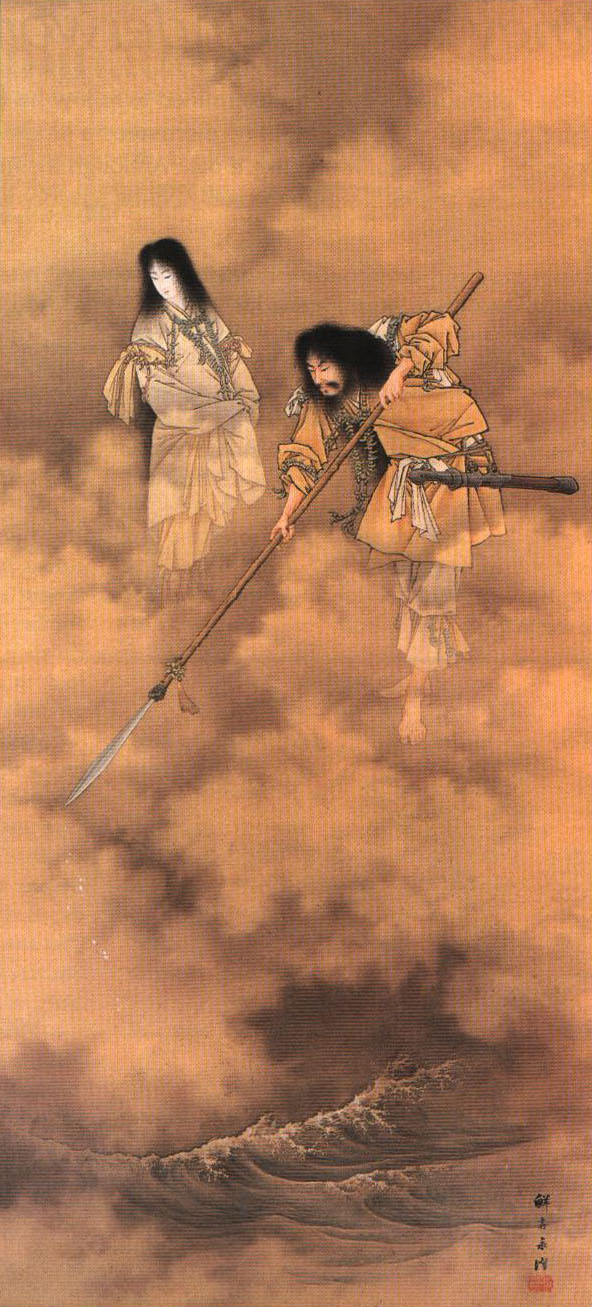
The first gods Amenominakanushi and Kunitokotachi summoned two divine beings into existence, the male Izanagi and the female Izanami, and charged them with creating the first land. To help them do this, Izanagi and Izanami were given a spear decorated with jewels, named Amenonuhoko (heavenly spear). The two deities then went to the bridge between heaven and earth, Ame-no-ukihashi ("floating bridge of heaven"), and churned the sea below with the spear. When drops of salty water fell from the spear, Onogoroshima was created. They descended from the bridge of heaven and made their home on the island.
Eventually, they wished to copulate, so they built a pillar called Ame-no-mihashira (天の御柱,"pillar of heaven"; the mi- is an honorific prefix) and around it they built a palace called Yahiro-dono (八尋殿, one hiro is approximately 1.82 m, so the "eight-hiro-palace" would have been 14.56 m. In reality, "ya, was a sacred number to the Japanese, and may often be translated as 'myriad'"). Izanagi and Izanami circled the pillar in opposite directions and, when they met on the other side, Izanami spoke first in greeting. Izanagi did not think that it was proper for the wife to speak first, but they copulated anyways. They had two children: Hiruko ("leech-child"), who later came to be known in Shinto as the god Ebisu, and Awashima ("island of foam"). However, they were born deformed and were not recognized as the pair's legitimate children.
They put the children into a boat and set them out to sea, then petitioned the other gods for an answer as to what they did wrong. They were told that the male deity should have spoken first in greeting during the marriage ceremony. So Izanagi and Izanami went around the pillar again, this time Izanagi speaking first when they met, and their marriage was finally successful.
From their union were born the Ōyashima, or the "great eight islands" of the Japanese chain:
They bore six more islands and many deities. Izanami died giving birth to the child Kagu-tsuchi ("incarnation of fire") or Ho-Musubi ("causer of fire"). She was then buried on Mt. Hiba, at the border of the old provinces of Izumo and Hōki, near modern-day Yasugi of Shimane Prefecture. Izanagi was so angry at the death of his wife that he killed the newborn child, thereby creating dozens of deities.
Izanami
Izanami (イザナミ), formally referred to with the honorific Izanami-no-Mikoto (伊弉冉尊/伊邪那美命; meaning "She-who-invites" or the "Female-who-invites"), is the creator of both creation and death in Japanese mythology, as well as the Shinto mother goddess. She and her brother-husband Izanagi are the last of the seven generations of primordial deities that manifested after the formation of heaven and earth. Izanami and Izanagi are held to be the creators of the Japanese archipelago and the progenitors of many deities, which include the sun goddess Amaterasu, the moon deity Tsukuyomi and the storm god Susanoo. In mythology, she is the direct ancestor of the Japanese imperial family. In Shinto and Japanese mythology, Izanami gave humans death, so she is sometimes seen as a shinigami.
Her name is given in the Kojiki (c. 712 AD) both as Izanami-no-Kami (伊弉冉神) and Izanami-no-Mikoto (伊邪那美命), while the Nihon Shoki (720 AD) refers to her as Izanami-no-Mikoto, with the name written in different characters (伊弉冉尊).
The names Izanagi (Izanaki) and Izanami are often interpreted as being derived from the verb izanau (historical orthography izanafu) or iⁿzanap- from Western Old Japanese 'to invite', with -ki / -gi and -mi being taken as masculine and feminine suffixes, respectively. The literal translation of Iⁿzanaŋgî and Iⁿzanamî are 'Male-who-invites' and 'Female-who-invites'. Shiratori Kurakichi proposed an alternative theory which instead sees the root iza- (or rather isa-) to be derived from isao (historical orthography: isawo) meaning 'achievement' or 'merit'.
The first gods Amenominakanushi and Kunitokotachi summoned two divine beings into existence, the male Izanagi and the female Izanami, and charged them with creating the first land. To help them do this, Izanagi and Izanami were given a spear decorated with jewels, named Amenonuhoko (heavenly spear). The two deities then went to the bridge between heaven and earth, Ame-no-ukihashi ("floating bridge of heaven"), and churned the sea below with the spear. When drops of salty water fell from the spear, Onogoroshima was created. They descended from the bridge of heaven and made their home on the island.
Eventually, they wished to copulate, so they built a pillar called Ame-no-mihashira (天の御柱,"pillar of heaven"; the mi- is an honorific prefix) and around it they built a palace called Yahiro-dono (八尋殿, one hiro is approximately 1.82 m, so the "eight-hiro-palace" would have been 14.56 m. In reality, "ya, was a sacred number to the Japanese, and may often be translated as 'myriad'"). Izanagi and Izanami circled the pillar in opposite directions and, when they met on the other side, Izanami spoke first in greeting. Izanagi did not think that it was proper for the wife to speak first, but they copulated anyways. They had two children: Hiruko ("leech-child"), who later came to be known in Shinto as the god Ebisu, and Awashima ("island of foam"). However, they were born deformed and were not recognized as the pair's legitimate children.
They put the children into a boat and set them out to sea, then petitioned the other gods for an answer as to what they did wrong. They were told that the male deity should have spoken first in greeting during the marriage ceremony. So Izanagi and Izanami went around the pillar again, this time Izanagi speaking first when they met, and their marriage was finally successful.
From their union were born the Ōyashima, or the "great eight islands" of the Japanese chain:
They bore six more islands and many deities. Izanami died giving birth to the child Kagu-tsuchi ("incarnation of fire") or Ho-Musubi ("causer of fire"). She was then buried on Mt. Hiba, at the border of the old provinces of Izumo and Hōki, near modern-day Yasugi of Shimane Prefecture. Izanagi was so angry at the death of his wife that he killed the newborn child, thereby creating dozens of deities.
Recent media
Recent media