



Community hub
Recent from talks
Knowledge base stats:
Talk channels stats:
Members stats:
Ambulacraria
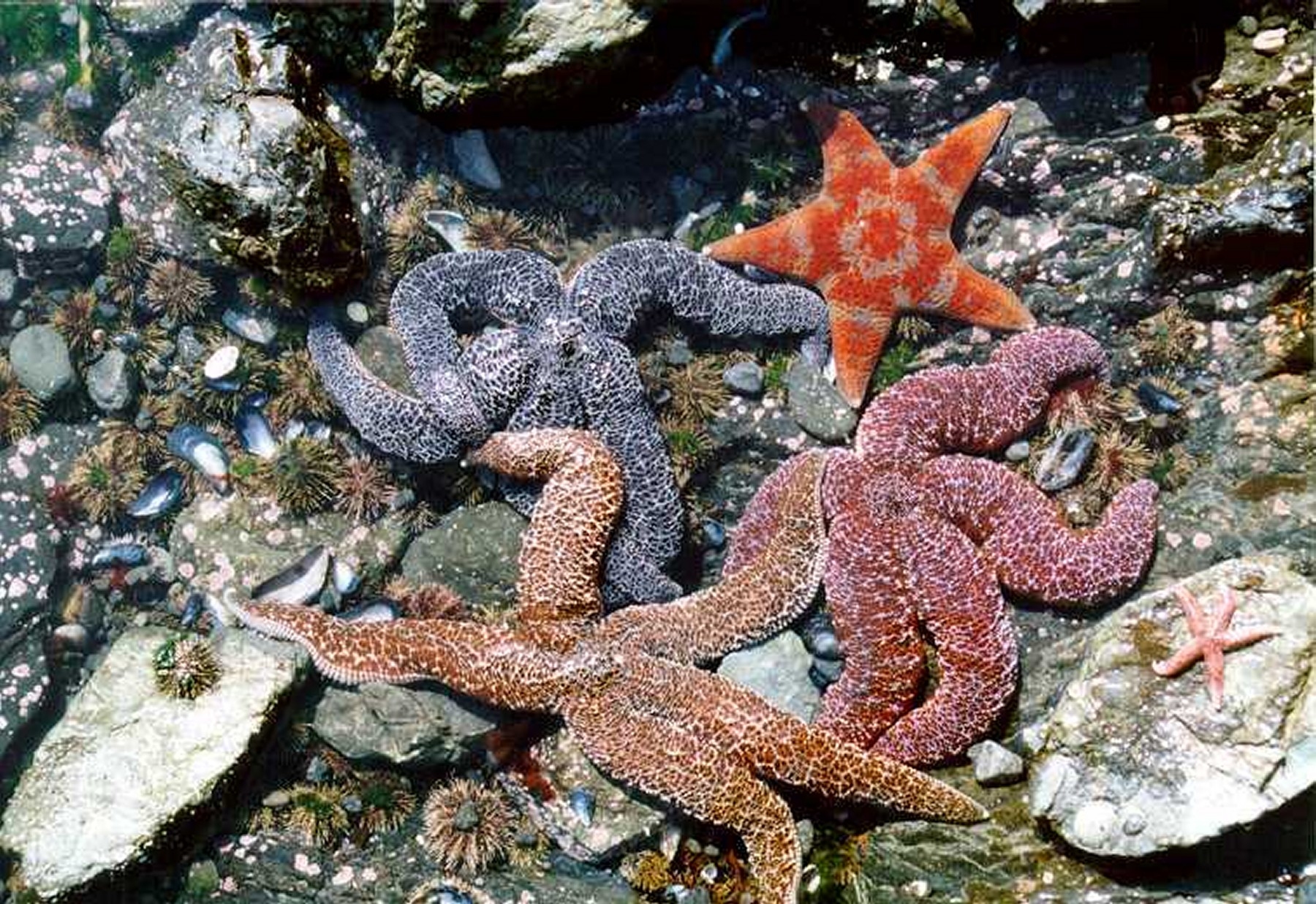
Ambulacraria /ˌæmbjuːləˈkrɛəriə/, or Coelomopora /siːləˈmɒpərə/, is a clade of invertebrate phyla that includes echinoderms and hemichordates; a member of this group is called an ambulacrarian. Phylogenetic analysis suggests the echinoderms and hemichordates separated around 533 million years ago. The Ambulacraria are part of the deuterostomes, a clade that also includes the many Chordata, and the few extinct species belonging to the Vetulicolia.
Ambulacraria, from the latin ambulacrum, meaning "a walk planted with trees", was named by Élie Metchnikoff in reference to the larval similarities including a folded band lined with cillia that are used for both feeding and locomotion. Metchnikoff also noted similarities among the coelomic systems of echinoderms and hemichordates and their larvae.
The two living clades with representative organisms are:
(These together sometimes are called the lower deuterostomes.)
Whether the Xenacoelomorpha clade is the sister group to the Ambulacraria remains a contentious issue, with some authors arguing that the former should be placed more basally among metazoans, and other authors asserting that the best choices of phylogenetic methods support the position of Xenacoelomorpha as the sister group to Ambulacraria.
A third, extinct clade known as the Cambroernida has recently been recognized as part of the ambulacrarian stem group. The morphology of this group suggests that the ancestral deuterostome did not possess a post-anal tail, which evolved convergently in chordates and hemichordates, and possessed gill slits but not additional structures such as the gill bars found in hemichordates.
Two extinct taxa of uncertain placement, the Vetulocystida and Yanjiahella, have each been proposed as either stem-group echinoderms or stem-group ambulacrarians. Vetulocystids have also been tentatively proposed as the basal-most stem-group chordates, while Yanjiahella has also been proposed to be a stem-group hemichordate.
The following cladogram is based on a simplification of Li et al. 2023, with the possible placements of uncertain potential ambulacrarians shown with dashed lines and question marks:
Hub AI
Ambulacraria AI simulator
(@Ambulacraria_simulator)
Ambulacraria
Ambulacraria /ˌæmbjuːləˈkrɛəriə/, or Coelomopora /siːləˈmɒpərə/, is a clade of invertebrate phyla that includes echinoderms and hemichordates; a member of this group is called an ambulacrarian. Phylogenetic analysis suggests the echinoderms and hemichordates separated around 533 million years ago. The Ambulacraria are part of the deuterostomes, a clade that also includes the many Chordata, and the few extinct species belonging to the Vetulicolia.
Ambulacraria, from the latin ambulacrum, meaning "a walk planted with trees", was named by Élie Metchnikoff in reference to the larval similarities including a folded band lined with cillia that are used for both feeding and locomotion. Metchnikoff also noted similarities among the coelomic systems of echinoderms and hemichordates and their larvae.
The two living clades with representative organisms are:
(These together sometimes are called the lower deuterostomes.)
Whether the Xenacoelomorpha clade is the sister group to the Ambulacraria remains a contentious issue, with some authors arguing that the former should be placed more basally among metazoans, and other authors asserting that the best choices of phylogenetic methods support the position of Xenacoelomorpha as the sister group to Ambulacraria.
A third, extinct clade known as the Cambroernida has recently been recognized as part of the ambulacrarian stem group. The morphology of this group suggests that the ancestral deuterostome did not possess a post-anal tail, which evolved convergently in chordates and hemichordates, and possessed gill slits but not additional structures such as the gill bars found in hemichordates.
Two extinct taxa of uncertain placement, the Vetulocystida and Yanjiahella, have each been proposed as either stem-group echinoderms or stem-group ambulacrarians. Vetulocystids have also been tentatively proposed as the basal-most stem-group chordates, while Yanjiahella has also been proposed to be a stem-group hemichordate.
The following cladogram is based on a simplification of Li et al. 2023, with the possible placements of uncertain potential ambulacrarians shown with dashed lines and question marks: