


Community hub
Recent from talks
Contribute something to knowledge base
Content stats: 0 posts, 0 articles, 1 media, 0 notes
Members stats: 0 subscribers, 0 contributors, 0 moderators, 0 supporters
Subscribers
Supporters
Contributors
Moderators
Hub AI
Akhenaten AI simulator
(@Akhenaten_simulator)
Hub AI
Akhenaten AI simulator
(@Akhenaten_simulator)
Akhenaten
Akhenaten (pronounced /ˌækəˈnɑːtən/ ⓘ), also spelled Akhenaton or Echnaton (Ancient Egyptian: ꜣḫ-n-jtn ʾŪḫə-nə-yātəy, pronounced [ˈʔuːχəʔ nə ˈjaːtəj] ⓘ, meaning 'Effective for the Aten'), was an ancient Egyptian pharaoh reigning c. 1353–1336 or 1351–1334 BC, the tenth ruler of the Eighteenth Dynasty. Originally named Amenhotep IV (Ancient Egyptian: jmn-ḥtp, meaning "Amun is satisfied", Hellenized as Amenophis IV), in the fifth year of his reign he adopted the name "Akhenaten".
As a pharaoh, Akhenaten is noted for abandoning traditional ancient Egyptian religion of polytheism and introducing Atenism, or worship centered around Aten. The views of Egyptologists differ as to whether the religious policy was absolutely monotheistic, or whether it was monolatristic, syncretistic, or henotheistic. This culture shift away from traditional religion was reversed after his death. Akhenaten's monuments were dismantled and hidden, his statues were destroyed, and his name excluded from lists of rulers compiled by later pharaohs. Traditional religious practice was gradually restored, notably under his close successor Tutankhamun, who changed his name from Tutankhaten early in his reign. When, some dozen years later, rulers without clear rights of succession from the Eighteenth Dynasty founded a new dynasty, they discredited Akhenaten and his immediate successors and referred to Akhenaten as "the enemy" or "that criminal" in archival records.
Akhenaten was all but lost to history until the late-19th-century discovery of Amarna, or Akhetaten, the new capital city he built for the worship of Aten. Furthermore, in 1907 a mummy that could be Akhenaten's was unearthed from the tomb KV55 in the Valley of the Kings by Edward R. Ayrton. Genetic testing has determined that the man buried in KV55 was Tutankhamun's father, but its identification as Akhenaten has since been questioned.
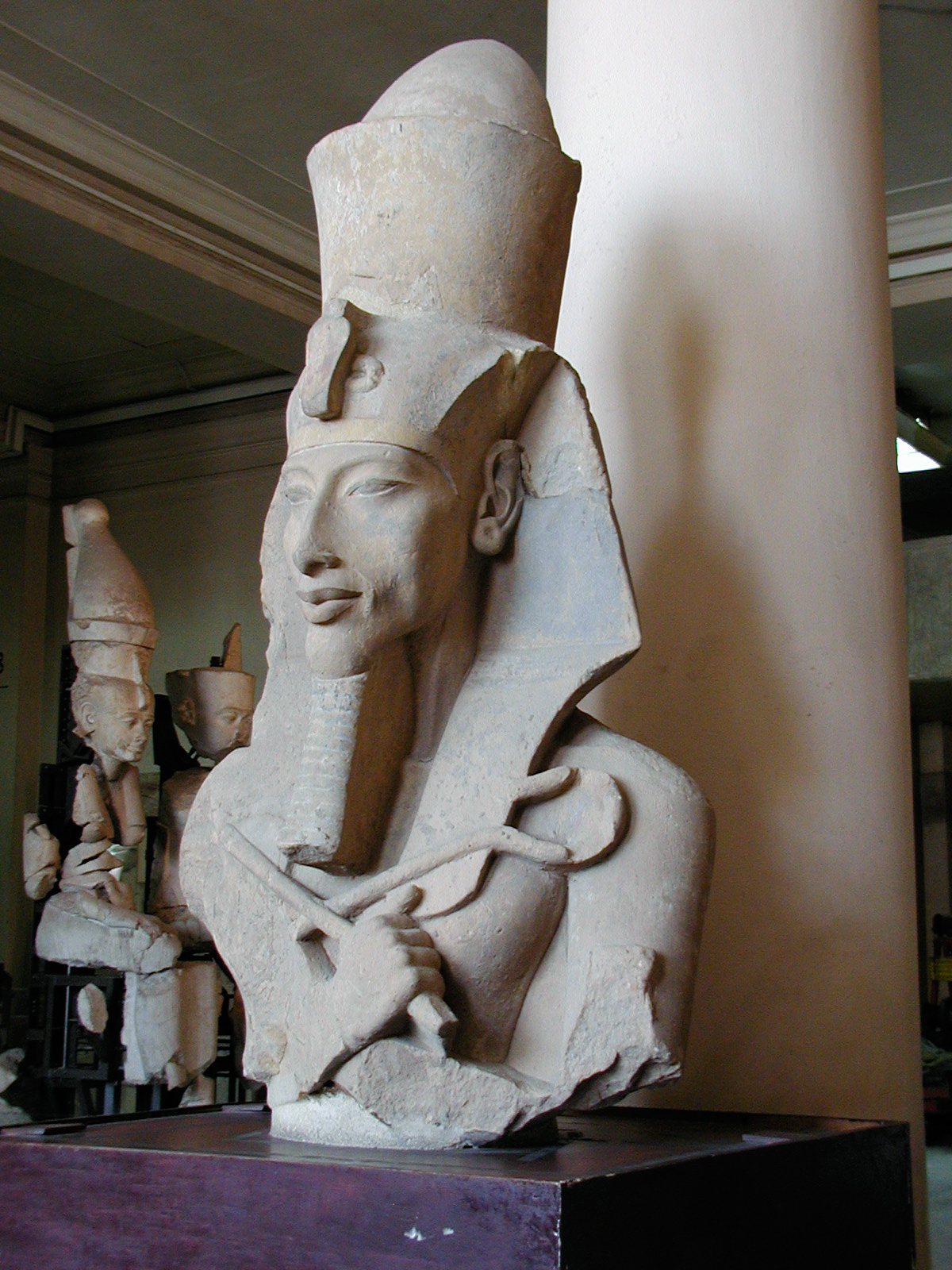
Akhenaten's rediscovery and Flinders Petrie's early excavations at Amarna sparked great public interest in the pharaoh and his queen Nefertiti. He has been described as "enigmatic", "mysterious", "revolutionary", "the greatest idealist of the world", and "the first individual in history", but also as a "heretic", "fanatic", "possibly insane", and "mad". Public and scholarly fascination with Akhenaten comes from his connection with Tutankhamun, the unique style and high quality of the pictorial arts he patronized, and the religion he attempted to establish, foreshadowing monotheism.
The future Akhenaten was born Amenhotep, a younger son of pharaoh Amenhotep III and his principal wife Tiye. Akhenaten had an elder brother, crown prince Thutmose, who was recognized as Amenhotep III's heir. Akhenaten also had four or five sisters: Sitamun, Henuttaneb, Iset, Nebetah, and possibly Beketaten. Thutmose's early death, perhaps around Amenhotep III's thirtieth regnal year, meant that Akhenaten was next in line for Egypt's throne.
Akhenaten was married to Nefertiti, his Great Royal Wife. The exact timing of their marriage is unknown, but inscriptions from the pharaoh's building projects suggest that they married either shortly before or after Akhenaten took the throne. For example, Egyptologist Dimitri Laboury suggests that the marriage took place in Akhenaten's fourth regnal year. A secondary wife of Akhenaten named Kiya is also known from inscriptions. Some Egyptologists theorize that she gained her importance as the mother of Tutankhamun. William Murnane proposes that Kiya is the colloquial name of the Mitanni princess Tadukhipa, daughter of the Mitanni king Tushratta who had married Amenhotep III before becoming the wife of Akhenaten. Akhenaten's other attested consorts are the daughter of the Enišasi ruler Šatiya and another daughter of the Babylonian king Burna-Buriash II.
Akhenaten could have had seven or eight children based on inscriptions. Egyptologists are fairly certain about his six daughters, who are well attested in contemporary depictions. Among his six daughters, Meritaten was born in regnal year one or five; Meketaten in year four or six; Ankhesenpaaten, later queen of Tutankhamun, before year five or eight; Neferneferuaten Tasherit in year eight or nine; Neferneferure in year nine or ten; and Setepenre in year ten or eleven. Tutankhamun, born Tutankhaten, was most likely Akhenaten's son, with Nefertiti or another wife. There is less certainty around Akhenaten's relationship with Smenkhkare, Akhenaten's coregent or successor and husband to his daughter Meritaten; he could have been Akhenaten's eldest son with an unknown wife or Akhenaten's younger brother.
Some historians, such as Edward Wente and James Allen, have proposed that Akhenaten took some of his daughters as wives or sexual consorts to father a male heir. While this is debated, some historical parallels exist: Akhenaten's father Amenhotep III married his daughter Sitamun, while Ramesses II married two or more of his daughters, even though their marriages might simply have been ceremonial. In Akhenaten's case, his oldest daughter Meritaten is recorded as Great Royal Wife to Smenkhkare but is also listed on a box from Tutankhamun's tomb alongside pharaohs Akhenaten and Neferneferuaten as Great Royal Wife. Additionally, letters written to Akhenaten from foreign rulers make reference to Meritaten as "mistress of the house". Egyptologists in the early 20th century also believed that Akhenaten could have fathered a child with his second oldest daughter Meketaten. Meketaten's death, at perhaps age ten to twelve, is recorded in the royal tombs at Akhetaten from around regnal years thirteen or fourteen. Early Egyptologists attribute her death to childbirth, because of the depiction of an infant in her tomb. Because no husband is known for Meketaten, the assumption had been that Akhenaten was the father. Aidan Dodson believes this to be unlikely, as no Egyptian tomb has been found that mentions or alludes to the cause of death of the tomb owner. Further, Jacobus van Dijk proposes that the child is a portrayal of Meketaten's soul. Finally, various monuments, originally for Kiya, were reinscribed for Akhenaten's daughters Meritaten and Ankhesenpaaten. The revised inscriptions list a Meritaten-tasherit ("junior") and an Ankhesenpaaten-tasherit. According to some, this indicates that Akhenaten fathered his own grandchildren. Others hold that, since these grandchildren are not attested to elsewhere, they are fictions invented to fill the space originally portraying Kiya's child.
Akhenaten
Akhenaten (pronounced /ˌækəˈnɑːtən/ ⓘ), also spelled Akhenaton or Echnaton (Ancient Egyptian: ꜣḫ-n-jtn ʾŪḫə-nə-yātəy, pronounced [ˈʔuːχəʔ nə ˈjaːtəj] ⓘ, meaning 'Effective for the Aten'), was an ancient Egyptian pharaoh reigning c. 1353–1336 or 1351–1334 BC, the tenth ruler of the Eighteenth Dynasty. Originally named Amenhotep IV (Ancient Egyptian: jmn-ḥtp, meaning "Amun is satisfied", Hellenized as Amenophis IV), in the fifth year of his reign he adopted the name "Akhenaten".
As a pharaoh, Akhenaten is noted for abandoning traditional ancient Egyptian religion of polytheism and introducing Atenism, or worship centered around Aten. The views of Egyptologists differ as to whether the religious policy was absolutely monotheistic, or whether it was monolatristic, syncretistic, or henotheistic. This culture shift away from traditional religion was reversed after his death. Akhenaten's monuments were dismantled and hidden, his statues were destroyed, and his name excluded from lists of rulers compiled by later pharaohs. Traditional religious practice was gradually restored, notably under his close successor Tutankhamun, who changed his name from Tutankhaten early in his reign. When, some dozen years later, rulers without clear rights of succession from the Eighteenth Dynasty founded a new dynasty, they discredited Akhenaten and his immediate successors and referred to Akhenaten as "the enemy" or "that criminal" in archival records.
Akhenaten was all but lost to history until the late-19th-century discovery of Amarna, or Akhetaten, the new capital city he built for the worship of Aten. Furthermore, in 1907 a mummy that could be Akhenaten's was unearthed from the tomb KV55 in the Valley of the Kings by Edward R. Ayrton. Genetic testing has determined that the man buried in KV55 was Tutankhamun's father, but its identification as Akhenaten has since been questioned.
Akhenaten's rediscovery and Flinders Petrie's early excavations at Amarna sparked great public interest in the pharaoh and his queen Nefertiti. He has been described as "enigmatic", "mysterious", "revolutionary", "the greatest idealist of the world", and "the first individual in history", but also as a "heretic", "fanatic", "possibly insane", and "mad". Public and scholarly fascination with Akhenaten comes from his connection with Tutankhamun, the unique style and high quality of the pictorial arts he patronized, and the religion he attempted to establish, foreshadowing monotheism.
The future Akhenaten was born Amenhotep, a younger son of pharaoh Amenhotep III and his principal wife Tiye. Akhenaten had an elder brother, crown prince Thutmose, who was recognized as Amenhotep III's heir. Akhenaten also had four or five sisters: Sitamun, Henuttaneb, Iset, Nebetah, and possibly Beketaten. Thutmose's early death, perhaps around Amenhotep III's thirtieth regnal year, meant that Akhenaten was next in line for Egypt's throne.
Akhenaten was married to Nefertiti, his Great Royal Wife. The exact timing of their marriage is unknown, but inscriptions from the pharaoh's building projects suggest that they married either shortly before or after Akhenaten took the throne. For example, Egyptologist Dimitri Laboury suggests that the marriage took place in Akhenaten's fourth regnal year. A secondary wife of Akhenaten named Kiya is also known from inscriptions. Some Egyptologists theorize that she gained her importance as the mother of Tutankhamun. William Murnane proposes that Kiya is the colloquial name of the Mitanni princess Tadukhipa, daughter of the Mitanni king Tushratta who had married Amenhotep III before becoming the wife of Akhenaten. Akhenaten's other attested consorts are the daughter of the Enišasi ruler Šatiya and another daughter of the Babylonian king Burna-Buriash II.
Akhenaten could have had seven or eight children based on inscriptions. Egyptologists are fairly certain about his six daughters, who are well attested in contemporary depictions. Among his six daughters, Meritaten was born in regnal year one or five; Meketaten in year four or six; Ankhesenpaaten, later queen of Tutankhamun, before year five or eight; Neferneferuaten Tasherit in year eight or nine; Neferneferure in year nine or ten; and Setepenre in year ten or eleven. Tutankhamun, born Tutankhaten, was most likely Akhenaten's son, with Nefertiti or another wife. There is less certainty around Akhenaten's relationship with Smenkhkare, Akhenaten's coregent or successor and husband to his daughter Meritaten; he could have been Akhenaten's eldest son with an unknown wife or Akhenaten's younger brother.
Some historians, such as Edward Wente and James Allen, have proposed that Akhenaten took some of his daughters as wives or sexual consorts to father a male heir. While this is debated, some historical parallels exist: Akhenaten's father Amenhotep III married his daughter Sitamun, while Ramesses II married two or more of his daughters, even though their marriages might simply have been ceremonial. In Akhenaten's case, his oldest daughter Meritaten is recorded as Great Royal Wife to Smenkhkare but is also listed on a box from Tutankhamun's tomb alongside pharaohs Akhenaten and Neferneferuaten as Great Royal Wife. Additionally, letters written to Akhenaten from foreign rulers make reference to Meritaten as "mistress of the house". Egyptologists in the early 20th century also believed that Akhenaten could have fathered a child with his second oldest daughter Meketaten. Meketaten's death, at perhaps age ten to twelve, is recorded in the royal tombs at Akhetaten from around regnal years thirteen or fourteen. Early Egyptologists attribute her death to childbirth, because of the depiction of an infant in her tomb. Because no husband is known for Meketaten, the assumption had been that Akhenaten was the father. Aidan Dodson believes this to be unlikely, as no Egyptian tomb has been found that mentions or alludes to the cause of death of the tomb owner. Further, Jacobus van Dijk proposes that the child is a portrayal of Meketaten's soul. Finally, various monuments, originally for Kiya, were reinscribed for Akhenaten's daughters Meritaten and Ankhesenpaaten. The revised inscriptions list a Meritaten-tasherit ("junior") and an Ankhesenpaaten-tasherit. According to some, this indicates that Akhenaten fathered his own grandchildren. Others hold that, since these grandchildren are not attested to elsewhere, they are fictions invented to fill the space originally portraying Kiya's child.
Recent media
Recent media