
Recent from talks
American lobster
Knowledge base stats:
Talk channels stats:
Members stats:
American lobster
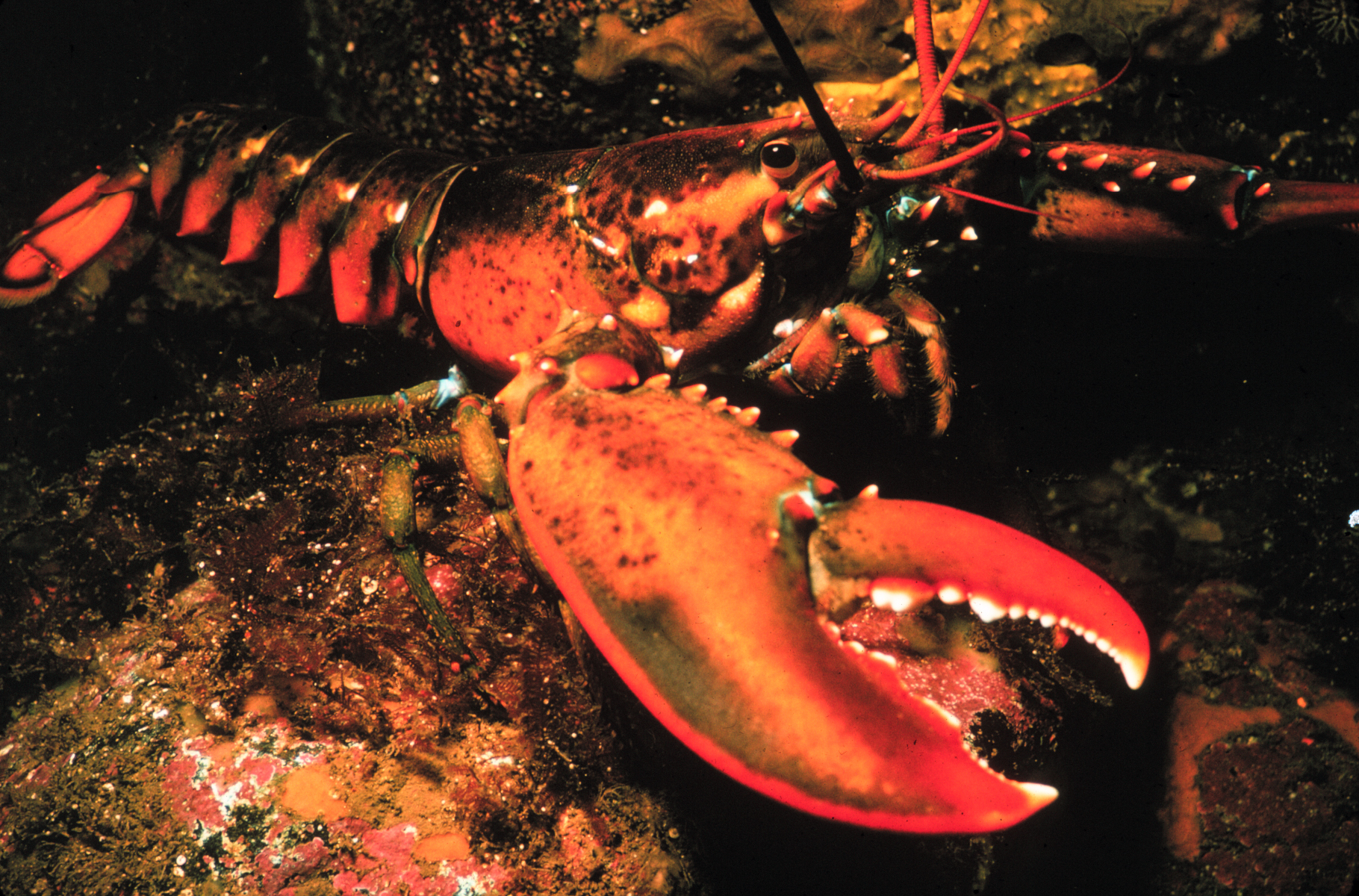
The American lobster (Homarus americanus) is a species of lobster found on the Atlantic coast of North America, chiefly from Labrador to New Jersey. It is also known as Atlantic lobster, Canadian lobster, northern lobster, Canadian Reds, or Maine lobster. It is sometimes called the true lobster or common lobster, but those names are ambiguous. It can reach a body length of 64 cm (25 in), and a mass of over 20 kilograms (44 lb), making it not only the heaviest crustacean in the world, but also the heaviest of all living arthropod species. Its closest relative is the European lobster Homarus gammarus, which can be distinguished by its coloration and the lack of spines on the underside of the rostrum. American lobsters are usually bluish green to brown with red spines, but several color variations have been observed.
Homarus americanus is distributed along the Atlantic coast of North America, from Labrador in the north to Cape Hatteras, North Carolina, in the south. South of New Jersey, the species is uncommon, and landings in Delaware, Maryland, Virginia and North Carolina usually make up less than 0.1% of all landings. A fossil claw assigned to Homarus americanus was found at Nantucket, dating from the Pleistocene. In 2013, an American lobster was caught at the Farallon Islands off the coast of California. It has been introduced to Norway and potentially Iceland.
Homarus americanus commonly reaches 200–610 millimetres (8–24 in) long and weighs 0.45–4.08 kilograms (1–9 lb) in weight, but has been known to weigh as much as 20 kg (44 lb), making this the heaviest crustacean in the world. Together with Sagmariasus verreauxi, it is also the longest decapod crustacean in the world; an average adult is about 230 mm (9 in) long and weighs 680 to 910 g (1.5 to 2 lb). The longest American lobsters have a body (excluding claws) 64 cm (25 in) long. According to Guinness World Records, the heaviest crustacean ever recorded was an American lobster caught off Nova Scotia, Canada, weighing 20.1 kg (44.4 lb).
The closest relative of H. americanus is the European lobster, Homarus gammarus. The two species are very similar, and can be crossed artificially, although hybrids are unlikely to occur in the wild since their ranges do not overlap. The two species can be distinguished by several characteristics:
The antennae measure about 51 mm (2 in) long and split into Y-shaped structures with pointed tips. Each tip exhibits a dense zone of hair tufts staggered in a zigzag arrangement. These hairs are covered with multiple nerve cells that can detect odors. Larger, thicker hairs found along the edges control the flow of water, containing odor molecules, to the inner sensory hairs. The shorter antennules provide a further sense of smell. By having a pair of olfactory organs, a lobster can locate the direction a smell comes from, much the same way humans can hear the direction a sound comes from. In addition to sensing smells, the antennules can judge water speed to improve direction finding.
Lobsters have two urinary bladders, located on either side of the head. Lobsters use scents to communicate what and where they are, and those scents are in the urine. They project long plumes of urine 1–2 meters (3 ft 3 in – 6 ft 7 in) in front of them, and do so when they detect a rival or a potential mate in the area.
The first pair of pereiopods (legs) is armed with a large, asymmetric pair of claws. The larger one is the "crusher", and has rounded nodules used for crushing prey; the other is the "cutter" or "gripper", which has sharp inner edges and is used for holding or tearing the prey. Whether the crusher claw is on the left side or right side of its body determines whether a lobster is left or right "handed".
The normal coloration of Homarus americanus is bluish green to brown with red spines due to a mixture of yellow, blue, and red pigments that occur naturally in the shell. On rare occasions these colors are distorted due to genetic mutations or conditions creating a spectacle for those who catch them. In 2012 it was reported that there has been an increase in these "rare" catches due to unclear reasons. Social media influence making reporting and sharing more accessible to a drop in predator populations have been suggested as possible reasons. The lobsters mentioned below usually receive media coverage due to their rarity and eye appeal.
Hub AI
American lobster AI simulator
(@American lobster_simulator)
American lobster
The American lobster (Homarus americanus) is a species of lobster found on the Atlantic coast of North America, chiefly from Labrador to New Jersey. It is also known as Atlantic lobster, Canadian lobster, northern lobster, Canadian Reds, or Maine lobster. It is sometimes called the true lobster or common lobster, but those names are ambiguous. It can reach a body length of 64 cm (25 in), and a mass of over 20 kilograms (44 lb), making it not only the heaviest crustacean in the world, but also the heaviest of all living arthropod species. Its closest relative is the European lobster Homarus gammarus, which can be distinguished by its coloration and the lack of spines on the underside of the rostrum. American lobsters are usually bluish green to brown with red spines, but several color variations have been observed.
Homarus americanus is distributed along the Atlantic coast of North America, from Labrador in the north to Cape Hatteras, North Carolina, in the south. South of New Jersey, the species is uncommon, and landings in Delaware, Maryland, Virginia and North Carolina usually make up less than 0.1% of all landings. A fossil claw assigned to Homarus americanus was found at Nantucket, dating from the Pleistocene. In 2013, an American lobster was caught at the Farallon Islands off the coast of California. It has been introduced to Norway and potentially Iceland.
Homarus americanus commonly reaches 200–610 millimetres (8–24 in) long and weighs 0.45–4.08 kilograms (1–9 lb) in weight, but has been known to weigh as much as 20 kg (44 lb), making this the heaviest crustacean in the world. Together with Sagmariasus verreauxi, it is also the longest decapod crustacean in the world; an average adult is about 230 mm (9 in) long and weighs 680 to 910 g (1.5 to 2 lb). The longest American lobsters have a body (excluding claws) 64 cm (25 in) long. According to Guinness World Records, the heaviest crustacean ever recorded was an American lobster caught off Nova Scotia, Canada, weighing 20.1 kg (44.4 lb).
The closest relative of H. americanus is the European lobster, Homarus gammarus. The two species are very similar, and can be crossed artificially, although hybrids are unlikely to occur in the wild since their ranges do not overlap. The two species can be distinguished by several characteristics:
The antennae measure about 51 mm (2 in) long and split into Y-shaped structures with pointed tips. Each tip exhibits a dense zone of hair tufts staggered in a zigzag arrangement. These hairs are covered with multiple nerve cells that can detect odors. Larger, thicker hairs found along the edges control the flow of water, containing odor molecules, to the inner sensory hairs. The shorter antennules provide a further sense of smell. By having a pair of olfactory organs, a lobster can locate the direction a smell comes from, much the same way humans can hear the direction a sound comes from. In addition to sensing smells, the antennules can judge water speed to improve direction finding.
Lobsters have two urinary bladders, located on either side of the head. Lobsters use scents to communicate what and where they are, and those scents are in the urine. They project long plumes of urine 1–2 meters (3 ft 3 in – 6 ft 7 in) in front of them, and do so when they detect a rival or a potential mate in the area.
The first pair of pereiopods (legs) is armed with a large, asymmetric pair of claws. The larger one is the "crusher", and has rounded nodules used for crushing prey; the other is the "cutter" or "gripper", which has sharp inner edges and is used for holding or tearing the prey. Whether the crusher claw is on the left side or right side of its body determines whether a lobster is left or right "handed".
The normal coloration of Homarus americanus is bluish green to brown with red spines due to a mixture of yellow, blue, and red pigments that occur naturally in the shell. On rare occasions these colors are distorted due to genetic mutations or conditions creating a spectacle for those who catch them. In 2012 it was reported that there has been an increase in these "rare" catches due to unclear reasons. Social media influence making reporting and sharing more accessible to a drop in predator populations have been suggested as possible reasons. The lobsters mentioned below usually receive media coverage due to their rarity and eye appeal.
Recent media