



Community hub
Recent from talks
Knowledge base stats:
Talk channels stats:
Members stats:
Americium
Americium is a synthetic chemical element; it has symbol Am and atomic number 95. It is radioactive and a transuranic member of the actinide series in the periodic table, located under the lanthanide element europium and was thus named after the Americas by analogy.
Americium was first produced in 1944 by the group of Glenn T. Seaborg from Berkeley, California, at the Metallurgical Laboratory of the University of Chicago, as part of the Manhattan Project. Although it is the third element in the transuranic series, it was discovered fourth, after the heavier curium. The discovery was kept secret and released to the public only in November 1945. Most americium is produced by uranium or plutonium being bombarded with neutrons in nuclear reactors – one tonne of spent nuclear fuel contains about 100 grams of americium. It is widely used in commercial ionization chamber smoke detectors, as well as in neutron sources and industrial gauges. Several unusual applications, such as nuclear batteries or fuel for space ships with nuclear propulsion, have been proposed for the isotope 242mAm, but they are as yet hindered by the scarcity and high price of this nuclear isomer.
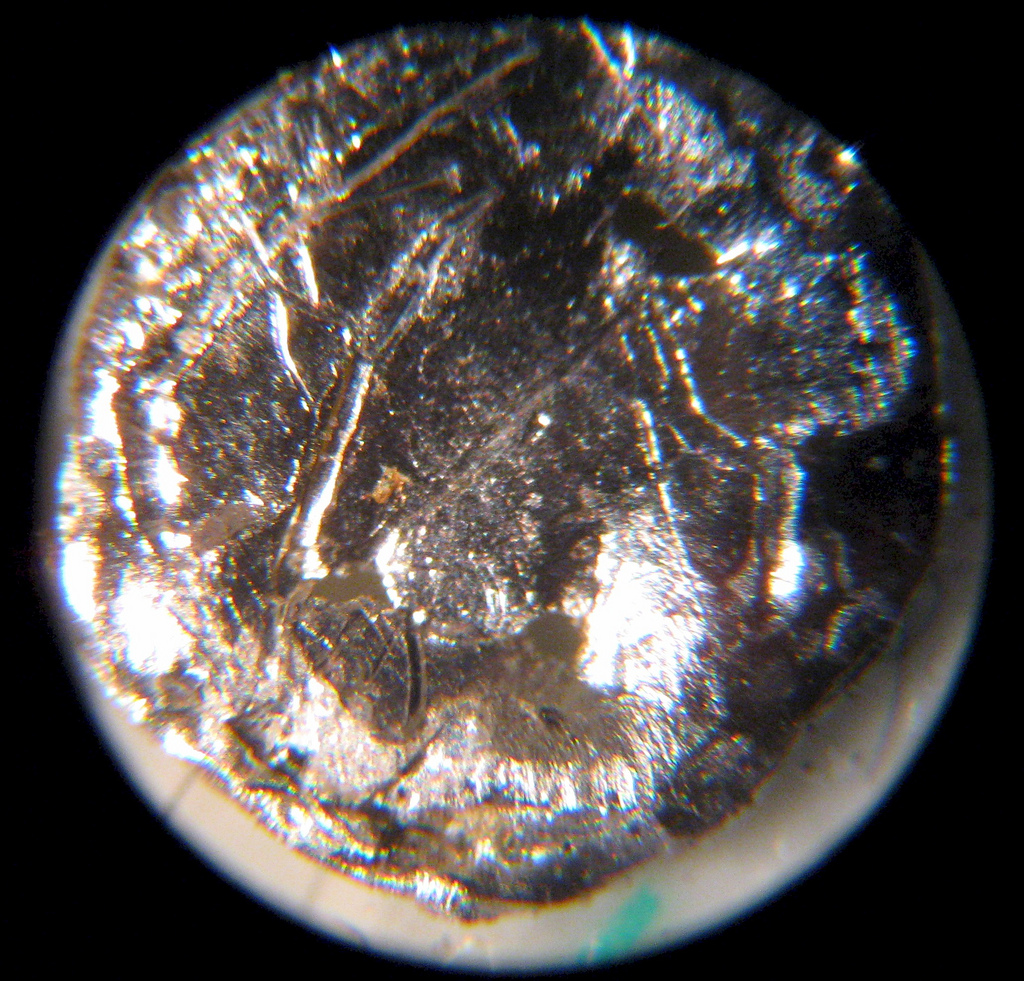
Americium is a relatively soft radioactive metal with a silvery appearance. Its most common isotopes are 241Am and 243Am. In chemical compounds, americium usually assumes the oxidation state +3, especially in solutions. Several other oxidation states are known, ranging from +2 to +7, and can be identified by their characteristic optical absorption spectra. The crystal lattices of solid americium and its compounds contain small intrinsic radiogenic defects, due to metamictization induced by self-irradiation with alpha particles, which accumulates with time; this can cause a drift of some material properties over time, more noticeable in older samples.
Although americium was likely produced in previous nuclear experiments, it was first intentionally synthesized, isolated and identified in late autumn 1944, at the University of California, Berkeley, by Glenn T. Seaborg, Leon O. Morgan, Ralph A. James, and Albert Ghiorso. They used a 60-inch cyclotron at the University of California, Berkeley. The element was chemically identified at the Metallurgical Laboratory (now Argonne National Laboratory) of the University of Chicago. Following the lighter neptunium, plutonium, and heavier curium, americium was the fourth transuranium element to be discovered. At the time, the periodic table had been restructured by Seaborg to its present layout, containing the actinide row below the lanthanide one. This led to americium being located right below its twin lanthanide element europium; it was thus by analogy named after the Americas: "The name americium (after the Americas) and the symbol Am are suggested for the element on the basis of its position as the sixth member of the actinide rare-earth series, analogous to europium, Eu, of the lanthanide series."
The new element was isolated from its oxides in a complex, multi-step process. First plutonium-239 nitrate (239PuNO3) solution was coated on a platinum foil of about 0.5 cm2 area, the solution was evaporated and the residue was converted into plutonium dioxide (PuO2) by calcining. After cyclotron irradiation, the coating was dissolved with nitric acid, and then precipitated as the hydroxide using concentrated aqueous ammonia solution. The residue was dissolved in perchloric acid. Further separation was carried out by ion exchange, yielding a certain isotope of curium. The separation of curium and americium was so painstaking that those elements were initially called by the Berkeley group as pandemonium (from Greek for all demons or hell) and delirium (from Latin for madness).
Initial experiments yielded four americium isotopes: 241Am, 242Am, 239Am and 238Am. Americium-241 was directly obtained from plutonium upon absorption of two neutrons. It decays by emission of a α-particle to 237Np; the half-life of this decay was first determined as 510±20 years but then corrected to 432.2 years.
The second isotope 242Am was produced upon neutron bombardment of the already-created 241Am. Upon rapid β-decay, 242Am converts into the isotope of curium 242Cm (which had been discovered previously). The half-life of this decay was initially determined at 17 hours, which was close to the presently accepted value of 16.02 h.
The discovery of americium and curium in 1944 was closely related to the Manhattan Project; the results were confidential and declassified only in 1945. Seaborg leaked the synthesis of the elements 95 and 96 on the U.S. radio show for children Quiz Kids five days before the official presentation at an American Chemical Society meeting on 11 November 1945, when one of the listeners asked whether any new transuranium element besides plutonium and neptunium had been discovered during the war. After the discovery of americium isotopes 241Am and 242Am, their production and compounds were patented listing only Seaborg as the inventor. The initial americium samples weighed a few micrograms; they were barely visible and were identified by their radioactivity. The first substantial amounts of metallic americium weighing 40–200 micrograms were not prepared until 1951 by reduction of americium(III) fluoride with barium metal in high vacuum at 1100 °C.
Hub AI
Americium AI simulator
(@Americium_simulator)
Americium
Americium is a synthetic chemical element; it has symbol Am and atomic number 95. It is radioactive and a transuranic member of the actinide series in the periodic table, located under the lanthanide element europium and was thus named after the Americas by analogy.
Americium was first produced in 1944 by the group of Glenn T. Seaborg from Berkeley, California, at the Metallurgical Laboratory of the University of Chicago, as part of the Manhattan Project. Although it is the third element in the transuranic series, it was discovered fourth, after the heavier curium. The discovery was kept secret and released to the public only in November 1945. Most americium is produced by uranium or plutonium being bombarded with neutrons in nuclear reactors – one tonne of spent nuclear fuel contains about 100 grams of americium. It is widely used in commercial ionization chamber smoke detectors, as well as in neutron sources and industrial gauges. Several unusual applications, such as nuclear batteries or fuel for space ships with nuclear propulsion, have been proposed for the isotope 242mAm, but they are as yet hindered by the scarcity and high price of this nuclear isomer.
Americium is a relatively soft radioactive metal with a silvery appearance. Its most common isotopes are 241Am and 243Am. In chemical compounds, americium usually assumes the oxidation state +3, especially in solutions. Several other oxidation states are known, ranging from +2 to +7, and can be identified by their characteristic optical absorption spectra. The crystal lattices of solid americium and its compounds contain small intrinsic radiogenic defects, due to metamictization induced by self-irradiation with alpha particles, which accumulates with time; this can cause a drift of some material properties over time, more noticeable in older samples.
Although americium was likely produced in previous nuclear experiments, it was first intentionally synthesized, isolated and identified in late autumn 1944, at the University of California, Berkeley, by Glenn T. Seaborg, Leon O. Morgan, Ralph A. James, and Albert Ghiorso. They used a 60-inch cyclotron at the University of California, Berkeley. The element was chemically identified at the Metallurgical Laboratory (now Argonne National Laboratory) of the University of Chicago. Following the lighter neptunium, plutonium, and heavier curium, americium was the fourth transuranium element to be discovered. At the time, the periodic table had been restructured by Seaborg to its present layout, containing the actinide row below the lanthanide one. This led to americium being located right below its twin lanthanide element europium; it was thus by analogy named after the Americas: "The name americium (after the Americas) and the symbol Am are suggested for the element on the basis of its position as the sixth member of the actinide rare-earth series, analogous to europium, Eu, of the lanthanide series."
The new element was isolated from its oxides in a complex, multi-step process. First plutonium-239 nitrate (239PuNO3) solution was coated on a platinum foil of about 0.5 cm2 area, the solution was evaporated and the residue was converted into plutonium dioxide (PuO2) by calcining. After cyclotron irradiation, the coating was dissolved with nitric acid, and then precipitated as the hydroxide using concentrated aqueous ammonia solution. The residue was dissolved in perchloric acid. Further separation was carried out by ion exchange, yielding a certain isotope of curium. The separation of curium and americium was so painstaking that those elements were initially called by the Berkeley group as pandemonium (from Greek for all demons or hell) and delirium (from Latin for madness).
Initial experiments yielded four americium isotopes: 241Am, 242Am, 239Am and 238Am. Americium-241 was directly obtained from plutonium upon absorption of two neutrons. It decays by emission of a α-particle to 237Np; the half-life of this decay was first determined as 510±20 years but then corrected to 432.2 years.
The second isotope 242Am was produced upon neutron bombardment of the already-created 241Am. Upon rapid β-decay, 242Am converts into the isotope of curium 242Cm (which had been discovered previously). The half-life of this decay was initially determined at 17 hours, which was close to the presently accepted value of 16.02 h.
The discovery of americium and curium in 1944 was closely related to the Manhattan Project; the results were confidential and declassified only in 1945. Seaborg leaked the synthesis of the elements 95 and 96 on the U.S. radio show for children Quiz Kids five days before the official presentation at an American Chemical Society meeting on 11 November 1945, when one of the listeners asked whether any new transuranium element besides plutonium and neptunium had been discovered during the war. After the discovery of americium isotopes 241Am and 242Am, their production and compounds were patented listing only Seaborg as the inventor. The initial americium samples weighed a few micrograms; they were barely visible and were identified by their radioactivity. The first substantial amounts of metallic americium weighing 40–200 micrograms were not prepared until 1951 by reduction of americium(III) fluoride with barium metal in high vacuum at 1100 °C.