Hubbry Logo
OxideOxideMain
Open search
Oxide
Community hub
Oxide
logo
8 pages, 0 posts
0 subscribers
Be the first to start a discussion here.
Oxide
Oxide
from Wikipedia
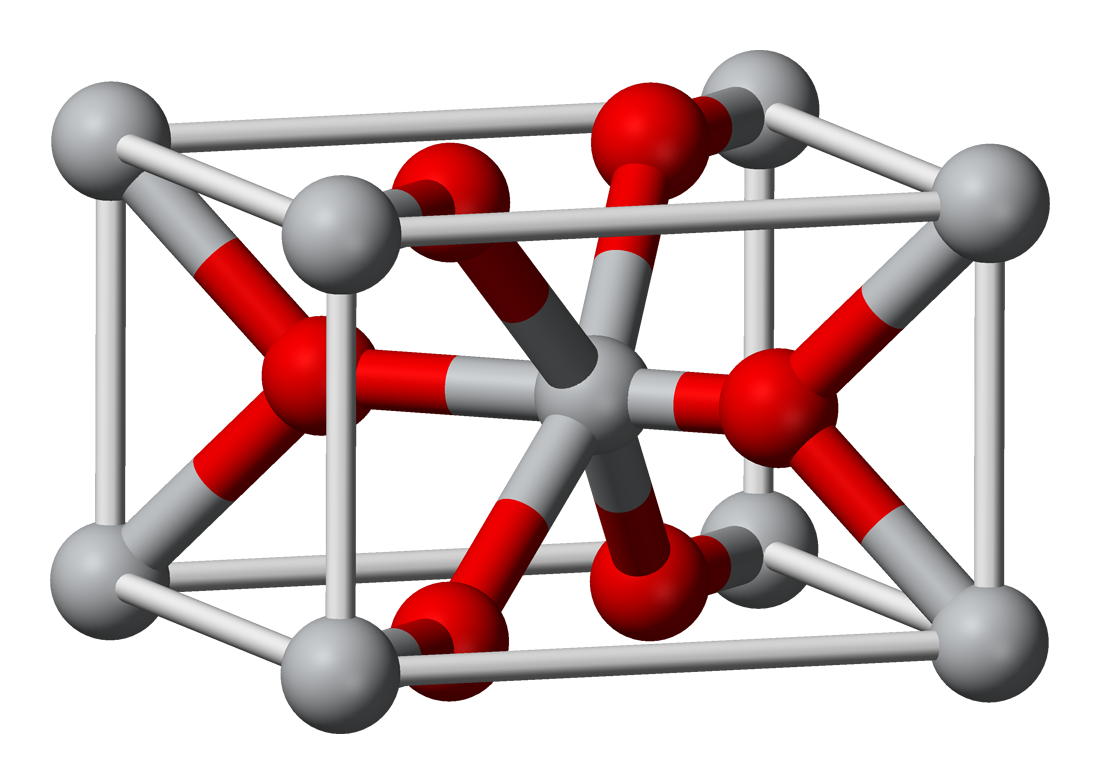
The unit cell of rutile, an important oxide of titanium. Ti(IV) centers are grey; oxygen centers are red. Notice that oxygen forms three bonds to titanium and titanium forms six bonds to oxygen.

An oxide (/ˈɒksd/) is a chemical compound containing at least one oxygen atom and one other element[1] in its chemical formula. "Oxide" itself is the dianion (anion bearing a net charge of −2) of oxygen, an O2− ion with oxygen in the oxidation state of −2. Most of the Earth's crust consists of oxides. Even materials considered pure elements often develop an oxide coating. For example, aluminium foil develops a thin skin of Al2O3 (called a passivation layer) that protects the foil from further oxidation.[2]

Stoichiometry

[edit]

Oxides are extraordinarily diverse in terms of stoichiometries (the measurable relationship between reactants and chemical equations of an equation or reaction) and in terms of the structures of each stoichiometry. Most elements form oxides of more than one stoichiometry. A well known example is carbon monoxide and carbon dioxide.[2] This applies to binary oxides, that is, compounds containing only oxide and another element. Far more common than binary oxides are oxides of more complex stoichiometries. Such complexity can arise by the introduction of other cations (a positively charged ion, i.e. one that would be attracted to the cathode in electrolysis) or other anions (a negatively charged ion). Iron silicate, Fe2SiO4, the mineral fayalite, is one of many examples of a ternary oxide. For many metal oxides, the possibilities of polymorphism and nonstoichiometry exist as well.[3] The commercially important dioxides of titanium exists in three distinct structures, for example. Many metal oxides exist in various nonstoichiometric states. Many molecular oxides exist with diverse ligands as well.[4]

For simplicity sake, most of this article focuses on binary oxides.

Formation

[edit]

Oxides are associated with all elements except a few noble gases. The pathways for the formation of this diverse family of compounds are correspondingly numerous.

Metal oxides

[edit]

Many metal oxides arise by decomposition of other metal compounds, e.g. carbonates, hydroxides, and nitrates. In the making of calcium oxide, calcium carbonate (limestone) breaks down upon heating, releasing carbon dioxide:[2]

CaCO3 → CaO + CO2

The reaction of elements with oxygen in air is a key step in corrosion relevant to the commercial use of iron especially. Almost all elements form oxides upon heating with oxygen atmosphere. For example, zinc powder will burn in air to give zinc oxide:[5]

2 Zn + O2 → 2 ZnO

The production of metals from ores often involves the production of oxides by roasting (heating) metal sulfide minerals in air. In this way, MoS2 (molybdenite) is converted to molybdenum trioxide, the precursor to virtually all molybdenum compounds:[6]

2 MoS2 + 7 O2 → 2 MoO3 + 4 SO2

Noble metals (such as gold and platinum) are prized because they resist direct chemical combination with oxygen.[2]

Non-metal oxides

[edit]

Important and prevalent nonmetal oxides are carbon dioxide and carbon monoxide. These species form upon full or partial oxidation of carbon or hydrocarbons. With a deficiency of oxygen, the monoxide is produced:[2]

2 CH4 + 3 O2 → 2 CO + 4 H2O
2 C + O2 → 2 CO

With excess oxygen, the dioxide is the product, the pathway proceeds by the intermediacy of carbon monoxide:

CH4 + 2 O2 → CO2 + 2 H2O
C + O2 → CO2

Elemental nitrogen (N2) is difficult to convert to oxides, but the combustion of ammonia gives nitric oxide, which further reacts with oxygen:

4 NH3 + 5 O2 → 4 NO + 6 H2O
2 NO + O2 → 2 NO2

These reactions are practiced in the production of nitric acid, a commodity chemical.[7]

The chemical produced on the largest scale industrially is sulfuric acid. It is produced by the oxidation of sulfur to sulfur dioxide, which is separately oxidized to sulfur trioxide:[8]

S + O2 → SO2
2 SO2 + O2 → 2 SO3

Finally the trioxide is converted to sulfuric acid by a hydration reaction:

SO3 + H2O → H2SO4

Structure

[edit]

Oxides have a range of structures, from individual molecules to polymeric and crystalline structures. At standard conditions, oxides may range from solids to gases. Solid oxides of metals usually have polymeric structures at ambient conditions.[9]

Molecular oxides

[edit]

Although most metal oxides are crystalline solids, many non-metal oxides are molecules. Examples of molecular oxides are carbon dioxide and carbon monoxide. All simple oxides of nitrogen are molecular, e.g., NO, N2O, NO2 and N2O4. Phosphorus pentoxide is a more complex molecular oxide with a deceptive name, the real formula being P4O10. Tetroxides are rare, with a few more common examples being ruthenium tetroxide, osmium tetroxide, and xenon tetroxide.[2]

Reactions

[edit]

Reduction

[edit]

Reduction of metal oxide to the metal is practiced on a large scale in the production of some metals. Many metal oxides convert to metals simply by heating (thermal decomposition). For example, silver oxide decomposes at 200 °C:[10]

2 Ag2O → 4 Ag + O2

Most often, however, metal oxides are reduced by a chemical reagent. A common and cheap reducing agent is carbon in the form of coke. The most prominent example is that of iron ore smelting. Many reactions are involved, but the simplified equation is usually shown as:[2]

2 Fe2O3 + 3 C → 4 Fe + 3 CO2

Some metal oxides dissolve in the presence of reducing agents, which can include organic compounds. Reductive dissolution of ferric oxides is integral to geochemical phenomena such as the iron cycle.[11]

Hydrolysis and dissolution

[edit]

Because the M–O bonds are typically strong, metal oxides tend to be insoluble in solvents, though they may be attacked by aqueous acids and bases.[2]

Dissolution of oxides often gives oxyanions. Adding aqueous base to P4O10 gives various phosphates. Adding aqueous base to MoO3 gives polyoxometalates. Oxycations are rarer, some examples being nitrosonium (NO+), vanadyl (VO2+), and uranyl (UO2+2). Many compounds are known with both oxides and other groups. In organic chemistry, these include ketones and many related carbonyl compounds. For the transition metals, many oxo complexes are known as well as oxyhalides.[2]

Nomenclature and formulas

[edit]

The chemical formulas of the oxides of the chemical elements in their highest oxidation state are predictable and are derived from the number of valence electrons for that element. Even the chemical formula of O4, tetraoxygen, is predictable as a group 16 element. One exception is copper, for which the highest oxidation state oxide is copper(II) oxide and not copper(I) oxide. Another exception is fluoride, which does not exist as one might expect—as F2O7—but as OF2.[12]

See also

[edit]

References

[edit]
Revisions and contributorsEdit on WikipediaRead on Wikipedia
from Grokipedia
An oxide is a binary chemical compound consisting of one or more oxygen atoms bonded to one or more atoms of another element, typically formed through the reaction of oxygen with metals, nonmetals, or other substances. Oxides are classified into several types based on their chemical behavior and reactivity: acidic oxides, which are typically formed by nonmetals and react with bases to produce salts and water (e.g., CO₂ and SO₂); basic oxides, formed by metals and react with acids to form salts and water (e.g., MgO and CaO); amphoteric oxides, which exhibit both acidic and basic properties and can react with either acids or bases (e.g., Al₂O₃ and ZnO); and neutral oxides, which do not display acidic or basic characteristics (e.g., N₂O and CO). The properties of oxides vary widely depending on their composition and structure; metal oxides are often crystalline solids with high melting points, serving as thermal insulators or conductors, while oxides are frequently gases or liquids at and contribute to atmospheric phenomena like . Oxides play a critical role in industry and daily life, with applications including ceramics and refractories (e.g., alumina in abrasives), catalysts (e.g., in ammonia synthesis), pigments and coatings (e.g., in paints and sunscreens), and electronics (e.g., in semiconductors).

Definition and Classification

Definition

An oxide is a binary chemical compound composed of oxygen and one other chemical element, formed typically through the reaction of that element with oxygen gas. These compounds are central to inorganic chemistry and include examples such as water (H₂O), carbon dioxide (CO₂), and calcium oxide (CaO). Oxides are ubiquitous in nature, with oxygen accounting for about 46% of the Earth's crust by weight, predominantly bound in oxide minerals like silicates and oxides of metals such as iron and aluminum. They form essential components of geological minerals, contribute to atmospheric constituents like carbon dioxide and sulfur dioxide, and play critical roles in biological systems through compounds involved in respiration, photosynthesis, and cellular processes. Oxides are distinguished from related oxygen-containing compounds by the oxidation state of oxygen, which is typically -2 in oxides (as O²⁻), whereas peroxides feature an O-O with oxygen in the -1 state (O₂²⁻), and superoxides contain the O₂⁻ ion with oxygen also at -1 but in a different bonding configuration. The term "oxide" originated in the late , coined by French chemists Louis-Bernard Guyton de Morveau and around 1790, blending "" (oxygen) with the suffix "-ide" from "acide" (acid) to denote compounds of oxygen with other elements.

Types of Oxides

Oxides are classified in various ways, primarily based on the elemental composition and their chemical reactivity. This categorization helps in understanding their roles in chemical reactions and applications.

Classification by Composition

Metal oxides are binary compounds formed between metals and oxygen, typically exhibiting and solid states at ; they often display basic properties due to the electropositive nature of metals. A representative example is (Na₂O), which reacts vigorously with to form . Non-metal oxides, in contrast, involve non-metals and oxygen, resulting in covalent bonds and frequently gaseous or volatile forms with acidic tendencies. (CO₂) serves as a classic example, dissolving in to produce . Metalloid oxides bridge these categories, showing variable bonding and reactivity; (SiO₂), for instance, forms a network covalent structure and behaves as an , resisting basic attack but reacting slowly with strong bases like .

Classification by Acid-Base Properties

Oxides are further categorized according to their behavior in acid-base reactions, reflecting their ability to donate or accept protons or electrons. Basic oxides, predominantly from metals in low oxidation states, react with acids to yield salts and water; (CaO), known as quicklime, exemplifies this by neutralizing to form . Acidic oxides, usually from non-metals, combine with water or bases to generate acids; (SO₃) reacts with water to produce , a key industrial process. Amphoteric oxides exhibit dual reactivity, interacting with both acids and bases, which is common in oxides of metals near the boundary; aluminum oxide (Al₂O₃) dissolves in acids to form aluminum salts and in bases to yield aluminates. Neutral oxides lack significant acid-base reactivity and are often from elements like carbon or nitrogen; (CO) does not react with acids or bases under standard conditions. Representative examples of these classifications include:
  • Basic oxides: Na₂O, CaO, MgO, Fe₂O₃, Fe₃O₄ (Fe₃O₄ is a mixed-valence oxide but exhibits predominantly basic behavior)
  • Acidic oxides: CO₂, SO₃, P₂O₅, SiO₂ (SiO₂ forms network structures and shows acidic character despite low reactivity with most acids except HF)
  • Amphoteric oxides: Al₂O₃, ZnO, PbO
  • Neutral oxides: CO, NO, N₂O

Mixed and Complex Oxides

Mixed oxides incorporate multiple metal cations or behave as combinations of simpler oxides, leading to unique properties like enhanced stability or catalytic activity. Magnetite (Fe₃O₄) is a well-known mixed oxide, effectively a composite of iron(II) oxide (FeO) and iron(III) oxide (Fe₂O₃), used in magnetic applications. Complex oxides feature intricate structures with multiple cations arranged in specific lattices; spinels, with the formula AB₂O₄ where A and B are divalent and trivalent metals respectively, represent this class, as seen in magnesium aluminate (MgAl₂O₄), which adopts a cubic close-packed oxygen framework with cations in tetrahedral and octahedral sites. These structures often arise in naturally occurring minerals and synthetic materials for electronics and ceramics.

Rare Types: Suboxides and Mixed-Valence Oxides

Suboxides are uncommon oxides where the oxygen content is deficient relative to the stoichiometric ratio, often resulting in non-stoichiometric compositions and metallic properties; (nominally FeO but actually Fe_{1-x}O) illustrates this, featuring iron vacancies that impart semiconducting behavior. Mixed-valence oxides contain the same metal ion in more than one within the lattice, enabling delocalization and interesting electronic properties; lead tetroxide (Pb₃O₄), or red lead, contains both Pb²⁺ and Pb⁴⁺, functioning as a of PbO and PbO₂ and used historically in paints and batteries. These types are less prevalent but significant in like catalysts and devices.

Stoichiometry and Nomenclature

Stoichiometric Variations

Oxides frequently exhibit ideal stoichiometry, where the ratio of metal atoms to oxygen atoms follows simple integer proportions determined by the oxidation state of the metal. For instance, magnesium oxide adopts a 1:1 ratio in the formula MgO, reflecting the +2 oxidation state of magnesium. Similarly, iron(III) oxide has a 2:3 ratio in Fe2O3, corresponding to the +3 oxidation state of iron. For metals in the +3 oxidation state, such as aluminum, the typical stoichiometry is M2O3, as seen in Al2O3. In contrast, non-stoichiometric oxides deviate from these integer ratios, often due to intrinsic defect structures such as cation vacancies or interstitial oxygen atoms. A prominent example is , formulated as Fe1-xO, where x typically ranges from 0.05 to 0.16, arising primarily from iron vacancy defects that maintain charge balance through higher-valence iron ions. This non-stoichiometry is particularly common in oxides, where structural imperfections allow for compositional flexibility without altering the overall crystal lattice significantly. The degree of stoichiometry in oxides is influenced by external conditions and intrinsic properties of the elements involved. Temperature plays a key role, as higher temperatures can promote defect formation or annealing, altering the oxygen-to-metal ratio; for example, in nickel oxide, heating reduces defects to approach stoichiometry. Oxygen partial pressure affects the equilibrium composition, with higher pressures favoring oxygen incorporation and lower pressures leading to metal excess, as observed in wüstite where defect concentration varies directly with oxygen activity. Additionally, the variable oxidation states of transition metals enable multiple stable stoichiometries, such as the coexistence of FeO-like and Fe2O3-like phases under different conditions. Non-stoichiometry can be generally illustrated by the formula MxOy, where the ratio x/y is not an integer, reflecting the presence of defects that disrupt perfect periodicity.

Naming Conventions

The International Union of Pure and Applied Chemistry (IUPAC) recommends systematic nomenclature for oxides, particularly binary compounds, where the name consists of the electropositive element followed by "oxide," with multiplicative prefixes such as "di-" or "tri-" used to denote stoichiometry when necessary. For metals exhibiting variable oxidation states, the oxidation number is indicated in Roman numerals in parentheses after the element name, ensuring clarity; for example, FeO is named iron(II) oxide, while Fe₂O₃ is iron(III) oxide. This stock system is preferred in modern chemical literature to avoid ambiguity. Traditional names, retained for some common oxides, employ Latin-derived roots with suffixes "-ous" for the lower and "-ic" for the higher; for instance, Cu₂O is cuprous oxide (copper(I)), and CuO is cupric oxide ((II)). Although these are accepted where unambiguous, IUPAC encourages the systematic approach for consistency across compounds. Special cases deviate from standard binary naming to reflect distinct oxygen bonding or . Peroxides, containing the O₂²⁻ , are named with the "peroxide" suffix, as in for H₂O₂ or for Na₂O₂. Superoxides, containing the O₂⁻ , are named with the "superoxide" suffix, as in for KO₂. Ozonides, featuring the O₃⁻ , use the "ozonide" ending, exemplified by potassium ozonide (KO₃). Suboxides, with oxygen content below typical , incorporate a "suboxide" descriptor, such as for C₃O₂. Oxide formulas are typically empirical for ionic compounds (e.g., CuO for cupric oxide) but molecular for covalent ones (e.g., CO₂ for ), reflecting the simplest whole-number ratio versus the actual atomic composition. In complex oxides involving multiple metals or polyatomic components, names combine cation elements with "oxide" and prefixes for , such as calcium titanium oxide for CaTiO₃ (or more precisely, calcium titanium trioxide), where polyatomic oxo-groups are implied in additive if coordination is specified.

Formation and Preparation

Metal Oxides

Metal oxides are commonly synthesized through direct oxidation, where metals are burned in an oxygen atmosphere to form the corresponding oxides. This method is particularly effective for alkali and alkaline earth metals due to their high reactivity. For instance, lithium metal reacts vigorously with oxygen to produce lithium oxide, as described by the balanced equation: 4Li+O22Li2O4\text{Li} + \text{O}_2 \rightarrow 2\text{Li}_2\text{O} This reaction occurs upon ignition and results in a white solid product, highlighting the exothermic nature of direct oxidation processes for less stable metals. Thermal decomposition represents another key high-temperature approach for preparing metal oxides, often applied to precursors like carbonates or hydroxides. In this process, the precursor is heated to drive off volatile components, leaving behind the oxide. A classic example is the of to produce quicklime (), which decomposes at around 900°C according to: CaCO3CaO+CO2\text{CaCO}_3 \rightarrow \text{CaO} + \text{CO}_2 This endothermic reaction is widely used in lime production and requires controlled heating to achieve complete decomposition without the product excessively. Similar decompositions apply to metal hydroxides, such as yielding magnesia. On an industrial scale, is integral to ceramic production, as seen in the for extracting alumina from . ore is digested in solution to form , which is then precipitated as aluminum and calcined at temperatures exceeding 1000°C to yield pure alumina (Al₂O₃). This high-temperature step removes water and impurities, producing a fine white powder essential for aluminum and refractories. Specific high-temperature methods are employed for metal oxides, exemplified by the production of zirconia (ZrO₂) from zircon sand (). dissociation or plasma processes decompose zircon at temperatures above 1800°C, liberating silica and forming zirconia via: ZrSiO4ZrO2+SiO2\text{ZrSiO}_4 \rightarrow \text{ZrO}_2 + \text{SiO}_2 This yields a stable, high-melting-point oxide used in ceramics and thermal barrier coatings, underscoring the emphasis on elevated temperatures to overcome the stability of precursors.

Non-Metal Oxides

Non-metal oxides are primarily prepared through direct reactions between non-metals and oxygen, often involving processes that yield gaseous or volatile products. These methods contrast with those for metal oxides by emphasizing high-temperature combination reactions that produce molecular rather than extended solids. Combustion of non-metals in oxygen is a common route, where the element is ignited in air or pure oxygen to form the oxide, with the completeness of the reaction depending on oxygen availability and temperature. A representative example is the of carbon, which produces under complete oxidation conditions according to the reaction: C+O2CO2\mathrm{C + O_2 \rightarrow CO_2} Incomplete , such as in limited oxygen environments, yields instead: 2C+O22CO\mathrm{2C + O_2 \rightarrow 2CO} These reactions release significant heat and are fundamental to understanding fuel oxidation, though they are exothermic and self-sustaining once initiated. Similarly, reacts with oxygen upon burning to form , typically requiring elevated temperatures to ensure efficient combination: S+O2SO2\mathrm{S + O_2 \rightarrow SO_2} This reaction occurs readily when is ignited in air, producing a characteristic and dense fumes of SO₂ gas, which is a key step in sulfur-based industrial chemistry. In laboratory settings, non-metal oxides like (N₂O₅) are prepared via dehydration of the corresponding acids using dehydrating agents such as (P₄O₁₀). For instance, concentrated is dehydrated at low temperatures: 4HNO3+P4O102N2O5+4HPO34 \mathrm{HNO_3} + \mathrm{P_4O_{10}} \rightarrow 2 \mathrm{N_2O_5} + 4 \mathrm{HPO_3} This method yields N₂O₅ as a white, unstable solid that decomposes readily, highlighting the volatility and reactivity of many non-metal oxides. The process must be controlled to avoid explosive decomposition, and it remains a standard preparative technique for anhydrides of oxyacids. On an industrial scale, the production of sulfur trioxide (SO₃) exemplifies catalytic methods in the contact process for sulfuric acid manufacturing. Sulfur dioxide, obtained from burning sulfur or roasting sulfide ores, is oxidized with oxygen over a vanadium pentoxide (V₂O₅) catalyst at approximately 400–450°C and 1–2 atm pressure: 2SO2+O2V2O52SO3\mathrm{2SO_2 + O_2 \xrightarrow{V_2O_5} 2SO_3}
Add your contribution
Related Hubs
User Avatar
No comments yet.