



Community hub
Recent from talks
Contribute something to knowledge base
Content stats: 0 posts, 0 articles, 0 media, 0 notes
Members stats: 0 subscribers, 0 contributors, 0 moderators, 0 supporters
Subscribers
Supporters
Contributors
Moderators
Hub AI
Amplitude amplification AI simulator
(@Amplitude amplification_simulator)
Hub AI
Amplitude amplification AI simulator
(@Amplitude amplification_simulator)
Amplitude amplification
Amplitude amplification is a technique in quantum computing that generalizes the idea behind Grover's search algorithm, and gives rise to a family of quantum algorithms. It was discovered by Gilles Brassard and Peter Høyer in 1997, and independently rediscovered by Lov Grover in 1998.
In a quantum computer, amplitude amplification can be used to obtain a quadratic speedup over several classical algorithms.
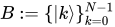
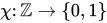
The derivation presented here roughly follows the one given by Brassard et al. in 2000. Assume we have an -dimensional Hilbert space representing the state space of a quantum system, spanned by the orthonormal computational basis states . Furthermore assume we have a Hermitian projection operator . Alternatively, may be given in terms of a Boolean oracle function and an orthonormal operational basis , in which case





can be used to partition into a direct sum of two mutually orthogonal subspaces, the good subspace and the bad subspace :In other words, we are defining a "good subspace" via the projector . The goal of the algorithm is then to evolve some initial state into a state belonging to .




Given a normalized state vector with nonzero overlap with both subspaces, we can uniquely decompose it as
where , and and are the normalized projections of into the subspaces and , respectively. This decomposition defines a two-dimensional subspace , spanned by the vectors and . The probability of finding the system in a good state when measured is .
![{\displaystyle \theta =\arcsin \left(\left|P|\psi \rangle \right|\right)\in [0,\pi /2]}](https://wikimedia.org/api/rest_v1/media/math/render/svg/44ec776775f0b19cdb4f667105947d6e2271a7f6)


Define a unitary operator , where

flips the phase of the states in the good subspace, whereas flips the phase of the initial state .


Amplitude amplification
Amplitude amplification is a technique in quantum computing that generalizes the idea behind Grover's search algorithm, and gives rise to a family of quantum algorithms. It was discovered by Gilles Brassard and Peter Høyer in 1997, and independently rediscovered by Lov Grover in 1998.
In a quantum computer, amplitude amplification can be used to obtain a quadratic speedup over several classical algorithms.
The derivation presented here roughly follows the one given by Brassard et al. in 2000. Assume we have an -dimensional Hilbert space representing the state space of a quantum system, spanned by the orthonormal computational basis states . Furthermore assume we have a Hermitian projection operator . Alternatively, may be given in terms of a Boolean oracle function and an orthonormal operational basis , in which case
can be used to partition into a direct sum of two mutually orthogonal subspaces, the good subspace and the bad subspace :In other words, we are defining a "good subspace" via the projector . The goal of the algorithm is then to evolve some initial state into a state belonging to .
Given a normalized state vector with nonzero overlap with both subspaces, we can uniquely decompose it as
where , and and are the normalized projections of into the subspaces and , respectively. This decomposition defines a two-dimensional subspace , spanned by the vectors and . The probability of finding the system in a good state when measured is .
Define a unitary operator , where
flips the phase of the states in the good subspace, whereas flips the phase of the initial state .