Recent from talks
Nothing was collected or created yet.
Amplitude modulation
View on Wikipedia

| Passband modulation |
|---|
| Analog modulation |
| Digital modulation |
| Hierarchical modulation |
| Spread spectrum |
| See also |
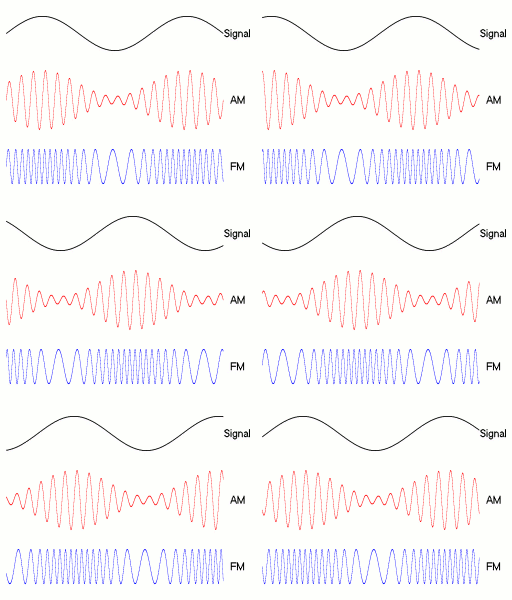
Amplitude modulation (AM) is a signal modulation technique used in electronic communication, most commonly for transmitting messages with a radio wave. In amplitude modulation, the instantaneous amplitude of the wave is varied in proportion to that of the message signal, such as an audio signal.[1] This technique contrasts with angle modulation, in which either the frequency of the carrier wave is varied, as in frequency modulation,[1] or its phase, as in phase modulation.
AM was the earliest modulation method used for transmitting audio in radio broadcasting. It was developed during the first quarter of the 20th century beginning with Roberto Landell de Moura and Reginald Fessenden's radiotelephone experiments in 1900.[2] This original form of AM is sometimes called double-sideband amplitude modulation (DSBAM), because the standard method produces sidebands on either side of the carrier frequency. Single-sideband modulation uses bandpass filters to eliminate one of the sidebands and possibly the carrier signal, which improves the ratio of message power to total transmission power, reduces power handling requirements of line repeaters, and permits better bandwidth utilization of the transmission medium.
AM remains in use in many forms of communication in addition to AM broadcasting: shortwave radio, amateur radio, two-way radios, VHF aircraft radio, citizens band radio, and in computer modems in the form of quadrature amplitude modulation (QAM).
Foundation
[edit]In electronics and telecommunications, modulation is the variation of a property of a continuous wave carrier signal according to an information-bearing signal, such as an audio signal which represents sound, or a video signal which represents images. In this sense, the carrier wave, which has a much higher frequency than the message signal, carries the information. At the receiving station, the message signal is extracted from the modulated carrier by demodulation.
In general form, a modulation process of a sinusoidal carrier wave may be described by the following equation:[3]
- .
A(t) represents the time-varying amplitude of the sinusoidal carrier wave and the cosine-term is the carrier at its angular frequency , and the instantaneous phase deviation . This description directly provides the two major groups of modulation, amplitude modulation and angle modulation. In angle modulation, the term A(t) is constant and the second term of the equation has a functional relationship to the modulating message signal. Angle modulation provides two methods of modulation, frequency modulation and phase modulation.[4]: 27–28
In amplitude modulation, the angle term is held constant and the first term, A(t), of the equation has a functional relationship to the modulating message signal.
The modulating message signal may be analog in nature, or it may be a digital signal, in which case the technique is generally called amplitude-shift keying.[5]: 124–128
For example, in AM radio communication, a continuous wave radio-frequency signal has its amplitude modulated by an audio waveform before transmission. The message signal determines the envelope of the transmitted waveform. In the frequency domain, amplitude modulation produces a signal with power concentrated at the carrier frequency and two adjacent sidebands. Each sideband is equal in bandwidth to that of the modulating signal, and is a mirror image of the other. Standard AM is thus sometimes called "double-sideband amplitude modulation" (DSBAM).
A disadvantage of all amplitude modulation techniques, not only standard AM, is that the receiver amplifies and detects noise and electromagnetic interference in equal proportion to the signal. Increasing the received signal-to-noise ratio, say, by a factor of 10 (a 10 decibel improvement), thus would require increasing the transmitter power by a factor of 10. This is in contrast to frequency modulation (FM) and digital radio where the effect of such noise following demodulation is strongly reduced so long as the received signal is well above the threshold for reception. For this reason AM broadcast is not favored for music and high fidelity broadcasting, but rather for voice communications and broadcasts (sports, news, talk radio etc.).
AM is inefficient in power usage, as at least two-thirds of the transmitting power is concentrated in the carrier signal. The carrier signal contains none of the transmitted information (voice, video, data, etc.). Its presence provides a simple means of demodulation using envelope detection, providing a frequency and phase reference for extracting the message signal from the sidebands. In some modulation systems based on AM, a lower transmitter power is required through partial or total elimination of the carrier component, however receivers for these signals are more complex because they must provide a precise carrier frequency reference signal (usually as shifted to the intermediate frequency) from a greatly reduced "pilot" carrier (in reduced-carrier transmission or DSB-RC) to use in the demodulation process. Even with the carrier eliminated in double-sideband suppressed-carrier transmission, carrier regeneration is possible using a Costas phase-locked loop. This does not work for single-sideband suppressed-carrier transmission (SSB-SC), leading to the characteristic "Donald Duck" sound from such receivers when slightly detuned. Single-sideband AM is nevertheless used widely in amateur radio and other voice communications because it has power and bandwidth efficiency (cutting the RF bandwidth in half compared to standard AM). On the other hand, in medium wave and short wave broadcasting, standard AM with the full carrier allows for reception using inexpensive receivers. The broadcaster absorbs the extra power cost to greatly increase potential audience.
Shift keying
[edit]A simple form of digital amplitude modulation which can be used for transmitting binary data is on–off keying, the simplest form of amplitude-shift keying, in which ones and zeros are represented by the presence or absence of a carrier. On–off keying is likewise used by radio amateurs to transmit Morse code where it is known as continuous wave (CW) operation, even though the transmission is not strictly "continuous". A more complex form of AM, quadrature amplitude modulation is now more commonly used with digital data, while making more efficient use of the available bandwidth.
Analog telephony
[edit]A simple form of amplitude modulation is the transmission of speech signals from a traditional analog telephone set using a common battery local loop.[6] The direct current provided by the central office battery is a carrier with a frequency of 0 Hz. It is modulated by a microphone (transmitter) in the telephone set according to the acoustic signal from the speaker. The result is a varying amplitude direct current, whose AC-component is the speech signal extracted at the central office for transmission to another subscriber.
Amplitude reference
[edit]An additional function provided by the carrier in standard AM, but which is lost in either single or double-sideband suppressed-carrier transmission, is that it provides an amplitude reference. In the receiver, the automatic gain control (AGC) responds to the carrier so that the reproduced audio level stays in a fixed proportion to the original modulation. On the other hand, with suppressed-carrier transmissions there is no transmitted power during pauses in the modulation, so the AGC must respond to peaks of the transmitted power during peaks in the modulation. This typically involves a so-called fast attack, slow decay circuit which holds the AGC level for a second or more following such peaks, in between syllables or short pauses in the program. This is very acceptable for communications radios, where compression of the audio aids intelligibility. However, it is absolutely undesired for music or normal broadcast programming, where a faithful reproduction of the original program, including its varying modulation levels, is expected.
ITU type designations
[edit]In 1982, the International Telecommunication Union (ITU) designated the types of amplitude modulation:
| Designation | Description |
|---|---|
| A3E | double-sideband a full-carrier – the basic amplitude modulation scheme |
| R3E | single-sideband reduced-carrier |
| H3E | single-sideband full-carrier |
| J3E | single-sideband suppressed-carrier |
| B8E | independent-sideband emission |
| C3F | vestigial-sideband |
| Lincompex | linked compressor and expander (a submode of any of the above ITU Emission Modes) |
History
[edit]

Amplitude modulation was used in experiments of multiplex telegraph and telephone transmission in the late 1800s.[7] However, the practical development of this technology is identified with the period between 1900 and 1920 of radiotelephone transmission, that is, the effort to send audio signals by radio waves. The first radio transmitters, called spark gap transmitters, transmitted information by wireless telegraphy, using pulses of the carrier wave to spell out text messages in Morse code. They could not transmit audio because the carrier consisted of strings of damped waves, pulses of radio waves that declined to zero, and sounded like a buzz in receivers. In effect they were already amplitude modulated.[8][9]
Continuous waves
[edit]The first AM transmission was made by Canadian-born American researcher Reginald Fessenden[10] on 23 December 1900[11] using a spark gap transmitter with a specially designed high frequency 10 kHz interrupter,[12] over a distance of one mile (1.6 km) at Cobb Island, Maryland, US. His first transmitted words were, "Hello. One, two, three, four. Is it snowing where you are, Mr. Thiessen?".[11] Though his words were "perfectly intelligible", the spark created a loud and unpleasant noise.[12]
Fessenden was a significant figure in the development of AM radio. He was one of the first researchers to realize, from experiments like the above, that the existing technology for producing radio waves, the spark transmitter, was not usable for amplitude modulation, and that a new kind of transmitter, one that produced sinusoidal continuous waves, was needed. This was a radical idea at the time, because experts believed the impulsive spark was necessary to produce radio frequency waves, and Fessenden was ridiculed. He invented and helped develop one of the first continuous wave transmitters – the Alexanderson alternator, with which he made what is considered the first AM public entertainment broadcast on Christmas Eve, 1906. He also discovered the principle on which AM is based, heterodyning, and invented one of the first detectors able to rectify and receive AM, the electrolytic detector or "liquid baretter", in 1902. Other radio detectors invented for wireless telegraphy, such as the Fleming valve (1904) and the crystal detector (1906) also proved able to rectify AM signals, so the technological hurdle was generating AM waves; receiving them was not a problem.[9]: 36, 55–75, 195 [8]: 76–77, 116–117, 125, 133–134, 162
Early technologies
[edit]Early experiments in AM radio transmission, conducted by Fessenden, Valdemar Poulsen, Ernst Ruhmer, Quirino Majorana, Charles Herrold, and Lee de Forest, were hampered by the lack of a technology for amplification. The first practical continuous wave AM transmitters were based on either the huge, expensive Alexanderson alternator, developed 1906–1910, or versions of the Poulsen arc transmitter (arc converter), invented in 1903. The modifications necessary to transmit AM were clumsy and resulted in very low quality audio. Modulation was usually accomplished by a carbon microphone inserted directly in the antenna or ground wire; its varying resistance varied the current to the antenna. The limited power handling ability of the microphone severely limited the power of the first radiotelephones; many of the microphones were water-cooled.
Vacuum tubes
[edit]The 1912 discovery of the amplifying ability of the Audion tube, invented in 1906 by Lee de Forest, solved these problems. The vacuum tube feedback oscillator, invented in 1912 by Edwin Armstrong and Alexander Meissner, was a cheap source of continuous waves and could be easily modulated to make an AM transmitter. Modulation did not have to be done at the output but could be applied to the signal before the final amplifier tube, so the microphone or other audio source didn't have to modulate a high-power radio signal. Wartime research greatly advanced the art of AM modulation, and after the war the availability of cheap tubes sparked a great increase in the number of radio stations experimenting with AM transmission of news or music. The vacuum tube was responsible for the rise of AM broadcasting around 1920, the first electronic mass communication medium. Amplitude modulation was virtually the only type used for radio broadcasting until FM broadcasting began after World War II.[9]: 203–205, 229–230, 237–242 [8]: 174, 177, 235, 355–357
At the same time as AM radio began, telephone companies such as AT&T were developing the other large application for AM: sending multiple telephone calls through a single wire by modulating them on separate carrier frequencies, called frequency division multiplexing.[7]
Single-sideband
[edit]In 1915, John Renshaw Carson formulated the first mathematical description of amplitude modulation, showing that a signal and carrier frequency combined in a nonlinear device creates a sideband on both sides of the carrier frequency. Passing the modulated signal through another nonlinear device can extract the original baseband signal.[7] His analysis also showed that only one sideband was necessary to transmit the audio signal, and Carson patented single-sideband modulation (SSB) on 1 December 1915.[7] This advanced variant of amplitude modulation was adopted by AT&T for longwave transatlantic telephone service beginning 7 January 1927. After WW-II, it was developed for military aircraft communication.
Analysis
[edit]
The carrier wave (sine wave) of frequency fc and amplitude A is expressed by
- .
The message signal, such as an audio signal that is used for modulating the carrier, is m(t), and has a frequency fm, much lower than fc:
- ,
where m is the amplitude sensitivity, M is the amplitude of modulation. If m < 1, (1 + m(t)/A) is always positive for undermodulation. If m > 1 then overmodulation occurs and reconstruction of message signal from the transmitted signal would lead in loss of original signal. Amplitude modulation results when the carrier c(t) is multiplied by the positive quantity (1 + m(t)/A):
In this simple case m is identical to the modulation index, discussed below. With m = 0.5 the amplitude modulated signal y(t) thus corresponds to the top graph (labelled "50% Modulation") in figure 4.
Using prosthaphaeresis identities, y(t) can be shown to be the sum of three sine waves:
Therefore, the modulated signal has three components: the carrier wave c(t) which is unchanged in frequency, and two sidebands with frequencies slightly above and below the carrier frequency fc.[4]
Spectrum
[edit]
A useful modulation signal m(t) is usually more complex than a single sine wave, as treated above. However, by the principle of Fourier decomposition, m(t) can be expressed as the sum of a set of sine waves of various frequencies, amplitudes, and phases. Carrying out the multiplication of 1 + m(t) with c(t) as above, the result consists of a sum of sine waves. Again, the carrier c(t) is present unchanged, but each frequency component of m at fi has two sidebands at frequencies fc + fi and fc – fi. The collection of the former frequencies above the carrier frequency is known as the upper sideband, and those below constitute the lower sideband. The modulation m(t) may be considered to consist of an equal mix of positive and negative frequency components, as shown in the top of figure 2. One can view the sidebands as that modulation m(t) having simply been shifted in frequency by fc as depicted at the bottom right of figure 2.[13]: 75–76

The short-term spectrum of modulation, changing as it would for a human voice for instance, the frequency content (horizontal axis) may be plotted as a function of time (vertical axis), as in figure 3. It can again be seen that as the modulation frequency content varies, an upper sideband is generated according to those frequencies shifted above the carrier frequency, and the same content mirror-imaged in the lower sideband below the carrier frequency. At all times, the carrier itself remains constant, and of greater power than the total sideband power.
Power and spectrum efficiency
[edit]The RF bandwidth of an AM transmission (refer to figure 2, but only considering positive frequencies) is twice the bandwidth of the modulating (or "baseband") signal, since the upper and lower sidebands around the carrier frequency each have a bandwidth as wide as the highest modulating frequency. Although the bandwidth of an AM signal is narrower than one using frequency modulation (FM), it is twice as wide as single-sideband techniques; it thus may be viewed as spectrally inefficient. Within a frequency band, only half as many transmissions (or "channels") can thus be accommodated. For this reason analog television employs a variant of single-sideband (known as vestigial sideband, somewhat of a compromise in terms of bandwidth) in order to reduce the required channel spacing.[4]: 175–176 [5]
Another improvement over standard AM is obtained through reduction or suppression of the carrier component of the modulated spectrum. In figure 2 this is the spike in between the sidebands; even with full (100%) sine wave modulation, the power in the carrier component is twice that in the sidebands, yet it carries no unique information. Thus there is a great advantage in efficiency in reducing or totally suppressing the carrier, either in conjunction with elimination of one sideband (single-sideband suppressed-carrier transmission) or with both sidebands remaining (double sideband suppressed carrier). While these suppressed carrier transmissions are efficient in terms of transmitter power, they require more sophisticated receivers employing synchronous detection and regeneration of the carrier frequency. For that reason, standard AM continues to be widely used, especially in broadcast transmission, to allow for the use of inexpensive receivers using envelope detection. Even (analog) television, with a (largely) suppressed lower sideband, includes sufficient carrier power for use of envelope detection. But for communications systems where both transmitters and receivers can be optimized, suppression of both one sideband and the carrier represent a net advantage and are frequently employed.
A technique used widely in broadcast AM transmitters is an application of the Hapburg carrier, first proposed in the 1930s but impractical with the technology then available. During periods of low modulation the carrier power would be reduced and would return to full power during periods of high modulation levels. This has the effect of reducing the overall power demand of the transmitter and is most effective on speech type programmes. Various trade names are used for its implementation by the transmitter manufacturers from the late 80's onwards.
Modulation index
[edit]The AM modulation index is a measure based on the ratio of the modulation excursions of the RF signal to the level of the unmodulated carrier. It is thus defined as:
where and are the modulation amplitude and carrier amplitude, respectively; the modulation amplitude is the peak (positive or negative) change in the RF amplitude from its unmodulated value. Modulation index is normally expressed as a percentage, and may be displayed on a meter connected to an AM transmitter.
So if , carrier amplitude varies by 50% above (and below) its unmodulated level, as is shown in the first waveform, below. For , it varies by 100% as shown in the illustration below it. With 100% modulation the wave amplitude sometimes reaches zero, and this represents full modulation using standard AM and is often a target (in order to obtain the highest possible signal-to-noise ratio) but mustn't be exceeded. Increasing the modulating signal beyond that point, known as overmodulation, causes a standard AM modulator (see below) to fail, as the negative excursions of the wave envelope cannot become less than zero, resulting in distortion ("clipping") of the received modulation. Transmitters typically incorporate a limiter circuit to avoid overmodulation, and/or a compressor circuit (especially for voice communications) in order to still approach 100% modulation for maximum intelligibility above the noise. Such circuits are sometimes referred to as a vogad.
However it is possible to talk about a modulation index exceeding 100%, without introducing distortion, in the case of double-sideband reduced-carrier transmission. In that case, negative excursions beyond zero entail a reversal of the carrier phase, as shown in the third waveform below. This cannot be produced using the efficient high-level (output stage) modulation techniques (see below) which are widely used especially in high power broadcast transmitters. Rather, a special modulator produces such a waveform at a low level followed by a linear amplifier. What's more, a standard AM receiver using an envelope detector is incapable of properly demodulating such a signal. Rather, synchronous detection is required. Thus double-sideband transmission is generally not referred to as "AM" even though it generates an identical RF waveform as standard AM as long as the modulation index is below 100%. Such systems more often attempt a radical reduction of the carrier level compared to the sidebands (where the useful information is present) to the point of double-sideband suppressed-carrier transmission where the carrier is (ideally) reduced to zero. In all such cases the term "modulation index" loses its value as it refers to the ratio of the modulation amplitude to a rather small (or zero) remaining carrier amplitude.

Modulation methods
[edit]
Modulation circuit designs may be classified as low- or high-level (depending on whether they modulate in a low-power domain—followed by amplification for transmission—or in the high-power domain of the transmitted signal).[14]
Low-level generation
[edit]In modern radio systems, modulated signals are generated via digital signal processing (DSP). With DSP many types of AM are possible with software control (including DSB with carrier, SSB suppressed-carrier and independent sideband, or ISB). Calculated digital samples are converted to voltages with a digital-to-analog converter, typically at a frequency less than the desired RF-output frequency. The analog signal must then be shifted in frequency and linearly amplified to the desired frequency and power level (linear amplification must be used to prevent modulation distortion).[15] This low-level method for AM is used in many Amateur Radio transceivers.[16]
AM may also be generated at a low level, using analog methods described in the next section.
High-level generation
[edit]High-power AM transmitters (such as those used for AM broadcasting) are based on high-efficiency class-D and class-E power amplifier stages, modulated by varying the supply voltage.[17]
Older designs (for broadcast and amateur radio) also generate AM by controlling the gain of the transmitter's final amplifier (generally class-C, for efficiency). The following types are for vacuum tube transmitters (but similar options are available with transistors):[18][19]
- Plate modulation
- In plate modulation, the plate voltage of the RF amplifier is modulated with the audio signal. The audio power requirement is 50 percent of the RF-carrier power.
- Heising (constant-current) modulation
- RF amplifier plate voltage is fed through a choke (high-value inductor). The AM modulation tube plate is fed through the same inductor, so the modulator tube diverts current from the RF amplifier. The choke acts as a constant current source in the audio range. This system has a low power efficiency.
- Control grid modulation
- The operating bias and gain of the final RF amplifier can be controlled by varying the voltage of the control grid. This method requires little audio power, but care must be taken to reduce distortion.
- Clamp tube (screen grid) modulation
- The screen-grid bias may be controlled through a clamp tube, which reduces voltage according to the modulation signal. It is difficult to approach 100-percent modulation while maintaining low distortion with this system.
- Doherty modulation
- One tube provides the power under carrier conditions and another operates only for positive modulation peaks. Overall efficiency is good, and distortion is low.[4]: 150–151
- Outphasing modulation
- Two tubes are operated in parallel, but partially out of phase with each other. As they are differentially phase modulated their combined amplitude is greater or smaller. Efficiency is good and distortion low when properly adjusted.
- Pulse-width modulation (PWM) or pulse-duration modulation (PDM)
- A highly efficient high voltage power supply is applied to the tube plate. The output voltage of this supply is varied at an audio rate to follow the program. This system was pioneered by Hilmer Swanson and has a number of variations, all of which achieve high efficiency and sound quality.
- Digital methods
- The Harris Corporation obtained a patent for synthesizing a modulated high-power carrier wave from a set of digitally selected low-power amplifiers, running in phase at the same carrier frequency.[20][citation needed] The input signal is sampled by a conventional audio analog-to-digital converter (ADC), and fed to a digital exciter, which modulates overall transmitter output power by switching a series of low-power solid-state RF amplifiers on and off. The combined output drives the antenna system.
Demodulation methods
[edit]The simplest form of an AM demodulator consists of a diode configured as an envelope detector. In 1904, John Ambrose Fleming developed such a circuit for a radio-wave detector in the crystal radio.[21] Adding variable capacitors to the crystal detector enables tuning to a specific frequency.[13]: 104-106}, 111, 115
Another type of demodulator, the product detector, can provide better-quality demodulation with additional circuit complexity.[4]: 157–158
See also
[edit]References
[edit]- ^ a b Smith, Robert H. (1993). Machines and Inventions. Alexandria, VA: Time Life. p. 85. ISBN 0-8094-9704-2.
- ^ "Father Landell de Moura : Radio Broadcasting Pioneer : FABIO S. FLOSI : UNICAMP – University of Campinas, State of São Paulo" (PDF). Aminharadio.com. Archived (PDF) from the original on 9 October 2022. Retrieved 15 July 2018.
- ^ AT&T Bell Laboratories Staff (1977). Telecommunication Transmission Engineering. Vol. 1—Principles (2 ed.). AT&T Bell Center for Technical Education.
- ^ a b c d e Black, Harold (1953). Modulation Theory. New York: D. Van Nostrand Company, Inc. p. 129.
- ^ a b Gibson, Jerry (1993). Principles of Digital and Analog Communications. New York: Macmillan Publishing Company. pp. 117–119. ISBN 0023418605.
- ^ AT&T Bell Laboratories Staff (1984). R.J. Rey (ed.). Engineering and Operations in the Bell System (2 ed.). Murray Hill, NJ: AT&T Bell Laboratories. p. 211. ISBN 0-932764-04-5.
- ^ a b c d Bray, John (2002). Innovation and the Communications Revolution: From the Victorian Pioneers to Broadband Internet. Inst. of Electrical Engineers. pp. 59, 61–62. ISBN 0852962185.
- ^ a b c McNicol, Donald (1946). Radio's Conquest of Space: The Experimental Rise in Radio Communication. New York: Murray Hill Books, Inc. pp. 66–68, 98–105.
- ^ a b c Aitken, Hugh (1985). The Continuous Wave: Technology and American Radio, 1900-1932. Princeton: Princeton University Press. p. 30,54. ISBN 0691023905.
- ^ "Reginald Fessenden (U.S. National Park Service)". NPS.gov Homepage (U.S. National Park Service). 22 July 1932. Retrieved 16 December 2024.
- ^ a b Reel, Monte (17 December 2000). "Island Is Birthplace of Broadcast". Washington Post. Retrieved 16 December 2024.
- ^ a b Advisory Group for Research and Development (AGARD) (2 October 1992). ELF/VLF/LF Radio Propagation and Systems Aspects (PDF) (Report). North Atlantic Treaty Organization (NATO). Retrieved 16 December 2024.
- ^ a b Nahin, Paul (2024). The Mathematical Radio: Inside the Magic of AM, FM, and Single-Sideband. Princeton: Princeton University Press. pp. 74–76. ISBN 9780691235318.
- ^ Atul P. Godse; U. A. Bakshi (2009). Communication Engineering. Technical Publications. p. 36. ISBN 978-81-8431-089-4.
- ^ Silver, Ward, ed. (2011). "Ch. 15 DSP and Software Radio Design". The ARRL Handbook for Radio Communications (Eighty-eighth ed.). American Radio Relay League. ISBN 978-0-87259-096-0.
- ^ Silver, Ward, ed. (2011). "Ch. 14 Transceivers". The ARRL Handbook for Radio Communications (Eighty-eighth ed.). American Radio Relay League. ISBN 978-0-87259-096-0.
- ^ Frederick H. Raab; et al. (May 2003). "RF and Microwave Power Amplifier and Transmitter Technologies – Part 2". High Frequency Design: 22ff. Archived from the original on 6 March 2016. Retrieved 8 September 2017.
- ^ Laurence Gray and Richard Graham (1961). Radio Transmitters. McGraw-Hill. pp. 141ff.
- ^ Cavell, Garrison C. Ed. (2018). National Association of Broadcasters Engineering Handbook, 11th Ed. Routledge. pp. 1099ff.
- ^ US 4580111, Swanson, Hilmer, "Amplitude modulation using digitally selected carrier amplifiers", published 1 April 1986, assigned to Harris Corp
- ^ Bertrand, Ron (2022). Radio Handbook. pp. 348–349. ISBN 9798362553722.
Bibliography
[edit]- Newkirk, David and Karlquist, Rick (2004). Mixers, modulators and demodulators. In D. G. Reed (ed.), The ARRL Handbook for Radio Communications (81st ed.), pp. 15.1–15.36. Newington: ARRL. ISBN 0-87259-196-4.
External links
[edit]- Amplitude Modulation by Jakub Serych, Wolfram Demonstrations Project.
- Amplitude Modulation, by S Sastry.
- Amplitude Modulation, an introduction by Federation of American Scientists.
- Amplitude Modulation tutorial including related topics of modulators, demodulators, etc...
- Analog Modulation online interactive demonstration using Python in Google Colab Platform, by C Foh.
Amplitude modulation
View on GrokipediaFundamentals
Definition and principles
Amplitude modulation (AM) is a technique used in electronic communication systems to encode information onto a high-frequency carrier wave by varying the carrier's amplitude in proportion to the instantaneous amplitude of a low-frequency modulating signal, while keeping the carrier's frequency and phase unchanged.[3] This process allows the low-frequency information, such as audio signals, to be transmitted over longer distances by superimposing it onto a higher-frequency carrier suitable for propagation through media like air or wire.[1] A fundamental AM system comprises three main components: a source for the modulating signal (typically a low-frequency waveform like voice or music), an oscillator generating the unmodulated carrier signal, and a modulator that multiplies or otherwise combines the two inputs to produce the amplitude-modulated output. The unmodulated carrier is mathematically expressed aswhere represents the constant amplitude of the carrier and its frequency, usually in the radio range (e.g., kHz to MHz).[8] During modulation, the varying amplitude of the carrier creates a spectrum consisting of the original carrier frequency surrounded by pairs of upper and lower sidebands, which are offset from the carrier by the frequencies present in the modulating signal and contain the encoded information.[9] These sidebands enable the recovery of the original message at the receiver but also determine the bandwidth required for transmission. To avoid overmodulation—a condition that leads to nonlinear distortion and signal clipping—the absolute value of the normalized modulating signal must satisfy , ensuring the envelope remains positive and faithful to the message.[10]
Types and designations
Amplitude modulation (AM) is classified using emission designations established by the International Telecommunication Union (ITU) to standardize radio communications globally. These designations consist of a bandwidth specifier followed by symbols indicating modulation type, signal nature, and information type. For AM, the first symbol "A" denotes double-sideband amplitude modulation of the main carrier. Subtypes include A1 for unmodulated carrier emissions used in telegraphy, such as A1A for on-off keying (OOK) of a telegraph signal for aural reception, like Morse code transmission. A2 designates double-sideband AM with one modulating frequency, typically a tone for telegraphy or signaling, while A3E represents full-carrier double-sideband AM for telephony or broadcasting, carrying analog information like voice or music.[11][12] Common variants of AM differ primarily in sideband usage and carrier presence, affecting efficiency and bandwidth. Double-sideband full carrier (DSB-FC), also known as conventional AM, transmits both upper and lower sidebands along with the full carrier, designated under A3E in ITU terms; this allows simple envelope detection but wastes power in the carrier, which carries no information. Double-sideband suppressed carrier (DSB-SC) eliminates the carrier to allocate all power to the sidebands, still using the full double-sideband spectrum but requiring coherent demodulation. Single-sideband suppressed carrier (SSB-SC) further optimizes by transmitting only one sideband without the carrier, designated as J3E, halving bandwidth and quadrupling power efficiency compared to DSB-FC for the same sideband power. Vestigial sideband (VSB), a hybrid form designated as C3F, retains a portion of one sideband alongside the other full sideband and a remnant carrier; it is employed in analog television video signals to save bandwidth while easing demodulation, as the vestige aids carrier recovery without full suppression complexity.[11][13] The following table compares key AM types based on bandwidth relative to message bandwidth , power efficiency (sideband power utilization relative to total transmitted power), and generation complexity:| Type | Bandwidth | Power Usage (Sidebands/Total) | Complexity |
|---|---|---|---|
| DSB-FC | 33% | Low (simple multiplier) | |
| DSB-SC | 100% | Medium (balanced modulator) | |
| SSB-SC | 100% | High (sharp filtering) | |
| VSB | High (asymmetric filtering) |
Historical Development
Early experiments
The foundational experiments in amplitude modulation began with Heinrich Hertz's demonstration of electromagnetic waves in 1887. Using a spark-gap transmitter consisting of a dipole antenna and a receiver loop, Hertz generated and detected radio waves in his laboratory at the Technische Hochschule in Karlsruhe, Germany, confirming James Clerk Maxwell's theoretical predictions by showing that these waves propagated through space at the speed of light and exhibited properties like reflection, refraction, and polarization similar to light.[15] These experiments established the existence of radio-frequency electromagnetic radiation, providing the essential groundwork for later modulation techniques by proving that information could potentially be encoded onto such waves.[16] Building on Hertz's discoveries, Guglielmo Marconi advanced wireless communication in the 1890s through experiments with spark-gap transmitters for wireless telegraphy. Starting in 1894, Marconi developed a system using a spark-gap device to generate damped electromagnetic pulses, which were transmitted via an elevated antenna and detected by a coherer receiver, enabling on-off keying—a rudimentary form of amplitude modulation where the carrier's amplitude was switched between full and zero to represent Morse code dots and dashes.[17] By 1895, he achieved transmissions over 1.5 miles (2.4 km) in Bologna, Italy, and in 1896, patented his system in the United Kingdom, marking the first practical application of amplitude variations for long-distance signaling without wires.[18] However, these early spark-gap systems produced damped waves with broad spectral occupancy, leading to significant interference challenges in multi-user environments.[19] Reginald Fessenden addressed these limitations by inventing continuous-wave amplitude modulation around 1900, enabling the transmission of voice and music. Working at his Brant Rock, Massachusetts station, Fessenden first demonstrated voice transmission in 1900 using a carbon microphone inserted in the antenna lead to vary the amplitude of a high-frequency carrier generated by a spark transmitter.[20] A pivotal achievement came on December 24, 1906, when he broadcast the world's first radio program of speech and music, including a violin rendition of "O Holy Night" and a Bible reading, received by ships up to 10 miles (16 km) offshore; this used a high-frequency alternator-transmitter producing a continuous carrier at approximately 100 kHz, modulated by the microphone.[21] This event highlighted the need for amplitude variation to faithfully reproduce audio signals, overcoming the harsh, unintelligible tones from prior damped-wave methods.[22] Early development faced key challenges, including electromagnetic interference from atmospheric noise and nearby electrical equipment, which distorted modulated signals and reduced reception range.[23] Continuous waves, while offering narrower bandwidth and better audio fidelity, initially required high-power generators to combat fading and static, complicating reliable amplitude control for voice transmission.[24] Fessenden's shift from spark-gap damped waves—prone to spectral spreading and poor audio quality—to continuous waves via alternators and arcs thus enabled true amplitude modulation, paving the way for practical radiotelephony.[25]Key technological advances
One pivotal advancement in amplitude modulation (AM) technology was the invention of the Audion vacuum tube by Lee de Forest in 1906, which introduced a control grid to enable electronic amplification of weak radio signals.[26] This triode tube allowed for the first practical AM transmitters by 1912, when de Forest demonstrated cascaded Audions for voice transmission over distance, marking a shift from mechanical detectors to electronic systems.[27] Edwin Armstrong further revolutionized AM reception with his 1913 regenerative receiver, which used feedback to boost signal sensitivity and selectivity in vacuum tube circuits.[28] Building on this, Armstrong patented the superheterodyne receiver in 1919, converting incoming AM signals to a fixed intermediate frequency for superior amplification and tuning stability, becoming the standard for broadcast receivers.[29] Theoretical foundations for single-sideband (SSB) modulation, a bandwidth-efficient variant of AM, were laid by John Renshaw Carson in 1915 through mathematical analysis showing that one sideband could convey the full information of double-sideband AM.[30] Practical implementation of SSB emerged in the 1920s for telephony, enabling multiple voice channels over limited spectrum in early transatlantic radio links.[31] Commercialization accelerated in the 1920s with KDKA's inaugural scheduled AM broadcast on November 2, 1920, relaying U.S. presidential election results from Pittsburgh, which spurred widespread adoption of AM for public entertainment and news.[32] This boom prompted the U.S. Department of Commerce to issue initial broadcasting regulations in 1922, assigning frequencies and power limits to curb interference amid proliferating stations.[33] Vacuum tube-based modulation techniques proliferated in the 1920s, including plate modulation, where audio signals varied the anode supply voltage of RF power tubes for efficient high-power AM generation, and grid modulation, which applied audio to the control grid for simpler low-power applications.[34] Bell Laboratories advanced SSB in the 1930s for long-distance telephony, deploying filter-based systems that suppressed the carrier and one sideband, halving the bandwidth required compared to conventional double-sideband AM while maintaining voice quality over transoceanic circuits.[31] During World War II, AM radios played a critical role in military communications, with innovations in portable sets like the backpack-mounted BC-611 transceiver enabling reliable short-range voice coordination for infantry units, driving miniaturization and ruggedization of tube-based AM equipment.[35]Mathematical Description
Time-domain modulation
In amplitude modulation (AM), the time-domain representation begins with a carrier signal defined as , where is the carrier amplitude and is the carrier frequency. The modulating signal is assumed to be bandlimited with its highest frequency component much less than (i.e., ), ensuring the modulated signal's bandwidth remains manageable.[5] The conventional double-sideband full-carrier (DSB-FC) AM signal is formed by varying the carrier's amplitude in proportion to , yielding the foundational time-domain equation: This expression describes the modulated waveform as the product of the amplitude-modulated term and the carrier cosine. To avoid overmodulation, is typically required, ensuring the amplitude remains non-negative.[5][36] To derive this form, start with the unmodulated carrier . The modulating term is added to the amplitude, so the instantaneous amplitude becomes . The modulated signal is then , which expands to . The second term represents the modulation effect, where multiplication by the high-frequency carrier shifts the modulating signal's content to frequencies around .[36] For a sinusoidal modulating signal , substitute into the equation: Applying the trigonometric product-to-sum identity to the second term yields: This expansion illustrates the carrier at plus upper and lower sideband components at and , respectively, demonstrating how the modulation introduces symmetric frequency shifts around the carrier.[36] In the general case for an arbitrary bandlimited , the modulated signal retains the form . The term generates upper and lower sidebands by effectively creating components whose frequencies are the carrier offset by the frequencies present in , while the carrier term remains unshifted. This structure preserves the information in within the envelope of the high-frequency carrier waveform.[5] The amplitude variation in AM can be visualized using a phasor diagram, where the carrier is represented as a fixed-length phasor rotating at , and the modulating signal scales its magnitude over time without altering the phase. At any instant, the phasor length corresponds to , tracing an amplitude trajectory that follows the envelope , illustrating the modulation as radial extension or contraction around the origin.[37]Frequency-domain analysis
The frequency-domain representation of an amplitude-modulated (AM) signal is obtained via the Fourier transform, which reveals the spectral components including the carrier and sidebands. For a double-sideband (DSB) AM signal expressed as , where is the carrier amplitude, is the message signal with Fourier transform , and is the carrier frequency, the Fourier transform consists of impulses at each scaled by , along with translated copies of the message spectrum: centered at (containing both upper and lower sidebands in the positive frequency domain) and centered at .[38][39] This spectral structure implies that the bandwidth of a DSB AM signal is , where is the bandwidth of the baseband message signal , effectively doubling the baseband bandwidth due to the symmetric sidebands.[38] For example, in AM radio broadcasting, the audio message typically spans 50 Hz to 5 kHz ( kHz), the resulting AM signal occupies a bandwidth of about 10 kHz.[40] In variants with suppressed carrier, the DSB-SC signal has a spectrum lacking the carrier impulses, consisting solely of the translated copies centered at and centered at , while retaining the same bandwidth.[41] Single-sideband (SSB) modulation further reduces bandwidth to by transmitting only one sideband, such as the upper sideband, eliminating redundancy while preserving the message information.[42] The frequency-domain multiplication property of the Fourier transform explains this structure through convolution: the spectrum of the modulated signal is the convolution of with the spectrum of the carrier , which is , yielding the shifted replicas of . SSB spectra can be generated using the Hilbert transform, where the analytic signal (with as the Hilbert transform of ) is modulated to isolate one sideband, as in for the upper sideband.[43]Modulation index calculation
The modulation index, often denoted as , is a key parameter in amplitude modulation that measures the degree to which the carrier amplitude is varied by the modulating signal. For a sinusoidal modulating signal, it is defined as the ratio of the peak amplitude of the modulating signal to the peak amplitude of the carrier signal , expressed mathematically as This index is dimensionless and typically expressed as a percentage by multiplying by 100, indicating the relative strength of the modulation.[44][45] For arbitrary modulating signals , where the modulated waveform takes the form , the peak modulation index is defined using the maximum absolute value of the modulating component relative to the carrier: This ensures the modulation depth is quantified based on the strongest excursion of the modulating signal, preventing assumptions limited to sinusoidal cases. The general modulated signal equation integrates the index as for the sinusoidal scenario, where is the modulating frequency and is the carrier frequency; here, scales the variation around the carrier level.[5][45] A modulation index of (or 100% modulation) represents the boundary for linear operation, where the amplitude envelope of varies symmetrically from 0 to . Graphically, this appears as the carrier waveform's envelope tracing a curve that touches zero at the troughs of the modulating cycle and doubles the carrier amplitude at the peaks, clearly illustrating as the proportional deviation from the steady level. At this point, the modulation fully utilizes the available dynamic range without clipping.[5][44] When , overmodulation occurs, leading to portions of the envelope dipping below zero. This inverts the phase of the carrier by 180 degrees during those intervals, as the negative envelope is physically equivalent to a sign reversal. Upon demodulation via envelope detection, this results in severe nonlinear distortion of the recovered signal, manifesting as harmonic generation and waveform clipping that introduces audible artifacts and adjacent-channel interference. The extent of this distortion can be assessed through the overmodulation percentage, calculated as , which quantifies how much the index exceeds the linear limit and correlates with the severity of the resulting nonlinear effects.[5][44] In AM broadcasting applications involving speech, the modulation index is typically maintained at average levels of 20% to 31%, with peaks controlled to approach but not exceed 100%, to optimize signal coverage, minimize interference, and ensure efficient power usage while preserving audio fidelity. This range reflects empirical measurements from various stations, where lower averages prevent excessive carrier power waste during quiet speech periods.[46]Generation Methods
Low-level amplitude modulation
Low-level amplitude modulation involves generating the modulated signal at a low power level, typically in the milliwatt range, before subjecting it to subsequent linear amplification stages to reach the desired transmission power. This technique begins with a low-power carrier signal from an oscillator, which is fed into a balanced modulator along with the modulating signal to produce a double-sideband suppressed-carrier (DSB-SC) waveform. The resulting composite signal is then amplified using linear RF power amplifiers, such as class B push-pull configurations, which preserve the amplitude variations without introducing significant nonlinear distortion.[47] A common circuit implementation employs a diode ring modulator or a transistor-based balanced modulator to achieve DSB-SC modulation. In the diode version, four diodes arranged in a ring configuration act as switches, multiplying the carrier and modulating signals while suppressing the carrier component through balanced operation; the output is then passed through linear amplifiers to restore full AM if needed by adding a portion of the carrier. Transistor variants, using differential pairs, offer similar functionality with improved isolation and are scalable for integrated circuits. This approach ensures the sidebands carry the information while minimizing carrier power waste.[48][49] The typical block diagram for a low-level AM transmitter is as follows:- Oscillator (generates low-power carrier)
- → Balanced modulator (mixes carrier with modulating signal to form DSB-SC)
- → Linear amplifier chain (boosts the modulated signal to high power)
- → Antenna (radiates the final AM signal)
