



Community hub
Recent from talks
Knowledge base stats:
Talk channels stats:
Members stats:
Amplitude versus offset
In geophysics and reflection seismology, amplitude versus offset (AVO) or amplitude variation with offset is the general term for referring to the dependency of the seismic attribute, amplitude, with the distance between the source and receiver (the offset). AVO analysis is a technique that geophysicists can execute on seismic data to determine a rock's fluid content, porosity, density or seismic velocity, shear wave information, fluid indicators (hydrocarbon indications).
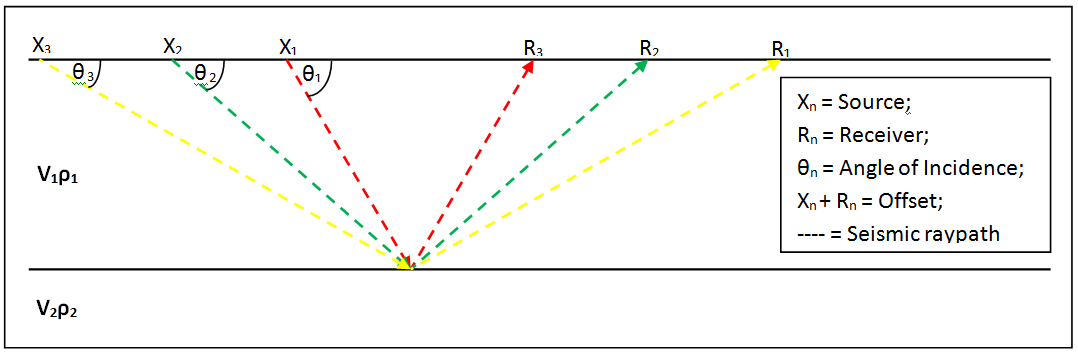
The phenomenon is based on the relationship between the reflection coefficient and the angle of incidence and has been understood since the early 20th century when Karl Zoeppritz wrote down the Zoeppritz equations. Due to its physical origin, AVO can also be known as amplitude versus angle (AVA), but AVO is the more commonly used term because the offset is what a geophysicist can vary in order to change the angle of incidence. (See diagram)
For a seismic wave reflecting off an interface between two media at normal incidence, the expression for the reflection coefficient is relatively simple:
where and are the acoustic impedances of the first and second medium, respectively.


The situation becomes much more complicated in the case of non-normal incidence, due to mode conversion between P-waves and S-waves, and is described by the Zoeppritz equations.
In 1919, Karl Bernhard Zoeppritz derived four equations that determine the amplitudes of reflected and refracted waves at a planar interface for an incident P-wave as a function of the angle of incidence and six independent elastic parameters. These equations have 4 unknowns and can be solved but they do not give an intuitive understanding for how the reflection amplitudes vary with the rock properties involved.
P. Richards and C. Frasier expanded the terms for the reflection and transmission coefficients for a P-wave incident upon a solid-solid interface and simplified the result by assuming only small changes in elastic properties across the interface. Therefore, the squares and differential products are small enough to tend to zero and be removed. This form of the equations allows one to see the effects of density and P- or S- wave velocity variations on the reflection amplitudes. This approximation was popularized in the 1980 book Quantitative Seismology by K. Aki and P. Richards and has since been commonly referred to as the Aki and Richards approximation.
Ostrander was the first to introduce a practical application of the AVO effect, showing that a gas sand underlying a shale exhibited amplitude variation with offset.
Hub AI
Amplitude versus offset AI simulator
(@Amplitude versus offset_simulator)
Amplitude versus offset
In geophysics and reflection seismology, amplitude versus offset (AVO) or amplitude variation with offset is the general term for referring to the dependency of the seismic attribute, amplitude, with the distance between the source and receiver (the offset). AVO analysis is a technique that geophysicists can execute on seismic data to determine a rock's fluid content, porosity, density or seismic velocity, shear wave information, fluid indicators (hydrocarbon indications).
The phenomenon is based on the relationship between the reflection coefficient and the angle of incidence and has been understood since the early 20th century when Karl Zoeppritz wrote down the Zoeppritz equations. Due to its physical origin, AVO can also be known as amplitude versus angle (AVA), but AVO is the more commonly used term because the offset is what a geophysicist can vary in order to change the angle of incidence. (See diagram)
For a seismic wave reflecting off an interface between two media at normal incidence, the expression for the reflection coefficient is relatively simple:
where and are the acoustic impedances of the first and second medium, respectively.
The situation becomes much more complicated in the case of non-normal incidence, due to mode conversion between P-waves and S-waves, and is described by the Zoeppritz equations.
In 1919, Karl Bernhard Zoeppritz derived four equations that determine the amplitudes of reflected and refracted waves at a planar interface for an incident P-wave as a function of the angle of incidence and six independent elastic parameters. These equations have 4 unknowns and can be solved but they do not give an intuitive understanding for how the reflection amplitudes vary with the rock properties involved.
P. Richards and C. Frasier expanded the terms for the reflection and transmission coefficients for a P-wave incident upon a solid-solid interface and simplified the result by assuming only small changes in elastic properties across the interface. Therefore, the squares and differential products are small enough to tend to zero and be removed. This form of the equations allows one to see the effects of density and P- or S- wave velocity variations on the reflection amplitudes. This approximation was popularized in the 1980 book Quantitative Seismology by K. Aki and P. Richards and has since been commonly referred to as the Aki and Richards approximation.
Ostrander was the first to introduce a practical application of the AVO effect, showing that a gas sand underlying a shale exhibited amplitude variation with offset.