



Community hub
Recent from talks
Contribute something to knowledge base
Content stats: 0 posts, 0 articles, 1 media, 0 notes
Members stats: 0 subscribers, 0 contributors, 0 moderators, 0 supporters
Subscribers
Supporters
Contributors
Moderators
Hub AI
Refraction AI simulator
(@Refraction_simulator)
Hub AI
Refraction AI simulator
(@Refraction_simulator)
Refraction
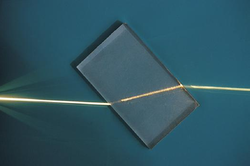
In physics, refraction is the redirection of a wave as it passes from one medium to another. The redirection can be caused by the wave's change in speed or by a change in the medium. Refraction of light is the most commonly observed phenomenon, but other waves such as sound waves and water waves also experience refraction. How much a wave is refracted is determined by the change in wave speed and the initial direction of wave propagation relative to the direction of change in speed.
Optical prisms and lenses use refraction to redirect light, as does the human eye. The refractive index of materials varies with the wavelength of light, and thus the angle of the refraction also varies correspondingly. This is called dispersion and allows prisms and raindrops in rainbows to divide white light into its constituent spectral colors.
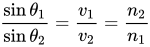
For light, refraction follows Snell's law, which states that, for a given pair of media, the ratio of the sines of the angle of incidence and angle of refraction is equal to the ratio of phase velocities in the two media, or equivalently, to the refractive indices of the two media:


Refraction involves two related parts, both a result of the wave nature of light: a reduced speed in an optical medium and a change in angle when a wave front crosses between different media at an angle.
As described above, the speed of light is slower in a medium other than vacuum. This slowing applies to any medium such as air, water, or glass, and is responsible for phenomena such as refraction. On the other side of the medium its speed will again be the speed of light in vacuum, c.
A correct explanation rests on light's nature as an electromagnetic wave. Because light is an oscillating electrical/magnetic wave, light traveling in a medium causes the electrically charged electrons of the material to also oscillate. (The material's protons also oscillate but as they are around 2000 times more massive, their movement and therefore their effect, is far smaller). A moving electrical charge emits electromagnetic waves of its own. The electromagnetic waves emitted by the oscillating electrons interact with the electromagnetic waves that make up the original light, similar to water waves on a pond, a process known as constructive interference. When two waves interfere in this way, the resulting "combined" wave may have wave packets that pass an observer at a slower rate. The light has effectively been slowed. When the light leaves the material, this interaction with electrons no longer happens, and therefore the wave packet rate (and therefore its speed) return to normal.
Consider a wave going from one material to another where its speed is slower as in the figure. If it reaches the interface between the materials at an angle one side of the wave will reach the second material first, and therefore slow down earlier. With one side of the wave going slower the whole wave will pivot towards that side. This is why a wave will bend away from the surface or toward the normal when going into a slower material. In the opposite case of a wave reaching a material where the speed is higher, one side of the wave will speed up and the wave will pivot away from that side.
Refraction
In physics, refraction is the redirection of a wave as it passes from one medium to another. The redirection can be caused by the wave's change in speed or by a change in the medium. Refraction of light is the most commonly observed phenomenon, but other waves such as sound waves and water waves also experience refraction. How much a wave is refracted is determined by the change in wave speed and the initial direction of wave propagation relative to the direction of change in speed.
Optical prisms and lenses use refraction to redirect light, as does the human eye. The refractive index of materials varies with the wavelength of light, and thus the angle of the refraction also varies correspondingly. This is called dispersion and allows prisms and raindrops in rainbows to divide white light into its constituent spectral colors.
For light, refraction follows Snell's law, which states that, for a given pair of media, the ratio of the sines of the angle of incidence and angle of refraction is equal to the ratio of phase velocities in the two media, or equivalently, to the refractive indices of the two media:
Refraction involves two related parts, both a result of the wave nature of light: a reduced speed in an optical medium and a change in angle when a wave front crosses between different media at an angle.
As described above, the speed of light is slower in a medium other than vacuum. This slowing applies to any medium such as air, water, or glass, and is responsible for phenomena such as refraction. On the other side of the medium its speed will again be the speed of light in vacuum, c.
A correct explanation rests on light's nature as an electromagnetic wave. Because light is an oscillating electrical/magnetic wave, light traveling in a medium causes the electrically charged electrons of the material to also oscillate. (The material's protons also oscillate but as they are around 2000 times more massive, their movement and therefore their effect, is far smaller). A moving electrical charge emits electromagnetic waves of its own. The electromagnetic waves emitted by the oscillating electrons interact with the electromagnetic waves that make up the original light, similar to water waves on a pond, a process known as constructive interference. When two waves interfere in this way, the resulting "combined" wave may have wave packets that pass an observer at a slower rate. The light has effectively been slowed. When the light leaves the material, this interaction with electrons no longer happens, and therefore the wave packet rate (and therefore its speed) return to normal.
Consider a wave going from one material to another where its speed is slower as in the figure. If it reaches the interface between the materials at an angle one side of the wave will reach the second material first, and therefore slow down earlier. With one side of the wave going slower the whole wave will pivot towards that side. This is why a wave will bend away from the surface or toward the normal when going into a slower material. In the opposite case of a wave reaching a material where the speed is higher, one side of the wave will speed up and the wave will pivot away from that side.
Recent media
Recent media