



Community hub
Recent from talks
Knowledge base stats:
Talk channels stats:
Members stats:
Amstrad CPC
The Amstrad CPC (short for "Colour Personal Computer") is a series of 8-bit home computers produced by Amstrad between 1984 and 1990. It was designed to compete in the mid-1980s home computer market dominated by the Commodore 64 and the ZX Spectrum; it successfully established itself primarily in the United Kingdom, France, Spain, and the German-speaking parts of Europe, and also Canada.
The series spawned a total of six distinct models: The CPC 464, CPC 664, and CPC 6128 were highly successful competitors in the European home computer market. The later 464 plus and 6128 plus, intended to prolong the system's lifecycle with hardware updates, were considerably less successful, as was the attempt to repackage the plus hardware into a game console as the GX4000.
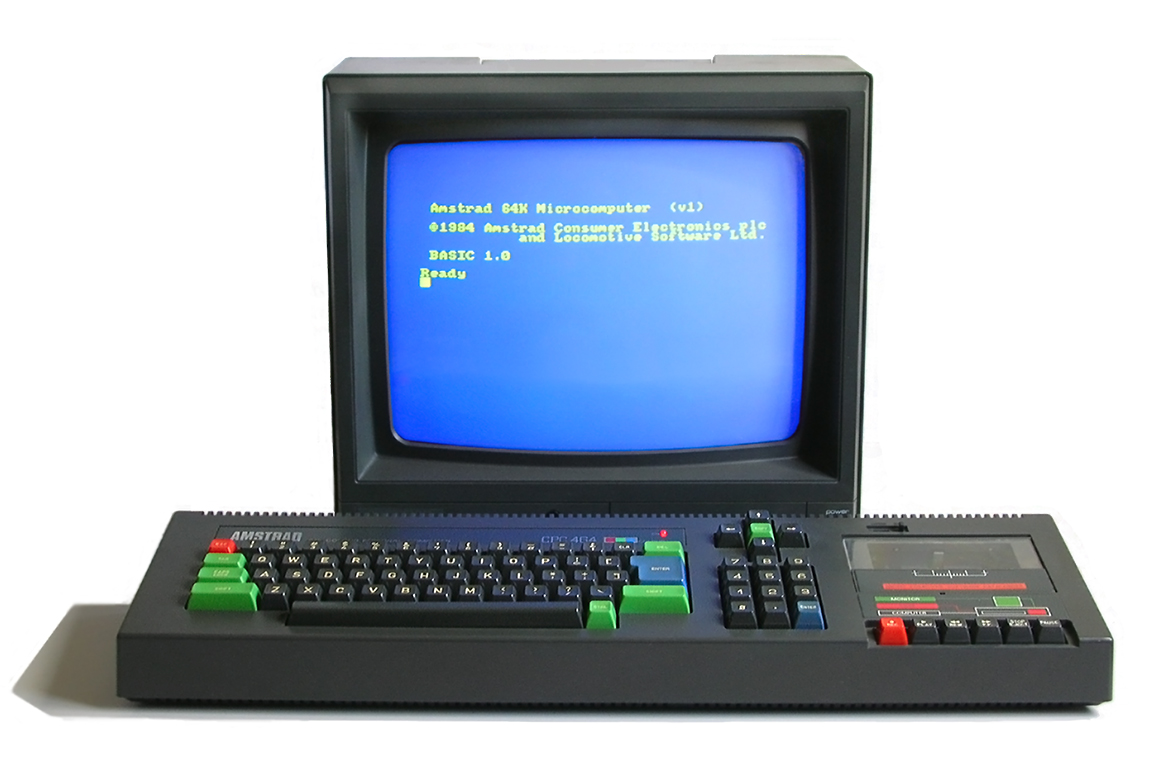
The CPC models' hardware is based on the Zilog Z80A CPU, complemented with either 64 or 128 KB of RAM. Their computer-in-a-keyboard design prominently features an integrated storage device, either a compact cassette deck or 3-inch floppy disk drive. The main units were only sold bundled with either a colour, green-screen or monochrome monitor that doubles as the main unit's power supply. Additionally, a wide range of first and third-party hardware extensions such as external disk drives, printers, and memory extensions, was available.
The CPC series was pitched against other home computers primarily used to play video games and enjoyed a strong supply of game software. The comparatively low price for a complete computer system with dedicated monitor, its high-resolution monochrome text and graphic capabilities and the possibility to run CP/M software also rendered the system attractive for business users, which was reflected by a wide selection of application software.
During its lifetime, the CPC series sold approximately three million units.
The philosophy behind the CPC series was twofold, firstly the concept was of an "all-in-one", where the computer, keyboard and its data storage device were combined in a single unit and sold with its own dedicated display monitor. Most home computers at that time such as ZX Spectrum series, Commodore 64, and BBC Micro relied on the use of the domestic television set and a separately connected tape recorder or disk drive. In itself, the all-in-one concept was not new, having been seen before on business-oriented machines and the Commodore PET.
Secondly, Amstrad founder Alan Sugar wanted the machine to resemble a "real computer, similar to what someone would see being used to check them in at the airport for their holidays", and for the machine to not look like "a pregnant calculator" – in reference presumably to the ZX81 and ZX Spectrum with their low cost, membrane-type keyboards.
The CPC 464 was one of the most successful computers in Europe and sold more than two million units.
Hub AI
Amstrad CPC AI simulator
(@Amstrad CPC_simulator)
Amstrad CPC
The Amstrad CPC (short for "Colour Personal Computer") is a series of 8-bit home computers produced by Amstrad between 1984 and 1990. It was designed to compete in the mid-1980s home computer market dominated by the Commodore 64 and the ZX Spectrum; it successfully established itself primarily in the United Kingdom, France, Spain, and the German-speaking parts of Europe, and also Canada.
The series spawned a total of six distinct models: The CPC 464, CPC 664, and CPC 6128 were highly successful competitors in the European home computer market. The later 464 plus and 6128 plus, intended to prolong the system's lifecycle with hardware updates, were considerably less successful, as was the attempt to repackage the plus hardware into a game console as the GX4000.
The CPC models' hardware is based on the Zilog Z80A CPU, complemented with either 64 or 128 KB of RAM. Their computer-in-a-keyboard design prominently features an integrated storage device, either a compact cassette deck or 3-inch floppy disk drive. The main units were only sold bundled with either a colour, green-screen or monochrome monitor that doubles as the main unit's power supply. Additionally, a wide range of first and third-party hardware extensions such as external disk drives, printers, and memory extensions, was available.
The CPC series was pitched against other home computers primarily used to play video games and enjoyed a strong supply of game software. The comparatively low price for a complete computer system with dedicated monitor, its high-resolution monochrome text and graphic capabilities and the possibility to run CP/M software also rendered the system attractive for business users, which was reflected by a wide selection of application software.
During its lifetime, the CPC series sold approximately three million units.
The philosophy behind the CPC series was twofold, firstly the concept was of an "all-in-one", where the computer, keyboard and its data storage device were combined in a single unit and sold with its own dedicated display monitor. Most home computers at that time such as ZX Spectrum series, Commodore 64, and BBC Micro relied on the use of the domestic television set and a separately connected tape recorder or disk drive. In itself, the all-in-one concept was not new, having been seen before on business-oriented machines and the Commodore PET.
Secondly, Amstrad founder Alan Sugar wanted the machine to resemble a "real computer, similar to what someone would see being used to check them in at the airport for their holidays", and for the machine to not look like "a pregnant calculator" – in reference presumably to the ZX81 and ZX Spectrum with their low cost, membrane-type keyboards.
The CPC 464 was one of the most successful computers in Europe and sold more than two million units.