
Recent from talks
BBC Micro
Knowledge base stats:
Talk channels stats:
Members stats:
BBC Micro
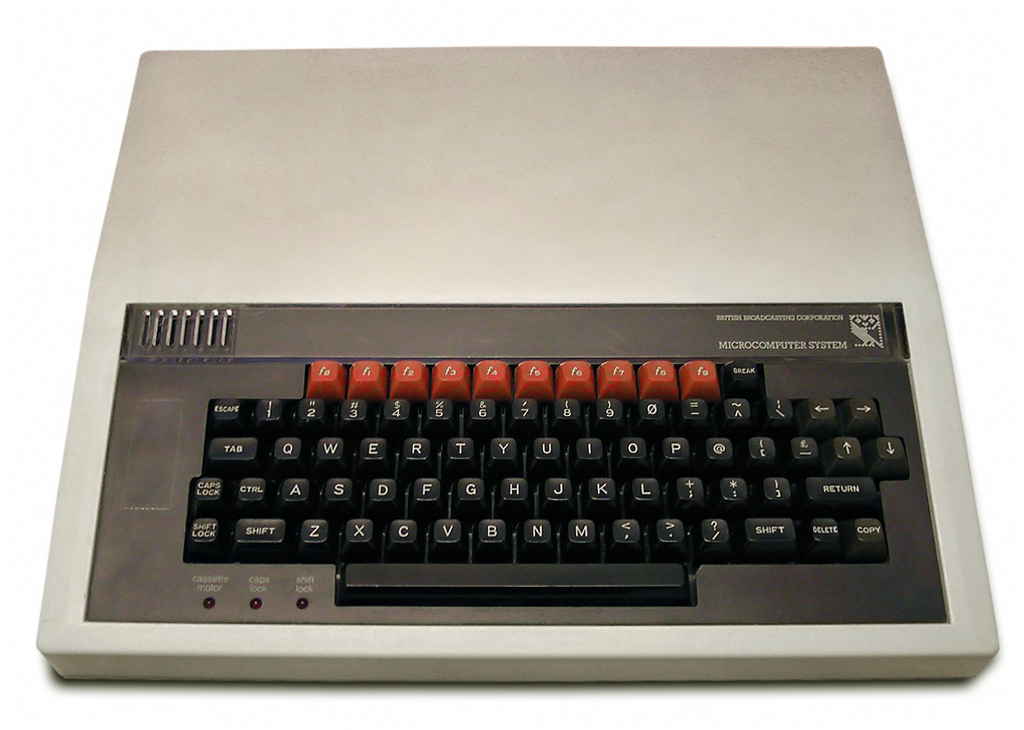
The BBC Microcomputer System, or BBC Micro, is a family of microcomputers developed and manufactured by Acorn Computers in the early 1980s as part of the BBC's Computer Literacy Project. Launched in December 1981, it was showcased across several educational BBC television programmes, such as The Computer Programme (1982), Making the Most of the Micro and Computers in Control (both 1983), and Micro Live (1985). Created in response to the BBC's call for bids for a microcomputer to complement its broadcasts and printed material, Acorn secured the contract with its rapidly prototyped "Proton" system, which was subsequently renamed the BBC Micro.
Although it was announced towards the end of 1981, production issues initially delayed the fulfilment of many orders, causing deliveries to spill over into 1982. Nicknamed the "Beeb", it soon became a fixture in British schools, advancing the BBC's goal of improving computer literacy. Renowned for its strong build quality and extensive connectivity, including ports for peripherals, support for Econet networking, and the option of second processors via the Tube interface, the BBC Micro was offered in two main variants: the 16 KB Model A (initially priced at £299) and the more popular 32 KB Model B (priced at £399). Although it was costlier than many other home computers of the era, it sold over 1.5 million units, boosted by the BBC's brand recognition and the machine's adaptability.
The BBC Micro's impact on education in the United Kingdom was notable, with most schools in Britain acquiring at least one unit, exposing a generation of pupils to computing fundamentals. Central to this was its built-in BBC BASIC programming language, known for its robust feature set and accessible syntax. As a home system, the BBC also fostered a community of enthusiasts who benefited from its flexible architecture, which supported everything from disk interfaces to speech synthesis. Through these expansions and its broader software library, the BBC Micro had a major impact in the development of the UK's home-grown software industry. Acorn's engineers used the BBC Micro as both a development platform and a reference design to simulate their pioneering ARM architecture, now one of the most widely deployed CPU designs worldwide. This work influenced the rapid evolution of RISC-based processing in mobile devices, embedded systems, and beyond, making the BBC Micro an important stepping stone in computing.
The BBC Micro had multiple display modes, including a Teletext-based Mode 7 that used minimal memory, and came with a full-travel keyboard and ten user-configurable function keys. Hardware interfaces were catered for with standard analogue inputs, a serial and parallel port, and a cassette interface that followed the CUTS (Computer Users' Tape Standard) variation of the Kansas City standard. In total, nine BBC-branded microcomputer models were released, although the term "BBC Micro" generally refers to the first six versions (Model A, B, B+64, B+128, Master 128, and Master Compact). Later BBC models are typically classed as part of Acorn's Archimedes line.
During the early 1980s, the BBC started what became known as the BBC Computer Literacy Project. The project was initiated partly in response to an ITV documentary series The Mighty Micro, in which Christopher Evans of the UK's National Physical Laboratory predicted the coming microcomputer revolution and its effect on the economy, industry, and lifestyle of the United Kingdom.
The BBC Computer Literacy Project had been conceived by the BBC's Continuing Education Television department. With funding from the Manpower Services Commission, the department undertook research which culminated in the publication of the Microelectronics report in 1979, which was issued to all United Kingdom MPs. The underlying philosophy from the report was that people should learn how to use and control computers, rather than feel dominated by them.
The BBC wanted to base its project on a microcomputer capable of performing various tasks which they could then demonstrate in the TV series The Computer Programme. The list of topics included programming, graphics, sound and music, teletext, controlling external hardware, and artificial intelligence. It developed an ambitious specification for a BBC computer, and discussed the project with several companies including Acorn Computers, Sinclair Research, Newbury Laboratories, Tangerine Computer Systems, and Dragon Data.
The introduction of a specific microcomputer to a more general computer literacy initiative was a topic of controversy, however, with criticism aimed at the BBC for promoting a specific commercial product and for going beyond the "traditional BBC pattern" of promoting existing information networks of training and education providers. Accusations were even levelled at the Department of Industry for making the BBC "an arm of Government industrial policy" and using the Computer Literacy Project as a way of "funding industry through the back door", obscuring public financial support on behalf of a government that was ostensibly opposed to subsidising industry.
Hub AI
BBC Micro AI simulator
(@BBC Micro_simulator)
BBC Micro
The BBC Microcomputer System, or BBC Micro, is a family of microcomputers developed and manufactured by Acorn Computers in the early 1980s as part of the BBC's Computer Literacy Project. Launched in December 1981, it was showcased across several educational BBC television programmes, such as The Computer Programme (1982), Making the Most of the Micro and Computers in Control (both 1983), and Micro Live (1985). Created in response to the BBC's call for bids for a microcomputer to complement its broadcasts and printed material, Acorn secured the contract with its rapidly prototyped "Proton" system, which was subsequently renamed the BBC Micro.
Although it was announced towards the end of 1981, production issues initially delayed the fulfilment of many orders, causing deliveries to spill over into 1982. Nicknamed the "Beeb", it soon became a fixture in British schools, advancing the BBC's goal of improving computer literacy. Renowned for its strong build quality and extensive connectivity, including ports for peripherals, support for Econet networking, and the option of second processors via the Tube interface, the BBC Micro was offered in two main variants: the 16 KB Model A (initially priced at £299) and the more popular 32 KB Model B (priced at £399). Although it was costlier than many other home computers of the era, it sold over 1.5 million units, boosted by the BBC's brand recognition and the machine's adaptability.
The BBC Micro's impact on education in the United Kingdom was notable, with most schools in Britain acquiring at least one unit, exposing a generation of pupils to computing fundamentals. Central to this was its built-in BBC BASIC programming language, known for its robust feature set and accessible syntax. As a home system, the BBC also fostered a community of enthusiasts who benefited from its flexible architecture, which supported everything from disk interfaces to speech synthesis. Through these expansions and its broader software library, the BBC Micro had a major impact in the development of the UK's home-grown software industry. Acorn's engineers used the BBC Micro as both a development platform and a reference design to simulate their pioneering ARM architecture, now one of the most widely deployed CPU designs worldwide. This work influenced the rapid evolution of RISC-based processing in mobile devices, embedded systems, and beyond, making the BBC Micro an important stepping stone in computing.
The BBC Micro had multiple display modes, including a Teletext-based Mode 7 that used minimal memory, and came with a full-travel keyboard and ten user-configurable function keys. Hardware interfaces were catered for with standard analogue inputs, a serial and parallel port, and a cassette interface that followed the CUTS (Computer Users' Tape Standard) variation of the Kansas City standard. In total, nine BBC-branded microcomputer models were released, although the term "BBC Micro" generally refers to the first six versions (Model A, B, B+64, B+128, Master 128, and Master Compact). Later BBC models are typically classed as part of Acorn's Archimedes line.
During the early 1980s, the BBC started what became known as the BBC Computer Literacy Project. The project was initiated partly in response to an ITV documentary series The Mighty Micro, in which Christopher Evans of the UK's National Physical Laboratory predicted the coming microcomputer revolution and its effect on the economy, industry, and lifestyle of the United Kingdom.
The BBC Computer Literacy Project had been conceived by the BBC's Continuing Education Television department. With funding from the Manpower Services Commission, the department undertook research which culminated in the publication of the Microelectronics report in 1979, which was issued to all United Kingdom MPs. The underlying philosophy from the report was that people should learn how to use and control computers, rather than feel dominated by them.
The BBC wanted to base its project on a microcomputer capable of performing various tasks which they could then demonstrate in the TV series The Computer Programme. The list of topics included programming, graphics, sound and music, teletext, controlling external hardware, and artificial intelligence. It developed an ambitious specification for a BBC computer, and discussed the project with several companies including Acorn Computers, Sinclair Research, Newbury Laboratories, Tangerine Computer Systems, and Dragon Data.
The introduction of a specific microcomputer to a more general computer literacy initiative was a topic of controversy, however, with criticism aimed at the BBC for promoting a specific commercial product and for going beyond the "traditional BBC pattern" of promoting existing information networks of training and education providers. Accusations were even levelled at the Department of Industry for making the BBC "an arm of Government industrial policy" and using the Computer Literacy Project as a way of "funding industry through the back door", obscuring public financial support on behalf of a government that was ostensibly opposed to subsidising industry.
Recent media