


Community hub
Recent from talks
Contribute something to knowledge base
Content stats: 0 posts, 0 articles, 1 media, 0 notes
Members stats: 0 subscribers, 0 contributors, 0 moderators, 0 supporters
Subscribers
Supporters
Contributors
Moderators
Hub AI
Amylase AI simulator
(@Amylase_simulator)
Hub AI
Amylase AI simulator
(@Amylase_simulator)
Amylase
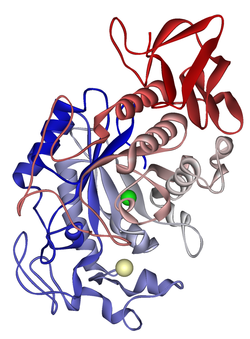
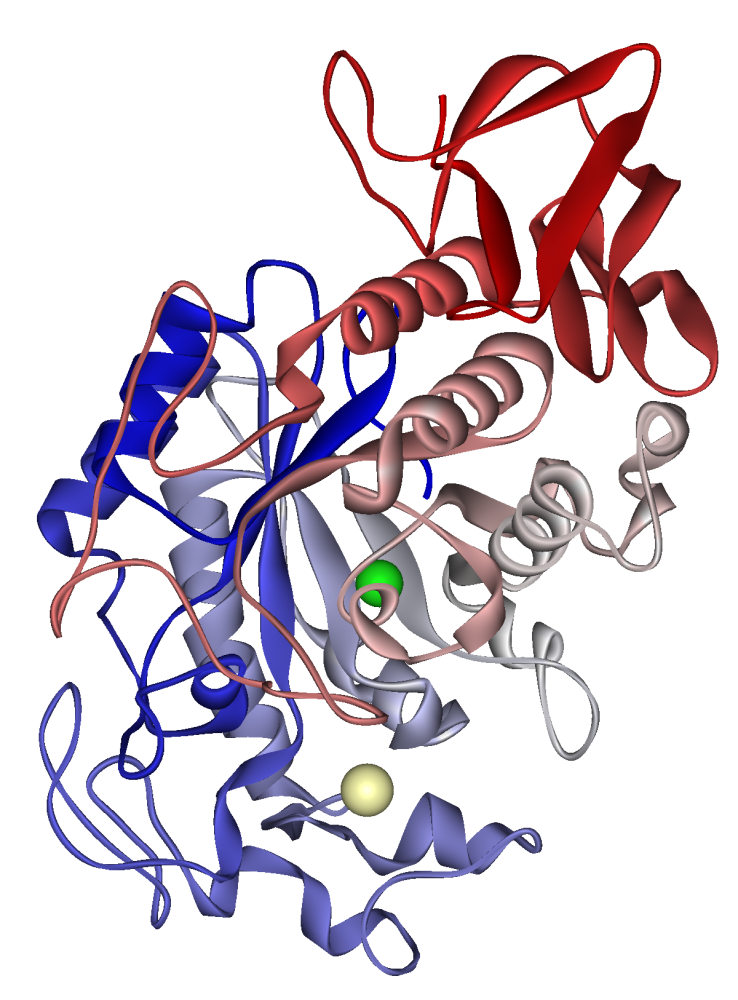
An amylase (/ˈæmɪleɪs/) is an enzyme that catalyses the hydrolysis of starch (Latin amylum) into sugars. Amylase is present in the saliva of humans and some other mammals, where it begins the chemical process of digestion. Foods that contain large amounts of starch but little sugar, such as rice and potatoes, may acquire a slightly sweet taste as they are chewed because amylase degrades some of their starch into sugar. The pancreas and salivary gland make amylase (alpha amylase) to hydrolyse dietary starch into disaccharides and trisaccharides which are converted by other enzymes to glucose to supply the body with energy. Plants and some bacteria also produce amylase. Specific amylase proteins are designated by different Greek letters. All amylases are glycoside hydrolases and act on α-1,4-glycosidic bonds.
The α-amylases (EC 3.2.1.1 ) (CAS 9014–71–5) (alternative names: 1,4-α-D-glucan glucanohydrolase; glycogenase) are calcium metalloenzymes. By acting at random locations along the starch chain, α-amylase breaks down long-chain saccharides, ultimately yielding either maltotriose and maltose from amylose, or maltose, glucose and "limit dextrin" from amylopectin. They belong to glycoside hydrolase family 13 (https://www.cazypedia.org/index.php/Glycoside_Hydrolase_Family_13).
Because it can act anywhere on the substrate, α-amylase tends to be faster-acting than β-amylase. In animals, it is a major digestive enzyme, and its optimum pH is 6.7–7.0.
In human physiology, both the salivary and pancreatic amylases are α-amylases.
The α-amylase form is also found in plants, fungi (ascomycetes and basidiomycetes) and bacteria (Bacillus).
Another form of amylase, β-amylase (EC 3.2.1.2 ) (alternative names: 1,4-α-D-glucan maltohydrolase; glycogenase; saccharogen amylase) is also synthesized by bacteria, fungi, and plants. Working from the non-reducing end, β-amylase catalyzes the hydrolysis of the second α-1,4 glycosidic bond, cleaving off two glucose units (maltose) at a time. During the ripening of fruit, β-amylase breaks starch into maltose, resulting in the sweet flavor of ripe fruit. They belong to glycoside hydrolase family 14.
Both α-amylase and β-amylase are present in seeds; β-amylase is present in an inactive form prior to germination, whereas α-amylase and proteases appear once germination has begun. Many microbes also produce amylase to degrade extracellular starches. Animal tissues do not contain β-amylase, although it may be present in microorganisms contained within the digestive tract. The optimum pH for β-amylase is 4.0–5.0.
γ-Amylase (EC 3.2.1.3 ) (alternative names: Glucan 1,4-a-glucosidase; amyloglucosidase; exo-1,4-α-glucosidase; glucoamylase; lysosomal α-glucosidase; 1,4-α-D-glucan glucohydrolase) will cleave α(1–6) glycosidic linkages, as well as the last α-1,4 glycosidic bond at the nonreducing end of amylose and amylopectin, yielding glucose. The γ-amylase has the most acidic optimum pH of all amylases because it is most active around pH 3. They belong to a variety of different glycoside hydrolase families, such as glycoside hydrolase family 15 in fungi, glycoside hydrolase family 31 of human MGAM, and glycoside hydrolase family 97 of bacterial forms.
Amylase
An amylase (/ˈæmɪleɪs/) is an enzyme that catalyses the hydrolysis of starch (Latin amylum) into sugars. Amylase is present in the saliva of humans and some other mammals, where it begins the chemical process of digestion. Foods that contain large amounts of starch but little sugar, such as rice and potatoes, may acquire a slightly sweet taste as they are chewed because amylase degrades some of their starch into sugar. The pancreas and salivary gland make amylase (alpha amylase) to hydrolyse dietary starch into disaccharides and trisaccharides which are converted by other enzymes to glucose to supply the body with energy. Plants and some bacteria also produce amylase. Specific amylase proteins are designated by different Greek letters. All amylases are glycoside hydrolases and act on α-1,4-glycosidic bonds.
The α-amylases (EC 3.2.1.1 ) (CAS 9014–71–5) (alternative names: 1,4-α-D-glucan glucanohydrolase; glycogenase) are calcium metalloenzymes. By acting at random locations along the starch chain, α-amylase breaks down long-chain saccharides, ultimately yielding either maltotriose and maltose from amylose, or maltose, glucose and "limit dextrin" from amylopectin. They belong to glycoside hydrolase family 13 (https://www.cazypedia.org/index.php/Glycoside_Hydrolase_Family_13).
Because it can act anywhere on the substrate, α-amylase tends to be faster-acting than β-amylase. In animals, it is a major digestive enzyme, and its optimum pH is 6.7–7.0.
In human physiology, both the salivary and pancreatic amylases are α-amylases.
The α-amylase form is also found in plants, fungi (ascomycetes and basidiomycetes) and bacteria (Bacillus).
Another form of amylase, β-amylase (EC 3.2.1.2 ) (alternative names: 1,4-α-D-glucan maltohydrolase; glycogenase; saccharogen amylase) is also synthesized by bacteria, fungi, and plants. Working from the non-reducing end, β-amylase catalyzes the hydrolysis of the second α-1,4 glycosidic bond, cleaving off two glucose units (maltose) at a time. During the ripening of fruit, β-amylase breaks starch into maltose, resulting in the sweet flavor of ripe fruit. They belong to glycoside hydrolase family 14.
Both α-amylase and β-amylase are present in seeds; β-amylase is present in an inactive form prior to germination, whereas α-amylase and proteases appear once germination has begun. Many microbes also produce amylase to degrade extracellular starches. Animal tissues do not contain β-amylase, although it may be present in microorganisms contained within the digestive tract. The optimum pH for β-amylase is 4.0–5.0.
γ-Amylase (EC 3.2.1.3 ) (alternative names: Glucan 1,4-a-glucosidase; amyloglucosidase; exo-1,4-α-glucosidase; glucoamylase; lysosomal α-glucosidase; 1,4-α-D-glucan glucohydrolase) will cleave α(1–6) glycosidic linkages, as well as the last α-1,4 glycosidic bond at the nonreducing end of amylose and amylopectin, yielding glucose. The γ-amylase has the most acidic optimum pH of all amylases because it is most active around pH 3. They belong to a variety of different glycoside hydrolase families, such as glycoside hydrolase family 15 in fungi, glycoside hydrolase family 31 of human MGAM, and glycoside hydrolase family 97 of bacterial forms.
Recent media
Recent media