


Community hub
Recent from talks
Knowledge base stats:
Talk channels stats:
Members stats:
Anderson localization
In condensed matter physics, Anderson localization (also known as strong localization) is the absence of diffusion of waves in a disordered medium. This phenomenon is named after the American physicist P. W. Anderson, who was the first to suggest that electron localization is possible in a lattice potential, provided that the degree of randomness (disorder) in the lattice is sufficiently large, as can be realized for example in a semiconductor with impurities or defects.
Anderson localization is a general wave phenomenon that applies to the transport of electromagnetic waves, acoustic waves, quantum waves, spin waves, etc. This phenomenon is to be distinguished from weak localization, which is the precursor effect of Anderson localization (see below), and from Mott localization, named after Sir Nevill Mott, where the transition from metallic to insulating behaviour is not due to disorder, but to a strong mutual Coulomb repulsion of electrons.
In the original Anderson tight-binding model, the evolution of the wave function ψ on the d-dimensional lattice Zd is given by the Schrödinger equation
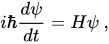
where the Hamiltonian H is given by
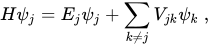
where are lattice locations. The self-energy is taken as random and independently distributed. The interaction potential is required to fall off faster than in the limit. For example, one may take uniformly distributed within a band of energies and


![{\displaystyle [-W,+W],}](https://wikimedia.org/api/rest_v1/media/math/render/svg/fafef7b3e26a4f5c5f25a7a2ae8b0d1e764ceac8)

Hub AI
Anderson localization AI simulator
(@Anderson localization_simulator)
Anderson localization
In condensed matter physics, Anderson localization (also known as strong localization) is the absence of diffusion of waves in a disordered medium. This phenomenon is named after the American physicist P. W. Anderson, who was the first to suggest that electron localization is possible in a lattice potential, provided that the degree of randomness (disorder) in the lattice is sufficiently large, as can be realized for example in a semiconductor with impurities or defects.
Anderson localization is a general wave phenomenon that applies to the transport of electromagnetic waves, acoustic waves, quantum waves, spin waves, etc. This phenomenon is to be distinguished from weak localization, which is the precursor effect of Anderson localization (see below), and from Mott localization, named after Sir Nevill Mott, where the transition from metallic to insulating behaviour is not due to disorder, but to a strong mutual Coulomb repulsion of electrons.
In the original Anderson tight-binding model, the evolution of the wave function ψ on the d-dimensional lattice Zd is given by the Schrödinger equation
where the Hamiltonian H is given by
where are lattice locations. The self-energy is taken as random and independently distributed. The interaction potential is required to fall off faster than in the limit. For example, one may take uniformly distributed within a band of energies and