

Recent from talks
Continuous uniform distribution
Knowledge base stats:
Talk channels stats:
Members stats:
Continuous uniform distribution
In probability theory and statistics, the continuous uniform distributions or rectangular distributions are a family of symmetric probability distributions. Such a distribution describes an experiment where there is an arbitrary outcome that lies between certain bounds. The bounds are defined by the parameters, and which are the minimum and maximum values. The interval can either be closed (i.e. ) or open (i.e. ). Therefore, the distribution is often abbreviated where stands for uniform distribution. The difference between the bounds defines the interval length; all intervals of the same length on the distribution's support are equally probable. It is the maximum entropy probability distribution for a random variable under no constraint other than that it is contained in the distribution's support.


![{\displaystyle [a,b]}](https://wikimedia.org/api/rest_v1/media/math/render/svg/9c4b788fc5c637e26ee98b45f89a5c08c85f7935)


The probability density function of the continuous uniform distribution is
![{\displaystyle f(x)={\begin{cases}{\dfrac {1}{b-a}}&{\text{for }}a\leq x\leq b,\\[8pt]0&{\text{for }}x<a\ {\text{ or }}\ x>b.\end{cases}}}](https://wikimedia.org/api/rest_v1/media/math/render/svg/fd04990d517bf9bb3663f31086a89abd1b0f077f)
The values of at the two boundaries and are usually unimportant, because they do not alter the value of over any interval nor of nor of any higher moment. Sometimes they are chosen to be zero, and sometimes chosen to be The latter is appropriate in the context of estimation by the method of maximum likelihood. In the context of Fourier analysis, one may take the value of or to be because then the inverse transform of many integral transforms of this uniform function will yield back the function itself, rather than a function which is equal "almost everywhere", i.e. except on a set of points with zero measure. Also, it is consistent with the sign function, which has no such ambiguity.


![{\displaystyle [c,d],}](https://wikimedia.org/api/rest_v1/media/math/render/svg/a9d224646c92ef76fbe024ed2eb56cb2964cab95)


Any probability density function integrates to so the probability density function of the continuous uniform distribution is graphically portrayed as a rectangle where is the base length and is the height. As the base length increases, the height (the density at any particular value within the distribution boundaries) decreases.


In terms of mean and variance the probability density function of the continuous uniform distribution is


![{\displaystyle f(x)={\begin{cases}{\dfrac {1}{2\sigma {\sqrt {3}}}}&{\text{for }}-\sigma {\sqrt {3}}\leq x-\mu \leq \sigma {\sqrt {3}},\\[2pt]0&{\text{otherwise}}.\end{cases}}}](https://wikimedia.org/api/rest_v1/media/math/render/svg/312995655df7721197b7772acbe6efb18cdf1056)
The cumulative distribution function of the continuous uniform distribution is:
![{\displaystyle F(x)={\begin{cases}0&{\text{for }}x<a,\\[8pt]{\frac {x-a}{b-a}}&{\text{for }}a\leq x\leq b,\\[8pt]1&{\text{for }}x>b.\end{cases}}}](https://wikimedia.org/api/rest_v1/media/math/render/svg/32f8fa14b36ce1147021a210b875bcc4b91d24a3)
Its inverse is:

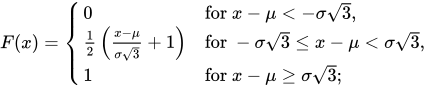
In terms of mean and variance the cumulative distribution function of the continuous uniform distribution is:
Hub AI
Continuous uniform distribution AI simulator
(@Continuous uniform distribution_simulator)
Continuous uniform distribution
In probability theory and statistics, the continuous uniform distributions or rectangular distributions are a family of symmetric probability distributions. Such a distribution describes an experiment where there is an arbitrary outcome that lies between certain bounds. The bounds are defined by the parameters, and which are the minimum and maximum values. The interval can either be closed (i.e. ) or open (i.e. ). Therefore, the distribution is often abbreviated where stands for uniform distribution. The difference between the bounds defines the interval length; all intervals of the same length on the distribution's support are equally probable. It is the maximum entropy probability distribution for a random variable under no constraint other than that it is contained in the distribution's support.
The probability density function of the continuous uniform distribution is
The values of at the two boundaries and are usually unimportant, because they do not alter the value of over any interval nor of nor of any higher moment. Sometimes they are chosen to be zero, and sometimes chosen to be The latter is appropriate in the context of estimation by the method of maximum likelihood. In the context of Fourier analysis, one may take the value of or to be because then the inverse transform of many integral transforms of this uniform function will yield back the function itself, rather than a function which is equal "almost everywhere", i.e. except on a set of points with zero measure. Also, it is consistent with the sign function, which has no such ambiguity.
Any probability density function integrates to so the probability density function of the continuous uniform distribution is graphically portrayed as a rectangle where is the base length and is the height. As the base length increases, the height (the density at any particular value within the distribution boundaries) decreases.
In terms of mean and variance the probability density function of the continuous uniform distribution is
The cumulative distribution function of the continuous uniform distribution is:
Its inverse is:
In terms of mean and variance the cumulative distribution function of the continuous uniform distribution is:
Recent media