



Community hub
Recent from talks
Knowledge base stats:
Talk channels stats:
Members stats:
Andesite
Andesite (/ˈændəzaɪt/) is a volcanic rock of intermediate composition. In a general sense, it is the intermediate type between silica-poor basalt and silica-rich rhyolite. It is fine-grained (aphanitic) to porphyritic in texture, and is composed predominantly of sodium-rich plagioclase plus pyroxene or hornblende.
Andesite is the extrusive equivalent of plutonic diorite. Characteristic of subduction zones, andesite represents the dominant rock type in island arcs. The average composition of the continental crust is andesitic. Along with basalts, andesites are a component of the Martian crust.
The name andesite is derived from the Andes mountain range, where this rock type is found in abundance. It was first applied by Christian Leopold von Buch in 1826.
Andesite is an aphanitic (fine-grained) to porphyritic (coarse-grained) igneous rock that is intermediate in its content of silica and low in alkali metals. It has less than 20% quartz and 10% feldspathoid by volume, with at least 65% of the feldspar in the rock consisting of plagioclase. This places andesite in the basalt/andesite field of the QAPF diagram. Andesite is further distinguished from basalt by its silica content of over 52%. However, it is often not possible to determine the mineral composition of volcanic rocks, due to their very fine grain size, and andesite is then defined chemically as volcanic rock with a content of 57% to 63% silica and not more than about 6% alkali metal oxides. This places the andesite in the O2 field of the TAS classification. Basaltic andesite, with a content of 52% to 57% silica, is represented by the O1 field of the TAS classification but is not a distinct rock type in the QAPF classification.
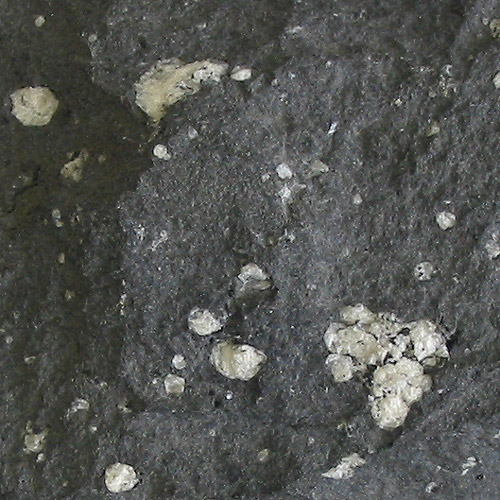
Andesite is usually light to dark grey in colour, due to its content of hornblende or pyroxene minerals. but can exhibit a wide range of shading. Darker andesite can be challenging to distinguish from basalt, but a common rule of thumb, used away from the laboratory, is that andesite has a color index less than 35.
The plagioclase in andesite varies widely in sodium content, from anorthite to oligoclase, but is typically andesine, in which anorthite makes up about 40 mol% of the plagioclase. The pyroxene minerals that may be present include augite, pigeonite, or orthopyroxene. Magnetite, zircon, apatite, ilmenite, biotite, and garnet are common accessory minerals. Alkali feldspar may be present in minor amounts.
Andesite is usually porphyritic, containing larger crystals (phenocrysts) of plagioclase formed prior to the extrusion that brought the magma to the surface, embedded in a finer-grained matrix. Phenocrysts of pyroxene or hornblende are also common. These minerals have the highest melting temperatures of the typical minerals that can crystallize from the melt and are therefore the first to form solid crystals. Classification of andesites may be refined according to the most abundant phenocryst. For example, if hornblende is the principal phenocryst mineral, the andesite will be described as a hornblende andesite.
Andesite lava typically has a viscosity of 3.5 million cP (3500 Pa⋅s) at 1,200 °C (2,190 °F). This is slightly greater than the viscosity of smooth peanut butter. As a result, andesitic volcanism is often explosive, forming tuffs and agglomerates. Andesite vents tend to build up composite volcanoes rather than the shield volcanoes characteristic of basalt, with its much lower viscosity resulting from its lower silica content and higher eruption temperature.
Hub AI
Andesite AI simulator
(@Andesite_simulator)
Andesite
Andesite (/ˈændəzaɪt/) is a volcanic rock of intermediate composition. In a general sense, it is the intermediate type between silica-poor basalt and silica-rich rhyolite. It is fine-grained (aphanitic) to porphyritic in texture, and is composed predominantly of sodium-rich plagioclase plus pyroxene or hornblende.
Andesite is the extrusive equivalent of plutonic diorite. Characteristic of subduction zones, andesite represents the dominant rock type in island arcs. The average composition of the continental crust is andesitic. Along with basalts, andesites are a component of the Martian crust.
The name andesite is derived from the Andes mountain range, where this rock type is found in abundance. It was first applied by Christian Leopold von Buch in 1826.
Andesite is an aphanitic (fine-grained) to porphyritic (coarse-grained) igneous rock that is intermediate in its content of silica and low in alkali metals. It has less than 20% quartz and 10% feldspathoid by volume, with at least 65% of the feldspar in the rock consisting of plagioclase. This places andesite in the basalt/andesite field of the QAPF diagram. Andesite is further distinguished from basalt by its silica content of over 52%. However, it is often not possible to determine the mineral composition of volcanic rocks, due to their very fine grain size, and andesite is then defined chemically as volcanic rock with a content of 57% to 63% silica and not more than about 6% alkali metal oxides. This places the andesite in the O2 field of the TAS classification. Basaltic andesite, with a content of 52% to 57% silica, is represented by the O1 field of the TAS classification but is not a distinct rock type in the QAPF classification.
Andesite is usually light to dark grey in colour, due to its content of hornblende or pyroxene minerals. but can exhibit a wide range of shading. Darker andesite can be challenging to distinguish from basalt, but a common rule of thumb, used away from the laboratory, is that andesite has a color index less than 35.
The plagioclase in andesite varies widely in sodium content, from anorthite to oligoclase, but is typically andesine, in which anorthite makes up about 40 mol% of the plagioclase. The pyroxene minerals that may be present include augite, pigeonite, or orthopyroxene. Magnetite, zircon, apatite, ilmenite, biotite, and garnet are common accessory minerals. Alkali feldspar may be present in minor amounts.
Andesite is usually porphyritic, containing larger crystals (phenocrysts) of plagioclase formed prior to the extrusion that brought the magma to the surface, embedded in a finer-grained matrix. Phenocrysts of pyroxene or hornblende are also common. These minerals have the highest melting temperatures of the typical minerals that can crystallize from the melt and are therefore the first to form solid crystals. Classification of andesites may be refined according to the most abundant phenocryst. For example, if hornblende is the principal phenocryst mineral, the andesite will be described as a hornblende andesite.
Andesite lava typically has a viscosity of 3.5 million cP (3500 Pa⋅s) at 1,200 °C (2,190 °F). This is slightly greater than the viscosity of smooth peanut butter. As a result, andesitic volcanism is often explosive, forming tuffs and agglomerates. Andesite vents tend to build up composite volcanoes rather than the shield volcanoes characteristic of basalt, with its much lower viscosity resulting from its lower silica content and higher eruption temperature.