


Community hub
Recent from talks
Contribute something to knowledge base
Content stats: 0 posts, 0 articles, 1 media, 0 notes
Members stats: 0 subscribers, 0 contributors, 0 moderators, 0 supporters
Subscribers
Supporters
Contributors
Moderators
Hub AI
Garnet AI simulator
(@Garnet_simulator)
Hub AI
Garnet AI simulator
(@Garnet_simulator)
Garnet
Garnets ( /ˈɡɑːrnɪt/) are a group of silicate minerals that have been used since the Bronze Age as gemstones and abrasives.
Garnet minerals, while sharing similar physical and crystallographic properties, exhibit a wide range of chemical compositions, defining distinct species. These species fall into two primary solid solution series: the pyralspite series (pyrope, almandine, spessartine), with the general formula [Mg,Fe,Mn]3Al2(SiO4)3; and the ugrandite series (uvarovite, grossular, andradite), with the general formula Ca3[Cr,Al,Fe]2(SiO4)3. Notable varieties of grossular include hessonite and tsavorite.
Although garnets are often associated with metamorphism, it can also occuur in volcanic rocks on rare occasions.
The word garnet comes from the 14th-century Middle English word gernet, meaning 'dark red'. It is borrowed from Old French grenate from Latin granatus, from granum ('grain, seed'). This is possibly a reference to mela granatum or even pomum granatum ('pomegranate', Punica granatum), a plant whose fruits contain abundant and vivid red seed covers (arils), which are similar in shape, size, and color to some garnet crystals. Hessonite garnet is also named 'gomed' in Indian literature and is one of the nine jewels in Vedic astrology that comprise the Navaratna.
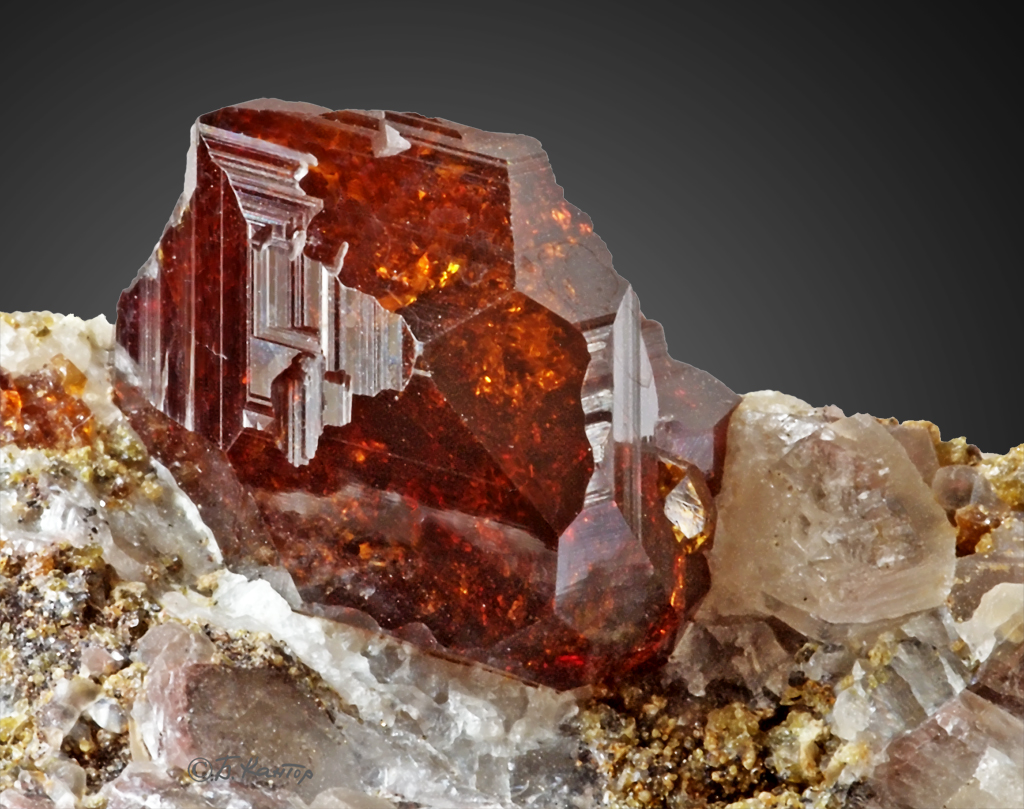
Garnet species are found in every colour, with reddish shades most common. Blue garnets are the rarest and were first reported in the 1990s.
Garnet species' light transmission properties can range from the gemstone-quality transparent specimens to the opaque varieties used for industrial purposes as abrasives. The mineral's lustre is categorized as vitreous (glass-like) or resinous (amber-like).
Garnets are nesosilicates having the general formula X3Y2(SiO
4)3. The X site is usually occupied by divalent cations (Ca, Mg, Fe, Mn)2+ and the Y site by trivalent cations (Al, Fe, Cr)3+ in an octahedral/tetrahedral framework with [SiO4]4− occupying the tetrahedra. Garnets are most often found in the dodecahedral crystal habit, but are also commonly found in the trapezohedron habit as well as the hexoctahedral habit. They crystallize in the cubic system, having three axes that are all of equal length and perpendicular to one another but are never actually cubic because, despite being isometric, the {100} and {111} families of planes are depleted. Garnets do not have any cleavage planes, so, when they fracture under stress, sharp, irregular (conchoidal) pieces are formed.
Because the chemical composition of garnet varies, the atomic bonds in some species are stronger than in others. As a result, this mineral group shows a range of hardness on the Mohs scale of about 6.0 to 7.5. The harder species like almandine are often used for abrasive purposes.
Garnet
Garnets ( /ˈɡɑːrnɪt/) are a group of silicate minerals that have been used since the Bronze Age as gemstones and abrasives.
Garnet minerals, while sharing similar physical and crystallographic properties, exhibit a wide range of chemical compositions, defining distinct species. These species fall into two primary solid solution series: the pyralspite series (pyrope, almandine, spessartine), with the general formula [Mg,Fe,Mn]3Al2(SiO4)3; and the ugrandite series (uvarovite, grossular, andradite), with the general formula Ca3[Cr,Al,Fe]2(SiO4)3. Notable varieties of grossular include hessonite and tsavorite.
Although garnets are often associated with metamorphism, it can also occuur in volcanic rocks on rare occasions.
The word garnet comes from the 14th-century Middle English word gernet, meaning 'dark red'. It is borrowed from Old French grenate from Latin granatus, from granum ('grain, seed'). This is possibly a reference to mela granatum or even pomum granatum ('pomegranate', Punica granatum), a plant whose fruits contain abundant and vivid red seed covers (arils), which are similar in shape, size, and color to some garnet crystals. Hessonite garnet is also named 'gomed' in Indian literature and is one of the nine jewels in Vedic astrology that comprise the Navaratna.
Garnet species are found in every colour, with reddish shades most common. Blue garnets are the rarest and were first reported in the 1990s.
Garnet species' light transmission properties can range from the gemstone-quality transparent specimens to the opaque varieties used for industrial purposes as abrasives. The mineral's lustre is categorized as vitreous (glass-like) or resinous (amber-like).
Garnets are nesosilicates having the general formula X3Y2(SiO
4)3. The X site is usually occupied by divalent cations (Ca, Mg, Fe, Mn)2+ and the Y site by trivalent cations (Al, Fe, Cr)3+ in an octahedral/tetrahedral framework with [SiO4]4− occupying the tetrahedra. Garnets are most often found in the dodecahedral crystal habit, but are also commonly found in the trapezohedron habit as well as the hexoctahedral habit. They crystallize in the cubic system, having three axes that are all of equal length and perpendicular to one another but are never actually cubic because, despite being isometric, the {100} and {111} families of planes are depleted. Garnets do not have any cleavage planes, so, when they fracture under stress, sharp, irregular (conchoidal) pieces are formed.
Because the chemical composition of garnet varies, the atomic bonds in some species are stronger than in others. As a result, this mineral group shows a range of hardness on the Mohs scale of about 6.0 to 7.5. The harder species like almandine are often used for abrasive purposes.
Recent media
Recent media