
Recent from talks
Continental crust
Knowledge base stats:
Talk channels stats:
Members stats:
Continental crust
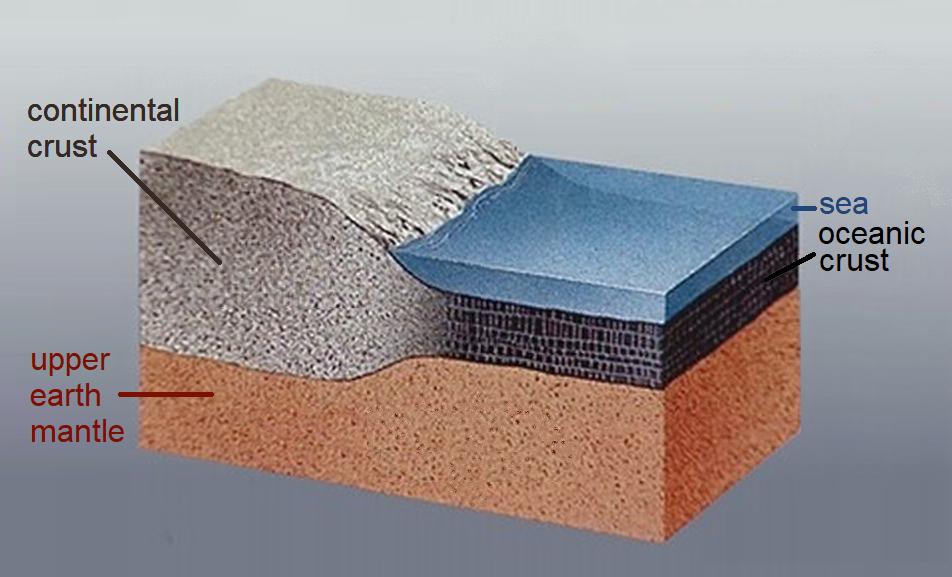
Continental crust is the layer of igneous, metamorphic, and sedimentary rocks that forms the geological continents and the areas of shallow seabed close to their shores, known as continental shelves. This layer is sometimes called sial because its bulk composition is richer in aluminium silicates (Al-Si) and has a lower density compared to the oceanic crust, called sima which is richer in magnesium silicate (Mg-Si) minerals. Changes in seismic wave velocities have shown that at a certain depth (the Conrad discontinuity), there is a reasonably sharp contrast between the more felsic upper continental crust and the lower continental crust, which is more mafic in character.
Most continental crust is dry land above sea level. However, 94% of the Zealandia continental crust region is submerged beneath the Pacific Ocean, with New Zealand constituting 93% of the above-water portion.
The continental crust consists of various layers, with a bulk composition that is intermediate (SiO2 wt% = 60.6). The average density of the continental crust is about 2.83 g/cm3 (0.102 lb/cu in), less dense than the ultramafic material that makes up the mantle, which has a density of around 3.3 g/cm3 (0.12 lb/cu in). Continental crust is also less dense than oceanic crust, whose density is about 2.9 g/cm3 (0.10 lb/cu in). At 25 to 70 km (16 to 43 mi) in thickness, continental crust is considerably thicker than oceanic crust, which has an average thickness of around 7 to 10 km (4.3 to 6.2 mi). Approximately 41% of Earth's surface area and about 70% of the volume of Earth's crust are continental crust.
Because the surface of continental crust mainly lies above sea level, its existence allowed land life to evolve from marine life. Its existence also provides broad expanses of shallow water known as epeiric seas and continental shelves where complex metazoan life could become established during early Paleozoic time, in what is now called the Cambrian explosion.
All continental crust is ultimately derived from mantle-derived melts (mainly basalt) through fractional differentiation of basaltic melt and the assimilation (remelting) of pre-existing continental crust. The relative contributions of these two processes in creating continental crust are debated, but fractional differentiation is thought to play the dominant role. These processes occur primarily at magmatic arcs associated with subduction.
There is little evidence of continental crust prior to 3.5 Ga. About 20% of the continental crust's current volume was formed by 3.0 Ga. There was relatively rapid development on shield areas consisting of continental crust between 3.0 and 2.5 Ga. During this time interval, about 60% of the continental crust's current volume was formed. The remaining 20% has formed during the last 2.5 Ga.
Proponents of a steady-state hypothesis argue that the total volume of continental crust has remained more or less the same after early rapid planetary differentiation of Earth and that presently found age distribution is just the result of the processes leading to the formation of cratons (the parts of the crust clustered in cratons being less likely to be reworked by plate tectonics). However, this is not generally accepted.
In contrast to the persistence of continental crust, the size, shape, and number of continents are constantly changing through geologic time. Different tracts rift apart, collide and recoalesce as part of a grand supercontinent cycle.
Hub AI
Continental crust AI simulator
(@Continental crust_simulator)
Continental crust
Continental crust is the layer of igneous, metamorphic, and sedimentary rocks that forms the geological continents and the areas of shallow seabed close to their shores, known as continental shelves. This layer is sometimes called sial because its bulk composition is richer in aluminium silicates (Al-Si) and has a lower density compared to the oceanic crust, called sima which is richer in magnesium silicate (Mg-Si) minerals. Changes in seismic wave velocities have shown that at a certain depth (the Conrad discontinuity), there is a reasonably sharp contrast between the more felsic upper continental crust and the lower continental crust, which is more mafic in character.
Most continental crust is dry land above sea level. However, 94% of the Zealandia continental crust region is submerged beneath the Pacific Ocean, with New Zealand constituting 93% of the above-water portion.
The continental crust consists of various layers, with a bulk composition that is intermediate (SiO2 wt% = 60.6). The average density of the continental crust is about 2.83 g/cm3 (0.102 lb/cu in), less dense than the ultramafic material that makes up the mantle, which has a density of around 3.3 g/cm3 (0.12 lb/cu in). Continental crust is also less dense than oceanic crust, whose density is about 2.9 g/cm3 (0.10 lb/cu in). At 25 to 70 km (16 to 43 mi) in thickness, continental crust is considerably thicker than oceanic crust, which has an average thickness of around 7 to 10 km (4.3 to 6.2 mi). Approximately 41% of Earth's surface area and about 70% of the volume of Earth's crust are continental crust.
Because the surface of continental crust mainly lies above sea level, its existence allowed land life to evolve from marine life. Its existence also provides broad expanses of shallow water known as epeiric seas and continental shelves where complex metazoan life could become established during early Paleozoic time, in what is now called the Cambrian explosion.
All continental crust is ultimately derived from mantle-derived melts (mainly basalt) through fractional differentiation of basaltic melt and the assimilation (remelting) of pre-existing continental crust. The relative contributions of these two processes in creating continental crust are debated, but fractional differentiation is thought to play the dominant role. These processes occur primarily at magmatic arcs associated with subduction.
There is little evidence of continental crust prior to 3.5 Ga. About 20% of the continental crust's current volume was formed by 3.0 Ga. There was relatively rapid development on shield areas consisting of continental crust between 3.0 and 2.5 Ga. During this time interval, about 60% of the continental crust's current volume was formed. The remaining 20% has formed during the last 2.5 Ga.
Proponents of a steady-state hypothesis argue that the total volume of continental crust has remained more or less the same after early rapid planetary differentiation of Earth and that presently found age distribution is just the result of the processes leading to the formation of cratons (the parts of the crust clustered in cratons being less likely to be reworked by plate tectonics). However, this is not generally accepted.
In contrast to the persistence of continental crust, the size, shape, and number of continents are constantly changing through geologic time. Different tracts rift apart, collide and recoalesce as part of a grand supercontinent cycle.
Recent media