Hubbry Logo
Andrew JohnsAndrew JohnsMain
Open search
Andrew Johns
Community hub
Andrew Johns
logo
8 pages, 0 posts
0 subscribers
Be the first to start a discussion here.
Andrew Johns
Andrew Johns
from Wikipedia

Andrew Gary Johns[3] (born 19 May 1974), also known by the nickname Joey, is an Australian former professional rugby league footballer who played in the 1990s and 2000s. He is considered one of the greatest rugby league players of all time.[4][5] Johns captained the Newcastle Knights in the National Rugby League and participated in the team's only two premiership victories in 1997 and 2001, playing a club record 249 games for the Knights. Johns also represented his country at two World Cups, and on one Kangaroo tour, playing in total 21 Test matches for the national side. He played in 23 State of Origin series matches for the New South Wales Blues (he captained the side to a series win in 2003, and shares a record 4 man-of-the-match awards for New South Wales players with Peter Sterling), and played for the Country Origin side in 1995 and 2003.[6]

Key Information

Johns announced his retirement from rugby league on 10 April 2007 at the age of 32. This followed a long run of injuries, the last of which was a bulging disc in his neck which forced his retirement due to the risk of serious spinal injury from further heavy contact.[7] Andrew Johns is one of only four players to have won the Golden Boot Award more than once and is one of only two players to have won the Dally M Medal for best player in the NRL three times. He finished his career as the highest points scorer in Australian first-grade premiership history with 2,176 points.

In 2008, less than a year into his retirement, Johns was named as the Greatest Player of the last 30 years[8] by the publication 'Rugby League Week', beating the likes of Queensland legend Wally Lewis (voted #2), fellow NSW star Brad Fittler (voted #3) and then former Queensland and Australian captain Darren Lockyer (voted #4). On 28 September 2012, Johns was named as the eighth 'Immortal' of rugby league.[9]

Football career

[edit]

Early days

[edit]

Andrew Johns began playing junior rugby league in his home town of Cessnock, New South Wales for the Cessnock Goannas.

Four years later, at 19, the opportunity at first grade presented itself as Johns was tested off the bench during the 1993 season in a handful of games. The following year in the last pre-season trial for the 1994 season, Matthew Rodwell, Newcastle's then-regular halfback sustained a knee injury handing Johns his opportunity.[citation needed]

Subsequently, he was named in the starting line-up against the South Sydney Rabbitohs and in his début match made an immediate impact as he amassed 23 points and won the Man of the Match award. He soon formed a winning partnership with his older brother, Matthew, who had played five-eighth at the Knights since 1991.

1995–2001

[edit]

The 1995 ARL season saw prosperous times for Johns, as in the absence of Super League-aligned players, he was selected for the first time to represent New South Wales in the 1995 State of Origin series. Incumbent New South Wales halfback Ricky Stuart was not selected due to his affiliation with Super League. Also that year he was able to make his début for the Kangaroos in Australia's successful 1995 World Cup campaign in England. He played as a hooker and was named man of the match in the decider against England at Wembley Stadium as Australia once again retained the World Cup.[10]

At the conclusion of the World Cup, Johns was awarded his first significant accolade, being named Most Valuable Player of the tournament. The following year Johns was moved to hooker for the State of Origin, with New South Wales selectors favouring Geoff Toovey in the halfback role.[citation needed] Since then, Johns was regularly chosen for state and national representative sides when fit, only missing out on a Blues or Australian cap due to injury.

During the 1997 ARL season Johns played a pivotal role in guiding the Knights to their first grand final appearance—against defending champions and '97 minor premiers the Manly Warringah Sea Eagles. There were grave concerns leading up to the match that Johns would be unable to play the game, as he had suffered three broken ribs and a punctured lung only a fortnight earlier. However, Johns was able to play, and with less than a minute of the match to go with scores tied at 16-all Johns made a play that has gone down in rugby league folklore. He went out of position unexpectedly and into dummy half where he ran down a narrow blind side before slipping a pass to Newcastle wing Darren Albert for the match-winning try. With only six seconds remaining in the game Newcastle had snatched victory and secured their first premiership title.[11]

The following year in the new National Rugby League the Knights performed even better during the regular season than in the previous year, losing only five matches and narrowly missing out on the minor premiership on points difference. Johns individually was brilliant and was awarded his first Player of the Year Dally M Medal award for the 1998 season. Unfortunately for Johns and NSW fans, he had one of his worst goal-kicking games in Game 1 of the 1998 State of Origin series as NSW lost by one point despite scoring more tries than Queensland. His performances at club, state and national level were again rewarded as he received his second Player of the Year Dally M Medal award, the first time a player had won the award consecutively since Parramatta Eels great Michael Cronin in 1977 and 1978.

Despite initial concerns regarding the leadership of the Knights after the retirement of Paul Harragon, and even more when Andrew's brother Matthew joined English Super League club the Wigan Warriors, Johns was given the responsibility of captaining the Newcastle squad. The fears proved groundless: Johns led Newcastle to another Grand Final victory, defeating the Parramatta Eels 30–24 in 2001. He was awarded the Clive Churchill Medal for Man of the Match in a Grand Final and at the end of the 2001 NRL season, he went on the 2001 Kangaroo tour. He was the top points scorer in Australia's successful Ashes series campaign and was named man of the match for the second Test. Also that year he was awarded the Australian Sports Medal for his contribution to Australia's international standing in the sport of rugby league.[12]

2002–2005

[edit]

Having won the 2001 NRL Premiership, the Knights travelled to England to play the 2002 World Club Challenge against Super League champions the Bradford Bulls. Johns captained as a halfback, scoring a try and kicking three goals in Newcastle's loss. In 2002, Johns was awarded the captaincy of both New South Wales and Australia, going on to win the title of Player of the Series against Great Britain. At a club level Andrew Johns and the Newcastle Knights performed well, narrowly missing out on the minor premiership on points difference. Unfortunately, the Knights' finals campaign derailed as Johns broke a bone in his back in the first week of the finals[citation needed], and the Knights without Johns ended up losing to eventual premiers the Sydney Roosters 38–12 to be knocked out of the season. Before his injury Johns' season had been marvellous and despite his lack of involvement in the finals series he was named the Player of the Year Dally M Medal for a record third time, a feat achieved by only one other player, Johnathan Thurston, to date.

Johns' back injury at the tail-end of 2002 was the first of what seemed like a plague of injuries over the next few seasons: he had a serious neck injury that threatened his career in 2003, sustained an anterior cruciate ligament (ACL) knee injury which kept him out of most of the 2004 season, and broke his jaw in early 2005.[citation needed]

During the 2003 Rugby Union World Cup, Wales assistant coach Scott Johnson got Johns to assist with pre-match preparation by speaking to the players and presenting them with their jerseys.[13]

Johns was the centre of controversy in 2004 after receiving a massive offer from rugby union to switch codes.[citation needed] Numerous past legends of both codes expressed their opinions. Debate continues about what happened during the negotiations with rugby union, since the contractual offers were made by the Waratahs without the salary top-ups from the Australian Rugby Union that had been usual in contractual negotiations with previous potential converts from rugby league. The ARU's formal reasons for not supporting the Waratahs' bid to secure Johns were his age (30) and injury history. These were later retracted after the "ecstasy controversy" (see below).[14]

Even without the additional monetary support from the ARU, the Waratahs were able to table an offer to Johns that was far larger than any rugby league club could offer on its own. After David Gallop, the CEO of the NRL and Channel Nine contributed money and a promise of a commentary position after his career ended, Johns finally decided to stay in league, ending months of speculation and debate.[citation needed] He says his decision was greatly affected by his son, who wanted him to stay in league. He was also approached by the Welsh Rugby Union because of his Welsh heritage.[15]

As Game 2 of the 2005 State of Origin series approached, the Blues were down 0–1 and Johns was selected to replace Brett Kimmorley in the New South Wales squad. The second game in the series was his first match since returning from a series of injuries that sidelined him for a number of weeks. Johns did not have to struggle to regain his form, receiving Man-of-the-Match honours in the Blues' 32–22 win over Queensland. He was again chosen as the first-choice halfback for Game 3 and performed well, sealing the series for the Blues with a strong 32–10 win, their last series win for quite some time.

In August 2005, it was announced that Johns would join the Super League side the Warrington Wolves on a short-term deal, playing in the final two games of the regular Super League season and any playoff games the Wolves might reach.[citation needed] The Knights agreed to these terms only after Johns first signed a new contract, making him available to captain the Knights until the end of 2008.

2006–2007

[edit]

Andrew Johns broke one of the longest-standing records in Round 2 of the 2006 season as he amassed 30 points against the Canberra Raiders and in doing so claimed the points-scoring record for a player at a single club, surpassing Mick Cronin's 1,971 points for Parramatta.

Back in the NRL, playing for Newcastle during a Round 18 match against the Parramatta Eels, Johns' name entered the NRL record books for the second time in the year. A Johns conversion of a Newcastle try made Johns the highest points scorer in the 98-year history of first-grade rugby league in Australia, eclipsing Jason Taylor's previous record of 2,107 points. He rather coincidentally scored the record-breaking conversion in a 46–12 loss to the Eels, who were coached at the time by Jason Taylor.

Things did not start well for Johns in the 2007 season as he lasted only four minutes into Round 1. As Canterbury Bulldogs forward Sonny Bill Williams went to perform one of his trade-mark hits on Johns, the tackle strayed high leaving Johns lying concussed.[citation needed] Williams pleaded guilty at the judiciary to a reckless high tackle, and received a two-week suspension for the hit.[citation needed] Johns missed the following match but returned in Round 3 against the Canberra Raiders—which would be his last career match in the NRL. On the Thursday after the Canberra match, a tackle with Newcastle teammate Adam Woolnough in a training session resulted in his referral to a specialist to examine a neck injury.[citation needed] It was revealed that Johns had a bulging disc in his neck. It was confirmed that this had been present for some time and was not related to the training incident. All medical advice was that Johns should retire from professional football, since any further neck injury could prove life-threatening and on 10 April 2007, Johns announced his retirement from rugby league.[citation needed]

The Newcastle Knights' season would fall apart: they finished 15th of 16 teams on the ladder, narrowly missing out on the Wooden Spoon with a narrow two-point victory in their last match of the season. Johns tried to soften the blow of his retirement by saying he had been seriously considering retirement at the end of the 2007 season and was quoted in the press as saying "I knew this year would be my last year, it's just unfortunate it's stopped five months before the end of the season." Commenting on his teammates' reaction to his retirement, Johns noted: "They were sort of relieved I think, after a couple of injuries this year ... I think the time's right."[16]

On his retirement a chorus of past league greats called for Johns to be immediately honoured as an immortal of the game. In the preceding 13 years, the former Cessnock junior had changed the game like few others before him. In October 2008 Johns completed a walk from Newcastle to Sydney to raise funds for the Black Dog Institute.

Cricket career

[edit]
Cricket information
BattingRight-handed
BowlingRight-arm off break
Domestic team information
YearsTeam
2006/07New South Wales
Career statistics
Competition Twenty20
Matches 2
Runs scored 9
Batting average 9.00
100s/50s 0
Top score 9
Balls bowled 6
Wickets 0
Bowling average -
5 wickets in innings
10 wickets in match
Best bowling 0/9
Catches/stumpings 0/0
Source: Cricinfo, 6 Jan 2025

In June 2006 it was announced that, while still playing rugby league, Johns would play cricket for New South Wales, in its Twenty20 series.[17] The announcement sparked much media interest and many critics and the public suspected a public relations stunt as his first match was to be played in Johns' home town of Newcastle. Despite this, Johns made his professional cricket debut for NSW on 7 January 2007 against South Australia in front of a record crowd at Newcastle Number 1 Sports Ground. He had a missed opportunity to take a wicket: a short-pitched delivery was pulled to the boundary but much to the dismay of the large Newcastle crowd, the catch was put down.[18] In his second match, against Tasmania at Stadium Australia in Sydney, Johns scored only nine runs and with that his short cricket career was over.

After retirement

[edit]
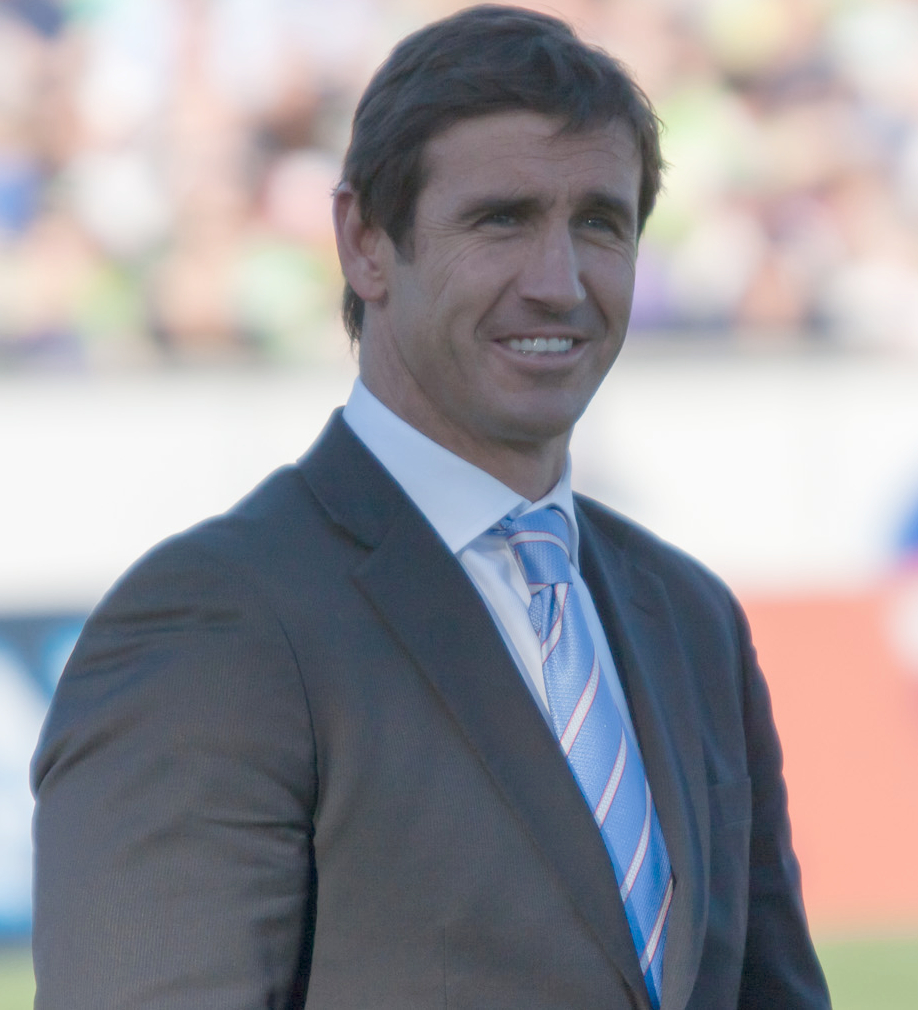
Johns in 2011

Johns sought to celebrate the inclusion of Australia's Dally Messenger in the original All Golds tour, Johns had been invited to join the New Zealand team for the match against the Northern Union.[19] Despite his neck injury, he was able to play with the squad, and completed the match uninjured, but declined another offer from the New Zealand team.[20] Queensland and Australia five-eighth Darren Lockyer was invited to take Johns' place[21] but then Lockyer himself was ruled out after suffering a season-ending knee injury.[22] New Zealand Warriors captain and Queensland front rower Steve Price was the eventual replacement for the match. Andrew became a commentator for Channel 9 and Monday Night Football on Triple M radio.

On 22 April in Round 6 of 2007, Newcastle held special farewell celebrations for Andrew Johns in the Knights' home game against Brisbane. The Knights board renamed the new $30 million East grandstand of EnergyAustralia Stadium the Andrew Johns Stand. In addition, in a first for the NRL, his number 7 jersey was retired for the match with new young halfback Jarrod Mullen wearing number 18.[23] Later in the year the Knights named Johns as halfback and captain for their commemorative Team of the Era.

In June 2007, in what would be the first of his involvements as a specialist part-time coach, rival code the Australian Rugby Union hired Johns as the Wallabies in-play kicking coach for the duration of the 2007 Tri Nations Series. On 27 October 2007, Johns married his partner Cathrine Mahoney in a secret wedding on a Sydney island.[citation needed] When Johns returned from his honeymoon at the beginning of the 2008 Pre-season, he began a part-time coaching role with the Parramatta Eels, working one on one with Eels halves Brett Finch and Tim Smith. In the same time frame Johns worked with his old club the Newcastle Knights in a similar skills specific coaching role. The third club to hire Johns for his coaching services was the Canterbury-Bankstown Bulldogs, who signed Johns for the 2008 season. The role involved him in specifically working with the halves, hookers and backs.[citation needed]

In February 2008, a year after his retirement, Johns moved a step closer to becoming rugby league's next Immortal after being named the Best Player of the Last 30 Years by a major rugby league magazine. On 17 April 2008 he was named in Team of the Century as a halfback by a 28-man judging panel, who voted in a secret ballot and chose the team from an original list of the 100 Greatest Players named earlier in the year. Later, Johns said he felt "the game has forgiven me". On 9 September 2008 at the Dally M awards in Sydney, Johns and his wife Cathrine announced they were expecting their first child in March 2009 (Johns has a son from his previous marriage).[24] On 1 March 2009, Johns and Cathrine welcomed their first child and son, Louis Byron[24]

In 2010 the Melbourne Rebels announced they had secured the services of Johns to work with the Super Rugby club's inside backs.[25] Recent Rebels signing James O'Connor said "Obviously he comes from a league background but there was nobody better at taking the ball to the line and pulling those balls back ... the chance to work with him was pretty awesome."[26]

Despite Johns' ecstasy use controversy, he was officially announced as the eighth 'Immortal' of the game on 28 September 2012, after Rugby League Week magazine stated the voting criteria were to be based solely on a player's "on field performance" (despite admitting to using ecstasy while playing).[27][28] In early November 2012, Johns signed on as assistant coach of the Manly Warringah Sea Eagles for the 2013 Rugby League season, mentoring and ambassadorial roles.[29]

Ecstasy use controversy

[edit]

On 26 August 2007, Johns was arrested for fare evasion on the London Underground, and subsequently found to be in possession of one ecstasy tablet. He was cautioned and released with no further charges. Johns initially claimed that an unknown person had pushed the tablet into his pocket which he later forgot to remove before leaving the crowded venue.[30] This initial statement was met with a great deal of cynicism from both the press and the public. On 30 August, Johns revealed, live on the Footy Show, that he had regularly taken ecstasy throughout his playing career, mainly during the off-season. He claimed he had suffered from depression and bipolar disorder and the drugs helped him in dealing with the high level of psychological 'pressure' associated with his career as an elite sportsman.[31] Not long after the incident he released his 'tell-all' autobiography that went into further details regarding his depression and drug use while playing in the NRL.

The ARU released a press statement shortly after the controversy arose, stating that Johns' drug use was known to the ARU and was a key factor in its decision not to proceed with contractual negotiations in 2004. Brett Robinson, then high-performance unit manager, said that, as well as Johns' age and injury history, the knowledge of his drug taking had been influential in the ARU making its final decision.[14]

Racism controversy

[edit]

In June 2010, during the lead-up to Origin II, New South Wales centre Timana Tahu withdrew mid-week from the NSW squad following reports Johns referred to Queensland player Greg Inglis as a "black c*nt" during a training session.[32] Johns was subsequently fired from his role as NSW assistant coach. Though he apologised for the incident on Tuesday 15 June,[33] it is alleged it was not the first time Johns had used racist language in a football environment.[34] Inglis demanded Johns be barred from any involvement in rugby league.[35]

More Joyous Scandal

[edit]

Johns was the catalyst to the More Joyous Scandal, engulfing leading Sydney horse trainer Gai Waterhouse, advertising figure John Singleton (racehorse More Joyous's owner) and bookmaker and son of the horse trainer Tom Waterhouse. Johns passed information from Tom Waterhouse that horse More Joyous was "off" on to brothel owner Eddie Hayson and former jockey Allan Robinson. Singleton received word of this and verbally attacked Gai Waterhouse on live television. Johns feared his Channel 9 commentating career would be over due to the trouble he caused Tom Waterhouse, a Channel 9 advertiser. Johns's commentating career survived, although his reputation was further damaged. Both Waterhouses were cleared of any major wrongdoing by a Racing NSW inquiry, however, Singleton and Gai's longstanding partnership ceased[36] until 2016.[37] On 28 September 2023, it was announced that Johns would be stepping down from his role within the New South Wales coaching staff after the NSWRL board informed him his contract would not be renewed after another series loss.[38]

Epilepsy

[edit]

In 2019, Johns revealed that he had been diagnosed with epilepsy. His doctors were of the view that his playing career could have contributed to the diagnosis. In an interview with his brother, Matthew Johns on Fox League on Sunday night,[when?] he said, “They think maybe a contributor could be some of the concussions I’ve had and ... continual head knocks”.[39] Johns lost his driver licence after suffering an epileptic seizure at a cafe in Yamba on the New South Wales north coast in December 2018.[40] The Roads and Maritime Service (RMS) initially refused to return his licence but later did so on appeal.[citation needed]

Live State of Origin rant

[edit]

Following the NSW loss to QLD in game 3 of the 2022 State of Origin series, resulting in a QLD series win, Johns was visibly upset while part of a commentary panel during the family friendly Channel 9 live broadcast. In an incident after the game, in which media speculated at the time might have been his unofficial resignation, Johns made the out of context statement in response to a question about the game, “Now we have to listen to all the bullshit from you (Queenslanders) in the next 12 months. It drives you mad.”[41]

Business life

[edit]

Johns is founder and co-owner of Steel City Beer Company with Matthew Johns, Danny Buderus, Kurt Gidley and Matt Hoy.[42][43]

Career statistics

[edit]

Club career

[edit]
Team Matches Tries Goals Field Goals Points
Newcastle Knights 1993–2007 249 80 917 22 2,176
Warrington Wolves 2005 4 1 12 1 29

Representative career

[edit]
Team Matches Tries Goals Field Goals Points
Country Origin 1995–1996, 2003 3 1 7 0 18
New South Wales 1995–2000, 2002–2003, 2005 23 4 37 4 94
Australia 1995–2003, 2005–2006 27 12 90 0 228

Achievements, awards and accolades

[edit]

In February 2008, Johns was named in the list of Australia's 100 Greatest Players (1908–2007) which was commissioned by the NRL and ARL to celebrate the code's centenary year in Australia.[44][45] Johns went on to be named as halfback in Australian rugby league's Team of the Century. Announced on 17 April 2008, the team is the panel's majority choice for each of the thirteen starting positions and four interchange players.[46][47] In 2008 New South Wales announced their rugby league team of the century also and Johns was again named as a halfback.[48]

Newcastle Knights records

[edit]
  • Most points in a match: 34 (v Canberra, 29 July 2001)
  • Most goals in a match: 11 (v Canberra, 19 March 2006)
  • Most points in a season: 279 (2001 National Rugby League Season)
  • Most points for the club: 2,176

Australian premiership records

[edit]
  • Retired as highest individual point scorer in premiership history: 2,176 (eclipsing Jason Taylor's previous record of 2,107; now 4th).
  • The competition's leading point scorer in 2001: 279 points.
  • Most ever points scored by a halfback in a single National Rugby League season (279 in 2001).

International records

[edit]
  • Most points scored on international debut: 30 (v South Africa at the 1995 World Cup)
  • Most points scored in a test match: 32 (v Fiji in 1996)
  • Most goals in a test match: 12 (v Fiji in 1996)

Awards

[edit]

See also

[edit]

References

[edit]

Further reading

[edit]
[edit]
Revisions and contributorsEdit on WikipediaRead on Wikipedia
from Grokipedia

Andrew Gary Johns (born 19 May 1974), commonly known as Joey, is an Australian former professional footballer who played primarily as a halfback for the in the (NRL) from 1993 to 2007.
Johns amassed 249 first-grade appearances for the Knights, scoring 80 tries, 917 goals, and 22 field goals, while captaining the club to premiership victories in 1997 and 2001.
He earned three Dally M Player of the Year awards in 1998, 1999, and 2002, and was inducted as the eighth Immortal in the NRL Hall of Fame in 2012, recognizing his status as one of the sport's all-time greats due to his innovative playmaking, kicking accuracy, and game management.
Johns represented in 23 matches and in 21 Test matches, contributing to multiple series wins.
Post-retirement, he has worked as a television commentator and authored an autobiography detailing his career alongside personal struggles with addiction to , which led to a temporary retirement in 2005 and shaped his public persona as candid and resilient.

Early life and background

Family and upbringing

Andrew Johns was born on 19 May 1974 in Cessnock, New South Wales, Australia. He grew up in the working-class coal-mining town of Cessnock in the Hunter Valley region, remaining there until age 19. Johns was raised alongside his older brother Matthew Johns, born 27 July 1971, who later pursued a professional rugby league career as a five-eighth, and younger sister Kate. The family environment emphasized rugby league, with Johns initially playing soccer for St Joseph's before transitioning to the sport at St Patrick's Primary School and local junior clubs like the Cessnock Goannas. His early exposure reflected the region's strong rugby league culture, where the sport served as a prominent community and family pursuit.

Junior rugby league development

Andrew Johns developed his rugby league abilities in the junior competitions of , where he was born on 19 May 1974. Initially involved in soccer with St Joseph's, he switched to and played through St Patrick's Minor League before aligning with the Cessnock Leagues Club, representing the Cessnock Goannas in local group matches. His early exposure emphasized grassroots development in the Hunter Valley region, without notable interstate relocation until joining the ' system at age 19. Johns' junior pathway reflected the ' reliance on regional talent pools, following his older brother Matthew into the club's development pipeline. He did not feature in high-profile underage representative sides but demonstrated proficiency as a halfback in club fixtures, leading to a reserve-grade stint before first-grade selection in 1993. This direct progression from Cessnock juniors to NRL debut underscored the efficacy of localized scouting in the pre-NRL era, where 75% of Knights players often originated from Hunter districts.

Rugby league playing career

Club career with Newcastle Knights

Andrew Johns commenced his first-grade career with the in 1993, following in the footsteps of his brother Matthew who had debuted the previous year. Playing primarily as a halfback, Johns quickly demonstrated exceptional skill, scoring a club-record 23 points in his initial full first-grade appearance against South Sydney in 1994—a mark he later surpassed. His early contributions helped establish the Knights as competitive contenders in the Australian Rugby League and subsequent competitions. Johns played a pivotal role in the Knights' maiden premiership victory in 1997, contributing decisively in the grand final against the Manly-Warringah Sea Eagles. The team repeated this success in 2001 under his leadership following the retirement of long-time captain in 1999, securing the club's only two championships to date. During this period of dominance from 1995 to 2001, Johns earned multiple individual accolades, including Dally M Medals, underscoring his influence on the club's attacking prowess and game management. Assuming full captaincy responsibilities around 2000, Johns guided through sustained contention in the early 2000s, highlighted by record-setting performances such as 34 points in a single match against on 29 July 2001. His tenure as skipper emphasized tactical acumen and resilience, though mounting injuries began to impact availability from 2002 onward. Persistent physical tolls, including a bulging disc in his neck, culminated in Johns' retirement announcement on 10 April 2007 at age 32, after 15 seasons and 249 appearances exclusively with . Across his club career, he amassed 80 tries, 917 goals, 22 field goals, and 2,176 points, cementing records like the most goals in a match (11 against on 19 March 2006). This output not only propelled team successes but also defined Johns as the Knights' highest career point-scorer.

Debut and early seasons (1993–1994)

Andrew Johns made his first-grade debut for the in 1993, following in the footsteps of his older brother Matthew, who had already established himself in the team's backline. Johns appeared in three matches off the bench that season, primarily as a , including a game on 17 April 1993 against the Gold Coast Seagulls at Seagulls Stadium in Tweed Heads, where he initially filled in at fullback. These limited appearances provided early exposure but did not yet showcase his halfback potential, with no recorded tries or goals in those outings. In 1994, Johns secured a starting role at halfback, making his run-on debut on 13 March against at Marathon Stadium. In that match, he scored two tries and kicked seven goals, amassing a club-record 23 points in a 43–14 victory, earning man-of-the-match honors. This performance marked the beginning of a pivotal halves with , contributing to the Knights' improved form early in the season and signaling Andrew's rapid emergence as a key . Over the 1994 season, Johns featured in multiple games, building on his debut explosiveness to help solidify Newcastle's backline attack.

Breakthrough and premiership successes (1995–2001)

In 1995, Andrew Johns experienced a breakthrough season at age 20, earning selection for the New South Wales State of Origin team for Game 1 on May 23, where he debuted alongside his brother Matthew in a 16-12 loss to Queensland. He also received his first Australian Test call-up that year, marking his rapid ascent as a premier halfback. For the Newcastle Knights, Johns contributed to a strong campaign that saw the club reach the semi-finals, building on his earlier seasons to establish himself as a key orchestrator. Johns' form propelled the Knights to their maiden premiership in 1997, defeating Manly-Warringah Sea Eagles 22-16 in the ARL on September 28 at the Sydney Football Stadium. Despite playing with fractured ribs from earlier playoffs, Johns delivered crucial plays, including the match-winning sequence where his short pass set up winger Darren Albert's famous try in the 94th minute. The victory came amid the schism, with the Knights loyal to the ARL, and highlighted Johns' resilience and playmaking under pressure. Following the unification into the NRL in 1998, Johns dominated individually, winning back-to-back Dally M Medals as the competition's best player in 1998 and 1999, while guiding to consistent appearances. His vision, kicking game, and leadership solidified his status as one of the game's elite halfbacks during this period. After assuming the captaincy following Paul Harragon's retirement in 1999, Johns led the team to their second premiership in 2001, triumphing 30-24 over in the on September 30 at . He earned the as man of the match for his commanding performance, including precise goal-kicking and game-managing that steered the comeback from a deficit. This success capped a six-year span of elevation from emerging talent to championship leader for Johns and .

Captaincy and individual dominance (2002–2005)

In 2002, Johns captained the to a second-place finish on the NRL ladder, compiling a regular-season record that secured their spot in the finals series. His commanding presence as halfback, characterized by precise playmaking and goal-kicking, earned him the as the competition's premier player for the third time in his career, along with the Dally M Halfback of the Year award. The Knights advanced through the qualifying final against St. George Illawarra but were eliminated in subsequent playoff matches, underscoring Johns' influence amid a competitive field. The 2003 season saw the Knights drop to seventh on the ladder, hampered by broader NRL industrial action that resulted in no Dally M awards being presented. Johns remained a pivotal leader and performer for the club, directing the team's attack despite the disruptions and maintaining his status as one of the league's elite halfbacks. By 2004, with the Knights finishing tenth and missing , Johns continued to captain a side reliant on his experience and skill, even as teammate Danny Buderus claimed the . In 2005, amid emerging injury concerns, he sustained his individual excellence, contributing significantly to the team's efforts before transitioning toward the later stages of his club tenure. Throughout this period, Johns' captaincy exemplified resilience, with his on-field dominance—evident in consistent try assists, field goals, and points accumulation—anchoring the Knights' campaigns despite fluctuating team results.

Injury-plagued final years and retirement (2006–2007)

In 2006, Johns continued as captain of the but was hampered by recurring injuries that limited his consistency. Early in the season, on April 1, he withdrew from a match against the due to a neck strain sustained during a mid-week weights session, which prevented him from training. Shortly after, on April 7, he faced another injury concern during club activities, raising doubts about his availability. Later, in April 16, Johns rolled his ankle during a game but continued playing before exiting on crutches, exemplifying his determination amid physical toll. By July, he sustained a in consecutive matches, requiring tests for clearance before returning. Entering the , Johns aimed to extend his career but managed only two appearances amid ongoing physical decline. On April 5, during a session, he collided with a teammate, exacerbating a pre-existing condition and revealing a bulging disc that posed a high of permanent spinal or if he continued playing. Medical specialists advised immediate cessation, leading Johns to announce his retirement on April 10, 2007, at age 32, effectively ending a career marked by persistent injuries in its latter stages, including prior issues, a broken in 2005, and and back problems. The decision was described by Johns as leaving him feeling "numb," reflecting the abrupt close to his tenure with the Knights after 249 first-grade games for the club.

State of Origin representation

Andrew Johns represented in 23 matches from 1995 to 2005, establishing himself as one of the competition's premier halfbacks through his tactical acumen, kicking precision, and playmaking ability. He debuted in Game 1 of the 1995 series on May 23 at the Sydney Football Stadium, aged 20, in a 16-22 loss to , marking the start of a career where he scored 4 tries, 38 goals, 4 field goals, and 96 points overall. Early in his Origin tenure, Johns featured in all three games of the 1995, 1996, and 1997 series, contributing to NSW's efforts amid dominance, including a man-of-the-match performance in Game 2 of 1996, where his 2 goals and general helped secure a 20-14 victory. He sat out the 1998 series due to club commitments but returned strongly, playing key roles in the 1999 and 2000 deciders, though NSW lost four straight series from 1995 to 1998 and struggled thereafter until his leadership era. Johns assumed the NSW captaincy in 2002, leading the Blues to a drawn series (12-12 in Game 1, 22-18 win in Game 2, 18-6 loss in Game 3). Under his captaincy in 2003, NSW clinched a 2-1 series win—their first since 1994—with Johns earning man-of-the-match in Game 2 for his commanding display in a 27-4 rout at , featuring precise kicking and defensive organization that limited to minimal possession. An sidelined him for the entire 2004 series, which won 2-1. He returned as for the 2005 series, delivering man-of-the-match efforts in Games 2 and 3, including a masterful Game 2 performance on July 6—scoring 10 points via a try, 3 goals, and a in a 10-0 —widely regarded as among the finest individual Origin displays for its control of tempo and breakdown dominance despite personal off-field challenges. Johns shares the record for most man-of-the-match awards in Origin history with four, underscoring his consistent impact in high-stakes games. His 23 appearances rank among NSW's elite, with contributions pivotal to five series victories during his era, though Queensland's overall supremacy limited team successes.

International career

Johns made his debut for the national team, known as the , during the against on 26 October 1995 at Sydney Football Stadium, scoring a debut-record 30 points through two tries and eleven goals in an 86–6 victory. won the , defeating 8–4 in the final on 28 October 1995 at , with Johns appearing in multiple matches including the semi-final against . Primarily deployed as a hooker in Tests despite his club halfback role, Johns featured in the 1998 Anzac Test against (a 34–22 win) and the 1999 Anzac Test (a 24–22 loss), marking rare international outings at halfback. Johns represented in the 2000 World Cup, contributing to their 46–2 final victory over on 27 November 2000 at , securing a second title in six years. He participated in the 2001 Ashes series against , earning player-of-the-series honors in 2002 for his pivotal role in a 3–0 despite playing amid injury concerns. Johns toured with the in 2001, playing in matches and midweek fixtures, and captained the side in two Tests during his career. His final appearance came in the 2006 Anzac Test against on 5 May 2006, a 50–10 win at Suncorp Stadium. In total, Johns played 26 Tests for between 1995 and 2006, scoring 12 tries and kicking 89 goals for 226 points, with a career Test win rate exceeding 85 percent. His international contributions earned him the International Federation's Golden Boot award as world player of the year in 1999 and 2001.

Other sporting pursuits

Cricket involvement

In June 2006, announced that Andrew Johns, then an active player for the , would join the state's squad for the 2006–07 competition, marking a rare cross-code crossover aimed at generating publicity and increasing attendance for the emerging format. Johns debuted on 7 January 2007 against at Newcastle No. 1 Sportsground, drawing a record crowd of 22,198 spectators to the domestic T20 fixture. Batting right-handed, he did not come to the crease as fell short by eight runs in pursuit of 166, but he bowled one over of off-spin medium pace, conceding 9 runs without taking a . Three days later, on 10 January 2007, Johns played his second and final match against at the , where he scored 9 runs off 7 balls in a lower-order cameo during ' innings. He did not bowl in this game, and lost by 37 runs. Across his two T20 appearances for , Johns recorded a of 9.00 from 9 runs scored, with no boundaries, and bowling figures of 0/9 from one over. The stint concluded his brief foray into professional , undertaken amid his rugby league career's injury challenges and just months before his NRL retirement announcement in March 2007; it highlighted early efforts to leverage celebrity athletes for T20's growth in but yielded no further involvement.

Post-retirement professional activities

Media commentary and analysis

Following his retirement from playing in 2007, Andrew Johns entered media commentary, leveraging his expertise as a two-time NRL premiership winner and standout to provide tactical breakdowns and player evaluations for major Australian broadcasters. He joined Channel Nine as a analyst, contributing to NRL coverage and telecasts, where his insights often focused on game strategy, such as defensive resets and player selection dilemmas. Johns also co-hosts the Immortal Behaviour podcast and segments on Nine, dissecting post-match performances, as seen in his 2025 analysis of ' Origin Game III shortcomings, emphasizing execution failures over preparation. Johns' commentary style emphasizes first-hand experience, frequently critiquing player effort and coaching decisions with directness; for instance, in July 2025, he questioned the "desire" of players following a 2-1 series loss to , attributing the defeat to lapses in intensity rather than structural issues. His analysis has influenced debates on eligibility rules, warning in April 2025 that unresolved residency criteria could dilute Origin quality by favoring second-tier imports over domestic talent developed through club systems. Such views, drawn from his 15 Origin appearances, prioritize merit-based selection, contrasting with broader league expansions. Reception of Johns' work varies, with praise for his authoritative breakdowns—rooted in achievements like the 2005 Golden Boot and two World Cups—but criticism for occasional disengagement or overly passionate reactions. In Game 1 of the 2025 Origin series, fans and media highlighted an awkward on-air exchange with colleagues, exemplifying perceived lulls in Channel Nine's broadcast energy amid broader scrutiny of veteran analysts like Johns and . Earlier incidents, including a 2022 post-match outburst after ' decider loss and a mid-game in April 2025 against Wests Tigers' coverage, underscore his emotional investment, which some viewers interpret as authentic while others see as detracting from professional delivery. Despite this, his role persists, with Nine valuing his predictive accuracy, as in calls to bench underperformers like for Origin II in May 2025 based on form metrics.

Coaching and advisory roles

In October 2021, Johns joined the as a specialist coaching consultant, providing expertise on game strategy and player development, particularly for halves positions, amid the club's efforts to rebuild following internal challenges. His involvement included sessions with junior players, such as halfback , where he emphasized tactical decision-making drawn from his playing career. In July 2022, the Knights extended his consultancy contract through the , allowing continued input on training and match preparation under head coach Adam O'Brien. Johns has also contributed to representative teams in advisory capacities. In May 2018, he assisted the Blues squad during training camp preparations, offering insights on playmaking and team dynamics as an informal assistant. More recently, in October 2025, Johns coached academy players from the during their Australian tour, focusing on skill development for emerging English talent ahead of international series like , while expressing no interest in a full-time head coaching role abroad. Despite speculation about potential head coaching positions, including with and , Johns has repeatedly declined interest, citing commitments to media analysis and concerns over the pressures of full-time coaching. His advisory work remains selective, prioritizing short-term consultations over sustained team leadership.

Business investments

Andrew Johns has participated in real estate transactions that reflect personal investment decisions. In the early , he sold his beachfront residence in Merewether, Newcastle, to mining entrepreneur for $4.3 million. In May 2016, Johns acquired a $2.8 million property in Bronte, , which he described as a rejuvenating retreat following personal challenges. These dealings align with patterns among retired athletes leveraging accumulated earnings into property holdings, though specific details on commercial yields or portfolio scale remain undisclosed in public records.

Personal life

Relationships and family

Andrew Johns was born in Cessnock, New South Wales, to parents Gary and Carol Johns, growing up alongside his older brother , a fellow player and media personality, and younger sister Kate. The brothers' competitive sibling dynamic influenced their early rugby involvement, with Matthew often mentoring Andrew before both pursued professional careers. Johns' first marriage was to Renae Chapman in the early , ending in in 2002 after two years; the couple shares a son, Andrew Jr., born around 2000. He married Cathrine Mahoney in 2007, following their meeting in 2002; they separated in 2011, briefly reconciled, and divorced permanently in 2014, sharing custody of their son Louis, born March 2009. Mahoney has publicly described their post- co-parenting as effective and amicable. In subsequent years, Johns began a relationship with yoga instructor Kate Kendall, with whom he has a daughter born around 2019. The couple married in a private ceremony in Bali on November 23, 2024, attended by a small number of guests. Johns has three children in total and resides primarily in Sydney, balancing family commitments with his media work.

Health challenges

Johns retired from professional rugby league on April 10, 2007, at the age of 32, following medical advice due to a recurring bulging disc in his neck, which had initially surfaced in 2003 and posed a risk of life-threatening injury if he continued playing. The injury stemmed from cumulative physical trauma during his career with the Newcastle Knights, contributing to permanent nerve damage that affected his daily life post-retirement. He also sustained other significant injuries, including multiple concussions, a torn anterior cruciate ligament (ACL), and chronic pain exacerbated by these conditions. Throughout his 14-year NRL career, Johns endured repeated head knocks, which his doctor later linked to the onset of seizures beginning in 2016. The first notable seizure occurred while he was commentating an NRL finals game, with subsequent episodes, including one during a family holiday in Yamba in late 2018, prompting neurological treatment and a formal epilepsy diagnosis in 2019. To manage both chronic pain from his injuries and seizure activity, Johns began using medicinal cannabis around 2018, reporting marked improvement in his symptoms after traditional painkillers and anti-inflammatories caused side effects like ulcers. In addition to physical ailments, Johns has publicly discussed struggles, including periods of depression described as "dark places" as early as 2008, amid concerns over pressures on athletes. In a 2019 interview with his brother Matty Johns, he disclosed a diagnosis, detailing ongoing battles with mood instability that compounded his post-career challenges. These revelations highlighted the interplay between his physical trauma—particularly concussions—and psychological impacts, though Johns emphasized resilience through treatment and openness.

Controversies

Ecstasy use admission and arrest

In August 2007, Andrew Johns was arrested by transport police on August 26 after being detained for suspected on the Underground; a search revealed an ecstasy tablet in his jeans pocket. Johns was cautioned for possession but not charged, with police confirming the substance tested positive for . Initially, he claimed an unknown individual had placed the tablet in his pocket without his knowledge during the incident. On August 30, 2007, Johns publicly admitted on Channel Nine's The Footy Show to regular , including ecstasy, over the prior 10 to 14 years, beginning at age 19 and continuing through much of his professional career with the and Australian national team. He specified using ecstasy during the in-season period to cope with performance pressure and personal lows, describing it as an escape mechanism rather than performance enhancement, and expressed remorse, stating he had "done the wrong thing and I'm so ashamed." The admission drew widespread criticism from fans, teammates, and NRL officials, who noted prior rumors of his drug use had circulated for years without formal intervention; some players had confronted him privately about it. As Johns had retired from playing in April 2007 following a injury, the NRL imposed no suspension, though the overshadowed his legacy and prompted discussions on drug testing rigor in . He later linked the habit to underlying depression, but maintained it did not impair his on-field performance.

Racism allegations

In June 2010, Andrew Johns, serving as assistant coach for the team, used a racial slur during a team presentation ahead of the series opener against . The comment targeted player , an Indigenous Australian, with Johns reportedly referring to him as a "black c***" while critiquing his playing style. This occurred in a closed-door session at the team's training camp in Sydney's Tamworth region on June 6, 2010. Indigenous NSW player , upon learning of the remark, confronted team management and left the camp in protest, citing the slur's offensiveness and its impact on Indigenous players. Tahu's departure triggered an Australian Rugby League investigation, revealing additional allegations that Johns had used other racist terms, including references to "abo" (a derogatory for Aboriginal) and slurs against players, during prior coaching sessions. Johns resigned from his NSW role on June 13, 2010, hours before the match, stating the comment was a "stupid mistake" made in the heat of motivational talk but acknowledging its unacceptability. The fallout extended beyond coaching; on June 18, 2010, Johns stepped down from a consultancy position with the , marking his third professional resignation in a week amid the . Public backlash included calls from figures like former player Tony Currie for a lifetime ban from the sport, though no formal sanction was imposed by the NRL. Johns issued a public apology, expressing remorse and emphasizing that his intent was not to target ethnicity but to rally the team, while Indigenous leaders like Mick Gooda of the Aboriginal and Islander Social Justice Commission criticized the incident as reflective of deeper cultural insensitivity in . Johns and Tahu later reconciled in a private meeting on June 28, 2010, with Tahu accepting the apology and both agreeing to move forward, though Tahu reported receiving death threats from supporters accusing him of overreacting. Johns described the episode as personally devastating, admitting in interviews that it crushed him and prompted reflection on his language in high-pressure environments. No criminal charges arose, and Johns continued media work post-incident, with the event cited in broader discussions of in Australian sports.

More Joyous horse racing scandal

In April 2013, Andrew Johns became indirectly involved in a high-profile Australian horse racing controversy centered on the mare More Joyous, trained by Gai Waterhouse and owned by prominent businessman John Singleton. On April 13, More Joyous finished 23rd in the Group 1 Queen Elizabeth Stakes at Randwick Racecourse, despite starting as the $2.50 favorite, prompting Singleton to publicly accuse bookmaker Tom Waterhouse—Gai Waterhouse's son—of disseminating insider information that the horse was "off" or unfit due to health issues, including respiratory problems confirmed post-race. This allegation escalated into a bitter feud, leading Singleton to remove his horses from Gai Waterhouse's stable on April 26, ending a lucrative partnership that had generated millions in prizemoney. Johns' connection stemmed from a conversation with Tom Waterhouse on April 12, the day before the race, during which Waterhouse expressed skepticism about More Joyous's chances, citing factors like its preparation and competition from rivals such as It's A Dundeel. Johns, a part-owner of racehorses, relayed this information to his friend Nathan Hayson—a known punter and associate of Singleton—after consuming alcohol at a social event, reportedly suggesting the horse "couldn't win" but later denying he used the term "off" to imply lameness or severe illness. Hayson then passed the tip to Singleton, who claimed it influenced his decision not to bet heavily, though Racing NSW investigators later determined that approximately $4 million in bets were placed nationwide on More Joyous by punters unaware of its undisclosed condition, raising concerns over transparency in wagering markets. Racing NSW launched a stewards' inquiry on April 30, 2013, subpoenaing Johns as a licensed horse owner to testify, despite his initial reluctance amid fears for his media career and family privacy. During his May 14 appearance, Johns described the exchange with Waterhouse as casual opinion-sharing rather than privileged information, admitting he may have "embellished" details under the influence of alcohol but insisting no intent to mislead or profit. Stewards cleared Tom Waterhouse of wrongdoing, finding he did not claim the horse was "off," though the probe highlighted Hayson's role in amplifying unverified tips; no charges of race manipulation or corruption were laid against any party, but the incident exposed vulnerabilities in how horse conditions are communicated within racing's interconnected social and betting circles. Johns publicly expressed over his peripheral role, stating the placed "immense " on his and that he was "shattered" to contribute to the breakdown of Singleton and Waterhouse's alliance, which he viewed as of informal banter. Singleton, in turn, urged Johns to "" and cooperate fully, while the prompted broader discussions on regulating insider tipping in Australian , though no systemic reforms directly resulted.

Public on-air outbursts

In July 2022, following ' 22–12 loss to in the decider on July 13, Andrew Johns, commentating for Channel 9, expressed visible frustration by swearing on , reportedly saying "fuck me" in reaction to the outcome. This prompted criticism from viewers and media, with some labeling the response as a "petulant outburst" and accusing Johns of poor as a legend. On April 27, 2025, during Channel 9's broadcast of the ' match against the Cronulla Sharks, Johns staged a silent by ceasing commentary for the final 20 to 23 minutes of the game. This action stemmed from his anger over the National Rugby League's strict enforcement of sin-bin rules that weekend, which resulted in 18 players being sidelined across matches, including multiple in the Tigers-Sharks game. Johns later explained the as a deliberate stand against what he viewed as "farcical" officiating that disrupted game flow, emphasizing his refusal to endorse inconsistent rule application on air. The NRL's chief executive responded by defending the crackdown on high tackles while acknowledging ongoing refereeing discussions. These incidents highlight Johns' passionate, sometimes unfiltered reactions during live commentary, often tied to his advocacy for player welfare and game integrity, though they drew mixed responses from fans and officials regarding professionalism.

Achievements, records, and legacy

Individual awards and honors

Andrew Johns won the Dally M Medal, awarded to the NRL's best player, three times: in 1998, 1999, and 2002. He also earned the Dally M Halfback of the Year award four times: 1995, 1998, 1999, and 2002. Johns was the recipient of the Golden Boot award, recognizing the world's best rugby league player, on two occasions: 1999 and 2001. He secured the Rugby League Week Player of the Year honor three times: 1998, 1999, and 2002. In the , Johns received the as man of the match, contributing to ' premiership victory. He won the Provan-Summons Medal, a fan-voted player of the year award, five consecutive times from 1998 to 2002.
AwardYear(s)
1998, 1999, 2002
Dally M Halfback of the Year1995, 1998, 1999, 2002
1999, 2001
Rugby League Week Player of the Year1998, 1999, 2002
Provan-Summons Medal1998–2002
2001

Team accomplishments

Andrew Johns was instrumental in the ' NRL Premiership victories in 1997 and 2001, playing as a halfback in the 22–16 win over Manly-Warringah Sea Eagles in 1997 and captaining the side to a 24–22 victory against in 2001. For , Johns contributed to three consecutive triumphs from 2003 to 2005, including captaining the to a 2–1 series win over in 2003 following a drawn 2002 series; he played all three games in the 2004 (2–1) and 2005 (2–1) victories, delivering pivotal performances such as in Game II of 2005 where NSW won 32–10. Internationally, Johns featured in Australia's World Cup-winning campaigns in 1995 (8–4 win over ) and 2000, appearing in a total of 21 Test matches; he also toured with the in 2001, helping secure a 2–1 series retention against .

Statistical records

Andrew Johns amassed 2,176 points over 250 first-grade appearances for the in the Australian (ARL) and (NRL) premierships, retiring in 2007 as the competition's all-time leading points scorer—a record that stood until surpassed by other players in subsequent years. His club statistics include 80 tries, 917 goals from 1,131 attempts (81.0% success rate), and 22 field goals. Key single-game and seasonal benchmarks underscore his scoring prowess: Johns set a Newcastle club record with 34 points (1 try, 12 goals, 2 field goals) in a 2002 match against the , surpassing his debut haul of 23 points in 1994. His highest seasonal tally was 279 points in 2001 (14 tries, 110 goals, 3 field goals over 21 games), ranking among the top individual season point totals in NRL history at the time.
SeasonAppearancesTriesGoalsField GoalsPoints
200121141103279
200222101022246
238840200
1999227764184
In representative football, Johns featured in 23 games for , scoring 4 tries, 37 goals, and 4 field goals for 94 points. He earned 25 Test caps for , contributing 12 tries and 86 goals for 220 points, including performances in three Anzac Tests, three series, and the and World Cups. Overall career totals across club and representative levels exceed 317 appearances, 98 tries, 1,037 goals, 26 field goals, and 2,594 points.

Hall of Fame inductions and recognition

Andrew Johns was elevated to Immortal status in the (NRL) Hall of Fame in 2012, recognizing him as one of the game's greatest players alongside legends such as and . This induction, the 13th and final one under the original Immortals system before its retirement, highlighted his exceptional playmaking, goal-kicking accuracy, and leadership over a 14-year career spanning 1993 to 2007, during which he played 307 first-grade games primarily for the . In the same year, Johns was inducted into the Sport Australia Hall of Fame on 11 October 2012, an honor bestowed for his contributions to and broader Australian sport. The selection committee cited his multiple individual accolades, including three Dally M Medals and two , as evidence of his dominance and innovation at the halfback position. More recently, on 15 September 2025, Johns was among the inaugural inductees into the Hall of Fame, alongside fellow NRL legend , acknowledging his impact on major events hosted at the venue, including matches and grand finals where he excelled. This recognition underscores his enduring legacy in high-stakes performances at the stadium, now known as Accor Stadium.

References

Add your contribution
Related Hubs
User Avatar
No comments yet.