Recent from talks
Nothing was collected or created yet.
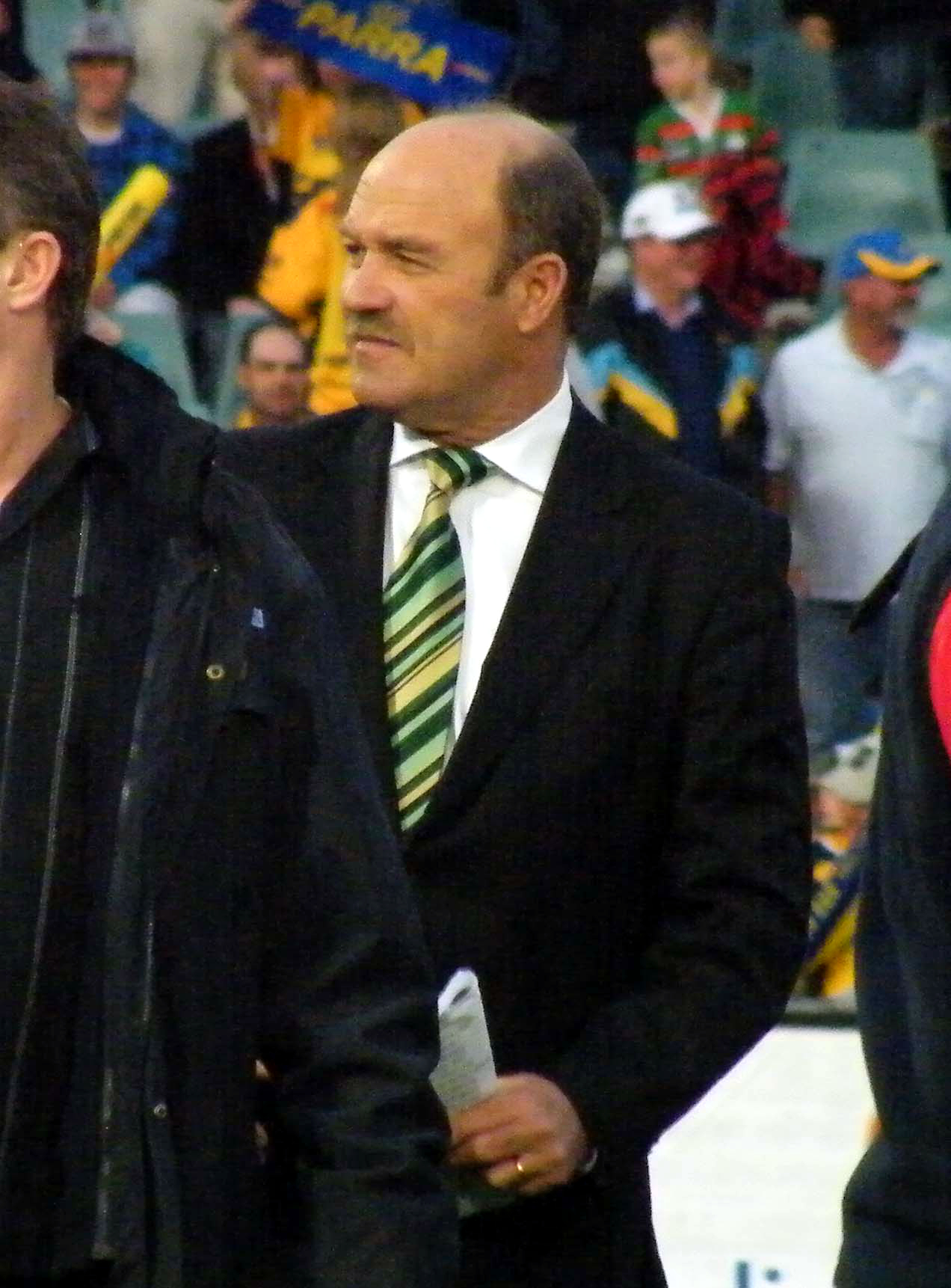
Wally Lewis
View on Wikipedia
Walter James Lewis AM (born 1 December 1959) is an Australian former professional rugby league footballer who played in the 1970s, 1980s and 1990s, and coached in the 1980s and 1990s. He became a commentator for television coverage of the sport. A highly decorated Australian national captain, Lewis is widely regarded as one of the greatest ever players of rugby league.[4][5] His time as a player and coach was followed by a career as a sports presenter for the Nine Network.
Key Information
Nicknamed The King and also The Emperor of Lang Park,[6] Lewis represented Queensland in thirty-one State of Origin games from 1980 to 1991, and was captain for thirty of them. He also represented Australia in thirty-three international matches from 1981 to 1991 and was national team captain from 1984 to 1989. Lewis is perhaps best known for his State of Origin performances, spearheading Queensland's dominance in that competition throughout the 1980s and winning a record 8 man of the match awards.
Lewis has since been inducted into the Australian Rugby League Hall of Fame and in 1999 he became the sixth member of 'The Immortals'. In 2000, he was awarded the Australian Sports Medal for his contribution to Australia's international standing in the sport of rugby league.[7]
In February 2008, Lewis was named in the list of Australia's 100 Greatest Players (1908–2007) which was commissioned by the NRL and ARL to celebrate the code's centenary year in Australia.[8][9] Lewis went on to be named in the halves in the Kangaroos' Team of the Century. Announced on 17 April 2008, the team is the panel's majority choice for each of the thirteen starting positions and four interchange players.[10][11] In June 2008, he was also chosen in the Queensland Rugby League's Team of the Century at five-eighth and captain.[12] In October 2016, he became the 38th Legend of Australian Sport at the Sport Australia Hall of Fame awards.[13]
In 2009 as part of the Q150 celebrations, Wally Lewis was announced as one of the Q150 Icons of Queensland for his role as a "sports legend".[14]
In 2011, Lewis was a recipient of the Queensland Greats Awards.[15]
Early life
[edit]Lewis was born in Hawthorne, Queensland[16] on 1 December 1959.[17] His father, Jimmy, played first grade rugby league at wing or fullback for Brisbane clubs Wests and Souths, later becoming coach of the Wynnum-Manly club. His mother, June, was a Queensland representative netball player.[18] When he was six years old, Lewis was playing rugby league with Cannon Hill Stars, usually at lock forward. He played in junior Queensland school teams, at times representing his state against New South Wales before a State or Test match at the Sydney Cricket Ground.
Lewis attended Brisbane State High School during the 1970s. In 1977 while still in high school, Lewis also played representative rugby union as a Centre, touring Europe and Japan with the Australian schoolboys team alongside the likes of Tony Melrose, Michael O'Connor, and all three Ella brothers Mark, Glen and Gary, all of whom went on to represent the Australia national rugby union team, while O'Connor would become a dual international when he played alongside Lewis for the Kangaroos.[19]
The 1977 Australian Schoolboys Rugby Union tour of Great Britain would see the first of three times Lewis would make undefeated tours of Britain with Australian national teams.
According to Lincoln Lewis, Wally and his brother Scott, who played alongside him in the BRL, are butchers by trade.[20]
Rugby League career
[edit]This section of a biography of a living person needs additional citations for verification. (June 2021) |
Fortitude Valley
[edit]Following his return to Australia from the 1977 Schoolboys tour, Lewis faced discrimination in the Queensland Rugby Union fraternity due to his rugby league background. After being told he would no longer be selected for any representative teams if he continued to play league, he immediately decided his future lay with rugby league,[21] playing in the Brisbane Rugby League premiership with Valleys Diehards from 1978. Also in 1978, Lewis (and another young Brisbane based lock from Wests named Paul Vautin) turned down an offer to play in the Sydney premiership with the North Sydney Bears.
While Lewis would remain for the 1979 Brisbane Rugby League season, Vautin would go on to sign with 1978 Sydney premiers the Manly-Warringah Sea Eagles. In 1979 Lewis made his senior début for Queensland from the bench in games played under the old State of Residence rules, and also during the 1979 Great Britain Lions tour, was selected to play for the Maroons as well as a Brisbane rugby league team against the touring Great Britain Lions. With former Australian halfback Ross Strudwick now captain-coach of the Diehards, Lewis helped Valleys to premiership victory over the Wayne Bennett-coached Souths Magpies side in the BRL Grand Final at Lang Park. Playing in the centres for the Magpies that day was a 19-year-old cadet policeman who would become a long serving Queensland and Australian teammate of Lewis in the coming decade, Mal Meninga.
Lewis made the run-on side for Queensland in the inaugural State of Origin match in 1980 at lock forward alongside his hero Arthur Beetson who at the age of 35 was playing in his first ever game for his home state. There were some in the press who questioned his selection, claiming he should have started from the bench with well performed Brisbane Wests lock Norm Carr in the starting side. [citation needed] Lewis however had a hand in Queensland's first ever State of Origin try scored by Kerry Boustead. The following year a second State of Origin match was played, and captain-coach Arthur Beetson was a late withdrawal due to injury. In what proved to be a master stroke, Beetson coached the team from the sidelines and handed the captaincy over to 21-year-old Lewis who had moved from lock to play Five-eighth.
His form for Queensland in both the two games played under the old residence system, and the one Origin game in which he scored one of four Qld tries, saw him selected to make his Test début for Australia in 1981, playing five-eighth in a 43–3 win over France at the SCG. At the Australian team's first training session (at Lang Park), coach Frank Stanton wasn't impressed with Lewis' fitness after he lagged behind in a set of 400 metre runs, though it was reported that Lewis wasn't alone and only lock forward Ray Price had completed the runs without too much trouble. During the game Lewis had a chance to score his first test try. Backing up a line break, Lewis received the ball only 15 metres out with a clear path to the line. Hearing someone closing in from behind he passed the ball to his Halfback partner Steve Mortimer to score before he could be tackled. After scoring Mortimer questioned Lewis as to why he passed as there was no French player near him. Lewis later saw a television replay which showed it was in fact the match referee who he could hear behind him. Ironically, the try was Mortimer's first test try in what was also his début test for Australia.
In the 1982 State of Origin series Lewis got his second Origin try and his first man-of-the-match award in Origin and later that year was a member of the 1982 Kangaroo tour as tour vice-captain. The 1982 Kangaroos became the first side to go through Great Britain and France undefeated, earning themselves the nickname The Invincibles. The tour raged with selection controversy as for the opening game of the tour against Hull Kingston Rovers, Stanton chose Parramatta's Winfield Cup Grand Final winning halves Brett Kenny and Peter Sterling (though Lewis actually played from the bench), who went about cementing their selection for the first test. Lewis was left out of the first Ashes test against Great Britain at Boothferry Park in Hull and coach Frank Stanton had been less than impressed with his attitude to training and his off-field habits which had seen him actually gain weight. Stanton then challenged him to get back into shape and force his way back into the test team and Lewis did just that. He began training harder to lose the weight, including jogging back from training to the team base, the Dragonara Hotel in Leeds. His form also improved and he became a vital player from the bench in the final two tests at Central Park and Headingley. Lewis' finest moment on the tour came in the second half of the second test in Wigan. After coming on as a replacement for injured winger Eric Grothe (he come on to play 5/8 with Brett Kenny moving to the centres and Mal Meninga to the wing), Lewis fired a bullet-like 20 metre cut-out pass to Meninga who then scored in the corner. Although the Kangaroos had soundly beaten Great Britain until that point of the series, Lewis' pass had a psychological effect on the Lions who were left wondering just how good the Australian's really were if they could afford to leave someone on the bench who could pass like that. Those long cut-out passes (something he learned playing junior rugby union and playing backyard football with his brothers) would become a feature of Lewis' game over the next 10 years.
During the tour, Lewis captained his first game for Australia in an international when the Kangaroos defeated Wales in a "non-test" at Ninian Park in Cardiff. Playing in the Centres, Lewis was one of four try scorers in a 37–7 win for the Kangaroos, with fullback Steve Ella leading the way with four. Wally also kicked four goals with the game played in driving rain.
Wally was selected at five-eighth for the first test against France on the French leg of the tour, but missed the second test after again dislocating his shoulder in a minor game between the tests which ended his tour as a player.
In the first and third games of the 1983 State of Origin series, Lewis was named man-of-the-match. In 1983, Lewis also regained his test five-eighth spot from Brett Kenny for the two tests against New Zealand at Carlaw Park in Auckland, and at Lang Park.
Lewis captained Queensland as they toured Papua New Guinea and England part of the 1983–84 Rugby Football League season. He played in their 8–6 defeat against Hull Kingston Rovers followed up by a 40–2 victory over Wigan RLFC and a 2–58 win over Leeds Rhinos.
Lewis played for English First Division side Wakefield Trinity for a short spell during the 1983–84 Rugby Football League season and he remains a favourite of Trinity fans, who named their fanzine Wally Lewis is Coming. Trinity won 5 of 10 games during Lewis's stay, including a win over St. Helens in which Lewis scored a hat-trick. After his last match on 12 February, Trinity did not win another game and were relegated to the second division. Initially, Lewis had been reluctant to sign with Wakefield after having played both club and representative football almost non-stop since the start of 1982, including the Kangaroo Tour and Queensland's three game tour of England at the end of 1983, when he came to the attention of Wakefield. The club asked him to name his price and, not believing that they could afford it, Lewis told them it would cost £30,000 for him to play in England (based on increases in average earnings, this would be approximately £140,100 in 2016).[22] What he did not know was that a wealthy Wakefield businessman financially supported the club and was bankrolling their attempt to sign Lewis (who by the end of 1983 had been rated the best player in rugby league). Good to his word and despite being jaded and in need of a break, Lewis signed to play his only season of English club football and became the highest paid player in England at the time.
Wynnum-Manly
[edit]Back in Australia, Lewis left Valleys and ultimately signed with the Wynnum-Manly Seagulls after initially considering an offer from Past Brothers.[23] In 1984 Lewis captained an Oceania team's 54–4 victory over an Anglo-French selection in an exhibition match Paris, returning to Brisbane after the match to continue playing for Wynnum-Manly.[24] He gained the national captaincy for the first time in the 1984 Ashes series against Great Britain, winning a well publicised battle with Parramatta and NSW captain Ray Price and becoming the 12th Queenslander to captain Australia.[25] Lewis was the first Queenslander to captain an Australian team to an Ashes victory.[26] Wally was also named player of the series for his performance as captain of the Brisbane Rugby League team that won the 1984 National Panasonic Cup Final against Sydney's Eastern Suburbs Roosters club. Lewis was named man-of-the match in the first two games of the 1984 State of Origin series, making it three consecutive Origin man-of-the-match awards. That year, he also won the Brisbane Rugby League premiership's grand final against Souths. The following year, Lewis was awarded the inaugural Golden Boot Award as the world's best international player in 1984.
Lewis was man-of-the-match for Game II of the 1985 State of Origin series, becoming the second player, after Mal Meninga in Game 1 1982, from the losing team to win the award. He then played in Wynnum-Manly's 1985 BRL grand final loss to a Souths Magpies team which included Gary Belcher, Mal Meninga and Peter Jackson. The Australian side toured New Zealand that year, winning the test series 2–1. The New Zealand tour was an unhappy one though, with coach Terry Fearnley, who had just led New South Wales to their first ever State of Origin series win, not getting along with captain Lewis or the other Queensland players and seemingly favoring NSW players, especially tour vice-captain Wayne Pearce. After winning the first two tests, Fearnley dropped four players from the team, all Queenslanders, in what Queensland Rugby League boss Senator Ron McAuliffe called a "Football Assassination". The changes to the team proved to be a disaster as the Kiwis defeated a disjointed Australia 18–0.
The following year, internal problems between the Seagulls club board and its head coach Des Morris saw Lewis installed as Captain-coach of Wynnum-Manly. Lewis would lead the team, which included rep players Colin Scott, Gene Miles and Bob Lindner, to a 14–6 win over Brothers in the 1986 BRL Grand Final at Lang Park. He then became the first Queenslander since Tom Gorman in 1929–30 to be named as captain for a Kangaroo tour. Following the successful 1986 Kangaroo tour which the Australians went through undefeated to earn themselves the nickname The Unbeatables, 1985 Australian coach Terry Fearnley wrote an article for Rugby League Week that was highly critical of Lewis' captaincy based on his experiences during the 1985 New Zealand tour.[27] Don Furner, who took over as Australian coach in 1986 before the mid-season test series against New Zealand, later told that while initially weary of working with Lewis based on Fearnley's public comments and Lewis' battles with Frank Stanton on the 1982 Kangaroo Tour, he encountered no problems with the Australian captain and the two formed a good personal and working relationship.
Although Queensland lost the 1986 State of Origin series 3–0 to NSW, the first clean sweep in Origin history, Lewis led the Australian's to a clean sweep of New Zealand in the mid-season test series, scoring a try in the 29-12 second test win at the SCG and the 32–12 win in the final game at Lang Park. Australia also won the opening test of the series 22–8 at Carlaw Park in Auckland.
In 1987 Lewis was honoured as a Member of the Order of Australia "for service to rugby league football".[28][29] Also that year King Wally, a biography of Lewis written by Adrian McGregor was published.[30] Lewis was also inducted into the Sport Australia Hall of Fame in 1987.[31] 1987 saw Lewis lead Queensland to a 2-1 Origin series win over NSW, though NSW won a fourth exhibition game played at the Veterans Memorial Stadium in Los Angeles. The Australians only played one test in 1987, suffering a shock 13–6 loss to New Zealand at Lang Park in July. It was the second time in succession that the Kangaroos, fresh from an unbeaten Kangaroo Tour, had lost a test to the Kiwis in Brisbane.
Brisbane Broncos
[edit]Several New South Wales Rugby League premiership clubs had attempted to lure Wally Lewis south during the 1980s, including the Bob Fulton coached Manly-Warringah which came closest to contracting him in 1986. However, the QRL, fearing they were going to lose Lewis (easily their biggest star) and possibly his Wynnum-Manly, Qld and Australian teammate Gene Miles to Manly soon after losing Souths players Gary Belcher and Mal Meninga to the Canberra Raiders, blocked the move to Sydney and Lewis stayed with the Seagulls. In 1988, Lewis finally got to play in the Sydney premiership when he was signed by the Brisbane Broncos as inaugural captain of the side upon their inception in 1988, leading the new club to a 44–10 win over defending NSWRL premiers Manly at Lang Park in their first ever game. Lewis was the Broncos' top try-scorer in their first season and also later had the honour of scoring the club's first hat-trick.
During the season Lewis was awarded the Harry Sunderland Medal as Australia's player of the 1988 Ashes series against Great Britain, whose 26–12 win in the dead rubber third test at the Sydney Football Stadium (SFS) was their first test victory over Australia since 1978. Lewis and teammate Sam Backo also joined Ken Irvine as the only Australian players to score a try in each test of an Ashes series. On 20 July 1988 Lewis played for Australia in their record 62-point win over Papua New Guinea, scoring a try.[32] At the end of the season he captained Australia to victory over New Zealand in the final of the 1985 - 1988 Rugby League World Cup. Australia won the game 25–12 in front of 47,363 fans at Auckland's home of rugby union Eden Park, though Lewis broke his right forearm in the 15th minute of the game while tackling Kiwi winger Tony Iro. After receiving treatment, he bravely played on for a further 20 minutes, making a number of one armed tackles despite being an obvious target in defense. Late in the first half when it became clear that with a 21–0 lead Australia would win the game, coach Don Furner replaced Lewis with Terry Lamb.
Lewis won another man-of-the-match award in the second game of the 1989 State of Origin series. Lewis scored a famous try in the second half of the game played at the SFS, when he went on a 40-metre cross field run to the line where he outpaced a much younger Laurie Daley, and held off NSW fullback Garry Jack's tackle over the last 10 metres to score in the corner. From there Lewis was captain of the Australian team for their mid-season tour of New Zealand.
At the end of the 1990 season, due to salary cap restrictions, Lewis was not made a large enough offer to keep him at the Broncos, with Bennett citing the need to retain younger talent.[33]
Gold Coast Seagulls and coaching
[edit]Following the souring of his relationship with the Broncos, Lewis was unwilling to move to Sydney for family reasons and in 1991, he joined the Gold Coast Seagulls and was appointed as captain by coach Malcolm Clift. He won his eighth and last man-of-the-match award in the first game of the State of Origin series that year, before playing both his last match for Queensland and Australia by the end of the season. He captained and coached Gold Coast during the 1992 NSWRL season but again finished the season in last place. In their last match under Lewis as captain-coach, the Gold Coast defeated Penrith, thus denying the Panthers a place in the finals play-offs. The following year he stopped playing but continued coaching the Seagulls, but departed after a third consecutive wooden spoon. In his time coaching Seagulls, the club had won just 7 games out of 44 played, losing the last 16 in a row.[34]
Wally Lewis played his last game for the Seagulls in a match against a South Australian 'Select' team (which included his longtime friend Paul Vautin, as well as St George Dragons players Ricky Walford and Jeff Hardy) at the Thebarton Oval in Adelaide on 7 November 1992, the night before the Australian Formula One Grand Prix.
Lewis also coached the Queensland State of Origin side in 1993 and 1994 but never won a series.
Legacy
[edit]
Wally Lewis is remembered for his creative, playmaking football and great on-field confrontations, most notably one in the 1991 State of Origin series with Mark Geyer. Years before that his and Brett Kenny's likenesses were put onto the State of Origin winner's shield. The Wally Lewis Medal has been awarded to the Queensland player of the series in State of Origin from 1992 to 2003. Since 2004, it has been awarded to the player of the series from either side.
A bronze statue of Wally was raised at the entrance to Lang Park. The statue text reads:
WALLY LEWIS
The Emperor of Lang Park
This honour was bestowed upon Wally Lewis by the former Chairman of the Queensland Rugby League, Senator and acclaimed father of State of Origin, the late Ron McAullife, in recognition of the impact Wally had on matches played at this ground across three decades.Lewis is arguably the greatest rugby league footballer of all time. He is one of only a handful of players to be named a Rugby League Immortal and was one of the six inaugural members of the Australian Rugby League Hall of Fame.
He achieved the greatest honour in Rugby League: the captaincy of his country, but it was his feats as Queensland skipper and playmaker in State of Origin that he achieved legendary status. He played 31 Origin games (30 as captain) and a record 8 Man of the Match awards over a 12-year period.
The name Wally Lewis is synonymous with State of Origin and Queensland Rugby League and continues to be an inspiration to future generations of footballers.
Wally Lewis has also appeared in numerous advertisements during and after his football playing career. Examples include promotions for XXXX beer and Burger King.
During the 2007 season at the Broncos' 20-year anniversary celebration, the club announced a list of the 20 best players to play for them to date which included Lewis.[35]
In December 2009 Lewis was inducted into the Queensland Sports Hall of Fame.[36]
Quotes
[edit]- "Lewis has to be number one because he's the only bloke who dominated the game at the highest level, in State of Origin, over a long period."[37] Ray Warren, Australian sports commentator
- "Certainly he's the best I've ever seen in the rugby codes, and my memory goes back to Raper and Gasnier, Catchpole and Hawthorne."[38] Peter Meares, Australian sports commentator and writer.
- "Lewis is the greatest player at representative level I've seen – and I've seen some great players, I was there when Gas and Chook were at the end of their careers."[39] Arthur Beetson, Australian former national team coach
- "...all great players, but I haven't seen anyone step past or ahead of Wally Lewis. You've got the right bloke in at No. 1."[40] Steve Mortimer, former New South Wales captain.
- "For what it is worth, I rate him as the best footballer I ever laid eyes on."[41] Bill Harrigan, leading referee
- "I've got to say here and now Wally is the greatest footballer I've seen, and all those great players knew that Wally was the greatest."[42] George Lovejoy, Queensland rugby league commentator
Personal life
[edit]
In November 1984, Lewis married Jacqueline in St John's Cathedral (Brisbane); however, they separated in 2021.[43] Together, they have two sons and one daughter: Mitchell, Lincoln and Jamie-Lee.[44]
Wally's son, Lincoln,[45] was a full-time actor on the Seven Network television drama, Home and Away, winning a TV Week Logie Award for best male new talent. His other son, Mitchell is a presenter on the Nova FM radio station, Nova 106.9 in Brisbane as the station's sports reporter and assistant producer on the Ash, Luttsy & Nikki breakfast show.[46] His daughter Jamie-Lee was born profoundly deaf. The family got confirmation of this on the day of the final State of Origin game of the 1991 series, prompting Wally's decision to retire from Origin football following the game. Jamie-Lee is a water polo player who is currently on a scholarship to the Queensland Academy of Sport who has represented Australia, and is the first[citation needed] deaf person in the world to ever represent her country's national hearing team.
In May 2010, Lewis was rushed to hospital and had his gallbladder removed.[47]
Wally Lewis completed his autobiography, Out of the Shadows: A Champion's Return to the Spotlight, in 2009.[44]

Lewis is well known as a big fan of The Phantom comic series.[48]
Following his retirement from the sport, Lewis became a television sports presenter, first on Seven Nightly News Brisbane,[49] before moving to the higher-rating Nine News Queensland where he remained until he stepped down from the role, citing health concerns, at the beginning of January 2023.[50]
Epilepsy
[edit]During the nightly news broadcast of 16 November 2006, Lewis previewed the sports segment but was not onscreen when the program returned from the commercial break, with newsreader Bruce Paige instead presenting the sports segment. A similar event occurred two weeks later, on 30 November, when Lewis appeared onscreen and began to read the autocue, saying "Good evening" before seeming distressed. A scheduled report was then played, with Paige delivering the rest of the bulletin. Following these events, Lewis was given medical leave for the rest of the year.[51] The following night, Lewis revealed that he had epilepsy. Lewis has revealed in his book that his on-air disorientation was caused by the condition.[52]
On 21 February 2007, Lewis underwent brain surgery to help his epilepsy at Austin Hospital in Melbourne. The surgery was reported as a success by Gavin Fabinyi, Director of Neurosurgery.[53] He has since made a full recovery.
Lewis was not expected to make a return as a TV reporter until 29 January but delivered a flawless report alongside new sports presenter Steve Haddan.[54] In September 2007, Lewis appeared on-air for the first time since the surgery, and by 2009 had returned to presenting on weeknights.[55]
Lewis is quoted as saying that "People come and ask me now about things (from his rugby league career) and I just don't remember them at all – that's absolutely frightening."[6]
Lewis said he wanted to work with epilepsy organisations and raise awareness about the condition.[6] He is also the vice patron of the Hear and Say Centre,[56] becoming involved with the charity organization after his daughter, Jamie-Lee, was born profoundly deaf.[44]
Statistics
[edit]Club
[edit]| † | Denotes seasons in which Lewis won a BRL premiership |
| Season | Team | Matches | T | G | F/G | Pts |
|---|---|---|---|---|---|---|
| 1978 | 22 | 10 | 0 | 0 | 30 | |
| 1979† | 20 | 19 | 0 | 1 | 58 | |
| 1980 | 21 | 16 | 2 | 0 | 52 | |
| 1981 | 18 | 11 | 0 | 1 | 34 | |
| 1982 | 15 | 5 | 0 | 2 | 17 | |
| 1983 | 15 | 10 | 9 | 0 | 58 | |
| 1983–84 | 10 | 6 | 0 | 0 | 24 | |
| 1984† | 17 | 11 | 0 | 0 | 44 | |
| 1985 | 16 | 7 | 0 | 2 | 30 | |
| 1986† | 14 | 6 | 8 | 0 | 40 | |
| 1987 | 8 | 2 | 1 | 0 | 10 | |
| 1988 | 19 | 15 | 8 | 0 | 76 | |
| 1989 | 18 | 4 | 2 | 0 | 20 | |
| 1990 | 9 | 1 | 1 | 0 | 6 | |
| 1991 | 14 | 3 | 2 | 0 | 16 | |
| 1992 | 20 | 3 | 1 | 0 | 14 | |
| Career totals | 301 | 155 | 45 | 12 | 654[a] | |
References
[edit]- ^ Rugby League Project
- ^ "Rugby League Project Coaches". Archived from the original on 7 December 2017. Retrieved 6 December 2017.
- ^ Walter, Brad (3 August 2005). "Let Joey go for the good of the game". The Sydney Morning Herald. Retrieved 30 April 2007.
- ^ Crawford, Sarah (13 December 2009). "King Wally upstages even Santa". Sunshine Coast Daily. APN News & Media Ltd. Retrieved 17 December 2009.
- ^ Tsitouris, Helen (21 July 2007). "Wally Lewis's waiting game". The Sunday Mail. Queensland Newspapers. Retrieved 17 December 2009.
- ^ a b c Strutt, Sam (11 January 2007). "Can surgery save Wally Lewis?". The Daily Telegraph. Retrieved 29 April 2007.
- ^ "Wally Lewis". Australian Honours Database. Retrieved 29 April 2007.
- ^ "Centenary of Rugby League – The Players". NRL & ARL. 23 February 2008. Retrieved 23 February 2008.
{{cite web}}:|archive-url=is malformed: timestamp (help)CS1 maint: url-status (link) - ^ Cassidy, Peter (23 February 2008). "Controversy reigns as NRL releases top 100 players". Macquarie National News. Archived from the original on 25 February 2008. Retrieved 23 February 2008.
- ^ Balym, Todd (17 April 2008). "Johns, Meninga among Immortals". Fox Sports Australia. Archived from the original on 7 September 2012. Retrieved 17 April 2008.
- ^ "Team of the Century Announced". NRL & ARL. 17 April 2008. Archived from the original on 21 May 2010. Retrieved 17 April 2008.
- ^ Ricketts, Steve (10 June 2008). "Locky named No.1 but Wal's still King". The Courier-Mail. Archived from the original on 2 July 2008. Retrieved 20 May 2009.
- ^ "King Wally becomes a Legend as Michelle Payne rides off with the 'The Don'". Sport Australia Hall of Fame website. 14 October 2016. Retrieved 13 July 2020.
- ^ Bligh, Anna (10 June 2009). "Premier Unveils Queensland's 150 Icons". Queensland Government. Archived from the original on 24 May 2017. Retrieved 24 May 2017.
- ^ "2011 Queensland Greats recipients". Queensland Government. Archived from the original on 31 May 2017. Retrieved 31 May 2017.
- ^ Meares, Peter (2003). Legends of Australian sport: the inside story. University of Queensland Press. p. 130. ISBN 9780702234101.
- ^ Toby Creswell and Samantha Trenoweth (2006). 1001 Australians You Should Know. Australia: Pluto Press. p. 683. ISBN 9781864033618.
- ^ Gallaway, Jack (2003). Origin: Rugby League's greatest contest 1980–2002. Australia: University of Queensland Press. p. 8. ISBN 9780702233838.
- ^ Ella, Mark (24 November 2012). "Follow the Australian Schoolboys' advice: don't kick the ball". The Australian. Retrieved 3 November 2016.
- ^ "Hell's Kitchen Australia". www.tvnz.co.nz. Retrieved 8 March 2023.
- ^ Sean Fagan. "Wally Lewis - Rugby League Hall of Fame". rl1908.com. Archived from the original on 7 February 2010. Retrieved 15 May 2011.
- ^ "Measuring Worth - Relative Value of UK Pounds". Measuring Worth. 31 December 2014. Retrieved 1 January 2015.
- ^ Durkin, Tony (21 March 184). "KOUGARI'S KAMIKAZES". Rugby League Week. Bauer Media Group. p. 30.
- ^ "Sport digest". The Sydney Morning Herald. 19 April 1984. Retrieved 3 September 2013.
- ^ Price, Tony (2020). More Than Just a Game: A History of Rugby League in Queensland. Alexandra Hills: Tony Price. p. 197. ISBN 9780994580269.
- ^ Price, Tony (2020). More Than Just a Game: A History of Rugby League in Queensland. Alexandra Hills: Tony Price. p. 205. ISBN 9780994580269.
- ^ Tait, Paul (28 February 1986). "Now Abbot attacks Fearnley". The Sydney Morning Herald. Australia. p. 31. Archived from the original on 17 April 2016. Retrieved 21 April 2010.
- ^ "THE QUEEN'S BIRTHDAY 1987 HONOURS". Commonwealth of Australia Gazette. Special. No. S117. Australia. 8 June 1987. p. 1. Retrieved 29 July 2022 – via National Library of Australia.
- ^ "QUEEN'S BIRTHDAY HONOURS LIST 1987". The Canberra Times. Vol. 61, no. 18, 875. Australian Capital Territory, Australia. 8 June 1987. p. 8. Retrieved 29 July 2022 – via National Library of Australia.
- ^ Headon, David (October 1999). "Up From the Ashes: The Phoenix of a Rugby League Literature" (PDF). Football Studies Volume 2, Issue 2. Football Studies Group. Archived from the original (PDF) on 21 July 2012. Retrieved 7 July 2009.
- ^ "Wally Lewis". Sport Australia Hall of Fame. Retrieved 25 September 2020.
- ^ "O'Connor helps set Test records". The Age. 21 July 1988. Retrieved 18 October 2013.
- ^ Harms, John (2005). The Pearl: Steve Renouf's Story. Australia: University of Queensland Press. p. 103. ISBN 9780702235368.
- ^ "Custom Match List". Rugby League Project. Retrieved 7 July 2011.
- ^ Dekroo, Karl (9 May 2007). "Still the king". The Courier-Mail. Australia: Queensland Newspapers. Archived from the original on 12 May 2007. Retrieved 8 December 2009.
- ^ Murdoch, Alex (4 December 2009). "Greg Inglis caps off stellar season with award". The courier Mail. Australia: Queensland Newspapers. Retrieved 5 December 2009.
- ^ Webster, Andrew (April 2004). "A few Drinks with Ray Warren Inside Sport". Retrieved 3 July 2009.
- ^ Meares, Peter (2003). Legends of Australian sport: The Inside Story. Australia: University of Queensland Press. p. 130. ISBN 9780702234101.
- ^ Sarno, Tony (9 August 1992). "The King abdicates with a whimper, not a bang". The Sydney Morning Herald. p. 39. Retrieved 6 October 2009.
- ^ Rothfield, Phil (26 May 2010). "Phil Rothfield names his 50 greatest Origin players". The Daily Telegraph. Australia: Herald and Weekly Times. Retrieved 26 May 2010.
- ^ Bill Harrigan with Daniel Lane (2003). Harrigan: the referee in a league of his own. Australia: Hachette. ISBN 9780733627743.
- ^ Mallory, Greg (2010). Voices from Brisbane Rugby League. Australia: Boolarong Press. p. 49. ISBN 9780975770412. Retrieved 9 September 2014.
- ^ "Lincoln Lewis spills on father Wally's messy and public marriage split". 21 May 2021.
- ^ a b c "King Wally Lewis' tell-all book". The Daily Telegraph. 20 September 2009. Retrieved 7 June 2012.
- ^ Edwards, Amy; Beaumont, Anita (22 June 2007). "Home or away he's marooned". Newcastle Herald. Fairfax Media. p. 14. Retrieved 13 November 2011.
- ^ "Wally Lewis hopes to be at Origin after surgery". Nova FM. Archived from the original on 20 February 2014. Retrieved 7 June 2012.
- ^ "Rugby league legend Wally Lewis recovering after surgery". Herald-Sun. AAP. 23 May 2010. Retrieved 7 June 2012.
- ^ [1][dead link]
- ^ Martin, Dan (17 May 2012). BTQ7 Seven Nightly News & Today Tonight (QLD) January 27, 1998. YouTube. Retrieved 16 August 2017.
- ^ McKnight, Robert (23 January 2023). "EXCLUSIVE – WALLY LEWIS steps down as sports presenter of 9NEWS Queensland – effective immediately". TV Blackbox. Retrieved 23 January 2023.
- ^ "Wally Lewis on leave after on-air mishap". ABC News. 1 December 2006. Retrieved 29 April 2007.
- ^ "Wally Lewis reveals he has epilepsy". AAP. The Age. 1 December 2006. Retrieved 29 April 2007.
- ^ "King Wally's brain surgery a success". ABC News. 21 February 2007. Retrieved 8 June 2012.
- ^ Connolly, Steve (29 January 2007). "League great Lewis back on air". AAP. news.com.au. Retrieved 22 May 2017.
- ^ Koch, Dan (7 September 2007). "The King back at his desk". The Australian. Retrieved 28 February 2018.
- ^ "Hear and Say Centre Board Members". Hear and Say Centre. Archived from the original on 29 August 2007. Retrieved 29 April 2007.
Notes
[edit]- ^ Tries were only worth three points until 1983.
Further reading
[edit]- McGregor, Adrian (2004). Wally Lewis: Forever the King. University of Queensland Press. ISBN 9780702234347.
- McGregor, Adrian (1993). Wally Lewis. Tandem Press. ISBN 9780908884353.
- McGregor, Adrian (1989). Wally and the Broncos. University of Queensland Press. ISBN 9780702221828.
- Lewis, Wally (2009). Out of the Shadows: A Champion's Return to the Spotlight. HarperCollins Publishers Australia. ISBN 9780732288808.
External links
[edit]Wally Lewis
View on GrokipediaEarly life
Walter James Lewis was born on 1 December 1959 in Hawthorne, Queensland.[6] He grew up in the Brisbane suburb of Cannon Hill in a working-class family with a strong passion for rugby league. His father, Jim Lewis, played first grade for clubs including Souths and Brothers, and served as an early coach for his son, teaching him the fundamentals of the game in their backyard.[7] Lewis attended Brisbane State High School.[8] He began playing organised rugby league at the age of six, joining the Cannon Hill club in the under-8s competition in 1967, before moving to the Fortitude Valley Diehards during his junior years. In 1977, he was selected for the Australian Schoolboys rugby union team, which undertook an undefeated tour of Great Britain.[7][8]Club career
Fortitude Valley
Wally Lewis began his professional rugby league career with Fortitude Valley Diehards in the Brisbane Rugby League (BRL) competition, making his first-grade debut on 9 April 1978 at the age of 18 against Northern Suburbs at Neumann Oval.[2] Playing initially as a lock forward, he scored three tries in a 31-14 victory, immediately showcasing his attacking flair and earning recognition as a rising talent.[9] His early passion for the sport, nurtured through junior ranks, had positioned him for this breakthrough opportunity with the club.[1] Over his tenure from 1978 to 1983, Lewis solidified his status as a star player, appearing in 111 games for Fortitude Valley and contributing 71 tries, 11 goals, and 4 field goals for a total of 249 points.[1] He quickly adapted to the demands of top-level play, demonstrating exceptional vision and ball-handling skills that made him a pivotal figure in the team's attack. His performances drew widespread acclaim, establishing him as one of the BRL's most exciting prospects during this formative period. A highlight of Lewis's time with Fortitude Valley came in the 1979 BRL Grand Final, where the Diehards defeated Souths Brisbane Magpies 26-0 at Lang Park to claim the premiership.[2] Lewis was instrumental in the dominant win, kicking a crucial field goal that underscored his playmaking prowess under the captain-coach Ross Strudwick.[10] This victory marked the club's first premiership in several years and highlighted Lewis's growing influence on the field. Lewis's role evolved significantly during his Valley years, transitioning from a versatile back to a primary five-eighth while developing into a natural leader renowned for his tactical acumen and ability to inspire teammates.[9] By the early 1980s, he had assumed greater responsibilities, paving the way for his eventual captaincy and cementing his reputation as a cornerstone of the club's success.[1]Wakefield Trinity
In 1983, Lewis took a break from the BRL to play for Wakefield Trinity in the English Championship during the off-season, appearing in 10 matches and scoring 6 tries for 24 points.[11] This overseas stint provided valuable experience against international opposition and exposure to different styles of play, enhancing his development as a world-class playmaker before returning to Australian rugby league.[1]Wynnum-Manly
Lewis joined Wynnum-Manly Seagulls in the Brisbane Rugby League (BRL) in 1984 after six seasons with Fortitude Valley, bringing his leadership and skill to a club on the rise.[12] In his debut season, he played a key role in their dominant campaign, culminating in a 42-8 grand final victory over Southern Suburbs Magpies to secure the BRL premiership.[13] The following year, 1985, Wynnum-Manly reached the grand final again but fell short in a loss to Souths, with Lewis's performances highlighting his consistency amid high-stakes matches. In 1986, following internal issues that led to the departure of head coach Des Morris, Wally Lewis assumed the dual role of captain-coach for Wynnum-Manly in the Brisbane Rugby League (BRL).[12] Under his guidance, the Seagulls enjoyed a dominant season, capturing multiple titles including the pre-season competition, the State League final (46-10 over Redcliffe), the Presidents Cup, and culminating in the BRL premiership with a hard-fought 14-6 grand final victory against Past Brothers at Lang Park before a crowd of 25,000.[12][14][15] Lewis's coaching emphasized a disciplined approach centered on ruck defense and ball control, which proved pivotal in the grand final where late tries, including one from Lewis himself, turned the match after a tense halftime stalemate.[14] His motivational halftime address highlighted the urgency of the moment, framing it as potentially the team's last chance amid looming budget constraints and roster changes, thereby boosting morale and focus following the disappointment of the 1985 BRL grand final loss.[14] Over two seasons from 1986 to 1987, Lewis's record as coach included 55 matches across regular season, pre-season, and finals, with 43 wins and 12 losses, reflecting a strong win percentage of approximately 78% despite a more challenging 1987 campaign where the team finished fourth and exited in the knockout semi-final.[16][17] In 1987, Wynnum-Manly continued their success in the Winfield State League by securing a fourth consecutive title (36-14 over Redcliffe), but Lewis stepped down from the coaching role at season's end to concentrate on his playing commitments with the newly established Brisbane Broncos in 1988.[12]Brisbane Broncos
Wally Lewis joined the Brisbane Broncos as their inaugural captain upon the club's entry into the New South Wales Rugby League (NSWRL) premiership in 1988, bringing his extensive experience as a representative player to lead the expansion team.[6][18] Over his three seasons with the Broncos from 1988 to 1990, Lewis played 46 games and scored 20 tries, serving primarily as five-eighth and occasionally as lock.[11] His arrival helped establish the club's identity in a competition dominated by Sydney-based teams, drawing significant fan support and setting a foundation for Queensland rugby league's national presence. In his debut season, Lewis was the Broncos' leading try-scorer with 15 tries and earned individual accolades, including the Dally M Five-Eighth of the Year award, as well as the Harry Sunderland Medal for his performance on the 1988 Kangaroo tour against Great Britain.[11] He also achieved a milestone by scoring the club's first hat-trick during the 1988 campaign.[2] Under his leadership, the Broncos showed early promise, securing a strong start with a 44-10 victory over Manly-Warringah in their inaugural match, where Lewis scored two tries.[18] The team finished seventh in 1988 but improved in 1989, tying for fifth place before losing a playoff decider to Cronulla-Sutherland 14-38, missing out on the semi-finals.[19] Lewis's captaincy was instrumental in fostering the Broncos' emerging culture, particularly through mentoring young talents such as halfback Allan Langer, who debuted for the club in 1988 and benefited from Lewis's guidance on leadership and game management.[20] Despite injuries limiting his 1990 season to nine games, Lewis contributed to a team that finished mid-table, emphasizing discipline and resilience amid the challenges of integrating a new roster.[11] Although the Broncos did not win a premiership during his tenure, his role in building team cohesion and inspiring the next generation laid groundwork for the club's future success.[21] Lewis departed the Broncos at the end of the 1990 season amid disputes over payments and salary cap pressures, with the club citing financial constraints as a key factor in unable to retain his services.[22] His exit, following a controversial mid-season stripping of the captaincy in 1989, marked the end of a pivotal but turbulent period for the franchise.[23]Gold Coast Seagulls
Wally Lewis joined the Gold Coast Seagulls in 1991 as a player following a fallout with the Brisbane Broncos, but transitioned into a player-coach role the following year.[8] In 1992, he assumed full head coaching duties alongside his playing responsibilities, a demanding position for the expansion franchise that had entered the New South Wales Rugby League in 1988.[1] The Seagulls faced immense challenges as a new team in a competitive league, including chronic underperformance, with the club having finished last in the previous season under coach Malcolm Clift.[24] Over his tenure from 1992 to 1993, Lewis coached 44 games, securing just 7 wins, 1 draw, and 36 losses, yielding a win percentage of approximately 16%.[24] Financial constraints and limited resources hampered recruitment and operations, preventing the club from competing effectively against more established rivals.[1] Despite the struggles, Lewis emphasized youth development, inspiring emerging players and establishing a foundation for long-term growth amid the team's wooden spoon finishes in both seasons.[1] The 1993 campaign proved particularly grueling, with only 1 win in the first 13 matches before the club parted ways with its football manager amid internal tensions.[25] Lewis resigned as head coach at the end of 1993, citing ongoing conflicts with club management that exacerbated the franchise's instability.[26] His time at the Seagulls highlighted the difficulties of steering an under-resourced expansion side, leaving a legacy of dedication through strategic leadership despite the poor results.[1] This period contrasted sharply with his earlier coaching success at Wynnum-Manly, underscoring the unique pressures of professional expansion rugby league.Representative career
Queensland
Wally Lewis made his State of Origin debut for Queensland in the inaugural match on 8 July 1980 at Lang Park in Brisbane, playing as a lock forward and scoring a try in the 20-10 victory over New South Wales.[2] This performance marked the beginning of his transformative influence on the series, where he transitioned to five-eighth and became a cornerstone of Queensland's team. Over his career, Lewis appeared in 31 Origin games from 1980 to 1991, captaining 30 of them after assuming the role in 1981 following Arthur Beetson's retirement; his only absence was Game 3 of the 1981 series due to injury.[2][8] Under Lewis's captaincy, Queensland secured series victories in 1981 (2-1), 1983 (2-1), 1984 (3-0), 1987 (2-1), 1988 (3-0), 1989 (2-1), and 1991 (2-1), establishing the Maroons as a dominant force in the rivalry after years of New South Wales supremacy.[27] His on-field leadership was instrumental in this shift, exemplified by his record eight Man of the Match awards—a tally unmatched by any other player—including standout performances in pivotal games that turned the series into Queensland's stronghold.[2][28] Lewis's tactical acumen, vision, and resilience, often demonstrated through miracle plays and comebacks, earned him the nickname "The Emperor of Lang Park" and solidified his legacy as the embodiment of Origin football.[8] Lewis retired from State of Origin after captaining Queensland to the 1991 series win, concluding his representative career on a high note with a 13-12 victory in Game 3 at the Sydney Football Stadium.[2][27] This farewell series, marked by intense drama including a golden point-like finish in the decider, underscored his enduring impact on the competition's intensity and Queensland's enduring pride.[8]Australia
Lewis made his Test debut for Australia against France on 4 July 1981 at the Sydney Cricket Ground, becoming the only Queenslander in the side and marking the start of a distinguished international career that spanned from 1981 to 1991.[3][1] Over this period, he played 33 Tests for the Kangaroos, showcasing his tactical brilliance as a five-eighth and earning widespread acclaim for his leadership qualities honed through State of Origin battles.[2] Appointed captain in 1984, Lewis led Australia in 24 Tests until 1989, guiding the team to several landmark victories in major tournaments.[2] Under his captaincy, Australia won the 1985–1988 Rugby League World Cup, defeating New Zealand 25–12 in the final at Auckland's Eden Park despite Lewis playing with a broken forearm.[3] He also captained the undefeated 1986 Kangaroo Tour of Great Britain and France, securing a 3–0 Ashes series whitewash against Great Britain with commanding wins of 38–16, 34–4, and 24–15, a feat that solidified Australia's dominance in the sport.[3][2] Lewis maintained an undefeated record as captain in Test series against both Great Britain and New Zealand during this era.[3] In his Test career, Lewis scored 11 tries, contributing significantly to Australia's offensive plays through his precise passing and game-reading ability.[2] He retired from international rugby league following Australia's participation in the 1989–1992 Rugby League World Cup, with his final Test appearance coming in 1991 against New Zealand.[2][3]Coaching career
Wynnum-Manly
In 1986, following internal issues that led to the departure of head coach Des Morris, Wally Lewis assumed the dual role of captain-coach for Wynnum-Manly in the Brisbane Rugby League (BRL).[12] Under his guidance, the Seagulls enjoyed a dominant season, capturing multiple titles including the pre-season competition, the State League final (46-10 over Redcliffe), the Presidents Cup, and culminating in the BRL premiership with a hard-fought 14-6 grand final victory against Past Brothers at Lang Park before a crowd of 25,000.[12][14][15] Lewis's coaching emphasized a disciplined approach centered on ruck defense and ball control, which proved pivotal in the grand final where late tries, including one from Lewis himself, turned the match after a tense halftime stalemate.[14] His motivational halftime address highlighted the urgency of the moment, framing it as potentially the team's last chance amid looming budget constraints and roster changes, thereby boosting morale and focus following the disappointment of the 1985 BRL grand final loss.[14] Over two seasons from 1986 to 1987, Lewis's record as coach included 55 matches across regular season, pre-season, and finals, with 43 wins and 12 losses, reflecting a strong win percentage of approximately 78% despite a more challenging 1987 campaign where the team finished fourth and exited in the knockout semi-final.[16][17] In 1987, Wynnum-Manly continued their success in the Winfield State League by securing a fourth consecutive title (36-14 over Redcliffe), but Lewis stepped down from the coaching role at season's end to concentrate on his playing commitments with the newly established Brisbane Broncos in 1988.[12]Gold Coast Seagulls
Wally Lewis joined the Gold Coast Seagulls in 1991 as a player following a fallout with the Brisbane Broncos, but transitioned into a player-coach role the following year.[8] In 1992, he assumed full head coaching duties alongside his playing responsibilities, a demanding position for the expansion franchise that had entered the New South Wales Rugby League in 1988.[1] The Seagulls faced immense challenges as a new team in a competitive league, including chronic underperformance, with the club having finished last in the previous season under coach Malcolm Clift.[24] Over his tenure from 1992 to 1993, Lewis coached 44 games, securing just 7 wins, 1 draw, and 36 losses, yielding a win percentage of approximately 16%.[24] Financial constraints and limited resources hampered recruitment and operations, preventing the club from competing effectively against more established rivals.[1] Despite the struggles, Lewis emphasized youth development, inspiring emerging players and establishing a foundation for long-term growth amid the team's wooden spoon finishes in both seasons.[1] The 1993 campaign proved particularly grueling, with only 1 win in the first 13 matches before the club parted ways with its football manager amid internal tensions.[25] Lewis resigned as head coach at the end of 1993, citing ongoing conflicts with club management that exacerbated the franchise's instability.[26] His time at the Seagulls highlighted the difficulties of steering an under-resourced expansion side, leaving a legacy of dedication through strategic leadership despite the poor results.[1] This period contrasted sharply with his earlier coaching success at Wynnum-Manly, underscoring the unique pressures of professional expansion rugby league.Queensland State of Origin
Lewis served as coach of the Queensland State of Origin team in 1993 and 1994. In 1993, Queensland lost the series 0–3 to New South Wales. In 1994, they won the series 2–1, securing victories in Games 2 and 3.[29]Broadcasting career
Early roles
Following his retirement from playing in 1992 and coaching in 1993, Wally Lewis transitioned fully into media, building on initial forays he had made toward the end of his on-field career. He began his television career with Network Ten in the late 1980s as a sports presenter.[1] In Queensland, he established himself as a prominent voice in local broadcasting, leveraging his status as a rugby league legend to provide expert analysis. His early roles emphasized regional coverage, where his deep knowledge of the game resonated with audiences familiar with his on-field exploits.[1] A key part of Lewis's post-retirement work in the 1990s involved television presenting on Channel 7, where he had joined Seven Nightly News Brisbane in 1992 and continued delivering nightly sports segments and match analyses until 1998. These local shows allowed him to host discussions on Queensland rugby league, breaking down games and highlighting emerging talent in a format that combined his charismatic presence with tactical insights. Concurrently, on radio, Lewis contributed to Sea FM Gold Coast's breakfast crew in the early 1990s by presenting sports news and later provided rugby league commentary and analysis for various Queensland stations, focusing on state-based matches and player development.[1] During the divisive Super League War of 1997, Lewis took on an analyst role with Fox Sports, the network aligned with the Super League competition, where he offered commentary supporting Queensland-affiliated teams amid the schism in Australian rugby league. His contributions included pre-game breakdowns that emphasized strategic elements, drawing on his experience as a former Queensland captain to contextualize the conflict's impact on players and the sport. This period marked a significant expansion of his media profile, showcasing his ability to navigate high-stakes broadcasting. Lewis's early roles were characterized by his adept use of playing fame to deliver nuanced commentary on tactics and player psychology, establishing him as a trusted voice in Queensland rugby league media.[1][30]Nine Network and later
Lewis joined the Nine Network in 1999 as the sports presenter for Nine News Queensland, a role that quickly established him as a prominent figure in national rugby league broadcasting.[31] His contributions extended to the NRL Footy Show, where he served as a regular panelist, offering insights drawn from his playing career alongside hosts and fellow experts.[32] Over the years, Lewis became a key voice in Nine's coverage, commentating on State of Origin series and international Tests, including as part of the broadcast team for Origin Game One in 2021.[33] Lewis also featured prominently on the Sunday Footy Show, contributing analysis and discussions on weekly NRL matches until his retirement from regular Nine roles in 2023 to focus on health management.[34] In January 2023, he stepped down from his sports presenting duties at Nine News Queensland after 24 years, citing the need to prioritize personal well-being, though he remained affiliated with the network in limited capacities.[35] His tenure was marked by a reputation for passionate yet unbiased commentary, blending tactical expertise with an infectious enthusiasm that resonated with fans.[1] In recent years, Lewis has further scaled back his involvement in NRL broadcasting amid ongoing health challenges, including a 2025 decision to reduce commentary commitments.[36] Despite this, he continues selective appearances, such as presenting the Wally Lewis Medal to Tom Dearden following Queensland's 2025 State of Origin series victory.[37] This enduring presence underscores his lasting influence in rugby league media, where his measured perspectives have helped shape public discourse on the sport.[38]Personal life
Family
Wally Lewis married his first wife, Jacqueline "Jacqui" Green, on November 10, 1984, at St John's Cathedral in Brisbane, following a brief 16-day courtship.[39] The couple remained together for 37 years, during which they raised three children: sons Lincoln, born in 1987, and Mitchell, born in 1999, and daughter Jamie-Lee, born in 1991.[40] Lincoln is an Australian actor best known for his roles in the television series Home and Away (2007–2010), while Mitchell has established himself as a businessman. Jamie-Lee was born profoundly deaf, a condition diagnosed at one year of age, which profoundly shaped the family's experiences and commitments.[41] The Lewis family announced their separation in early 2021, marking the end of a long partnership amid reports of personal challenges.[42] In interviews following the split, Lewis has spoken about the emotional adjustments involved, emphasizing the ongoing support from his family as he navigated this transition.[43] Jamie-Lee's hearing loss inspired the family to advocate for greater accessibility in sports; for instance, Lewis and Jamie-Lee participated in a silent touch rugby league match during Hearing Awareness Week in 2014 to promote inclusive activities for those with disabilities.[44] The children often attended their father's games during his playing career, fostering a close-knit dynamic centered around sports and family encouragement.[45] In April 2025, Lewis remarried Lynda Adams, his partner of four years, in a ceremony in Brisbane.[46] Despite reported tensions, with his children aligning closely with their mother and not attending the wedding, Lewis has publicly denied any lasting feud and expressed a desire to preserve strong relationships with Jacqui and his children.[43] He continues to highlight the enduring bonds within his family, including his role as a grandfather to four grandchildren.[39]Health
In 2006, Wally Lewis experienced a seizure on live television while presenting the sports bulletin for Nine News in Brisbane, publicly revealing his long-undiagnosed epilepsy, which he had managed privately since his early twenties through medication.[47][48] The following year, in February 2007, Lewis underwent neurosurgery at Austin Hospital in Melbourne, where a 5 cm by 3 cm section of his brain containing the epileptic focus was removed in a three-and-a-half-hour procedure, aimed at controlling the seizures.[49][50] The surgery was successful, allowing Lewis to make a gradual recovery and return to his broadcasting role at Nine by March 2009, presenting weeknight sports segments.[51] In July 2023, Lewis was diagnosed with probable chronic traumatic encephalopathy (CTE), a degenerative brain condition associated with repeated concussions sustained over his 17-year professional rugby league career, using research criteria for traumatic encephalopathy syndrome since definitive confirmation requires post-mortem autopsy.[52][53] Symptoms of his probable CTE include short-term memory loss and mood changes, which have progressively impacted his daily functioning.[54][1] Following his CTE diagnosis, Lewis became a prominent advocate for improved concussion management in rugby league, leading a delegation to Parliament House in Canberra in February 2024 to secure federal funding for CTE education, research, and support services.[54] In April 2024, he publicly called for stricter NRL protocols, including a ban on tackling during training sessions to reduce head impacts, warning that without such measures, the sport's future viability could be jeopardized.[55] His efforts contributed to a $12.5 million government investment in CTE initiatives announced in February 2025.[56] Lewis's health challenges influenced his decision to retire from his Nine Network sports presenting role in January 2023, citing the need to prioritize his well-being amid ongoing epilepsy management and emerging neurological issues.[57] He continues to receive support from his medical team for monitoring and treating both conditions, as detailed in 2025 interviews where he discussed adapting to CTE's effects.[58][59]Legacy and honours
Awards and recognition
Lewis was honored with several prestigious individual awards during his playing career, recognizing his exceptional skill and leadership. In 1984, he received the inaugural Golden Boot Award as the world's best rugby league player. He also earned the Dally M Representative Player of the Year award on three occasions—in 1982, 1984, and 1988—for his outstanding performances in representative matches. Additionally, in 1988, Lewis was named the Dally M Five-Eighth of the Year and won the Harry Sunderland Medal for his performance in the NSWRL Grand Final. In State of Origin series, he holds the record with eight Man of the Match awards across his 31 appearances, underscoring his dominance in the interstate rivalry.[2][6][60][61] On the team front, Lewis played a key role in securing three Brisbane Rugby League premierships: one with the Valleys Diehards in 1979 and two with the Wynnum-Manly Seagulls in 1984 and 1986. As captain, he led Australia to victory in the 1985–1988 Rugby League World Cup, defeating New Zealand 25–12 in the final at Auckland's Eden Park.[6][62] Following his retirement, Lewis's contributions to the sport earned him enduring recognition. In 1987, he was appointed a Member of the Order of Australia (AM) for service to rugby league and inducted into the Sport Australia Hall of Fame (elevated to Legend status in 2016). He became the sixth Immortal in 1999, one of the Immortals, the select group of players deemed the greatest in the game's history. Lewis was part of the inaugural inductees to the Australian Rugby League Hall of Fame in 2002 and the NRL Hall of Fame in 2008. He was selected for the Australian Rugby League Team of the Century in 2006 and the Queensland Team of the Century in 2008. In 2000, he received the Australian Sports Medal for enhancing Australia's international standing in rugby league.[63][64][63][6][3] The Wally Lewis Medal, established in 1992 to honor the best player across the State of Origin series, bears his name and reflects his legacy; it was first awarded to the Queensland player of the series before expanding to the overall recipient in 2004, with Tom Dearden winning it in 2025.[65][66]Cultural impact
Wally Lewis's leadership on the field earned him the enduring nickname "The King," a moniker reflecting his commanding presence and inspirational role in rugby league, particularly during Queensland's State of Origin campaigns in the 1980s. This title, also extended to "The Emperor of Lang Park," captured his ability to rally teammates and intimidate opponents, cementing his status as a cultural icon for Queenslanders. A bronze statue of Lewis in his iconic captain's pose was unveiled outside Suncorp Stadium in 2003, serving as a lasting symbol of state pride and the sport's deep ties to regional identity.[64][67] Under Lewis's captaincy, the State of Origin series evolved from a regional rivalry into a cornerstone of Australian sporting culture, drawing massive national audiences and fostering intense interstate passion. As Queensland captain in 30 of his 31 appearances from 1980 to 1991, he led the Maroons to seven series victories, instilling a winning mentality that inspired decades of dominance and elevated the competition's prestige. His on-field brilliance, including a record eight Man of the Match awards, not only boosted the series' popularity but also reinforced rugby league's role in unifying and dividing communities across Australia.[64][8] Beyond the game, Lewis has influenced discussions on player welfare, particularly after his 2023 diagnosis of probable chronic traumatic encephalopathy (CTE), linked to repeated head impacts during his career. As an ambassador for Dementia Australia, he has publicly advocated for increased funding and awareness of concussion-related issues, including a successful push for a $12.5 million federal pilot program in 2025 to support those affected by CTE. This advocacy has highlighted the long-term human cost of the sport, prompting broader conversations within rugby league about player health and safety. Lewis's story was explored in the 2023 Wide World of Sports documentary The King, which chronicled his legacy and personal challenges, further amplifying his impact on public perceptions of the game.[5][52][68] His memorable pronouncements from 1980s interviews, such as reflections on the all-consuming nature of rugby league, continue to resonate in media and fan discourse, encapsulating the sport's profound hold on participants' lives.Statistics
Club statistics
Wally Lewis played a total of 253 first-grade club games across his career in Australian rugby league competitions. These appearances contributed to 532 career club points, accumulated through 129 tries, 35 goals, and 7 field goals. His club career began with Fortitude Valley in the Brisbane Rugby League, where he featured in 111 games and scored 71 tries between 1978 and 1983.[1] He then played 10 games for Wakefield Trinity in England in 1983, scoring 6 tries for 24 points. Lewis then moved to Wynnum-Manly for the 1984–1987 seasons, appearing in 52 games and scoring 26 tries during that period.[2] In 1988, he joined the newly formed Brisbane Broncos in the Winfield Cup, playing 46 games over three seasons and contributing 20 tries along with 11 goals for 102 points.[11] Lewis concluded his club career with the Gold Coast Seagulls from 1991 to 1992, making 34 appearances, scoring 6 tries, and kicking 3 goals for 30 points.[11]| Club | Years | Games | Tries | Goals | Field Goals | Points |
|---|---|---|---|---|---|---|
| Fortitude Valley | 1978–1983 | 111 | 71 | 11 | 4 | 249 |
| Wakefield Trinity | 1983 | 10 | 6 | 0 | 0 | 24 |
| Wynnum-Manly | 1984–1987 | 52 | 26 | 10 | 3 | 127 |
| Brisbane Broncos | 1988–1990 | 46 | 20 | 11 | 0 | 102 |
| Gold Coast | 1991–1992 | 34 | 6 | 3 | 0 | 30 |
| Total | - | 253 | 129 | 35 | 7 | 532 |
Representative statistics
Wally Lewis's representative career showcased his pivotal role in both state and international rugby league, where he excelled as a playmaker and leader. For Queensland in State of Origin matches, he appeared in 31 games between 1980 and 1991, scoring 7 tries, 1 goal, and 2 field goals for a total of 30 points.[2] He captained the Maroons in 30 of those appearances, demonstrating his enduring influence on the team's strategy and morale.[2] Lewis's international record with Australia further highlighted his consistency, as he played 34 Test matches, including World Cup fixtures, from 1981 to 1991, where he notched 11 tries and 2 field goals for 45 points.[2] He led Australia as captain in 24 Tests, often orchestrating key victories in high-stakes series.[2] His contributions in World Cup competitions spanned 9 games, during which he scored 3 tries, underscoring his ability to perform under global pressure.[11] Across his representative tenure, Lewis accumulated 65 games, reflecting his status as a cornerstone of Australian rugby league. His 8 Man of the Match awards in State of Origin— a record at the time—emphasized his standout performances, particularly in decisive moments that shaped series outcomes.[2]| Category | Games | Tries | Goals | Field Goals | Points |
|---|---|---|---|---|---|
| Queensland State of Origin | 31 | 7 | 1 | 2 | 30 |
| Australia Tests (incl. World Cup) | 34 | 11 | 0 | 2 | 45 |
| Total Representative | 65 | 18 | 1 | 4 | 75 |
