
Recent from talks
Android Lollipop
Knowledge base stats:
Talk channels stats:
Members stats:
Android Lollipop
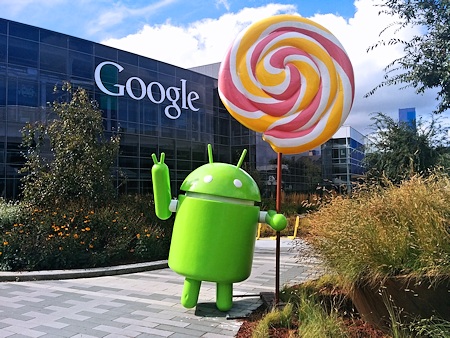
Android Lollipop (codenamed Android L during development) is the fifth major version of the Android mobile operating system developed by Google and the 12th version of Android, spanning versions between 5.0 and 5.1.1.
Unveiled on June 25, 2014, at the Google I/O 2014 conference, it became available through official over-the-air (OTA) updates on November 12, 2014, for select devices that run distributions of Android serviced by Google (such as Nexus and Google Play edition devices). Its source code was made available on November 3, 2014. The first phone with Android Lollipop was the Nexus 6.
One of the most prominent changes in the Lollipop release is a redesigned user interface built around a design language known as Material Design, which was made to retain a paper-like feel to the interface. Other changes include improvements to the notifications, which can be accessed from the lockscreen and displayed within applications as top-of-the-screen banners. Google also made internal changes to the platform, with the Android Runtime (ART) officially replacing Dalvik for improved application performance, and with changes intended to improve and optimize battery usage. The Roboto font, which was originally made for Android Ice Cream Sandwich, was redesigned in favor of Material Design.
As of January 2025, 0.92% of Android devices run Lollipop (0.47% on 5.0, and 0.45% on 5.1). Google Play Services support for Lollipop ended in July 2024.
The release was internally codenamed "Lemon Meringue Pie". Android 5.0 was first unveiled under the codename "Android L" on June 25, 2014, during a keynote presentation at the Google I/O developers' conference. Alongside Lollipop, the presentation focused on a number of new Android-oriented platforms and technologies, including Android TV, in-car platform Android Auto, wearable computing platform Android Wear, and health tracking platform Google Fit.
Part of the presentation was dedicated to a new cross-platform design language referred to as "Material Design". Expanding upon the "card" motifs first seen in Google Now, it is a design with increased use of grid-based layouts, responsive animations and transitions, padding, and depth effects such as lighting and shadows. Designer Matías Duarte explained that "unlike real paper, our digital material can expand and reform intelligently. Material has physical surfaces and edges. Seams and shadows provide meaning about what you can touch." The material design language would not only be used on Android, but across Google's suite of web software as well, providing a consistent experience across all platforms.
Android 5.0 introduces a refreshed notification system. Individual notifications are now displayed on cards to adhere to the material design language, and batches of notifications can be grouped by the app that produced them. Notifications are now displayed on the lock screen as cards, and "heads up" notifications can also be displayed as large banners across the top of the screen, along with their respective action buttons. A do-not-disturb feature is also added for notifications. The recent apps menu was redesigned to use a three-dimensional stack of cards to represent open apps. Individual apps can also display multiple cards in the recents menu, such as for a web browser's open tabs. Upon the release of this version, for most Android devices, the navigation buttons were completely changed from a left arrow, a house, and two squares, to a left triangle, a circle and a square.
Lollipop also contains major new platform features for developers, with over 5,000 new APIs added for use by applications. For example, there is the possibility to save photos in a raw image format. Additionally, the Dalvik virtual machine was officially replaced by Android Runtime (ART), which is a new runtime environment that was introduced as a technology preview in KitKat. ART is a cross-platform runtime which supports the x86, ARM, and MIPS architectures in both 32-bit and 64-bit environments. Unlike Dalvik, which uses just-in-time compilation (JIT), ART compiles apps upon installation, which are then run exclusively from the compiled version from then on. This technique removes the processing overhead associated with the JIT process, improving system performance.
Hub AI
Android Lollipop AI simulator
(@Android Lollipop_simulator)
Android Lollipop
Android Lollipop (codenamed Android L during development) is the fifth major version of the Android mobile operating system developed by Google and the 12th version of Android, spanning versions between 5.0 and 5.1.1.
Unveiled on June 25, 2014, at the Google I/O 2014 conference, it became available through official over-the-air (OTA) updates on November 12, 2014, for select devices that run distributions of Android serviced by Google (such as Nexus and Google Play edition devices). Its source code was made available on November 3, 2014. The first phone with Android Lollipop was the Nexus 6.
One of the most prominent changes in the Lollipop release is a redesigned user interface built around a design language known as Material Design, which was made to retain a paper-like feel to the interface. Other changes include improvements to the notifications, which can be accessed from the lockscreen and displayed within applications as top-of-the-screen banners. Google also made internal changes to the platform, with the Android Runtime (ART) officially replacing Dalvik for improved application performance, and with changes intended to improve and optimize battery usage. The Roboto font, which was originally made for Android Ice Cream Sandwich, was redesigned in favor of Material Design.
As of January 2025, 0.92% of Android devices run Lollipop (0.47% on 5.0, and 0.45% on 5.1). Google Play Services support for Lollipop ended in July 2024.
The release was internally codenamed "Lemon Meringue Pie". Android 5.0 was first unveiled under the codename "Android L" on June 25, 2014, during a keynote presentation at the Google I/O developers' conference. Alongside Lollipop, the presentation focused on a number of new Android-oriented platforms and technologies, including Android TV, in-car platform Android Auto, wearable computing platform Android Wear, and health tracking platform Google Fit.
Part of the presentation was dedicated to a new cross-platform design language referred to as "Material Design". Expanding upon the "card" motifs first seen in Google Now, it is a design with increased use of grid-based layouts, responsive animations and transitions, padding, and depth effects such as lighting and shadows. Designer Matías Duarte explained that "unlike real paper, our digital material can expand and reform intelligently. Material has physical surfaces and edges. Seams and shadows provide meaning about what you can touch." The material design language would not only be used on Android, but across Google's suite of web software as well, providing a consistent experience across all platforms.
Android 5.0 introduces a refreshed notification system. Individual notifications are now displayed on cards to adhere to the material design language, and batches of notifications can be grouped by the app that produced them. Notifications are now displayed on the lock screen as cards, and "heads up" notifications can also be displayed as large banners across the top of the screen, along with their respective action buttons. A do-not-disturb feature is also added for notifications. The recent apps menu was redesigned to use a three-dimensional stack of cards to represent open apps. Individual apps can also display multiple cards in the recents menu, such as for a web browser's open tabs. Upon the release of this version, for most Android devices, the navigation buttons were completely changed from a left arrow, a house, and two squares, to a left triangle, a circle and a square.
Lollipop also contains major new platform features for developers, with over 5,000 new APIs added for use by applications. For example, there is the possibility to save photos in a raw image format. Additionally, the Dalvik virtual machine was officially replaced by Android Runtime (ART), which is a new runtime environment that was introduced as a technology preview in KitKat. ART is a cross-platform runtime which supports the x86, ARM, and MIPS architectures in both 32-bit and 64-bit environments. Unlike Dalvik, which uses just-in-time compilation (JIT), ART compiles apps upon installation, which are then run exclusively from the compiled version from then on. This technique removes the processing overhead associated with the JIT process, improving system performance.
Recent media