



Community hub
Recent from talks
Knowledge base stats:
Talk channels stats:
Members stats:
Anglo-Russian Convention
The Anglo-Russian Convention of 1907 was a treaty signed between United Kingdom and the Russian Empire on 31 August 1907 in Saint Petersburg. It marked the end of the "Great Game" in Central Asia, where a longstanding rivalry had ensued between the two European colonial empires. The treaty also furthered the Anglo-Russian interest to outflank the German Empire, which was threatening to establish a railroad from Berlin to Baghdad and align with the weakened Ottoman Empire.
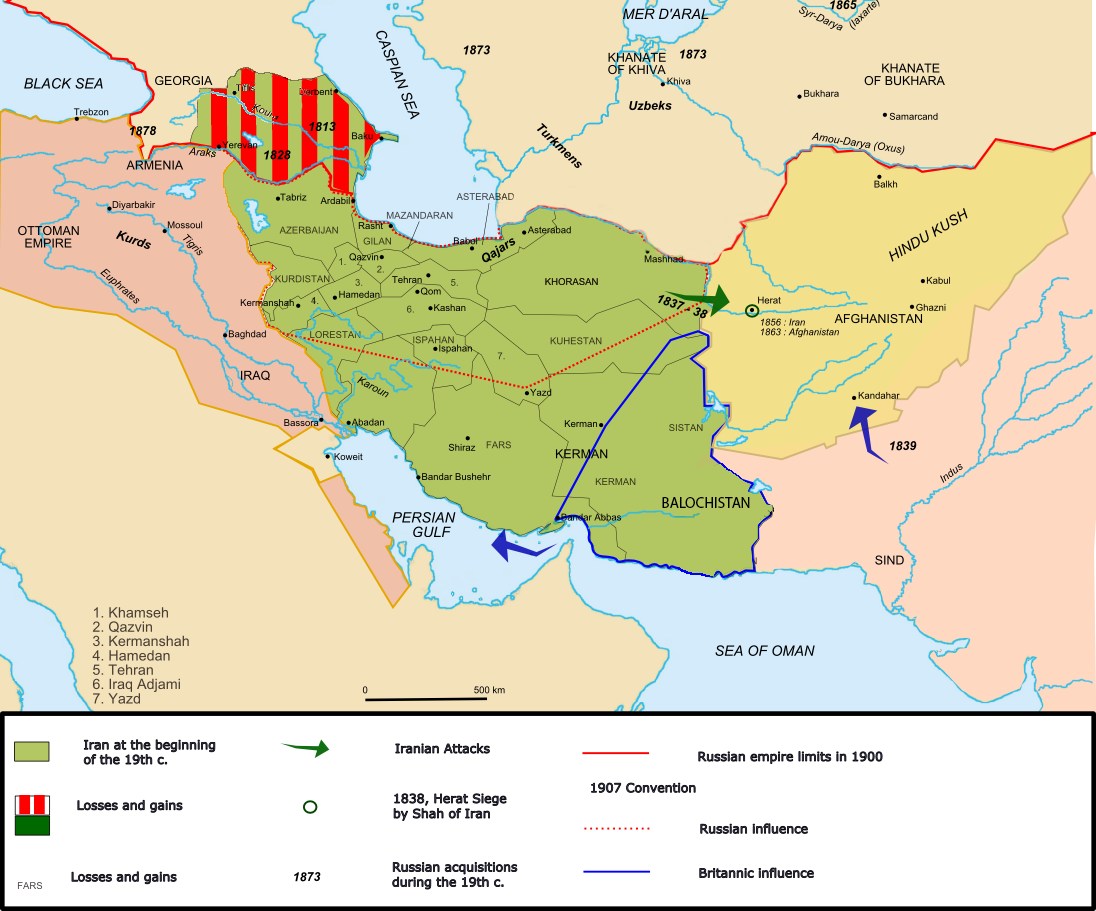
The Convention ended the long dispute over Persia between the two parties. The United Kingdom promised to stay out of northern Persia, and Russia recognized southern Persia as part of the British sphere of influence. Russia also promised to stay out of Tibet and Afghanistan. In exchange, London extended loans and some political support. The convention brought shaky British–Russian relations to the forefront by solidifying boundaries that identified respective control in Persia, Afghanistan, and Tibet. This agreement would eventually form a component of the Triple Entente.
During the last third of the nineteenth century, the Russian Empire's advances into Central Asia and the consolidation of the United Kingdom's domination of South Asia led to intense rivalry between the two European powers. The conflicting interests centered on Afghanistan, Iran, and Tibet, three states that constituted buffers between the two powers. The emergence of the German Empire as a world power and the defeat in 1905 of Russia by a nascent Asian power, the Empire of Japan, in the Russo-Japanese War, helped to persuade some British and Russian officials of a need to resolve their respective differences in Asia.[failed verification] There was talk of an entente during the 1880s and 1890s, especially after Britain's occupation of Egypt in 1882. However, there was stiff resistance in Britain to a deal with Russia. In the leadup to the convention, there were discussions on the Straits question. Foreign Minister Sir Edward Grey thought entente with Russia a good idea. On 20 October 1905, during the election, he said:
...if Russia accepts, cordially and whole-heartedly, our intention to preserve the peaceable possession of our Asiatic possessions, then I am quite sure that in this country no government will make it its business to thwart or obstruct Russia's policy in Europe. On the contrary, it is urgently desirable that Russia's position and influence be re-established in the councils of Europe.
and later, writing to his ambassador to Russia Sir Arthur Nicolson:
It is not for us to propose changes with regard to the treaty conditions of the Dardanelles. I think some change in the direction desired by Russia would be admissible and we should be prepared to discuss the question if Russia introduces it.
In early 1907, Alexander Izvolsky, the Russian ambassador at Paris, raised the question and talks were carried on in London with Russian Ambassador Count Alexander Benckendorff. Little is known but the "suggestion appears to have been made that Russia should have free egress from the Black Sea through the Straits, while other powers should have the right to send their vessels of war into the Straits without going into the Black Sea" together with some talk of "Russia's occupying the Bosphorus and England the Dardanelles, after which the Straits might be opened to other warships as well." In the event nothing came of the discussions at the time.
On 20 May 1882, Germany entered into the Triple Alliance with Italy and Austria-Hungary, complementing its industrial and socio-political ascendance in the world arena. Furthermore, Germany dramatically increased its military output from the early 1900s up to the outbreak of the First World War. Under the unified German state, Otto von Bismarck worked to increase the nation's global influence and reach what was then the zenith of German power. While Britain and Russia were hostile to German designs in the region, members of the Triple Alliance were in turn opposed to Anglo-Russian influence in Asia. Thus, military and territorial expansion was Germany's key to making itself a major player in the international arena of power. Germany's interest in the Middle East took a secondary position, one subordinate to Germany's primary policy toward Europe, throughout the late 19th and early 20th centuries. While of secondary importance, it was a tool that was used to manipulate the Middle Eastern attempt to play off the Western powers against each other. Berlin peacefully made inroads into the Ottoman Empire and had few colonial aspirations in the region.
Hub AI
Anglo-Russian Convention AI simulator
(@Anglo-Russian Convention_simulator)
Anglo-Russian Convention
The Anglo-Russian Convention of 1907 was a treaty signed between United Kingdom and the Russian Empire on 31 August 1907 in Saint Petersburg. It marked the end of the "Great Game" in Central Asia, where a longstanding rivalry had ensued between the two European colonial empires. The treaty also furthered the Anglo-Russian interest to outflank the German Empire, which was threatening to establish a railroad from Berlin to Baghdad and align with the weakened Ottoman Empire.
The Convention ended the long dispute over Persia between the two parties. The United Kingdom promised to stay out of northern Persia, and Russia recognized southern Persia as part of the British sphere of influence. Russia also promised to stay out of Tibet and Afghanistan. In exchange, London extended loans and some political support. The convention brought shaky British–Russian relations to the forefront by solidifying boundaries that identified respective control in Persia, Afghanistan, and Tibet. This agreement would eventually form a component of the Triple Entente.
During the last third of the nineteenth century, the Russian Empire's advances into Central Asia and the consolidation of the United Kingdom's domination of South Asia led to intense rivalry between the two European powers. The conflicting interests centered on Afghanistan, Iran, and Tibet, three states that constituted buffers between the two powers. The emergence of the German Empire as a world power and the defeat in 1905 of Russia by a nascent Asian power, the Empire of Japan, in the Russo-Japanese War, helped to persuade some British and Russian officials of a need to resolve their respective differences in Asia.[failed verification] There was talk of an entente during the 1880s and 1890s, especially after Britain's occupation of Egypt in 1882. However, there was stiff resistance in Britain to a deal with Russia. In the leadup to the convention, there were discussions on the Straits question. Foreign Minister Sir Edward Grey thought entente with Russia a good idea. On 20 October 1905, during the election, he said:
...if Russia accepts, cordially and whole-heartedly, our intention to preserve the peaceable possession of our Asiatic possessions, then I am quite sure that in this country no government will make it its business to thwart or obstruct Russia's policy in Europe. On the contrary, it is urgently desirable that Russia's position and influence be re-established in the councils of Europe.
and later, writing to his ambassador to Russia Sir Arthur Nicolson:
It is not for us to propose changes with regard to the treaty conditions of the Dardanelles. I think some change in the direction desired by Russia would be admissible and we should be prepared to discuss the question if Russia introduces it.
In early 1907, Alexander Izvolsky, the Russian ambassador at Paris, raised the question and talks were carried on in London with Russian Ambassador Count Alexander Benckendorff. Little is known but the "suggestion appears to have been made that Russia should have free egress from the Black Sea through the Straits, while other powers should have the right to send their vessels of war into the Straits without going into the Black Sea" together with some talk of "Russia's occupying the Bosphorus and England the Dardanelles, after which the Straits might be opened to other warships as well." In the event nothing came of the discussions at the time.
On 20 May 1882, Germany entered into the Triple Alliance with Italy and Austria-Hungary, complementing its industrial and socio-political ascendance in the world arena. Furthermore, Germany dramatically increased its military output from the early 1900s up to the outbreak of the First World War. Under the unified German state, Otto von Bismarck worked to increase the nation's global influence and reach what was then the zenith of German power. While Britain and Russia were hostile to German designs in the region, members of the Triple Alliance were in turn opposed to Anglo-Russian influence in Asia. Thus, military and territorial expansion was Germany's key to making itself a major player in the international arena of power. Germany's interest in the Middle East took a secondary position, one subordinate to Germany's primary policy toward Europe, throughout the late 19th and early 20th centuries. While of secondary importance, it was a tool that was used to manipulate the Middle Eastern attempt to play off the Western powers against each other. Berlin peacefully made inroads into the Ottoman Empire and had few colonial aspirations in the region.