
Recent from talks
Angrivarii
Knowledge base stats:
Talk channels stats:
Members stats:
Angrivarii
The Angrivarii (or Angrivari) were a Germanic people of the early Roman Empire, who lived in what is now northwest Germany near the middle of the Weser river. They were mentioned by the Roman authors Tacitus and Ptolemy.
They were part of the Germanic alliance led by Arminius and his defeat of the Romans at the Battle of the Teutoburg Forest in the ninth year of the Common Era.
The Angrivarii lived in an area which was later called Angria (Modern German "Engern") in the Middle Ages, which was a major part of the Carolingian Duchy of Saxony. Both names probably derive from geographical terminology.
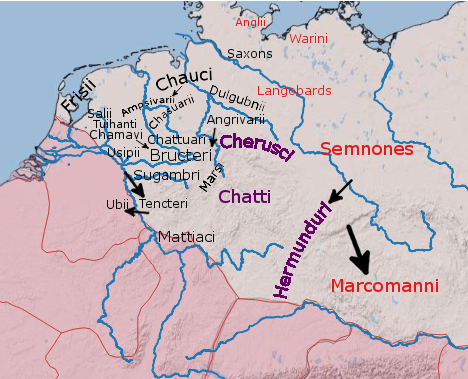
In his Germania Tacitus described the Angrivarii and their western neighbours the Chamavi living east of the Frisii who lived towards the Rhine river which was the official border of the Roman Empire, and behind them, further from the Romans, were "the Dulgubini and Chasuarii, and other tribes not equally famous". The Chasuarii probably lived near the Hase river, north of them, and the Dulgubini probably lived further east towards the Elbe. North of all these peoples lived the Chauci, living along the North Sea coast in what is now Germany.
Among the more detailed mentions of the Angrivarii which Tacitus makes in his Annals, he describes them also as neighbours to the powerful Cherusci people, of Arminius, who apparently lived east of them. They had built a dike to mark the boundary, and this was west of the Weser.
Tacitus also notes in his Germania that together with the Chamavi, the Angrivarii had invaded the lands formerly held by the Bructeri to their south, the Bructeri having been expelled and utterly destroyed by an alliance of neighboring peoples.... The Bructeri had lived near the Ems and Lippe rivers, between the Rhine and Weser. This occurred after the battle of the Teutoburg Forest.
Nevertheless, in the second century CE, the geographer Ptolemy reported that the Bructeri were still living in the same approximate area, with a lesser group of Bructeri residing near the mouth of the Rhine, among the Frisii, and a larger group located just south of the coastal Chauci, who lived between the Ems and Weser rivers. He places the Chamavi (Chamai) south of these Bructeri. He reports the Angrivarii east of the Weser river, just south of the "greater" Chauci who lived on the coast between Weser and Elbe. South of the Angrivarii, he positions the Langobardi, and then the Dulgubnii. Unfortunately, Ptolemy's positioning of these peoples is confused in various places.
The name appears earliest in the Annales and Germania of Tacitus as Angrivarii. In Greek, Ptolemy called them the Angriouarroi (Ancient Greek: Ἀνγριουάρροι), which transliterates into Latin Angrivari. In post-classical history the name of the people had a number of different spellings in addition to the ones just mentioned.
Hub AI
Angrivarii AI simulator
(@Angrivarii_simulator)
Angrivarii
The Angrivarii (or Angrivari) were a Germanic people of the early Roman Empire, who lived in what is now northwest Germany near the middle of the Weser river. They were mentioned by the Roman authors Tacitus and Ptolemy.
They were part of the Germanic alliance led by Arminius and his defeat of the Romans at the Battle of the Teutoburg Forest in the ninth year of the Common Era.
The Angrivarii lived in an area which was later called Angria (Modern German "Engern") in the Middle Ages, which was a major part of the Carolingian Duchy of Saxony. Both names probably derive from geographical terminology.
In his Germania Tacitus described the Angrivarii and their western neighbours the Chamavi living east of the Frisii who lived towards the Rhine river which was the official border of the Roman Empire, and behind them, further from the Romans, were "the Dulgubini and Chasuarii, and other tribes not equally famous". The Chasuarii probably lived near the Hase river, north of them, and the Dulgubini probably lived further east towards the Elbe. North of all these peoples lived the Chauci, living along the North Sea coast in what is now Germany.
Among the more detailed mentions of the Angrivarii which Tacitus makes in his Annals, he describes them also as neighbours to the powerful Cherusci people, of Arminius, who apparently lived east of them. They had built a dike to mark the boundary, and this was west of the Weser.
Tacitus also notes in his Germania that together with the Chamavi, the Angrivarii had invaded the lands formerly held by the Bructeri to their south, the Bructeri having been expelled and utterly destroyed by an alliance of neighboring peoples.... The Bructeri had lived near the Ems and Lippe rivers, between the Rhine and Weser. This occurred after the battle of the Teutoburg Forest.
Nevertheless, in the second century CE, the geographer Ptolemy reported that the Bructeri were still living in the same approximate area, with a lesser group of Bructeri residing near the mouth of the Rhine, among the Frisii, and a larger group located just south of the coastal Chauci, who lived between the Ems and Weser rivers. He places the Chamavi (Chamai) south of these Bructeri. He reports the Angrivarii east of the Weser river, just south of the "greater" Chauci who lived on the coast between Weser and Elbe. South of the Angrivarii, he positions the Langobardi, and then the Dulgubnii. Unfortunately, Ptolemy's positioning of these peoples is confused in various places.
The name appears earliest in the Annales and Germania of Tacitus as Angrivarii. In Greek, Ptolemy called them the Angriouarroi (Ancient Greek: Ἀνγριουάρροι), which transliterates into Latin Angrivari. In post-classical history the name of the people had a number of different spellings in addition to the ones just mentioned.
Recent media