Angrivarii
Angrivarii
Main page
2040842

Angrivarii

logo
Community Hub0 subscribers
Read side by side
from Wikipedia
The approximate locations of the Sicambri and Bructeri in about 10 BC
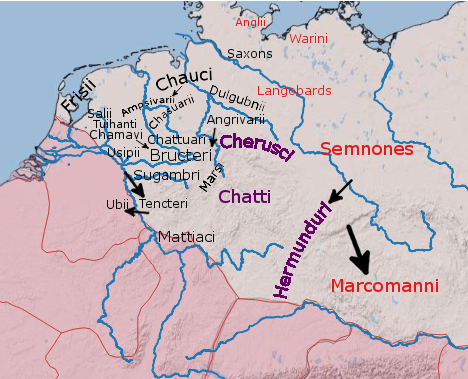
Approximate positions of tribes in about 100 AD
A view of the country around Minden, part of ancient Engern

The Angrivarii (or Angrivari) were a Germanic people of the early Roman Empire, who lived in what is now northwest Germany near the middle of the Weser river. They were mentioned by the Roman authors Tacitus and Ptolemy.

They were part of the Germanic alliance led by Arminius and his defeat of the Romans at the Battle of the Teutoburg Forest in the ninth year of the Common Era.

The Angrivarii lived in an area which was later called Angria (Modern German "Engern") in the Middle Ages, which was a major part of the Carolingian Duchy of Saxony. Both names probably derive from geographical terminology.

Location

[edit]

In his Germania Tacitus described the Angrivarii and their western neighbours the Chamavi living east of the Frisii who lived towards the Rhine river which was the official border of the Roman Empire, and behind them, further from the Romans, were "the Dulgubini and Chasuarii, and other tribes not equally famous".[1] The Chasuarii probably lived near the Hase river, north of them, and the Dulgubini probably lived further east towards the Elbe. North of all these peoples lived the Chauci, living along the North Sea coast in what is now Germany.

Among the more detailed mentions of the Angrivarii which Tacitus makes in his Annals, he describes them also as neighbours to the powerful Cherusci people, of Arminius, who apparently lived east of them. They had built a dike to mark the boundary, and this was west of the Weser.[2]

Tacitus also notes in his Germania that together with the Chamavi, the Angrivarii had invaded the lands formerly held by the Bructeri to their south, the Bructeri having been expelled and utterly destroyed by an alliance of neighboring peoples....[3] The Bructeri had lived near the Ems and Lippe rivers, between the Rhine and Weser.[4] This occurred after the battle of the Teutoburg Forest.

Nevertheless, in the second century CE, the geographer Ptolemy reported that the Bructeri were still living in the same approximate area, with a lesser group of Bructeri residing near the mouth of the Rhine, among the Frisii, and a larger group located just south of the coastal Chauci, who lived between the Ems and Weser rivers. He places the Chamavi (Chamai) south of these Bructeri. He reports the Angrivarii east of the Weser river, just south of the "greater" Chauci who lived on the coast between Weser and Elbe. South of the Angrivarii, he positions the Langobardi, and then the Dulgubnii. Unfortunately, Ptolemy's positioning of these peoples is confused in various places.[5]

Name and etymology

[edit]
Upland meadow in Wiehengebirge, part of ancient Engern

The name appears earliest in the Annales and Germania of Tacitus as Angrivarii. In Greek, Ptolemy called them the Angriouarroi (Ancient Greek: Ἀνγριουάρροι), which transliterates into Latin Angrivari. In post-classical history the name of the people had a number of different spellings in addition to the ones just mentioned.

The name Angrivarii can be segmented Angri-varii, meaning "the men of Engern", parallel to Ampsi-varii, "the men of the Ems". Engern, their region, is related to a word for meadows, as in modern German "Anger", and appears as a component in placenames around Germany.

Julius Pokorny derives the first element from an Indo-European root *ang-, "to bend, bow." From this root are also derived German Anger, English dialect ing, Danish eng, Swedish äng, Dutch eng/enk, and many other forms in Germanic languages, all meaning "meadow, pasture."[6] Cf. the similar element Angeln.

The second element -varii is most prolific among Germanic tribal names, commonly taken to mean "inhabitants of", "dwellers in". Its precise etymology remains unclear, but there is a consensus that it cannot be derived from the PIE root *wihxrós, "man", surviving in English "were-wolf".[7]

Their geographical-based name is associated with the 8th century region called Angria (Angaria, Angeriensis, Aggerimensis, and Engaria), which was one of four subdivisions of Old Saxony (the others were Westfalahi, Ostfalahi, and Nordalbingia). This region is now referred to in modern German as Engern, and it corresponds reasonably well with the area where the Angrivarii lived, comprising most of the country surrounding the middle Weser, including both flat land, as around Minden, and low hills (Holzminden).

Ancient history

[edit]
Thusnelda at the Triumph of Germanicus, by Karl von Piloty, 1873.[8]

Although the Angrivarii receive brief mention in Ptolemy (2.10) and the Germania of Tacitus (33), they appear mainly at several locations in Annales. They were involved marginally in the wars fought by the talented Germanicus Caesar on behalf of his uncle Tiberius, emperor of Rome, against the perpetrators of the massacre of three Roman legions in the Battle of the Teutoburg Forest, in the year 9.

The wars began in the last years of the reign of Augustus, the first emperor of Rome. Augustus died an old but respected man in the year 14 and was celebrated with much pomp and splendor. He left a document to be read to the senate posthumously, expressly forbidding extension of the empire beyond the Rhine. News of the will was welcomed by the Germans, thinking it gave them a free hand in the region. Germanicus found it necessary to pacify the border, which he did by a combination of scorched earth raids and offers of alliance with Rome - in short, stick and carrot. These raids also kept the army of the Lower Rhine distracted from the possibility of mutiny, which had broken out on Augustus's death and only been quelled by concessions and executions.

For punitive expeditions, Germanicus used the Ems river, which flowed from the heart of the country occupied by the tribes that became the Franks. These were still under Arminius, who had led the German confederation to victory in 9. Unlike Arminius' native tribe, the Cherusci, the loyalty of the other tribes in the confederation was at best equivocal.

The Angrivarii's defection or revolt (defectio) in the middle of Arminius's renewed operations against the Teutoburg Forest must have been secured in advance by Germanicus.[9] Even if it was not, a cavalry attack soon brought the Angrivarii's capitulation. Soon afterwards, however, they are back in alliance with the Cherusci and opposition to the Romans,[10] setting an ambush at the Cheruscan border, which was a high dirt embankment. They hid their cavalry in the woods and stationed their infantry on the reverse slope of the bank. The Romans had intelligence of the plan beforehand. They assaulted the embankment, preceding their assault with volleys from slings and spears thrown by machines. Driving the Angrivarii from the bank, they went on to pursue the cavalry in the woods. Once again, the Angrivarii were totally routed.

Once the Cherusci had been dealt with, Germanicus turned his attention to the Angrivarii.[11] They, however, surrendered unconditionally to the general sent by Germanicus and placed themselves in the status of suppliants, begging for mercy, which Germanicus granted. This later reaped dividends for the Angrivarii, who played a major role in securing the return of ships and men lost in a North Sea storm, which scattered the Roman fleet upon the shore of hostile or neutral Germanic tribes.[12]

Finally, on May 26 of the year 17, Germanicus celebrated a triumph for his victory over lower Germany, and his uncle sent him off to the east.[13] Arminius died, and the Angrivarii, the other west Germans, and their successor tribes continued friendly towards Rome, providing it with elite troops and urban and palace police. Together with the Cherusci and the Chatti, the Angrivari belong to the three tribes that Tacitus particularly emphasizes in his account of the triumphal march of Germanicus in 17 AD:

"Germanicus Caesar, celebrated his triumph over the Cherusci, Chatti, and Angrivarii, and the other tribes which extend as far as the Elbe."[14]

See also

[edit]

References

[edit]

Further reading

[edit]
[edit]
Revisions and contributorsEdit on WikipediaRead on Wikipedia
from Grokipedia
The Angrivarii (Latin: Angrivarii; Greek: Ἀνγριουάρροι) were an ancient Germanic tribe of the early Roman Empire, inhabiting the region west of the middle Weser River in what is now northwestern Germany, specifically the area known as Engern around modern Minden and parts of Westphalia.[1][2] They belonged to the broader group of West Germanic peoples and were situated between the Chauchi to the north and the Suebi to the east, forming part of the tribal landscape between the Rhine and Elbe rivers.[3][4] The Angrivarii are primarily known from classical Roman sources, with their earliest mentions appearing in the Germania and Annales of the historian Tacitus (c. 56–120 AD), as well as in Claudius Ptolemy's Geography (c. 150 AD).[1] In Tacitus' Germania (chapter 34), they are described as neighboring the Chamavi and other lesser-known tribes like the Dulgibini and Chasauri, positioned inland along the Frisian frontier.[4] Ptolemy locates them more precisely in his coordinate-based map of Germania Magna, placing them between the greater Chauchi and the Suebi as one of the smaller inland tribes.[2] Earlier references occur in accounts of Roman military expeditions, such as Tiberius' campaigns against the Germanic tribes in 4 AD, which traversed regions including their territory.[3] Historically, the Angrivarii played a notable role in Roman-Germanic conflicts following the Battle of the Teutoburg Forest in 9 AD. During Germanicus' punitive expeditions (14–16 AD), they initially supported the Cheruscan leader Arminius but soon defected, raising an earthen barrier against the Cherusci and surrendering unconditionally to Roman forces under Stertinius.[5] Tacitus details their submission in Annales Book II, chapters 8, 19, and 22, recounting how they aided the Romans by returning many stranded soldiers after a storm (Annals 2.24), and were subsequently forgiven and integrated as allies.[5] After Arminius' death around 19 AD, the tribe maintained peaceful relations with Rome, contributing to the stabilization of the frontier without further major revolts recorded.[1]

Name and Etymology

Linguistic Origins

The name "Angrivarii" derives from the Proto-Germanic compound *angrawarjaz, formed by combining *angraz, meaning "meadow" or "grassy plain," with *warjaz, denoting "inhabitants" or "dwellers."[6][7][8] This construction yields a translation of "meadow-dwellers" or "people of the meadows," reflecting a typical pattern in early Germanic tribal nomenclature where a locative element describes the group's association with a landscape feature, followed by a suffix indicating collective identity. The *angraz element traces back to Proto-Indo-European *h₂eng- ("corner"), evolving to signify lowland meadows or floodplains in Germanic contexts.[6] This etymological structure parallels other Germanic tribal names employing the *-warjaz suffix, such as the Ampsivarii ("dwellers by the Ems") and Chasuarii ("dwellers in the Chasu"), where the suffix denotes "men of" or "inhabitants of" a specific territory.[9] Such formations underscore the role of landscape in shaping early Germanic ethnonyms, distinguishing groups by their environmental niches without implying nomadic origins. The earliest attestation of the name occurs in Tacitus's Germania (c. 98 CE), where it is rendered as "Angrivarii," describing the tribe's position among northern Germanic peoples east of the Rhine. Approximately fifty years later, Claudius Ptolemy records it as "Angriouarroi" in his Geography (c. 150 CE), placing the tribe inland from the Frisii along the Weser River region.[10] These Latin and Greek forms preserve the phonetic core of the Proto-Germanic original, with minor adaptations for classical orthography. The name later evolved into medieval regional terms like "Engern," linking the ancient tribe to Westphalian districts.[9]

Historical and Medieval Designations

The Angrivarii were first attested as a distinct Germanic tribe in Roman ethnographic literature of the late first century CE. In his Germania, the Roman historian Tacitus described them as residing between the Chamavi to the west and the Dulgubnii and Chasuarii to the south, with the Frisii bordering them to the north along the Rhine and adjacent lakes.[11] This positioning highlighted their inland location within the broader network of West Germanic peoples during the early Roman Empire. Approximately a century later, the geographer Claudius Ptolemy included the Angriouarioi—corresponding to the Angrivarii—among the inland Germanic tribes in Book II, Chapter 10 of his Geography, placing them east of the Chamavi and north of the Chatti, with coordinates approximating the middle Weser River region (55° 40' N, 17° E). By the eighth century, during the Carolingian conquests, the tribal name evolved into forms reflecting their territorial designation within the Saxon confederation. The Annales Regni Francorum records that in 775, the Angriani—leaders of the Angrivarii—submitted to Charlemagne, concluding a separate peace treaty and providing hostages, marking their integration into Frankish overlordship as a distinct Saxon subgroup alongside the Westphali and Eastphali.[12] This usage persisted in Carolingian documents from the late eighth and ninth centuries, where the region was redesignated as Angria or Engern, denoting a pagus or administrative district within the Duchy of Saxony, as evidenced in charters and annals that trace the continuity of the name from ancient tribal identity to medieval territorial units.[13] In the ninth century, references to the Angrivarii as a tribe faded, with the Annales Regni Francorum treating the area as an undifferentiated part of the Saxon duchy under Frankish control, without explicit tribal nomenclature. This shift underscored the absorption of the Angrivarii into broader Saxon structures following the Saxon Wars (772–804 CE), where Engern became a standard toponym for the central Weser valley in ecclesiastical and royal records, symbolizing the transition from ethnic to regional designation.

Geography and Territory

Primary Location

The Angrivarii primarily inhabited the central territory along the middle Weser River in northwest Germany, a region extending from modern-day Minden northward to the area near Hanover. This area, historically known as Engern, formed the core of their settlement during the Roman era, encompassing both flat alluvial plains and low hills suitable for dispersed villages and farming communities.[9][14] As described by the Roman historian Tacitus in his work Germania (chapter 34), the Angrivarii shared a frontier with the Chamavi and were bordered to the south by the Dulgubnii and Chasuarii, while to their west lay the Frisii along the coastal zones. This positioning placed their lands east of the Rhine River and inland from the North Sea coast, within the broader landscape of Magna Germania beyond direct Roman control.[15][16] The environmental characteristics of this territory included fertile river valleys and extensive meadows along the Weser, supported by loess and alluvial soils that facilitated agriculture, pastoralism, and permanent settlements. These features, with their rich, silt-like deposits, provided ideal conditions for grain cultivation and livestock rearing, reflecting the tribe's adaptation to a landscape of meandering waterways and floodplains.[17][18]

Neighboring Tribes and Boundaries

The Angrivarii occupied a territory in northwest Germany during antiquity, positioned within the broader West Germanic tribal landscape as described by Ptolemy in his Geography (Book 2, Chapter 10), where they are placed between the greater Chauci to the north and the Suebi to the east, with their settlements inferred from coordinates along the middle Weser River region.[2] Their northern boundary was shared with the Chauci, extending along the lower Weser River and into the coastal marshes of the North Sea, where the Chauci maiores stretched from approximately 31° longitude to the Albis (Elbe) River at 56°15' latitude, forming a natural divide marked by estuarine wetlands and tidal flats.[2][19] To the southeast, the Angrivarii bordered the Cherusci, whose territories lay south of the middle Weser toward the Harz Mountains, while to the southwest the Bructeri occupied areas along the upper Ems River, with fluid boundaries often delineated by river courses such as the Ems (Amisia at 29° longitude, 55° latitude) and associated woodlands that hindered large-scale migrations.[2][15] On the western side, they were proximate to the Chamavi, who dwelt nearer the Rhine frontier, sharing a common rear boundary with the Dulgubnii and Chasuarii to the south, as the two tribes together fronted the Frisii along the western coastal lowlands.[15] These tribal adjacencies reflect the interconnected West Germanic groupings, with Ptolemy's schematic coordinates positioning the Angrivarii inland from the Frisian and Chaucian coastal zones but east of the Rhine-dominated areas held by the Chamavi and Batavi.[2] Natural features reinforced these boundaries, with the Weser River serving as a central axis through the Angrivarii's core territory around its middle reaches, flanked by dense forests like the remnants of the Teutoburg and extensive wetlands that limited expansion northward into Chaucian marshes or eastward across the Ems toward the Bructeri.[15][2] Such geographical constraints, including riverine barriers and boggy terrains, contributed to the relative stability of these tribal frontiers during the early Roman Empire, though they remained permeable to seasonal movements and alliances.[15]

History

Early Roman Encounters

The Angrivarii first enter the Roman historical record in Tacitus's Germania, composed around 98 CE, where they are portrayed as a Germanic tribe sharing a frontier with the Chamavi and bordered to the south by the Dulgubnii, Chasuarii, and other lesser-known groups, with the Frisians positioned to their northwest along the Rhine and adjacent waterways.[20] This ethnographic description situates the Angrivarii in the inland territories east of the Rhine, in close proximity to the Cherusci, reflecting Roman familiarity with their location and regional associations well before the pivotal events of 9 CE.[9] Direct Roman interactions with the Angrivarii remained minimal prior to Arminius's revolt, given their position beyond the primary Rhine limes and away from the more accessible frontier zones occupied by tribes like the Sugambri or Ubii. Roman awareness of the tribe during the late 1st century BCE and early 1st century CE stemmed primarily from indirect channels, including merchant trade routes extending from the Rhine garrisons and preliminary scouting during the exploratory campaigns led by Nero Claudius Drusus and Tiberius, which probed as far as the Weser River without establishing lasting control over inland areas. These efforts provided Romans with basic intelligence on tribal distributions but did not involve significant military or diplomatic engagements with the Angrivarii themselves. In the 2nd century CE, Claudius Ptolemy's Geography further documents the Angrivarii—rendered as Angriouarroi in Greek—placing their settlements inland between the Weser and Elbe rivers, north of the Cherusci and east of the Chamavi. This mapping, derived from earlier Roman itineraries and astronomical observations rather than conquest, underscores the empire's reliance on reconnaissance surveys for knowledge of such remote groups, highlighting the Angrivarii's peripheral role in early imperial expansions. The Angrivarii's ties to the Cherusci as neighboring allies are implied in these accounts through shared territorial boundaries.[1]

Role in Germanic-Roman Wars

The Angrivarii were neighbors and allies of the Cherusci during the early 1st century CE, within the broader context of Germanic resistance to Roman expansion following the Battle of the Teutoburg Forest in 9 CE. Around 98 AD, the Angrivarii, in alliance with the Chamavi, invaded the territory of the Bructeri to their south in a major inter-tribal conflict. According to Tacitus, these neighboring tribes defeated the Bructeri in a massive battle, nearly annihilating them and seizing their lands.[21] During Germanicus's retaliatory campaigns in 15 CE, the Angrivarii defected from their earlier alignment with Arminius's anti-Roman coalition, betraying the Cherusci and contributing to escalating internal conflicts among the Germanic tribes. Tacitus records this shift in allegiance, noting a revolt by the Angrivarii that disrupted unified resistance. This defection led to the Battle of the Angrivarian Wall, where Roman forces under Germanicus supported the Angrivarii by defeating Arminius's Cherusci, further weakening the broader Germanic front against Rome.[5][22]

Post-Conflict Relations and Integration

Following the campaigns of Germanicus in Germania, the Angrivarii surrendered to Roman forces in 16 CE without engaging in battle. Tacitus records that Germanicus dispatched the legate Stertinius to subdue the tribe, but the Angrivarii preempted conflict by submitting as suppliants and yielding to all demands, thereby securing a complete pardon.[23] This act of submission came after their earlier defection to Arminius in 15 CE, marking a swift reversal in allegiance. The pacification of the Angrivarii was formally recognized in Germanicus's triumph held in Rome on May 26, 17 CE. Tacitus describes the procession as celebrating victories over the Cherusci, Chatti, Angrivarii, and other tribes up to the Elbe River, with spoils, prisoners, and symbolic representations of the conquered landscapes paraded through the city.[24] Despite the grandeur of the event, the triumph underscored an incomplete conquest, as Germanicus had been recalled by Tiberius before fully subjugating the region. Post-surrender, the Angrivarii integrated into the Roman sphere as a client tribe, contributing to the imperial auxiliary system without their territory being annexed or occupied by legions. This arrangement allowed Rome to leverage their manpower for frontier defense while maintaining a buffer against more resistant groups like the Cherusci, reflecting Tiberius's policy of stabilization over expansion.[23] Their compliance ensured ongoing Roman influence in the area east of the Rhine for several decades.

Legacy and Later Developments

Merger with Saxon Groups

During the late 3rd and 4th centuries CE, the Angrivarii experienced increasing integration with emerging Saxon groups, as smaller Germanic tribes coalesced into larger confederations amid Roman pressures and internal migrations. Historical reconstructions indicate that by around 300 CE, the Angrivarii lost much of their distinct identity, becoming subsumed within the Saxon alliance, which encompassed neighboring peoples like the Chauci and Frisians along the North Sea coast.[9] This process reflected broader shifts in West Germanic tribal dynamics, where shared cultural and economic ties facilitated the formation of the Saxon ethnonym. As part of this confederation, elements from the Angrivarii region contributed to the broader Saxon migrations across the North Sea in the 5th century CE. Geographical and linguistic linkages further underscore this merger, with Claudius Ptolemy's 2nd-century Geography placing the Angrivarii adjacent to the early Saxones between the Weser and Elbe rivers, territories that later formed the core of Saxon domains. Later chroniclers, drawing on these positions and shared West Germanic dialects—characterized by North Sea Germanic features like the Ingvaeonic nasal spirant law—portrayed the Angrivarii as a subgroup of the Saxons, evidenced by toponymic survivals such as "Angern" in medieval Lower Saxony.[13] This ethnic blending solidified by the mid-5th century, marking the Angrivarii's transition from an independent tribe to a constituent part of the Saxon confederation.

Influence on Medieval Regions

Following the conquest and integration of Saxon territories into the Carolingian Empire during the 8th century CE, the former lands of the Angrivarii were designated as the region of Engern, forming one of the three primary stem duchies of the Duchy of Saxony alongside Westphalia and Eastphalia. This administrative structure emerged as part of Charlemagne's reorganization of conquered Saxon areas to consolidate Frankish control, dividing the duchy into these historical provinces based on pre-existing tribal divisions.[25][26] The Engern region played a central role in the Saxon Wars (772–804 CE), serving as a key battleground for conflicts between Charlemagne's Frankish forces and the Saxon leader Widukind, who rallied resistance from Westphalian and Angrian territories. Major engagements, including Widukind's raids and Frankish reprisals, devastated the area, leading to forced Christianization through missionary efforts and the destruction of pagan sites like the Irminsul, as well as the imposition of feudal hierarchies that bound local elites to Carolingian authority. These wars ultimately resulted in the subjugation of Engern, transforming it from a focal point of rebellion into a stabilized province under imperial oversight.[27][28] The designation "Engern" or "Angri" endured in medieval Latin chronicles and administrative records, referring to the territory encompassing much of modern Lower Saxony between the Weser and Leine rivers, and it shaped subsequent county divisions, notably the County of Engern that operated from the 10th to 12th centuries as a local administrative unit under Saxon ducal oversight. This persistence reflected the lasting impact of Carolingian reforms on regional governance, where Engern's boundaries influenced the allocation of fiefs and ecclesiastical jurisdictions amid the fragmentation of Saxon power.[9]

References

User Avatar
No comments yet.