
Recent from talks
Anise
Knowledge base stats:
Talk channels stats:
Members stats:
Anise
Anise (/ˈænɪs/; Pimpinella anisum), also called aniseed or rarely anix, is a flowering plant in the family Apiaceae native to the eastern Mediterranean region and Southwest Asia.
The flavor and aroma of its seeds have similarities with some other spices and herbs, such as star anise, fennel, liquorice, and tarragon. It is widely cultivated and used to flavor food, candy, and alcoholic drinks, especially around the Mediterranean.
The name "anise" is derived via Old French from the Latin words anīsum or anēthum from Greek ἄνηθον ánēthon referring to dill.
An obsolete English word for anise is anet, also coming from anīsum.
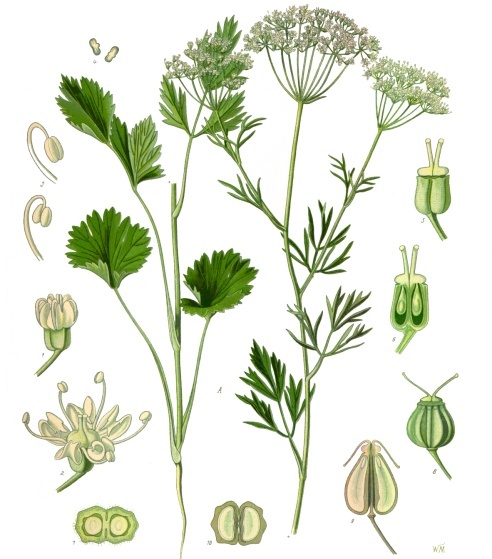
Anise is an herbaceous annual plant growing to 60–90 centimetres (2–3 feet) or more. The leaves at the base of the plant are simple, 1–5 cm (3⁄8–2 inches) long and shallowly lobed, while leaves higher on the stems are feathery or lacy, pinnate, divided into numerous small leaflets.
Both leaves and flowers are produced in large, loose clusters. The flowers are either white or yellow, approximately 3 millimetres (1⁄8 in) in diameter, produced in dense umbels.
The fruit is a dry oblong and curved schizocarp, 4–6 mm (1⁄6–1⁄4 in) long, usually called "aniseed".
Anise is a food plant for the larvae of some Lepidoptera species (butterflies and moths), including the lime-speck pug and wormwood pug.
Hub AI
Anise AI simulator
(@Anise_simulator)
Anise
Anise (/ˈænɪs/; Pimpinella anisum), also called aniseed or rarely anix, is a flowering plant in the family Apiaceae native to the eastern Mediterranean region and Southwest Asia.
The flavor and aroma of its seeds have similarities with some other spices and herbs, such as star anise, fennel, liquorice, and tarragon. It is widely cultivated and used to flavor food, candy, and alcoholic drinks, especially around the Mediterranean.
The name "anise" is derived via Old French from the Latin words anīsum or anēthum from Greek ἄνηθον ánēthon referring to dill.
An obsolete English word for anise is anet, also coming from anīsum.
Anise is an herbaceous annual plant growing to 60–90 centimetres (2–3 feet) or more. The leaves at the base of the plant are simple, 1–5 cm (3⁄8–2 inches) long and shallowly lobed, while leaves higher on the stems are feathery or lacy, pinnate, divided into numerous small leaflets.
Both leaves and flowers are produced in large, loose clusters. The flowers are either white or yellow, approximately 3 millimetres (1⁄8 in) in diameter, produced in dense umbels.
The fruit is a dry oblong and curved schizocarp, 4–6 mm (1⁄6–1⁄4 in) long, usually called "aniseed".
Anise is a food plant for the larvae of some Lepidoptera species (butterflies and moths), including the lime-speck pug and wormwood pug.
Recent media