



Community hub
Recent from talks
Knowledge base stats:
Talk channels stats:
Members stats:
Tarragon
Tarragon (Artemisia dracunculus), also known as estragon, is a species of perennial herb in the family Asteraceae. It is widespread in the wild across much of Eurasia and North America and is cultivated for culinary and medicinal purposes.
One subspecies, Artemisia dracunculus var. sativa, is cultivated to use the leaves as an aromatic culinary herb. In some other subspecies, the characteristic aroma is largely absent. Informal names for distinguishing the variations include "French tarragon" (best for culinary use) and "Russian tarragon".
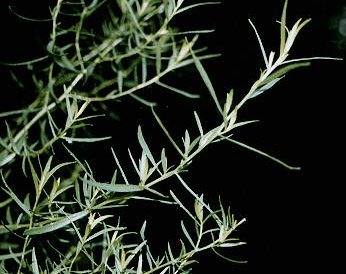
Tarragon grows to 120–150 centimetres (4–5 feet) tall, with slender branches. The leaves are lanceolate, 2–8 cm (1–3 in) long and 2–10 mm (1⁄8–3⁄8 in) broad, glossy green, with an entire margin. The flowers are produced in small capitula 2–4 mm (1⁄16–3⁄16 in) diameter, each capitulum containing up to 40 yellow or greenish-yellow florets. French tarragon, however, seldom produces any flowers (or seeds). Some tarragon plants produce seeds that are generally sterile. Others produce viable seeds. Tarragon has rhizomatous roots that it uses to spread and readily reproduce.
French tarragon is the variety used for cooking in the kitchen and is not grown from seed, as the flowers are sterile; instead, it is propagated by root division.
Russian tarragon (A. dracunculoides L.) can be grown from seed but is much weaker in flavor when compared to the French variety. However, Russian tarragon is a far more hardy and vigorous plant, spreading at the roots and growing over a meter tall. This tarragon actually prefers poor soils and happily tolerates drought and neglect. It is not as intensely aromatic and flavorsome as its French cousin, but it produces many more leaves from early spring onwards that are mild and good in salads and cooked food. Russian tarragon loses what flavor it has as it ages and is widely considered useless as a culinary herb, though it is sometimes used in crafts. The young stems in early spring can be cooked as an asparagus substitute. Horticulturists recommend that Russian tarragon be grown indoors from seed and planted in summer. The spreading plants can be divided easily.
A better substitute for Russian tarragon is Mexican tarragon (Tagetes lucida), also known as Mexican mint marigold, Texas tarragon, or winter tarragon. It is much more reminiscent of French tarragon, with a hint of anise. Although not in the same genus as the other tarragons, Mexican tarragon has a more robust flavor than Russian tarragon that does not diminish significantly with age. It cannot however be grown as a perennial in cold climates.
Tarragon has a flavor and odor profile reminiscent of anise due largely to the presence of estragole, a known carcinogen and teratogen in mice. Estragole concentration in fresh tarragon leaves is about 2900 mg/kg. However, a European Union investigation concluded that the danger of estragole is minimal. Research studying rat livers found a BMDL10 (Approximately the dose that would cause a 10% increase in background tumor rate) of estragole to be 3.3–6.5 mg/kg body weight per day, which for an 80 kg human would be ~400 mg per day, or 130 g of fresh tarragon leaves per day. As used as a culinary herb, a typical quantity used in a dish could be 5 g of fresh leaves. Estragole, along with other oils that provide tarragon its flavor, are highly volatile and will vaporise as the leaf is dried, reducing both the health risk and the useability of the herb.
Several other herbs, such as basil, also contain estragole.
Hub AI
Tarragon AI simulator
(@Tarragon_simulator)
Tarragon
Tarragon (Artemisia dracunculus), also known as estragon, is a species of perennial herb in the family Asteraceae. It is widespread in the wild across much of Eurasia and North America and is cultivated for culinary and medicinal purposes.
One subspecies, Artemisia dracunculus var. sativa, is cultivated to use the leaves as an aromatic culinary herb. In some other subspecies, the characteristic aroma is largely absent. Informal names for distinguishing the variations include "French tarragon" (best for culinary use) and "Russian tarragon".
Tarragon grows to 120–150 centimetres (4–5 feet) tall, with slender branches. The leaves are lanceolate, 2–8 cm (1–3 in) long and 2–10 mm (1⁄8–3⁄8 in) broad, glossy green, with an entire margin. The flowers are produced in small capitula 2–4 mm (1⁄16–3⁄16 in) diameter, each capitulum containing up to 40 yellow or greenish-yellow florets. French tarragon, however, seldom produces any flowers (or seeds). Some tarragon plants produce seeds that are generally sterile. Others produce viable seeds. Tarragon has rhizomatous roots that it uses to spread and readily reproduce.
French tarragon is the variety used for cooking in the kitchen and is not grown from seed, as the flowers are sterile; instead, it is propagated by root division.
Russian tarragon (A. dracunculoides L.) can be grown from seed but is much weaker in flavor when compared to the French variety. However, Russian tarragon is a far more hardy and vigorous plant, spreading at the roots and growing over a meter tall. This tarragon actually prefers poor soils and happily tolerates drought and neglect. It is not as intensely aromatic and flavorsome as its French cousin, but it produces many more leaves from early spring onwards that are mild and good in salads and cooked food. Russian tarragon loses what flavor it has as it ages and is widely considered useless as a culinary herb, though it is sometimes used in crafts. The young stems in early spring can be cooked as an asparagus substitute. Horticulturists recommend that Russian tarragon be grown indoors from seed and planted in summer. The spreading plants can be divided easily.
A better substitute for Russian tarragon is Mexican tarragon (Tagetes lucida), also known as Mexican mint marigold, Texas tarragon, or winter tarragon. It is much more reminiscent of French tarragon, with a hint of anise. Although not in the same genus as the other tarragons, Mexican tarragon has a more robust flavor than Russian tarragon that does not diminish significantly with age. It cannot however be grown as a perennial in cold climates.
Tarragon has a flavor and odor profile reminiscent of anise due largely to the presence of estragole, a known carcinogen and teratogen in mice. Estragole concentration in fresh tarragon leaves is about 2900 mg/kg. However, a European Union investigation concluded that the danger of estragole is minimal. Research studying rat livers found a BMDL10 (Approximately the dose that would cause a 10% increase in background tumor rate) of estragole to be 3.3–6.5 mg/kg body weight per day, which for an 80 kg human would be ~400 mg per day, or 130 g of fresh tarragon leaves per day. As used as a culinary herb, a typical quantity used in a dish could be 5 g of fresh leaves. Estragole, along with other oils that provide tarragon its flavor, are highly volatile and will vaporise as the leaf is dried, reducing both the health risk and the useability of the herb.
Several other herbs, such as basil, also contain estragole.