Hubbry Logo
Anne BredonAnne BredonMain
Open search
Anne Bredon
Community hub
Anne Bredon
logo
8 pages, 0 posts
0 subscribers
Be the first to start a discussion here.
Anne Bredon
Anne Bredon
from Wikipedia
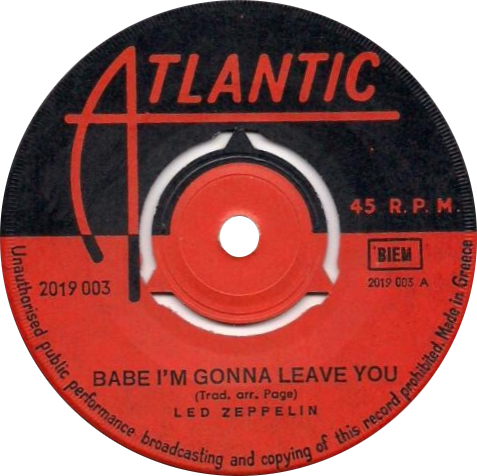
Greek vinyl of "Babe I'm Gonna Leave You", credited to "Traditional arr. Page"; Bredon would be credited with the song in 1991.

Anne Leonard Bredon (born Anne Loeb; September 7, 1930 – November 9, 2019) was an American folk singer, best known for composing the song "Babe I'm Gonna Leave You" while she was a student at University of California, Berkeley in the late 1950s. Bredon was the daughter of physicist Leonard Benedict Loeb and granddaughter of physiologist Jacques Loeb. She majored in art at Humboldt State University and completed her master's degree in mathematics at Berkeley, California.[1]

Sometime around 1960, while attending Berkeley, Bredon appeared on a live folk-music radio show, The Midnight Special, on radio station KPFA singing "Babe I'm Gonna Leave You".[2] Janet Smith, another folk singer, developed her own version of the song and performed it on the same radio show sometime later, catching the attention of Joan Baez who used the song on Joan Baez in Concert, Part 1 (1962).[2] The song was initially credited as "Traditional, arr. Baez" but properly attributed on Baez's 1964 sheet music, The Joan Baez Song Book.[2]

The English rock band Led Zeppelin covered the song after hearing Baez's version, crediting the song as "Traditional, arr. Page". In the 1980s, Bredon was made aware of Led Zeppelin's version of the song and so, since 1991, this version has been credited to Anne Bredon/Jimmy Page and Robert Plant. Bredon also received a substantial back-payment of royalties.[3]

Bredon married Lee Johannsen in 1951. She divorced in 1959, leaving her first two children, Lenore and Joel, with her ex-husband. Later, she married Glen Bredon, a mathematics professor at UC Berkeley. In 1969, they moved to Rutgers University in New Jersey where they raised their two children, Joelle and Aaron.[1]

She lived for many years in North Fork, California where she was active in the Sierra Mono Museum designs and sold beaded jewelry.[1][4] Bredon was also a Navajo-style rug-weaver and basket-weaver, focusing on Mono Indian. She possessed an extensive knowledge of the complex aspects of harvesting and preparation of grasses and materials used in traditional California "Indian" basket weaving.

Bredon died November 9, 2019, in Clovis, California.[5]

References

[edit]
Revisions and contributorsEdit on WikipediaRead on Wikipedia
from Grokipedia
Anne Leonard Bredon (née Loeb; September 7, 1930 – November 9, 2019) was an American folk , and artisan best known for composing the song in the late 1950s. Born in , she performed the song on the radio program The Midnight Special around 1960 and contributed to the early folk revival scene through her original compositions and live appearances. Later in life, Bredon lived in , where she worked as a , creating beaded jewelry, Navajo-style rugs, and baskets. Bredon's most notable work, "Babe I'm Gonna Leave You," gained widespread popularity when included it on her 1962 live album In Concert, though Baez did not initially credit Bredon as the writer, leading many to assume it was a traditional folk tune. Baez had learned the song from Janet Smith, a student at who had heard Bredon perform it. The track was later adapted by Led Zeppelin for their 1969 self-titled debut album, where it was credited as "traditional, arranged by ," further delaying Bredon's recognition. In the 1980s, after advocacy from associates, Bredon received proper songwriting credit alongside Page and , along with back royalties amounting to 50% of the song's earnings from Led Zeppelin's version, which were settled in 1991. This resolution highlighted ongoing issues in music during the folk-to-rock transition era. Bredon's limited reflects her niche role in , with her originals primarily known through covers by major artists rather than extensive personal recordings.

Early life and education

Family background

Anne Leonard Loeb was born on September 7, 1930, in , the eldest of two daughters. Her father, Leonard Benedict Loeb, was a Swiss-born American specializing in electrical phenomena, gaseous electronics, and atomic physics, who joined the faculty at the , in 1923 and rose to full professor by 1929. Her mother was Lora Loeb (née Lane). Leonard Benedict Loeb was the son of prominent German-American physiologist and biologist Jacques Loeb. Loeb's research advanced the understanding of artificial —the development of unfertilized eggs into through chemical means—and animal tropisms, the involuntary orientation responses of organisms to environmental stimuli. Raised in Berkeley amid its vibrant academic community, Anne experienced an early immersion in scientific discourse through her father's career at UC Berkeley, fostering her enduring interests in and despite the absence of musical influences in her family lineage.

Academic pursuits

Anne Bredon pursued her undergraduate studies at Humboldt State College, where she majored in and earned an A.B. degree in 1957. This artistic foundation reflected her early creative inclinations, which she later balanced with a shift toward analytical disciplines. In 1959, Bredon moved to Berkeley to undertake graduate studies in at the , culminating in a in 1963. Her academic path at UC Berkeley was influenced by her family's scholarly legacy, including her father, Leonard B. Loeb, who served as a there, and her grandfather, renowned Jacques Loeb. She did not pursue a doctorate or take on teaching roles, instead focusing on integrating her interests in art and mathematics without further formal academic advancement. During her time as a student at UC Berkeley in the late and early 1960s, Bredon became involved in the vibrant scene that characterized the campus environment. This period, amid the burgeoning folk revival and access to platforms like radio, allowed her to explore songwriting alongside her studies, though she prioritized her dual passions in the arts and sciences over professional academic or musical careers at that stage.

Career

Musical beginnings

Anne Bredon emerged in the Bay Area scene during her graduate studies in at the , in the late 1950s and early 1960s, following her undergraduate degree in art from Humboldt State College, a period marked by the burgeoning American folk revival that emphasized acoustic performances and traditional influences. As a student, she found creative outlets in the vibrant local community, where coffeehouses and radio broadcasts fostered grassroots musical expression amid the broader cultural shift toward folk authenticity. Bredon's early activities centered on live performances rather than formal training or commercial ventures, aligning with the revival's ethos of communal sharing. Her first known public appearance occurred around 1959 on radio's The Midnight Special, a late-night program hosted by folk enthusiast Barry Olivier that featured live broadcasts from Berkeley performers, showcasing original and traditional material from 11 p.m. to midnight on Saturdays. This exposure introduced her introspective style to a wider audience within the regional scene, though she remained more oriented toward personal composition than prolific output. Throughout the early , Bredon's involvement stayed rooted in non-commercial channels, with her work primarily documented through radio airings and informal gatherings rather than studio recordings. She produced few original releases during this time, prioritizing live settings that captured the intimate, reflective nature of her folk contributions, consistent with the era's emphasis on authenticity over .

Notable compositions and performances

Anne Bredon composed her signature folk ballad "Babe I'm Gonna Leave You" in the late 1950s while studying mathematics at the . The song features a simple acoustic structure typical of the era's folk tradition, centered on themes of romantic love, heartbreak, and inevitable departure, delivered through poignant and a haunting melody. The song's early dissemination occurred within the community after Bredon performed it on the live The Midnight Special at Berkeley's station in 1960. Fellow folk singer Janet Smith heard the broadcast, learned the piece, and introduced it at , where encountered it through a student performer. Baez included a solo rendition on her 1962 live album , though initial pressings did not credit Bredon as the composer; later publications did. Beyond this radio debut, Bredon's performances remained limited to occasional appearances on the Bay Area folk circuit during the early , reflecting her amateur status in the scene without pursuing a professional recording career. She released no major solo albums, and most of her original compositions, including "," stayed largely unrecorded by her, though the song appeared in early folk compilations like The Association's single. After the mid-, Bredon shifted her focus away from music toward other pursuits, leaving behind a sparse defined by this one influential work. The original's gentle folk authenticity, rooted in acoustic intimacy, contrasted sharply with the electrified rock arrangements that would later reinterpret it.

Personal life

Marriages and family

Anne Bredon, born Anne Leonard Loeb, entered her first marriage with Lee Johannsen in 1951, a union that lasted until their in 1959. This marriage produced two children: a daughter, Lenore (later married to George Hemphill), and a son, Joel (married to , with whom he had children Hillary and Maxwell). Following her divorce, Bredon relocated to Berkeley to pursue graduate studies in at the , where she earned a in 1963. There, she met her second husband, Glen Bredon, a professor at UC Berkeley. They married on February 2, 1963, and adopted the surname Bredon for Anne. Their marriage endured for 37 years until Glen's death in 2000, during which they had two children: a daughter, Joelle, and a son, . The Bredon family life was deeply intertwined with academic circles, reflecting Glen's career trajectory. In 1969, they relocated to when Glen joined the Mathematics Department at , where they raised their two younger children alongside Anne's two from her first marriage. The family returned to in 1993 following Glen's retirement, settling in North Fork. Anne Bredon had no further marriages and focused on raising her four children while nurturing her interests in music and Native American crafts.

Later years and death

In her later years, Anne Bredon relocated to , following her husband Glen's retirement in 1993, where she shifted her focus from music to local cultural preservation and artistic crafts. As a lifelong member of the Sierra Mono Museum, she actively volunteered her time, skills, and financial resources to support the preservation of Mono Indian cultural artifacts, including crafting regalia for Native American youth at powwows and earning recognition from tribal elders for her contributions. Bredon pursued hobbies centered on traditional crafts, designing intricate beaded jewelry with a Native American focus and becoming skilled in Navajo-style rugs as well as traditional Mono Indian baskets. She developed expertise in harvesting and processing plants for basketry, integrating these activities into her retirement while also engaging in community efforts such as supporting the Friends of the North Fork Library and local spay-and-neuter programs. Her children—Lenore, Joel, Aaron, and Joelle—provided support during this period. Bredon passed away peacefully in her sleep on November 9, 2019, in , at the age of 89, following a brief illness; the specific cause was not publicly detailed beyond this.

Legacy

Song recognition and covers

Anne Bredon's song "," originally composed in the late 1950s, gained widespread recognition through covers by prominent artists, particularly and Led Zeppelin. Baez learned the song from student Janet Smith during a 1962 campus performance and included it as the opening track on her live album , marking the first commercial recording and introducing it to broader audiences. Led Zeppelin's adaptation appeared on their self-titled debut album, transforming the folk tune into a staple with heavy instrumentation and Robert Plant's vocals; however, it was initially credited solely to Baez or as a traditional by , omitting Bredon. In the 1980s, after discovering the omission through Smith's son, Bredon pursued legal action with assistance from music rights advocate Janet Smith, resulting in a settlement that amended credits. The case settled out of court, leading to re-credits on 1991 album reissues that included Bredon as co-writer alongside , thereby entitling her to songwriter royalties from sales and ensuring financial recognition decades after the song's release. Beyond these pivotal versions, "Babe I'm Gonna Leave You" has been covered by numerous artists across genres, with databases like Second Hand Songs documenting over 40 recordings. Notable examples include The Association's single and 1970 live rendition, Quicksilver Messenger Service's 1968 album track, and Doro's 2007 heavy metal interpretation on a Led Zeppelin tribute. No other compositions by Bredon have received comparable levels of cover activity or legal milestones for recognition.

Broader influence

Anne Bredon's composition "Babe I'm Gonna Leave You" exemplifies an early bridge between the folk revival of the late 1950s and the emerging rock genre of the 1960s and 1970s, as its adaptation by Led Zeppelin in 1969 transformed the acoustic folk ballad into a dynamic blend of hard rock intensity and acoustic introspection. This arrangement, featuring Jimmy Page's innovative use of a Gibson J-200 acoustic guitar interspersed with flamenco-style flourishes and pedal steel, highlighted the band's signature light-and-shade dynamics, influencing subsequent genre-blending in rock music by demonstrating how folk structures could support electric amplification and rhythmic drive. Despite the song's widespread success through covers by artists like and Led Zeppelin, Bredon lived most of her life in relative obscurity, performing sporadically in folk circles and avoiding the rock scene until discovering the Led Zeppelin version in the . A 2015 NPR feature explored her overlooked contributions and the legal battles that secured her royalties, contributing to her recognition prior to her death. Following her 2019 death, there has been continued interest in her story, positioning Bredon within broader discussions of unsung women in and music scenes. The out-of-court settlement amending the song's credits to include Bredon alongside represented a pivotal acknowledgment of her authorship. In her later years, Bredon's involvement with the Sierra Mono Museum in , where she served as a lifelong member, connected her to cultural preservation efforts rooted in Native American traditions, indirectly echoing folk artistry through her expertise in , Navajo-style rug weaving, and basketry. She donated time, materials, and for Pow Wows, earning respect from tribal elders and contributing to the safeguarding of indigenous crafts that parallel the communal ethos of mid-20th-century . With no solo albums to her name, Bredon's influence extended through the enduring presence of "Babe I'm Gonna Leave You" in popular media, including its feature in the trailer for the 2017 film : Legend of the and full renditions in television episodes such as the season three finale of One Tree Hill.

References

Add your contribution
Related Hubs
User Avatar
No comments yet.