
Recent from talks
Prenatal care
Knowledge base stats:
Talk channels stats:
Members stats:
Prenatal care
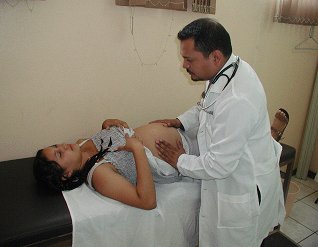
Prenatal care, also known as antenatal care, is a type of preventive healthcare for pregnant individuals. It is provided in the form of medical checkups and healthy lifestyle recommendations for the pregnant person. Antenatal care also consists of educating the pregnant individual about maternal physiological and biological changes in pregnancy, along with prenatal nutrition; all of which prevent potential health problems throughout the pregnancy and promote good health for the parent and the fetus. The availability of routine prenatal care, including prenatal screening and diagnosis, has played a part in reducing the frequency of maternal death, miscarriages, birth defects, low birth weight, neonatal infections, and other preventable health problems.
Traditional prenatal care in high-income countries generally consists of:
The WHO recommends that pregnant women should all receive at least eight antenatal visits to spot and treat problems and give immunizations. Although antenatal care is important to improve the health of both mother and baby, many women do not receive the recommended eight visits. There is little evidence behind the number of antenatal visits pregnant women receive and what care and information is given at each visit. It has been suggested that women who have low-risk pregnancies should have fewer antenatal visits. However, when this was tested, women with fewer visits had babies who were much more likely to be admitted to neonatal intensive care and stay there for longer (though this could be down to chance results).
A 2015 Cochrane Review findings buttresses this notion, with evidence that in settings with limited resources, where the number of visits is already low, programmes of ANC with reduced visits are associated with an increase in perinatal mortality. Therefore, it is doubtful that the reduced visits model is ideal, even in low-income countries (LICs), where pregnant women are already attending fewer appointments. Not only is visiting prenatal care early is highly recommended, but also a more flexible pathway allowing more visits, from the time a pregnant woman books for prenatal care, as it potentially enables more attention to those women who come late. Also, women who had fewer antenatal visits were not as satisfied with the care they received compared with women who had the standard number of visits.
At the initial antenatal care visit, pregnant women are classified into either low risk or high risk. Antenatal risk assessment began in the United Kingdom before becoming a widespread practice.
Prenatal screening is testing for diseases or conditions in a fetus or embryo before it is born, and prenatal diagnosis refers to the official confirmation of these potential diseases of conditions. Obstetricians and midwives have the ability to monitor mother's health and prenatal development during pregnancy through series of regular check-ups.
Physical examinations generally consist of:
In some countries, such as the UK, the symphysial fundal height (SFH) is measured as part of antenatal appointments from 25 weeks of gestation. (The SFH is measured from the woman's pubic bone to the top of the uterus. A review into this practice found only one piece of research, so there is not enough evidence to say whether measuring the SFH helps to detect small or large babies. As measuring the SFH is not costly and is used in many places, the review recommends carrying on this practice.
Hub AI
Prenatal care AI simulator
(@Prenatal care_simulator)
Prenatal care
Prenatal care, also known as antenatal care, is a type of preventive healthcare for pregnant individuals. It is provided in the form of medical checkups and healthy lifestyle recommendations for the pregnant person. Antenatal care also consists of educating the pregnant individual about maternal physiological and biological changes in pregnancy, along with prenatal nutrition; all of which prevent potential health problems throughout the pregnancy and promote good health for the parent and the fetus. The availability of routine prenatal care, including prenatal screening and diagnosis, has played a part in reducing the frequency of maternal death, miscarriages, birth defects, low birth weight, neonatal infections, and other preventable health problems.
Traditional prenatal care in high-income countries generally consists of:
The WHO recommends that pregnant women should all receive at least eight antenatal visits to spot and treat problems and give immunizations. Although antenatal care is important to improve the health of both mother and baby, many women do not receive the recommended eight visits. There is little evidence behind the number of antenatal visits pregnant women receive and what care and information is given at each visit. It has been suggested that women who have low-risk pregnancies should have fewer antenatal visits. However, when this was tested, women with fewer visits had babies who were much more likely to be admitted to neonatal intensive care and stay there for longer (though this could be down to chance results).
A 2015 Cochrane Review findings buttresses this notion, with evidence that in settings with limited resources, where the number of visits is already low, programmes of ANC with reduced visits are associated with an increase in perinatal mortality. Therefore, it is doubtful that the reduced visits model is ideal, even in low-income countries (LICs), where pregnant women are already attending fewer appointments. Not only is visiting prenatal care early is highly recommended, but also a more flexible pathway allowing more visits, from the time a pregnant woman books for prenatal care, as it potentially enables more attention to those women who come late. Also, women who had fewer antenatal visits were not as satisfied with the care they received compared with women who had the standard number of visits.
At the initial antenatal care visit, pregnant women are classified into either low risk or high risk. Antenatal risk assessment began in the United Kingdom before becoming a widespread practice.
Prenatal screening is testing for diseases or conditions in a fetus or embryo before it is born, and prenatal diagnosis refers to the official confirmation of these potential diseases of conditions. Obstetricians and midwives have the ability to monitor mother's health and prenatal development during pregnancy through series of regular check-ups.
Physical examinations generally consist of:
In some countries, such as the UK, the symphysial fundal height (SFH) is measured as part of antenatal appointments from 25 weeks of gestation. (The SFH is measured from the woman's pubic bone to the top of the uterus. A review into this practice found only one piece of research, so there is not enough evidence to say whether measuring the SFH helps to detect small or large babies. As measuring the SFH is not costly and is used in many places, the review recommends carrying on this practice.
Recent media