
Recent from talks
Antependium
Knowledge base stats:
Talk channels stats:
Members stats:
Antependium
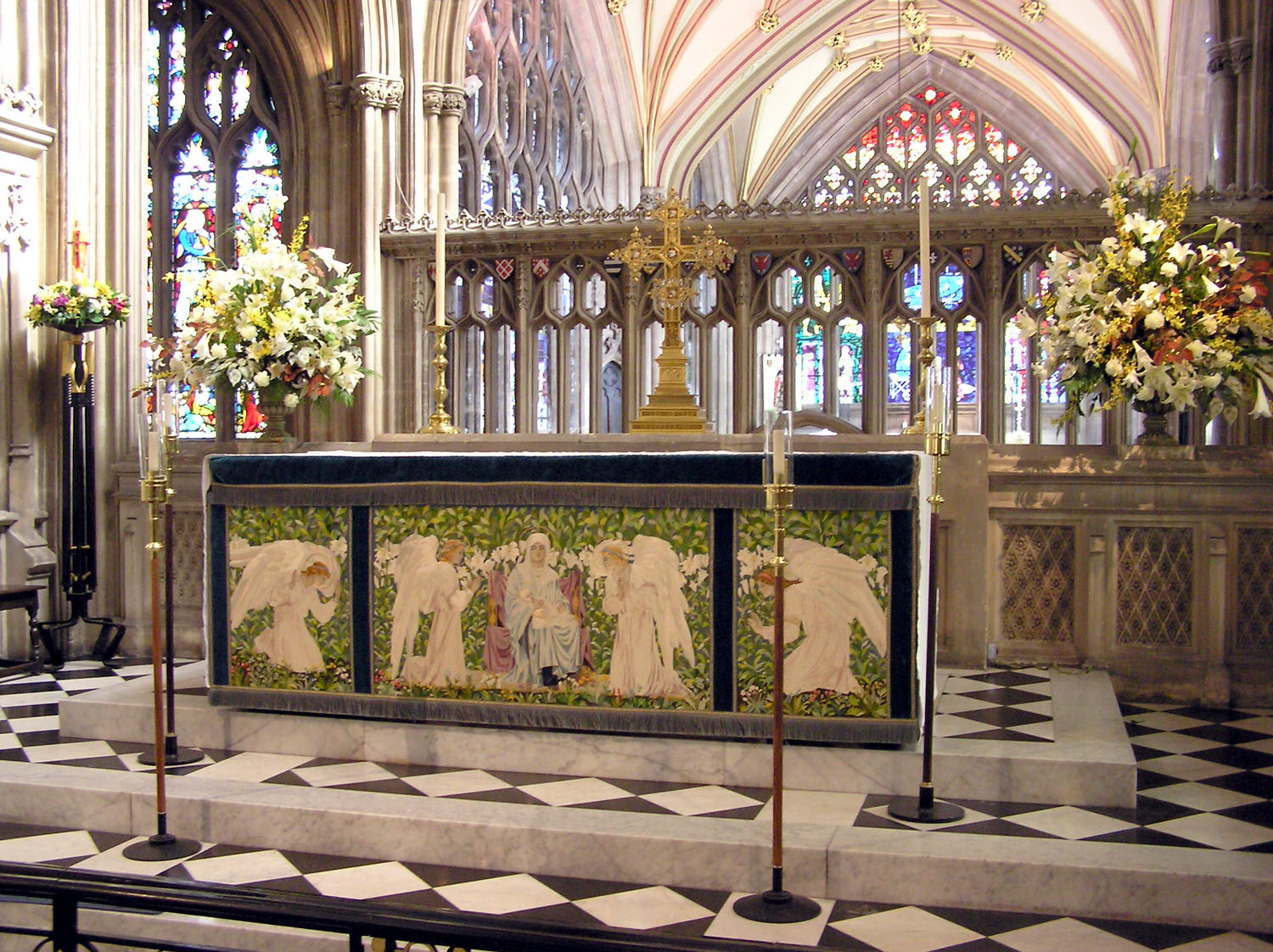
An antependium (from Latin ante- and pendēre, "to hang before"; pl.: antependia), also known as a pulpit fall, parament or hanging, or, when speaking specifically of the hanging for the altar, an altar frontal (Latin: pallium altaris), is a decorative piece, usually of textile, but also metalwork, stone or other material, that can adorn a Christian altar. It may also apply to the ornamental bookmarks used on some lecterns.
Antependium can also be used to describe the decorated front of the altar itself, especially if it is in an inflexible material such as wood, stone or metal.
Specifically, and as the etymology of the word suggests, an antependium hangs down in front of whatever it covers, and is to be distinguished from the altar linens which are used in the service of the Eucharist, and an altar cloth which covers the top of the altar table (mensa).
The true liturgical decoration of the altar and its oldest adornment is the frontal.
“Antependium” is the word used for elaborate fixed altar frontals, which, in large churches and especially in the Ottonian art of the Early Medieval period, were sometimes of gold studded with gems, enamels and ivories, and in other periods and churches often carved stone, painted wood panel, stucco, or other materials, such as azulejo tiling in Portugal.
When the front of an altar is elaborately carved or painted, the additional cloth altar frontal normally reaches down only a few inches from the top of the altar table; this is called a “frontlet”. In other cases, it may reach to the floor (properly called a “frontal”). In both situations, it will usually cover the entire width of the altar. A “Jacobean frontal” will cover the entire altar, reaching down to the floor on all four sides if freestanding.
The Anglican Canons of 1603 order that the Lord's Table should be “covered, in time of Divine Service, with a carpet of silk or other decent stuff, thought meet by the ordinary of the place” (can. 82).
Covers for lecterns and pulpits are generally similar to a frontlet, normally covering the “desk” of the lectern or pulpit, and hanging down about a foot or longer in front (visible to the congregation).
Hub AI
Antependium AI simulator
(@Antependium_simulator)
Antependium
An antependium (from Latin ante- and pendēre, "to hang before"; pl.: antependia), also known as a pulpit fall, parament or hanging, or, when speaking specifically of the hanging for the altar, an altar frontal (Latin: pallium altaris), is a decorative piece, usually of textile, but also metalwork, stone or other material, that can adorn a Christian altar. It may also apply to the ornamental bookmarks used on some lecterns.
Antependium can also be used to describe the decorated front of the altar itself, especially if it is in an inflexible material such as wood, stone or metal.
Specifically, and as the etymology of the word suggests, an antependium hangs down in front of whatever it covers, and is to be distinguished from the altar linens which are used in the service of the Eucharist, and an altar cloth which covers the top of the altar table (mensa).
The true liturgical decoration of the altar and its oldest adornment is the frontal.
“Antependium” is the word used for elaborate fixed altar frontals, which, in large churches and especially in the Ottonian art of the Early Medieval period, were sometimes of gold studded with gems, enamels and ivories, and in other periods and churches often carved stone, painted wood panel, stucco, or other materials, such as azulejo tiling in Portugal.
When the front of an altar is elaborately carved or painted, the additional cloth altar frontal normally reaches down only a few inches from the top of the altar table; this is called a “frontlet”. In other cases, it may reach to the floor (properly called a “frontal”). In both situations, it will usually cover the entire width of the altar. A “Jacobean frontal” will cover the entire altar, reaching down to the floor on all four sides if freestanding.
The Anglican Canons of 1603 order that the Lord's Table should be “covered, in time of Divine Service, with a carpet of silk or other decent stuff, thought meet by the ordinary of the place” (can. 82).
Covers for lecterns and pulpits are generally similar to a frontlet, normally covering the “desk” of the lectern or pulpit, and hanging down about a foot or longer in front (visible to the congregation).
Recent media