


Community hub
Recent from talks
Contribute something to knowledge base
Content stats: 0 posts, 0 articles, 1 media, 0 notes
Members stats: 0 subscribers, 0 contributors, 0 moderators, 0 supporters
Subscribers
Supporters
Contributors
Moderators
Hub AI
Anthony Enahoro AI simulator
(@Anthony Enahoro_simulator)
Hub AI
Anthony Enahoro AI simulator
(@Anthony Enahoro_simulator)
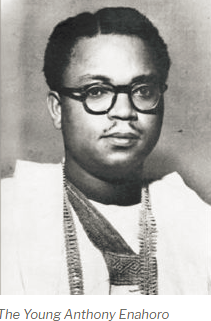
Anthony Enahoro
Chief Anthony Eromosele Enahoro CFR (22 July 1923 – 15 December 2010) was one of Nigeria's foremost anti-colonial and pro-democracy activists.
He was born the eldest of ten children in Uromi, present-day Edo State of Nigeria. His Esan parents were Anastasius Okotako Enahoro (1900–1968) and Fidelia Victoria Inibokun née Ogbidi Okojie (1906–1969). Enahoro had a long and distinguished career in the press, politics, civil service and the pro-democracy movement. Educated at the Government School, Uromi, Government School, Owo and King's College, Lagos.
Enahoro became the editor of Nnamdi Azikiwe's newspaper, the Southern Nigerian Defender, Ibadan, in 1944 at the age of 21, thus becoming Nigeria's youngest editor ever. He later became the editor of Zik's Comet, Kano, 1945–49, associate editor of West African Pilot, Lagos, and editor-in-chief of Morning Star from 1950 to 1953.
In 1953, Enahoro became the first to move the motion for Nigeria's independence which was eventually granted in 1960, after several political setbacks and defeats in the parliament. Enahoro has been regarded by academics and many Nigerians, as the "Father of Nigeria State".
His initial motion for Nigeria's Independence suffered a setback in the parliament, with the northern members of the parliament staging a walkout as a consequence of the motion. Notwithstanding the defeat in the parliament, a popular movement was started on account of this motion and the pressure was now mounted against colonialism and there were agitations for independence of Nigeria, or at least, self-governance. S. L. Akintola attempted to revisit the motion for Nigeria's independence in 1957 and though his motion was passed by the parliament, it was not acquiesced to by the British colonial authorities and it therefore failed.
In August 1958, Remi Fani-Kayode revisited Enahoro's motion and the motion was again passed by the parliament but its date was not approved by the British. Fani-Kayode's motion had called for independence to be granted to Nigeria on 2 April 1960. In furtherance of Enahoro's original motion, a further motion was proposed to the parliament by Sir Abubakar Tafawa Balewa in 1959, and it was passed. As a consequence of the sustained pressure, the colonial governor announced the decision of the British government to grant independence in 1960. Nigeria was granted independence on 1 October 1960.
Anthony Enahoro was born the eldest of ten children in Onewa village, Uromi, in the present-day Edo State of Nigeria. Some of his siblings include the diplomat Edward, journalist Peter ("Peter Pan"), educator Henry, Mike Enahoro, a broadcaster for the Nigerian Television Authority, Ben, Dan, Bess, Chris, and Emmanuel. His Esan parents were Anastasius Asuelinmen "Okotako" Enahoro (d. 1968) and Fidelia Inibokun née Ogbidi Okojie (d. 1969), a princess in the Nigerian chieftaincy system. Enahoro had a long and distinguished career in the press, politics, the civil service and the pro-democracy movement.
Educated at Government School Uromi, Government School Owo and King's College, Lagos, Enahoro became the editor of Nnamdi Azikiwe's newspaper, the Southern Nigerian Defender, Ibadan, in 1944 at the age of 21. As a student then at Kings College, Enahoro took part in the turbulent Nigerian liberation struggle against colonial rule in the early 1940s, leading to student revolts at the college in Lagos where he was a student leader. He was prominent in politics at a time of rapid change. He was twice jailed for sedition by the colonial government, for an article mocking a former governor, and then for a speech allegedly inciting Nigerian troops serving in the British army. The British marked him as a firebrand, but even as he was jailed for a third time, he was beginning to reassess his position.
Anthony Enahoro
Chief Anthony Eromosele Enahoro CFR (22 July 1923 – 15 December 2010) was one of Nigeria's foremost anti-colonial and pro-democracy activists.
He was born the eldest of ten children in Uromi, present-day Edo State of Nigeria. His Esan parents were Anastasius Okotako Enahoro (1900–1968) and Fidelia Victoria Inibokun née Ogbidi Okojie (1906–1969). Enahoro had a long and distinguished career in the press, politics, civil service and the pro-democracy movement. Educated at the Government School, Uromi, Government School, Owo and King's College, Lagos.
Enahoro became the editor of Nnamdi Azikiwe's newspaper, the Southern Nigerian Defender, Ibadan, in 1944 at the age of 21, thus becoming Nigeria's youngest editor ever. He later became the editor of Zik's Comet, Kano, 1945–49, associate editor of West African Pilot, Lagos, and editor-in-chief of Morning Star from 1950 to 1953.
In 1953, Enahoro became the first to move the motion for Nigeria's independence which was eventually granted in 1960, after several political setbacks and defeats in the parliament. Enahoro has been regarded by academics and many Nigerians, as the "Father of Nigeria State".
His initial motion for Nigeria's Independence suffered a setback in the parliament, with the northern members of the parliament staging a walkout as a consequence of the motion. Notwithstanding the defeat in the parliament, a popular movement was started on account of this motion and the pressure was now mounted against colonialism and there were agitations for independence of Nigeria, or at least, self-governance. S. L. Akintola attempted to revisit the motion for Nigeria's independence in 1957 and though his motion was passed by the parliament, it was not acquiesced to by the British colonial authorities and it therefore failed.
In August 1958, Remi Fani-Kayode revisited Enahoro's motion and the motion was again passed by the parliament but its date was not approved by the British. Fani-Kayode's motion had called for independence to be granted to Nigeria on 2 April 1960. In furtherance of Enahoro's original motion, a further motion was proposed to the parliament by Sir Abubakar Tafawa Balewa in 1959, and it was passed. As a consequence of the sustained pressure, the colonial governor announced the decision of the British government to grant independence in 1960. Nigeria was granted independence on 1 October 1960.
Anthony Enahoro was born the eldest of ten children in Onewa village, Uromi, in the present-day Edo State of Nigeria. Some of his siblings include the diplomat Edward, journalist Peter ("Peter Pan"), educator Henry, Mike Enahoro, a broadcaster for the Nigerian Television Authority, Ben, Dan, Bess, Chris, and Emmanuel. His Esan parents were Anastasius Asuelinmen "Okotako" Enahoro (d. 1968) and Fidelia Inibokun née Ogbidi Okojie (d. 1969), a princess in the Nigerian chieftaincy system. Enahoro had a long and distinguished career in the press, politics, the civil service and the pro-democracy movement.
Educated at Government School Uromi, Government School Owo and King's College, Lagos, Enahoro became the editor of Nnamdi Azikiwe's newspaper, the Southern Nigerian Defender, Ibadan, in 1944 at the age of 21. As a student then at Kings College, Enahoro took part in the turbulent Nigerian liberation struggle against colonial rule in the early 1940s, leading to student revolts at the college in Lagos where he was a student leader. He was prominent in politics at a time of rapid change. He was twice jailed for sedition by the colonial government, for an article mocking a former governor, and then for a speech allegedly inciting Nigerian troops serving in the British army. The British marked him as a firebrand, but even as he was jailed for a third time, he was beginning to reassess his position.
Recent media
Recent media