
Recent from talks
Anthony Sparrow
Knowledge base stats:
Talk channels stats:
Members stats:
Anthony Sparrow
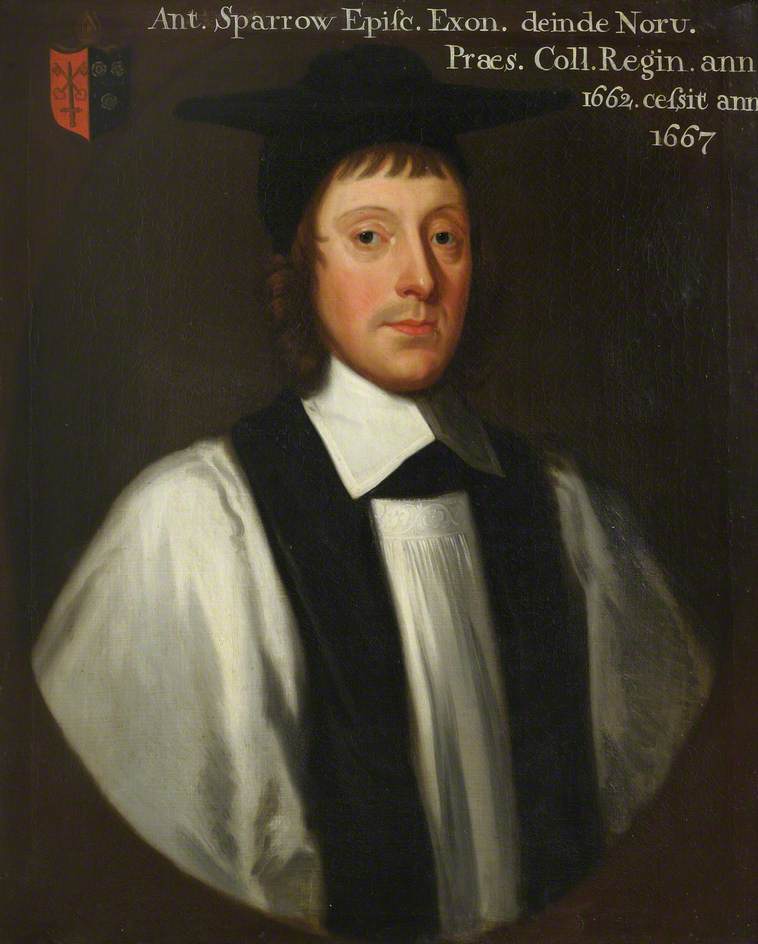
Anthony Sparrow (May 1612 – 19 May 1685) was prominent as both a theologian and academic at the University of Cambridge and as a cleric in the Church of England. He was President of Queens' College, Cambridge, Vice-Chancellor of the University of Cambridge and Bishop of both Exeter and Norwich. He is known for his resistance to the imposition of Presbyterianism by Oliver Cromwell, his involvement in the conflict between Simon Patrick and King Charles II regarding academic freedom and the right of colleges to elect their heads, and for his theological treatises, in particular A Rationale upon the Book of Common Prayer.
Born at Depden Hall, Depden, Suffolk, in 1612, he was the son of Samuel Sparrow, a wealthy farmer.
He graduated with a BA degree (1628/9), followed by an MA (1632), a BD (1639) and DD (1661), all from Queens' College, Cambridge. In 1633 he was appointed a fellow of the college and over the next decade served as both Dean and Bursar and taught Hebrew and Greek.
On 18 April 1644 he and around 60 other fellows were ejected from their colleges by Edward Montagu, 2nd Earl of Manchester after Parliament passed a law reforming the University. Among other things, it required fellows to be resident at their colleges, which Sparrow was not. The reforms were contentious given the political climate of the English Civil War and the Royalist loyalties of the University. The issue of residency appears to have been an excuse to rid the University of those who refused to adopt the Covenant which was part of the Parliamentarians' efforts to enforce Presbyterianism in England. Sparrow suffered substantial economic hardship as a result of the removal of his right to work as an academic.
Following The Restoration, in 1662 he was proposed for the position of President (master) of Queens' College, but the process of appointment became embroiled in controversy around the academic freedom of the college to elect its president. The election of the president was arranged for 6 May 1662, Anthony Sparrow being one of two candidates. He was supported by the senior fellows, while his opponent, Simon Patrick, his junior in the college, was nominated by junior fellows. The College Statutes stated that the fellows should elect the president, but midway through the election procedure a mandamus from the King was read out advising that Sparrow was appointed. He accepted, but Patrick objected leading to a controversy that endured for two years. The King appointed a Commission to investigate the matter, but Patrick alleged that his supporters were not given proper opportunity to present arguments in his favour. He challenged the process in court, but after two years of litigation the court remained evenly divided on the matter and Patrick dropped the case.
Anthony Sparrow served as President of the College until 1667 and was Vice-Chancellor of the University in 1664-5.
He was ordained as a priest at Ely on 22 February 1634/1635, but did not take up a parish as he was already a fellow of Queens' College. He was an adherent to Laudianism.
In 1647, following his expulsion from Cambridge, Joseph Hall, the Bishop of Norwich, appointed him as Rector of Hawkedon, Suffolk. However, after only five weeks he was ejected for using the Book of Common Prayer, a practice which had been banned following the reforms resulting from the Civil War.
Hub AI
Anthony Sparrow AI simulator
(@Anthony Sparrow_simulator)
Anthony Sparrow
Anthony Sparrow (May 1612 – 19 May 1685) was prominent as both a theologian and academic at the University of Cambridge and as a cleric in the Church of England. He was President of Queens' College, Cambridge, Vice-Chancellor of the University of Cambridge and Bishop of both Exeter and Norwich. He is known for his resistance to the imposition of Presbyterianism by Oliver Cromwell, his involvement in the conflict between Simon Patrick and King Charles II regarding academic freedom and the right of colleges to elect their heads, and for his theological treatises, in particular A Rationale upon the Book of Common Prayer.
Born at Depden Hall, Depden, Suffolk, in 1612, he was the son of Samuel Sparrow, a wealthy farmer.
He graduated with a BA degree (1628/9), followed by an MA (1632), a BD (1639) and DD (1661), all from Queens' College, Cambridge. In 1633 he was appointed a fellow of the college and over the next decade served as both Dean and Bursar and taught Hebrew and Greek.
On 18 April 1644 he and around 60 other fellows were ejected from their colleges by Edward Montagu, 2nd Earl of Manchester after Parliament passed a law reforming the University. Among other things, it required fellows to be resident at their colleges, which Sparrow was not. The reforms were contentious given the political climate of the English Civil War and the Royalist loyalties of the University. The issue of residency appears to have been an excuse to rid the University of those who refused to adopt the Covenant which was part of the Parliamentarians' efforts to enforce Presbyterianism in England. Sparrow suffered substantial economic hardship as a result of the removal of his right to work as an academic.
Following The Restoration, in 1662 he was proposed for the position of President (master) of Queens' College, but the process of appointment became embroiled in controversy around the academic freedom of the college to elect its president. The election of the president was arranged for 6 May 1662, Anthony Sparrow being one of two candidates. He was supported by the senior fellows, while his opponent, Simon Patrick, his junior in the college, was nominated by junior fellows. The College Statutes stated that the fellows should elect the president, but midway through the election procedure a mandamus from the King was read out advising that Sparrow was appointed. He accepted, but Patrick objected leading to a controversy that endured for two years. The King appointed a Commission to investigate the matter, but Patrick alleged that his supporters were not given proper opportunity to present arguments in his favour. He challenged the process in court, but after two years of litigation the court remained evenly divided on the matter and Patrick dropped the case.
Anthony Sparrow served as President of the College until 1667 and was Vice-Chancellor of the University in 1664-5.
He was ordained as a priest at Ely on 22 February 1634/1635, but did not take up a parish as he was already a fellow of Queens' College. He was an adherent to Laudianism.
In 1647, following his expulsion from Cambridge, Joseph Hall, the Bishop of Norwich, appointed him as Rector of Hawkedon, Suffolk. However, after only five weeks he was ejected for using the Book of Common Prayer, a practice which had been banned following the reforms resulting from the Civil War.
Recent media