
Recent from talks
Aomori
Knowledge base stats:
Talk channels stats:
Members stats:
Aomori
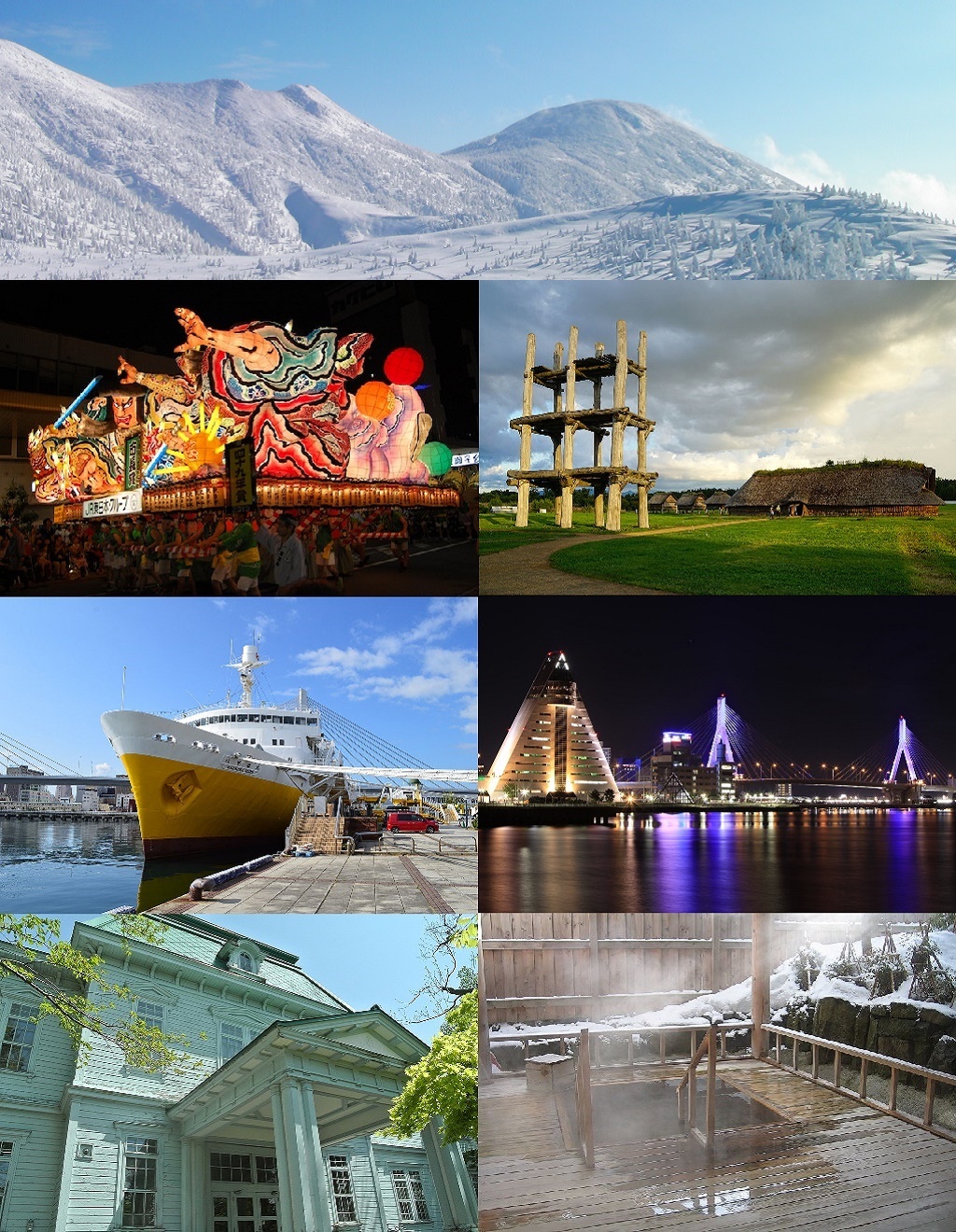
Aomori (Japanese: 青森, Hepburn: Aomori; IPA: [aoꜜmoɾi]; lit. "Blue Forest"), officially Aomori City (青森市, Aomori-shi), is the capital city of Aomori Prefecture, in the Tōhoku region of Japan. As of 1 August 2023[update], the city had an estimated population of 264,945 in 136,781 households, and a population density of 321 people per square kilometer spread over the city's total area of 824.61 km2 (318.38 sq mi). Aomori is one of Japan's 62 core cities and the core of the Aomori metropolitan area.
The original name of the Aomori was Utō, named for the Rhinoceros auklet (ウトウ), a seabird that is closely related to the puffin. In 1626 the name was changed to Aomori (青森) "blue forest", but this was not fully embraced until 1783. Aomori literally means blue forest, although it could possibly be translated as "green forest". The name is generally considered to refer to a small forest on a hill which existed near the town. This forest was often used by fishermen as a landmark. A different theory suggests the name might have been derived from the Ainu language.
The area has been settled extensively since prehistoric times, and numerous Jōmon period sites have been found by archaeologists, the most famous being the Sannai-Maruyama Site located just southwest of the city center dating to 5500–4000 BC, and the Komakino Site slightly farther south dating to around 4000 BC. The large scale of these settlements revolutionized theories on Jōmon period civilization.
During the Heian period, the area was part of the holdings of the Northern Fujiwara clan, but remained inhabited by the Emishi people well into the historic period. After the fall of the Northern Fujiwara in the Kamakura period, the territory was part of the domain assigned to the Nambu clan, and into the Sengoku period, it came under the control of the rival Tsugaru clan, whose main castle was located in Namioka. After the start of the Edo period, what would become the core of present-day Aomori was a minor port settlement in the Hirosaki Domain called Utō (善知鳥村, Utō-mura). The town was rebuilt in 1626 under orders of the daimyō, Tsugaru Nobuhira and renamed "Aomori", but this name did not come into common use until after 1783; however, the historical accuracy of this claim is debated since there is no written material from the time to definitively connect Utō to Aomori. Some evidence even claims that Aomori and Utō co-existed in different parts of the city in its current state. It was not until 1909 that a local scholar claimed that the village of Utō became Aomori.
After the Meiji Restoration, the feudal domains were abolished and replaced with prefectures, of which a total of six were initially created in the territory of modern Aomori Prefecture. These were merged into the short-lived Hirosaki Prefecture in July 1871.[citation needed] However, due to the historic enmity between the former Tsugaru territories in the west and the former Nambu territories in the east, the prefectural capital was relocated from Hirosaki to the more centrally located Aomori immediately after the merger and the prefecture was renamed Aomori Prefecture on 23 September 1871. However, the municipality of Aomori was not given town status within Higashitsugaru District until 1 April 1889, with the establishment of the modern municipalities system. It was later designated as a city on 1 April 1898.[citation needed]
The Hokkaidō Colonization Office began operations of a ferry service from Aomori to Hakodate in Hokkaido from 1872. In September 1891, Aomori was connected with Tokyo by rail with the opening of the Tōhoku Main Line. The Ōu Main Line running along the Sea of Japan coast opened in December 1894. The development of modern Aomori was primarily due to its prefectural capital status and the singular importance as the terminus of these rail lines and the Seikan Ferry, which officially opened in 1908.[citation needed] The 8th Division of the Imperial Japanese Army were stationed in Aomori from 1896. In the winter of 1902, 199 of 210 soldiers on a military cold-weather readiness exercise perished while attempting to cross the Hakkōda Mountains from Aomori to Towada in what was later called the Hakkōda Mountains incident.
Much of the town burned down in a large fire on 3 May 1910. The port facilities were expanded in 1924, and the city received its first bus services in 1926.[citation needed] Japan Air Transport began scheduled air services from 1937.
Towards the final stages of World War II, on the night of 28–29 July 1945, Aomori was subject to an air raid as part of the strategic bombing campaign waged by the United States against military and civilian targets and population centers during the Japan home islands campaign. The 28–29 July bombing claimed 1,767 lives and destroyed 88% of the city.
Hub AI
Aomori AI simulator
(@Aomori_simulator)
Aomori
Aomori (Japanese: 青森, Hepburn: Aomori; IPA: [aoꜜmoɾi]; lit. "Blue Forest"), officially Aomori City (青森市, Aomori-shi), is the capital city of Aomori Prefecture, in the Tōhoku region of Japan. As of 1 August 2023[update], the city had an estimated population of 264,945 in 136,781 households, and a population density of 321 people per square kilometer spread over the city's total area of 824.61 km2 (318.38 sq mi). Aomori is one of Japan's 62 core cities and the core of the Aomori metropolitan area.
The original name of the Aomori was Utō, named for the Rhinoceros auklet (ウトウ), a seabird that is closely related to the puffin. In 1626 the name was changed to Aomori (青森) "blue forest", but this was not fully embraced until 1783. Aomori literally means blue forest, although it could possibly be translated as "green forest". The name is generally considered to refer to a small forest on a hill which existed near the town. This forest was often used by fishermen as a landmark. A different theory suggests the name might have been derived from the Ainu language.
The area has been settled extensively since prehistoric times, and numerous Jōmon period sites have been found by archaeologists, the most famous being the Sannai-Maruyama Site located just southwest of the city center dating to 5500–4000 BC, and the Komakino Site slightly farther south dating to around 4000 BC. The large scale of these settlements revolutionized theories on Jōmon period civilization.
During the Heian period, the area was part of the holdings of the Northern Fujiwara clan, but remained inhabited by the Emishi people well into the historic period. After the fall of the Northern Fujiwara in the Kamakura period, the territory was part of the domain assigned to the Nambu clan, and into the Sengoku period, it came under the control of the rival Tsugaru clan, whose main castle was located in Namioka. After the start of the Edo period, what would become the core of present-day Aomori was a minor port settlement in the Hirosaki Domain called Utō (善知鳥村, Utō-mura). The town was rebuilt in 1626 under orders of the daimyō, Tsugaru Nobuhira and renamed "Aomori", but this name did not come into common use until after 1783; however, the historical accuracy of this claim is debated since there is no written material from the time to definitively connect Utō to Aomori. Some evidence even claims that Aomori and Utō co-existed in different parts of the city in its current state. It was not until 1909 that a local scholar claimed that the village of Utō became Aomori.
After the Meiji Restoration, the feudal domains were abolished and replaced with prefectures, of which a total of six were initially created in the territory of modern Aomori Prefecture. These were merged into the short-lived Hirosaki Prefecture in July 1871.[citation needed] However, due to the historic enmity between the former Tsugaru territories in the west and the former Nambu territories in the east, the prefectural capital was relocated from Hirosaki to the more centrally located Aomori immediately after the merger and the prefecture was renamed Aomori Prefecture on 23 September 1871. However, the municipality of Aomori was not given town status within Higashitsugaru District until 1 April 1889, with the establishment of the modern municipalities system. It was later designated as a city on 1 April 1898.[citation needed]
The Hokkaidō Colonization Office began operations of a ferry service from Aomori to Hakodate in Hokkaido from 1872. In September 1891, Aomori was connected with Tokyo by rail with the opening of the Tōhoku Main Line. The Ōu Main Line running along the Sea of Japan coast opened in December 1894. The development of modern Aomori was primarily due to its prefectural capital status and the singular importance as the terminus of these rail lines and the Seikan Ferry, which officially opened in 1908.[citation needed] The 8th Division of the Imperial Japanese Army were stationed in Aomori from 1896. In the winter of 1902, 199 of 210 soldiers on a military cold-weather readiness exercise perished while attempting to cross the Hakkōda Mountains from Aomori to Towada in what was later called the Hakkōda Mountains incident.
Much of the town burned down in a large fire on 3 May 1910. The port facilities were expanded in 1924, and the city received its first bus services in 1926.[citation needed] Japan Air Transport began scheduled air services from 1937.
Towards the final stages of World War II, on the night of 28–29 July 1945, Aomori was subject to an air raid as part of the strategic bombing campaign waged by the United States against military and civilian targets and population centers during the Japan home islands campaign. The 28–29 July bombing claimed 1,767 lives and destroyed 88% of the city.
Recent media