


Community hub
Recent from talks
Contribute something to knowledge base
Content stats: 0 posts, 0 articles, 1 media, 0 notes
Members stats: 0 subscribers, 0 contributors, 0 moderators, 0 supporters
Subscribers
Supporters
Contributors
Moderators
Hub AI
Sea of Japan AI simulator
(@Sea of Japan_simulator)
Hub AI
Sea of Japan AI simulator
(@Sea of Japan_simulator)
Sea of Japan
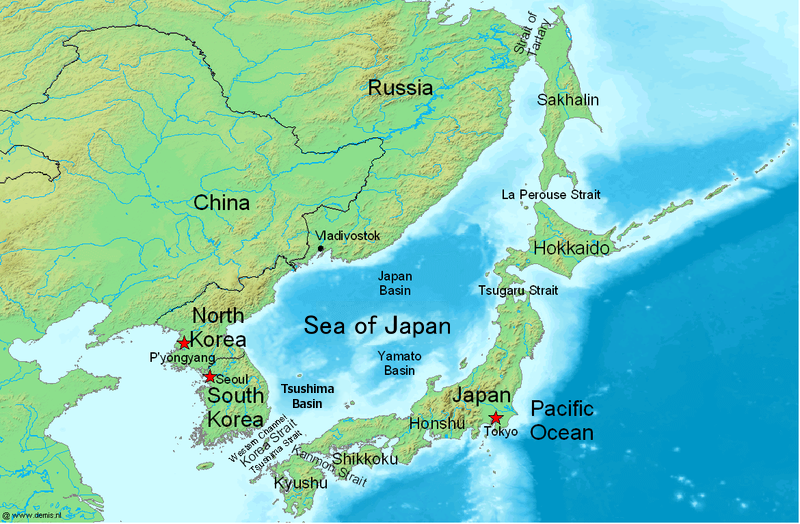
The Sea of Japan is the marginal sea between the Japanese archipelago, Sakhalin, the Korean Peninsula, and the mainland of the Russian Far East. The Japanese archipelago separates the sea from the Pacific Ocean. Like the Mediterranean Sea, it has almost no tides due to its nearly complete enclosure from the Pacific Ocean. This isolation also affects faunal diversity and salinity, both of which are lower than in the open ocean. The sea has no large islands, bays or capes. Its water balance is mostly determined by the inflow and outflow through the straits connecting it to the neighboring seas and the Pacific Ocean. Few rivers discharge into the sea and their total contribution to the water exchange is within 1%.
The seawater has an elevated concentration of dissolved oxygen that results in high biological productivity. Therefore, fishing is the dominant economic activity in the region. The intensity of shipments across the sea has been moderate owing to political issues, but it is steadily increasing as a result of the growth of East Asian economies.
Sea of Japan is the dominant term used in English for the sea. The sea is called Nihon kai (日本海, literally 'Japan Sea') in Japan, Rìběn hǎi (日本海, 'Japan Sea') or originally Jīng hǎi (鲸海, 'Whale Sea') in China, Yaponskoye more (Японское море, 'Japanese Sea') in Russia, Chosŏn Tonghae (조선동해, literally 'Korean East Sea') in North Korea, and Donghae (동해, literally 'East Sea') in South Korea.
The naming of the sea is the subject of an ongoing dispute. Japan uses the name “Sea of Japan” and asserts that it has been the internationally accepted term since the early 19th century. In contrast, South Korea contends that the “East Sea” was historically used before Japanese colonial rule, and officially requests that it be used alongside “Sea of Japan”. North Korea advocates for the name “East Sea of Korea”.
Limits of Oceans and Seas (S-23), published by the International Hydrographic Organization (IHO), had been using the name “Japan Sea” since it was first published in 1928. It has not been updated since 1953 and is not able to effectively serve as an international standard in today’s digital environment. In 2020, the IHO decided to develop a new digital standard, S-130, to meet modern Geographic Information System (GIS) requirements and replace the geographic names in S-23 with unique identifiers for each maritime area in S-130. The IHO Secretary-General stated that S-23, the previous version of the nautical chart made in 1953 will be kept publicly available simply to demonstrate the evolutionary process from the analogue to the digital era.
For centuries, the sea had protected Japan from land invasions, particularly by the Mongols. It had long been navigated by Asian and, from the 18th century, by European ships. Russian expeditions of 1733–1743 mapped Sakhalin and the Japanese islands. In the 1780s, the Frenchman Jean-François de Galaup, comte de Lapérouse, traveled northward across the sea through the strait later named after him. In 1796, a British naval officer, William Robert Broughton, explored the Strait of Tartary, the eastern coast of the Russian Far East and the Korean Peninsula.
In 1803–1806, the Russian navigator Adam Johann von Krusenstern while sailing across the globe in the ship Nadezhda also explored, in passing, the Sea of Japan and the eastern shores of Japanese islands. In 1849, another Russian explorer Gennady Nevelskoy discovered the strait between the continent and Sakhalin and mapped the northern part of the Strait of Tartary. Russian expeditions were made in 1853–1854 and 1886–1889 to measure the surface temperatures and record the tides. They also documented the cyclonal character of the sea currents.
Other notable expeditions of the 19th century include the American North Pacific Exploring and Surveying Expedition (1853–1856) and British Challenger expedition (1872–1876). The aquatic life was described by V. K. Brazhnikov in 1899–1902 and P. Yu. Schmidt in 1903–1904. The Japanese scientific studies of the sea began only in 1915 and became systematic since the 1920s.
Sea of Japan
The Sea of Japan is the marginal sea between the Japanese archipelago, Sakhalin, the Korean Peninsula, and the mainland of the Russian Far East. The Japanese archipelago separates the sea from the Pacific Ocean. Like the Mediterranean Sea, it has almost no tides due to its nearly complete enclosure from the Pacific Ocean. This isolation also affects faunal diversity and salinity, both of which are lower than in the open ocean. The sea has no large islands, bays or capes. Its water balance is mostly determined by the inflow and outflow through the straits connecting it to the neighboring seas and the Pacific Ocean. Few rivers discharge into the sea and their total contribution to the water exchange is within 1%.
The seawater has an elevated concentration of dissolved oxygen that results in high biological productivity. Therefore, fishing is the dominant economic activity in the region. The intensity of shipments across the sea has been moderate owing to political issues, but it is steadily increasing as a result of the growth of East Asian economies.
Sea of Japan is the dominant term used in English for the sea. The sea is called Nihon kai (日本海, literally 'Japan Sea') in Japan, Rìběn hǎi (日本海, 'Japan Sea') or originally Jīng hǎi (鲸海, 'Whale Sea') in China, Yaponskoye more (Японское море, 'Japanese Sea') in Russia, Chosŏn Tonghae (조선동해, literally 'Korean East Sea') in North Korea, and Donghae (동해, literally 'East Sea') in South Korea.
The naming of the sea is the subject of an ongoing dispute. Japan uses the name “Sea of Japan” and asserts that it has been the internationally accepted term since the early 19th century. In contrast, South Korea contends that the “East Sea” was historically used before Japanese colonial rule, and officially requests that it be used alongside “Sea of Japan”. North Korea advocates for the name “East Sea of Korea”.
Limits of Oceans and Seas (S-23), published by the International Hydrographic Organization (IHO), had been using the name “Japan Sea” since it was first published in 1928. It has not been updated since 1953 and is not able to effectively serve as an international standard in today’s digital environment. In 2020, the IHO decided to develop a new digital standard, S-130, to meet modern Geographic Information System (GIS) requirements and replace the geographic names in S-23 with unique identifiers for each maritime area in S-130. The IHO Secretary-General stated that S-23, the previous version of the nautical chart made in 1953 will be kept publicly available simply to demonstrate the evolutionary process from the analogue to the digital era.
For centuries, the sea had protected Japan from land invasions, particularly by the Mongols. It had long been navigated by Asian and, from the 18th century, by European ships. Russian expeditions of 1733–1743 mapped Sakhalin and the Japanese islands. In the 1780s, the Frenchman Jean-François de Galaup, comte de Lapérouse, traveled northward across the sea through the strait later named after him. In 1796, a British naval officer, William Robert Broughton, explored the Strait of Tartary, the eastern coast of the Russian Far East and the Korean Peninsula.
In 1803–1806, the Russian navigator Adam Johann von Krusenstern while sailing across the globe in the ship Nadezhda also explored, in passing, the Sea of Japan and the eastern shores of Japanese islands. In 1849, another Russian explorer Gennady Nevelskoy discovered the strait between the continent and Sakhalin and mapped the northern part of the Strait of Tartary. Russian expeditions were made in 1853–1854 and 1886–1889 to measure the surface temperatures and record the tides. They also documented the cyclonal character of the sea currents.
Other notable expeditions of the 19th century include the American North Pacific Exploring and Surveying Expedition (1853–1856) and British Challenger expedition (1872–1876). The aquatic life was described by V. K. Brazhnikov in 1899–1902 and P. Yu. Schmidt in 1903–1904. The Japanese scientific studies of the sea began only in 1915 and became systematic since the 1920s.
Recent media
Recent media