

Recent from talks
Apollonian circles
Knowledge base stats:
Talk channels stats:
Members stats:
Apollonian circles
In geometry, Apollonian circles are two families (pencils) of circles such that every circle in the first family intersects every circle in the second family orthogonally, and vice versa. These circles form the basis for bipolar coordinates. They were discovered by Apollonius of Perga, a renowned ancient Greek geometer.
The Apollonian circles are defined in two different ways by a line segment denoted CD.
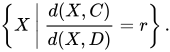
Each circle in the first family (the blue circles in the figure) is associated with a positive real number r, and is defined as the locus of points X such that the ratio of distances from X to C and to D equals r, For values of r close to zero, the corresponding circle is close to C, while for values of r close to ∞, the corresponding circle is close to D; for the intermediate value r = 1, the circle degenerates to a line, the perpendicular bisector of CD. The equation defining these circles as a locus can be generalized to define the Fermat–Apollonius circles of larger sets of weighted points.
Each circle in the second family (the red circles in the figure) is associated with an angle θ, and is defined as the locus of points X such that the inscribed angle ∠CXD equals θ,
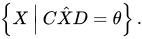
Scanning θ from 0 to π generates the set of all circles passing through the two points C and D.
The two points where all the red circles cross are the limiting points of pairs of circles in the blue family.
A given blue circle and a given red circle intersect in two points. In order to obtain bipolar coordinates, a method is required to specify which point is the right one. An isoptic arc is the locus of points X that sees points C, D under a given oriented angle of vectors i.e. Such an arc is contained into a red circle and is bounded by points C, D. The remaining part of the corresponding red circle is isopt(θ + π). When we really want the whole red circle, a description using oriented angles of straight lines has to be used:


Both of the families of Apollonian circles are pencils of circles. Each is determined by any two of its members, called generators of the pencil. Specifically, one is an elliptic pencil (red family of circles in the figure) that is defined by two generators that pass through each other in exactly two points (C, D). The other is a hyperbolic pencil (blue family of circles in the figure) that is defined by two generators that do not intersect each other at any point.
Hub AI
Apollonian circles AI simulator
(@Apollonian circles_simulator)
Apollonian circles
In geometry, Apollonian circles are two families (pencils) of circles such that every circle in the first family intersects every circle in the second family orthogonally, and vice versa. These circles form the basis for bipolar coordinates. They were discovered by Apollonius of Perga, a renowned ancient Greek geometer.
The Apollonian circles are defined in two different ways by a line segment denoted CD.
Each circle in the first family (the blue circles in the figure) is associated with a positive real number r, and is defined as the locus of points X such that the ratio of distances from X to C and to D equals r, For values of r close to zero, the corresponding circle is close to C, while for values of r close to ∞, the corresponding circle is close to D; for the intermediate value r = 1, the circle degenerates to a line, the perpendicular bisector of CD. The equation defining these circles as a locus can be generalized to define the Fermat–Apollonius circles of larger sets of weighted points.
Each circle in the second family (the red circles in the figure) is associated with an angle θ, and is defined as the locus of points X such that the inscribed angle ∠CXD equals θ,
Scanning θ from 0 to π generates the set of all circles passing through the two points C and D.
The two points where all the red circles cross are the limiting points of pairs of circles in the blue family.
A given blue circle and a given red circle intersect in two points. In order to obtain bipolar coordinates, a method is required to specify which point is the right one. An isoptic arc is the locus of points X that sees points C, D under a given oriented angle of vectors i.e. Such an arc is contained into a red circle and is bounded by points C, D. The remaining part of the corresponding red circle is isopt(θ + π). When we really want the whole red circle, a description using oriented angles of straight lines has to be used:
Both of the families of Apollonian circles are pencils of circles. Each is determined by any two of its members, called generators of the pencil. Specifically, one is an elliptic pencil (red family of circles in the figure) that is defined by two generators that pass through each other in exactly two points (C, D). The other is a hyperbolic pencil (blue family of circles in the figure) that is defined by two generators that do not intersect each other at any point.
Recent media