
Recent from talks
Appalachian Americans
Knowledge base stats:
Talk channels stats:
Members stats:
Appalachian Americans
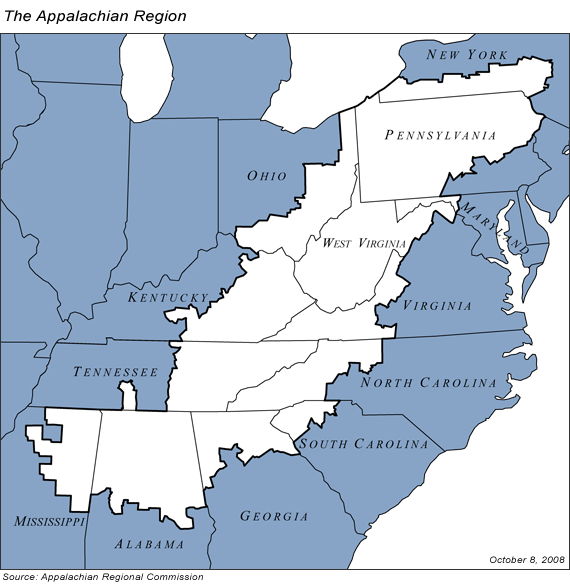
Appalachian Americans, or simply Appalachians, are an American cultural group living in the geocultural area of Appalachia in the eastern United States, or their descendants.
The Appalachian Land is known for a number of reasons. Notable attributes include having one of the oldest and largest mountain range in the world, an intense biodiversity, and rich reserves for bituminous coal.
The Appalachian region is home to more than 1800 endangered species. The region is a hot spot for migration because of its connected forests that assist climate adaptation. The region is distinguishable for its wildlife and sheer number of plant species. This distinguishment allows for careers in conservation and land management, forestry and agriculture, and environmental education as well as outdoor recreation to thrive. The biodiverse land also makes outdoor activities like hiking, camping, hunting, fishing, white water rafting/ kayaking, and wildlife viewing popular.
The coal industry in the Appalachian region had thrived from the 1800s through the 1970s, with its biggest surge being post civil war. The reason the coal industry deemed so successful is because the coal is generally low in sulfur and ash and high in carbon content. This is ideal for fuel, making the coal higher in desire and value. Before the crash of the coal industry, the economy of the Appalachian region relied heavily on the resource. The reliance of the coal industry and the Appalachian economy is still a healing relationship and the region has yet to recover from. The region had its own experience of the resource curse, which ultimately made it harder for them to rebound from the industries collapse. Today, the coal mining industry has been connected to shorter life expectancies of the people, increased chances of black lung disease, and detrimental financial challenges. Moreover, it has taken over 1.5 million acres of forest, compromised groundwater, and polluted waterways, these all pose health and safety threats to the people of the Appalachian region. The fight to make these issues right are long debated and still in the works.
While not an official demographic used or recognized by the United States Census Bureau, The term 'Appalachian Americans' has seen growing usage in recent years, possibly in opposition to the use of hillbilly, which is still often used to describe people of the region.
The historical roots of the Appalachian people is built on the tribal people of the land. The northern, central, and southern regions of the region can be traced to distinctive influential tribes. The northern tribe has Iroquois and Haydenosaunee influence, while the central region has major Shawnee Influence, and lastly the southern region has significant Cherokee influence. Due to the forced migration and further genocide of these people, it is important to honor and remember these tribes for their influence of the region. The trail of tears can give more insight on this aspect of the indigenous absence in current Appalachia.
The first European settlers of the region arrived in 1514 in the western part of North Carolina. This was in pursuit of cheap uninhabited land to develop into farms. In the years 1759-1771 the white population doubled in North-Western North Carolina/West Virginia. The wave of settlers that started showing up at this time were English, Scots-Irish, German, French, and Dutch. Upon the success and growth of white settlers, native claimed land was pushed back further into the interior, many native tribes allied with the British during both the Revolutionary War and the War of 1812, leading to many massacres of "white" settlers in the South and Mid-West. This eventually led to the Indian Removal Act of 1830, which was focused on lands far to the South of West Virginia, and forced the last remaining natives from the east that refused to become American citizens, to leave for what is today Oklahoma. Almost all natives that went to Oklahoma did so rather than taking US citizenship, although over the centuries 2/3rds of the "Civilized Tribes" had integrated/intermarried into the European culture by the time of removal. Both parties thinking this would preserve native culture from being assimilated by the ever growing "white" settler majority. Today the culture of most Eastern American tribes' is still thriving in places like Oklahoma, so perhaps they were correct to move east in preservation of their culture in the face of European encroachment. The white settlers manifested a kind of 'ethnically cleansed' land, except for Africans and natives married to their partners, and their half white/native children.
Historically, the Appalachian region has struggled to obtain a stable education system that provides the people with quality education. Considering the devastating collapse of the coal industry, the education system has suffered from underfunding, extreme poverty, geographic isolation, and other cultural influences.[1] The cycle of academic struggle has perpetuated but in recent years has begun to heal itself. With high school diploma rates rising 2% and earning at least a bachelors degree has increased to 27.3%. Despite these accomplishments, a four-year college degree remains considerably below the US average. This can be attributed to several factors including financial struggles, future mindset space, lack of knowledge on secondary-school, and desire to stay close to home. These contribute to an issue that is still in the works to heal.
Hub AI
Appalachian Americans AI simulator
(@Appalachian Americans_simulator)
Appalachian Americans
Appalachian Americans, or simply Appalachians, are an American cultural group living in the geocultural area of Appalachia in the eastern United States, or their descendants.
The Appalachian Land is known for a number of reasons. Notable attributes include having one of the oldest and largest mountain range in the world, an intense biodiversity, and rich reserves for bituminous coal.
The Appalachian region is home to more than 1800 endangered species. The region is a hot spot for migration because of its connected forests that assist climate adaptation. The region is distinguishable for its wildlife and sheer number of plant species. This distinguishment allows for careers in conservation and land management, forestry and agriculture, and environmental education as well as outdoor recreation to thrive. The biodiverse land also makes outdoor activities like hiking, camping, hunting, fishing, white water rafting/ kayaking, and wildlife viewing popular.
The coal industry in the Appalachian region had thrived from the 1800s through the 1970s, with its biggest surge being post civil war. The reason the coal industry deemed so successful is because the coal is generally low in sulfur and ash and high in carbon content. This is ideal for fuel, making the coal higher in desire and value. Before the crash of the coal industry, the economy of the Appalachian region relied heavily on the resource. The reliance of the coal industry and the Appalachian economy is still a healing relationship and the region has yet to recover from. The region had its own experience of the resource curse, which ultimately made it harder for them to rebound from the industries collapse. Today, the coal mining industry has been connected to shorter life expectancies of the people, increased chances of black lung disease, and detrimental financial challenges. Moreover, it has taken over 1.5 million acres of forest, compromised groundwater, and polluted waterways, these all pose health and safety threats to the people of the Appalachian region. The fight to make these issues right are long debated and still in the works.
While not an official demographic used or recognized by the United States Census Bureau, The term 'Appalachian Americans' has seen growing usage in recent years, possibly in opposition to the use of hillbilly, which is still often used to describe people of the region.
The historical roots of the Appalachian people is built on the tribal people of the land. The northern, central, and southern regions of the region can be traced to distinctive influential tribes. The northern tribe has Iroquois and Haydenosaunee influence, while the central region has major Shawnee Influence, and lastly the southern region has significant Cherokee influence. Due to the forced migration and further genocide of these people, it is important to honor and remember these tribes for their influence of the region. The trail of tears can give more insight on this aspect of the indigenous absence in current Appalachia.
The first European settlers of the region arrived in 1514 in the western part of North Carolina. This was in pursuit of cheap uninhabited land to develop into farms. In the years 1759-1771 the white population doubled in North-Western North Carolina/West Virginia. The wave of settlers that started showing up at this time were English, Scots-Irish, German, French, and Dutch. Upon the success and growth of white settlers, native claimed land was pushed back further into the interior, many native tribes allied with the British during both the Revolutionary War and the War of 1812, leading to many massacres of "white" settlers in the South and Mid-West. This eventually led to the Indian Removal Act of 1830, which was focused on lands far to the South of West Virginia, and forced the last remaining natives from the east that refused to become American citizens, to leave for what is today Oklahoma. Almost all natives that went to Oklahoma did so rather than taking US citizenship, although over the centuries 2/3rds of the "Civilized Tribes" had integrated/intermarried into the European culture by the time of removal. Both parties thinking this would preserve native culture from being assimilated by the ever growing "white" settler majority. Today the culture of most Eastern American tribes' is still thriving in places like Oklahoma, so perhaps they were correct to move east in preservation of their culture in the face of European encroachment. The white settlers manifested a kind of 'ethnically cleansed' land, except for Africans and natives married to their partners, and their half white/native children.
Historically, the Appalachian region has struggled to obtain a stable education system that provides the people with quality education. Considering the devastating collapse of the coal industry, the education system has suffered from underfunding, extreme poverty, geographic isolation, and other cultural influences.[1] The cycle of academic struggle has perpetuated but in recent years has begun to heal itself. With high school diploma rates rising 2% and earning at least a bachelors degree has increased to 27.3%. Despite these accomplishments, a four-year college degree remains considerably below the US average. This can be attributed to several factors including financial struggles, future mindset space, lack of knowledge on secondary-school, and desire to stay close to home. These contribute to an issue that is still in the works to heal.
Recent media