



Community hub
Recent from talks
Knowledge base stats:
Talk channels stats:
Members stats:
Aquarium
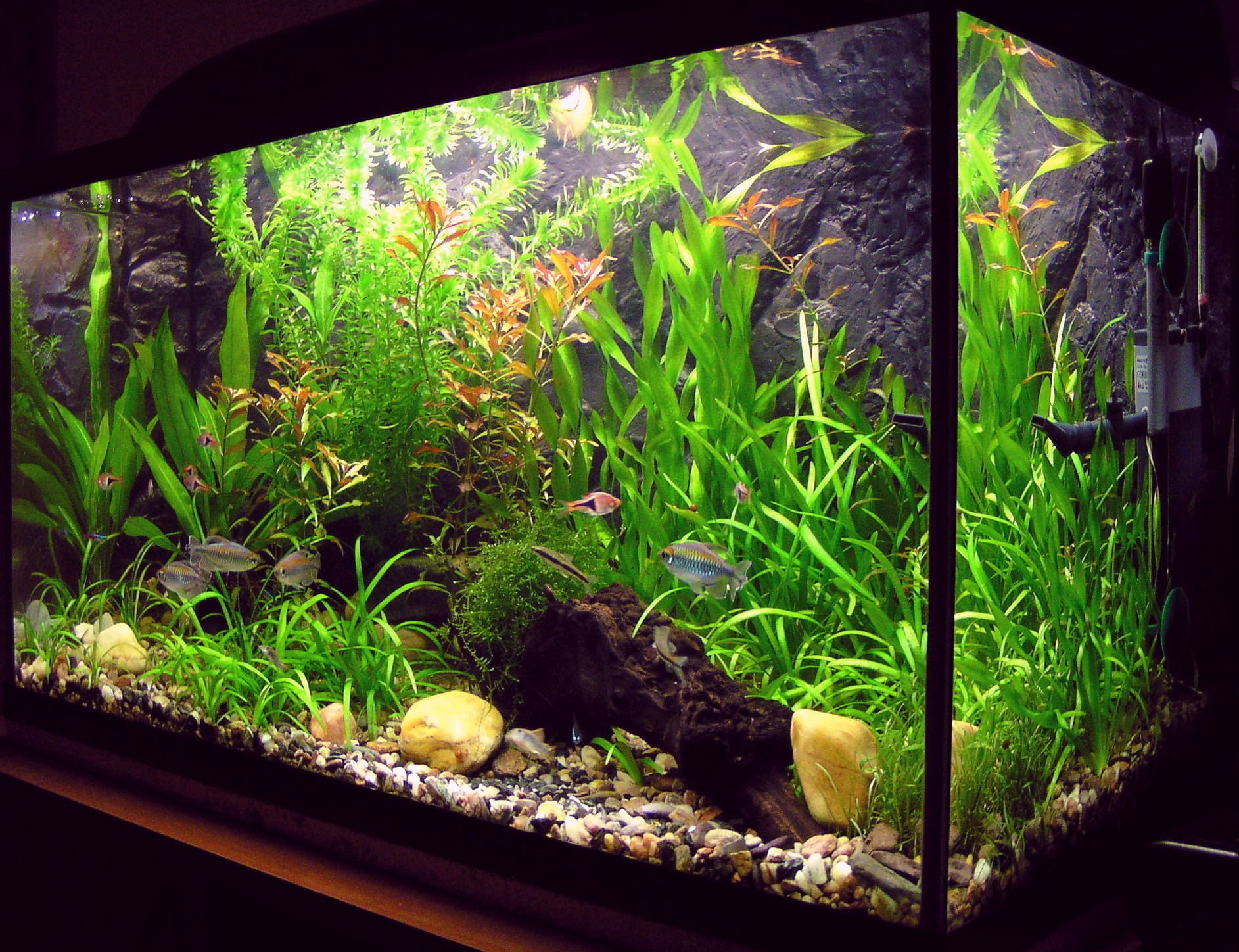
An aquarium (pl.: aquariums or aquaria) is a vivarium of any size having at least one transparent side in which aquatic plants or animals are kept and displayed. Fishkeepers use aquaria to keep fish, invertebrates, amphibians, aquatic reptiles, such as turtles, and aquatic plants. The term aquarium, coined by English naturalist Philip Henry Gosse, combines the Latin root aqua, meaning 'water', with the suffix -arium, meaning 'a place for relating to'.
The aquarium principle was fully developed in 1850 by the chemist Robert Warington, who explained that plants added to water in a container would give off enough oxygen to support animals, so long as the numbers of animals did not grow too large. The aquarium craze was launched in early Victorian England by Gosse, who created and stocked the first public aquarium at the London Zoo in 1853, and published the first manual, The Aquarium: An Unveiling of the Wonders of the Deep Sea in 1854. Small aquariums are kept in the home by hobbyists. There are large public aquariums in many cities. Public aquariums keep fish and other aquatic animals in large tanks. A large aquarium may have otters, dolphins, sharks, penguins, seals, and whales. Many aquarium tanks also have plants.
An aquarist owns fish or maintains an aquarium, typically constructed of glass or high-strength acrylic. Aquaria with flat walls are known as fish tanks or simply tanks, while those with rounded walls are known as fish bowls. Size can range from a small glass bowl, a few liters in volume, to immense public aquaria of thousands of liters. Specialized equipment maintains appropriate water quality and other characteristics suitable for the aquarium's residents.
In 1369, the Hongwu Emperor of China established a porcelain company that produced large porcelain tubs for maintaining goldfish; over time, people produced tubs that approached the shape of modern fish bowls. Leonhard Baldner, who wrote Vogel-, Fisch- und Tierbuch (Bird, Fish, and Animal Book) in 1666, maintained weather loaches and newts. It is sometimes held that the aquarium was invented by the Romans, who are said to have kept sea barbels in marble-and-glass tanks, but scholars doubt the veracity of this.
In 1832, Jeanne Villepreux-Power, a pioneering French marine biologist, became the first person to create aquaria for experimenting with aquatic organisms. This experimentation led to several discoveries, including the first direct evidence that argonauts, a marine cephalopod, create their own shells. In 1836, soon after his invention of the Wardian case, Dr. Nathaniel Bagshaw Ward proposed to use his tanks for tropical animals. In 1841 he did so, though only with aquatic plants and toy fish. However, he soon housed real animals. In 1838, Félix Dujardin noted owning a saltwater aquarium, though he did not use the term. In 1846, Anne Thynne maintained stony corals and seaweed for almost three years, and was credited as the creator of the first balanced marine aquarium in London. English chemist Robert Warington experimented with a 13-gallon container, which contained goldfish, eelgrass, and snails, creating one of the first stable aquaria. The aquarium principle was fully developed by Warington, explaining that plants added to water in a container would give off enough oxygen to support animals, so long as their numbers do not grow too large. He published his findings in 1850 in the Chemical Society's journal.
The keeping of fish in an aquarium became a popular hobby and spread quickly. In the United Kingdom, it became popular after ornate aquaria in cast-iron frames were featured at the Great Exhibition of 1851. In 1853, the aquarium craze was launched in England, spreading from there to Germany, the United States and France as the result of the publications and activity of Philip Henry Gosse, the marine zoologist known as the "Father of the Aquarium". He created and stocked the first public aquarium at the London Zoo in Regent's Park, which came to be known as the Fish House. The Regent's Park aquarium, initially indiscriminately referred to as the "Fish House", "Vivarium", "Aquavivarium" or "Marine vivarium", soon yielded to the word "aquarium", a term coined by Gosse used as the title of his 1854 book The Aquarium: An Unveiling of the Wonders of the Deep Water. In this book, Gosse primarily discussed saltwater aquaria. The high-water mark of the popular aquarium movement in Britain lasted from 1853 to 1860. Tank designs and techniques for maintaining water quality were developed by Warington, later cooperating with Gosse until his critical review of the tank water composition. Edward Edwards developed these glass-fronted aquaria in his 1858 patent for a "dark-water-chamber slope-back tank", with water slowly circulating to a reservoir beneath.
Influenced by Gosse, the German Emil Adolf Rossmässler promoted the value of the aquarium movement in the educational field. Rossmässler wrote of its use in an 1855 article in Die Gartenlaube (The Gazebo) and in his 1857 book Das Susswasser-Aquarium (The Freshwater Aquarium), the freshwater aquarium being much easier to maintain in landlocked areas. In 1862 William Alford Lloyd, then bankrupt because of the craze in England being over, moved to Grindel Dammthor, Hamburg, to supervise the installation of the circulating system and tanks at the Hamburg Aquarium.[citation needed] During the 1870s, some of the first aquarist societies were appearing in Germany. The United States soon followed. Published in 1858, Henry D. Butler's The Family Aquarium was one of the first books written in the United States solely about the aquarium. According to the July issue of The North American Review of the same year, William Stimson may have owned some of the first functional aquaria, and had as many as seven or eight. Henry Bishop, a bird and fish dealer in Baltimore ("Goldfish King"), is credited with revolutionizing the aquarium business in the US, selling a wide range of tanks and supplies beginning in the 1870s-1880s. The first aquarist society in the United States was founded in New York City in 1893, followed by others. The New York Aquarium Journal, first published in October 1876, is considered to be the world's first aquarium magazine.
In the Victorian era in the United Kingdom, a common design for the home aquarium was a glass front with the other sides made of wood (made watertight with a pitch coating). The bottom would be made of slate and heated from below. More advanced systems soon began to be introduced, along with tanks of glass in metal frames. During the latter half of the 19th century, a variety of aquarium designs were explored, such as hanging the aquarium on a wall, mounting it as part of a window, or even combining it with a birdcage.
Hub AI
Aquarium AI simulator
(@Aquarium_simulator)
Aquarium
An aquarium (pl.: aquariums or aquaria) is a vivarium of any size having at least one transparent side in which aquatic plants or animals are kept and displayed. Fishkeepers use aquaria to keep fish, invertebrates, amphibians, aquatic reptiles, such as turtles, and aquatic plants. The term aquarium, coined by English naturalist Philip Henry Gosse, combines the Latin root aqua, meaning 'water', with the suffix -arium, meaning 'a place for relating to'.
The aquarium principle was fully developed in 1850 by the chemist Robert Warington, who explained that plants added to water in a container would give off enough oxygen to support animals, so long as the numbers of animals did not grow too large. The aquarium craze was launched in early Victorian England by Gosse, who created and stocked the first public aquarium at the London Zoo in 1853, and published the first manual, The Aquarium: An Unveiling of the Wonders of the Deep Sea in 1854. Small aquariums are kept in the home by hobbyists. There are large public aquariums in many cities. Public aquariums keep fish and other aquatic animals in large tanks. A large aquarium may have otters, dolphins, sharks, penguins, seals, and whales. Many aquarium tanks also have plants.
An aquarist owns fish or maintains an aquarium, typically constructed of glass or high-strength acrylic. Aquaria with flat walls are known as fish tanks or simply tanks, while those with rounded walls are known as fish bowls. Size can range from a small glass bowl, a few liters in volume, to immense public aquaria of thousands of liters. Specialized equipment maintains appropriate water quality and other characteristics suitable for the aquarium's residents.
In 1369, the Hongwu Emperor of China established a porcelain company that produced large porcelain tubs for maintaining goldfish; over time, people produced tubs that approached the shape of modern fish bowls. Leonhard Baldner, who wrote Vogel-, Fisch- und Tierbuch (Bird, Fish, and Animal Book) in 1666, maintained weather loaches and newts. It is sometimes held that the aquarium was invented by the Romans, who are said to have kept sea barbels in marble-and-glass tanks, but scholars doubt the veracity of this.
In 1832, Jeanne Villepreux-Power, a pioneering French marine biologist, became the first person to create aquaria for experimenting with aquatic organisms. This experimentation led to several discoveries, including the first direct evidence that argonauts, a marine cephalopod, create their own shells. In 1836, soon after his invention of the Wardian case, Dr. Nathaniel Bagshaw Ward proposed to use his tanks for tropical animals. In 1841 he did so, though only with aquatic plants and toy fish. However, he soon housed real animals. In 1838, Félix Dujardin noted owning a saltwater aquarium, though he did not use the term. In 1846, Anne Thynne maintained stony corals and seaweed for almost three years, and was credited as the creator of the first balanced marine aquarium in London. English chemist Robert Warington experimented with a 13-gallon container, which contained goldfish, eelgrass, and snails, creating one of the first stable aquaria. The aquarium principle was fully developed by Warington, explaining that plants added to water in a container would give off enough oxygen to support animals, so long as their numbers do not grow too large. He published his findings in 1850 in the Chemical Society's journal.
The keeping of fish in an aquarium became a popular hobby and spread quickly. In the United Kingdom, it became popular after ornate aquaria in cast-iron frames were featured at the Great Exhibition of 1851. In 1853, the aquarium craze was launched in England, spreading from there to Germany, the United States and France as the result of the publications and activity of Philip Henry Gosse, the marine zoologist known as the "Father of the Aquarium". He created and stocked the first public aquarium at the London Zoo in Regent's Park, which came to be known as the Fish House. The Regent's Park aquarium, initially indiscriminately referred to as the "Fish House", "Vivarium", "Aquavivarium" or "Marine vivarium", soon yielded to the word "aquarium", a term coined by Gosse used as the title of his 1854 book The Aquarium: An Unveiling of the Wonders of the Deep Water. In this book, Gosse primarily discussed saltwater aquaria. The high-water mark of the popular aquarium movement in Britain lasted from 1853 to 1860. Tank designs and techniques for maintaining water quality were developed by Warington, later cooperating with Gosse until his critical review of the tank water composition. Edward Edwards developed these glass-fronted aquaria in his 1858 patent for a "dark-water-chamber slope-back tank", with water slowly circulating to a reservoir beneath.
Influenced by Gosse, the German Emil Adolf Rossmässler promoted the value of the aquarium movement in the educational field. Rossmässler wrote of its use in an 1855 article in Die Gartenlaube (The Gazebo) and in his 1857 book Das Susswasser-Aquarium (The Freshwater Aquarium), the freshwater aquarium being much easier to maintain in landlocked areas. In 1862 William Alford Lloyd, then bankrupt because of the craze in England being over, moved to Grindel Dammthor, Hamburg, to supervise the installation of the circulating system and tanks at the Hamburg Aquarium.[citation needed] During the 1870s, some of the first aquarist societies were appearing in Germany. The United States soon followed. Published in 1858, Henry D. Butler's The Family Aquarium was one of the first books written in the United States solely about the aquarium. According to the July issue of The North American Review of the same year, William Stimson may have owned some of the first functional aquaria, and had as many as seven or eight. Henry Bishop, a bird and fish dealer in Baltimore ("Goldfish King"), is credited with revolutionizing the aquarium business in the US, selling a wide range of tanks and supplies beginning in the 1870s-1880s. The first aquarist society in the United States was founded in New York City in 1893, followed by others. The New York Aquarium Journal, first published in October 1876, is considered to be the world's first aquarium magazine.
In the Victorian era in the United Kingdom, a common design for the home aquarium was a glass front with the other sides made of wood (made watertight with a pitch coating). The bottom would be made of slate and heated from below. More advanced systems soon began to be introduced, along with tanks of glass in metal frames. During the latter half of the 19th century, a variety of aquarium designs were explored, such as hanging the aquarium on a wall, mounting it as part of a window, or even combining it with a birdcage.