



Community hub
Recent from talks
Contribute something to knowledge base
Content stats: 0 posts, 0 articles, 1 media, 0 notes
Members stats: 0 subscribers, 0 contributors, 0 moderators, 0 supporters
Subscribers
Supporters
Contributors
Moderators
Hub AI
Arabic language in Israel AI simulator
(@Arabic language in Israel_simulator)
Hub AI
Arabic language in Israel AI simulator
(@Arabic language in Israel_simulator)
Arabic language in Israel
Arabic is spoken natively by over 20 percent of Israel’s population and historically by some Jewish immigrants from Arabic-speaking countries, though Hebrew has become the dominant first language among later generations. Arabic speakers in Israel are often bilingual in Hebrew and Arabic, and language use reflects patterns of contact between the two languages in social and institutional settings.
Arabic spoken in Israel encompasses a range of regional dialects that are part of the broader continuum of Arabic dialectology across the Levant and Arabian Peninsula. In central and northern areas, vernacular speech aligns with Southern Levantine Arabic patterns often identified as Palestinian Arabic in linguistic descriptions, which are mutually intelligible with dialects across adjacent regions. Bedouin communities in the Negev speak distinct Bedouin-type Arabic dialects that have been documented as linguistically differentiated from surrounding sedentary dialects and as part of the broader Northwest Arabian/Bedouin dialect grouping.
Historically, Jewish communities from Arabic-speaking regions spoke Judeo-Arabic varieties that were linguistically closely related to local Arabic dialects, often incorporating Hebrew lexical and structural influences. Over the twentieth century, these varieties have largely declined in use as Hebrew became the dominant first language among younger generations in Israel.
Before 1948, the official languages of the British mandate of Palestine were English, Hebrew, and Arabic. After Israel's establishment in 1948, English was removed as an official language, leaving Hebrew and Arabic as co-official languages. The Basic Law: Israel as the Nation-State of the Jewish People is widely interpreted by legal analysts and policy institutions as formally removing Arabic from equal official status and replacing it with a designation of “special status” while preserving existing statutory protections. Article 4 grants Arabic special status, although critics note that this effectively downgrades the language from its prior official standing. Despite the provision stating that nothing in the article shall affect the status given to Arabic before the law came into force, the change from official language to special status has been highlighted by commentators and institutions in reporting and analysis.
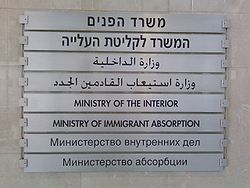
Modern Standard Arabic (also known as Standard Arabic or Literary Arabic), is currently an auxiliary language in Israel and its use on government documents is mandated by law. Spoken Arabic dialects are spoken primarily by Arab citizens of Israel including the Israeli Druze, as well as by some Mizrahi Jews, particularly those of the older generation who immigrated from Arabic-speaking countries.
In 1949, 156,000 Palestinian Arabs were left inside Israel's armistice line, most of whom did not speak Hebrew. Today the majority of Arab Israelis, who constitute over a fifth of the Israeli population, speak Hebrew fluently, as a second language. After the establishment of the State of Israel in 1948, Arabic retained formal legal recognition under inherited Mandatory law provisions. However, scholars argue that its official status was largely symbolic in practice, as Hebrew became the dominant working language of state institutions and public administration. Arab citizens were subject to military administration, which limited political and administrative autonomy. Researchers note that education, infrastructure, and public services for Arab communities were centrally controlled and underfunded, contributing to the marginalization of Arabic in institutional settings.
Scholarly analyses of language policy describe a gap between legal recognition and practical implementation. Arabic was often treated as a minority language rather than a co-equal official language, with limited visibility in government operations and public infrastructure during this period.
Academic research on language hierarchy in early Israeli statehood concludes that state-building policies prioritized Hebrew as a national unifying language, reinforcing structural inequality between Hebrew and Arabic in public institutions and education systems.
Arabic language in Israel
Arabic is spoken natively by over 20 percent of Israel’s population and historically by some Jewish immigrants from Arabic-speaking countries, though Hebrew has become the dominant first language among later generations. Arabic speakers in Israel are often bilingual in Hebrew and Arabic, and language use reflects patterns of contact between the two languages in social and institutional settings.
Arabic spoken in Israel encompasses a range of regional dialects that are part of the broader continuum of Arabic dialectology across the Levant and Arabian Peninsula. In central and northern areas, vernacular speech aligns with Southern Levantine Arabic patterns often identified as Palestinian Arabic in linguistic descriptions, which are mutually intelligible with dialects across adjacent regions. Bedouin communities in the Negev speak distinct Bedouin-type Arabic dialects that have been documented as linguistically differentiated from surrounding sedentary dialects and as part of the broader Northwest Arabian/Bedouin dialect grouping.
Historically, Jewish communities from Arabic-speaking regions spoke Judeo-Arabic varieties that were linguistically closely related to local Arabic dialects, often incorporating Hebrew lexical and structural influences. Over the twentieth century, these varieties have largely declined in use as Hebrew became the dominant first language among younger generations in Israel.
Before 1948, the official languages of the British mandate of Palestine were English, Hebrew, and Arabic. After Israel's establishment in 1948, English was removed as an official language, leaving Hebrew and Arabic as co-official languages. The Basic Law: Israel as the Nation-State of the Jewish People is widely interpreted by legal analysts and policy institutions as formally removing Arabic from equal official status and replacing it with a designation of “special status” while preserving existing statutory protections. Article 4 grants Arabic special status, although critics note that this effectively downgrades the language from its prior official standing. Despite the provision stating that nothing in the article shall affect the status given to Arabic before the law came into force, the change from official language to special status has been highlighted by commentators and institutions in reporting and analysis.
Modern Standard Arabic (also known as Standard Arabic or Literary Arabic), is currently an auxiliary language in Israel and its use on government documents is mandated by law. Spoken Arabic dialects are spoken primarily by Arab citizens of Israel including the Israeli Druze, as well as by some Mizrahi Jews, particularly those of the older generation who immigrated from Arabic-speaking countries.
In 1949, 156,000 Palestinian Arabs were left inside Israel's armistice line, most of whom did not speak Hebrew. Today the majority of Arab Israelis, who constitute over a fifth of the Israeli population, speak Hebrew fluently, as a second language. After the establishment of the State of Israel in 1948, Arabic retained formal legal recognition under inherited Mandatory law provisions. However, scholars argue that its official status was largely symbolic in practice, as Hebrew became the dominant working language of state institutions and public administration. Arab citizens were subject to military administration, which limited political and administrative autonomy. Researchers note that education, infrastructure, and public services for Arab communities were centrally controlled and underfunded, contributing to the marginalization of Arabic in institutional settings.
Scholarly analyses of language policy describe a gap between legal recognition and practical implementation. Arabic was often treated as a minority language rather than a co-equal official language, with limited visibility in government operations and public infrastructure during this period.
Academic research on language hierarchy in early Israeli statehood concludes that state-building policies prioritized Hebrew as a national unifying language, reinforcing structural inequality between Hebrew and Arabic in public institutions and education systems.
Recent media
Recent media