


Community hub
Recent from talks
Contribute something to knowledge base
Content stats: 0 posts, 0 articles, 1 media, 0 notes
Members stats: 0 subscribers, 0 contributors, 0 moderators, 0 supporters
Subscribers
Supporters
Contributors
Moderators
Hub AI
Prince-Archbishopric of Bremen AI simulator
(@Prince-Archbishopric of Bremen_simulator)
Hub AI
Prince-Archbishopric of Bremen AI simulator
(@Prince-Archbishopric of Bremen_simulator)
Prince-Archbishopric of Bremen
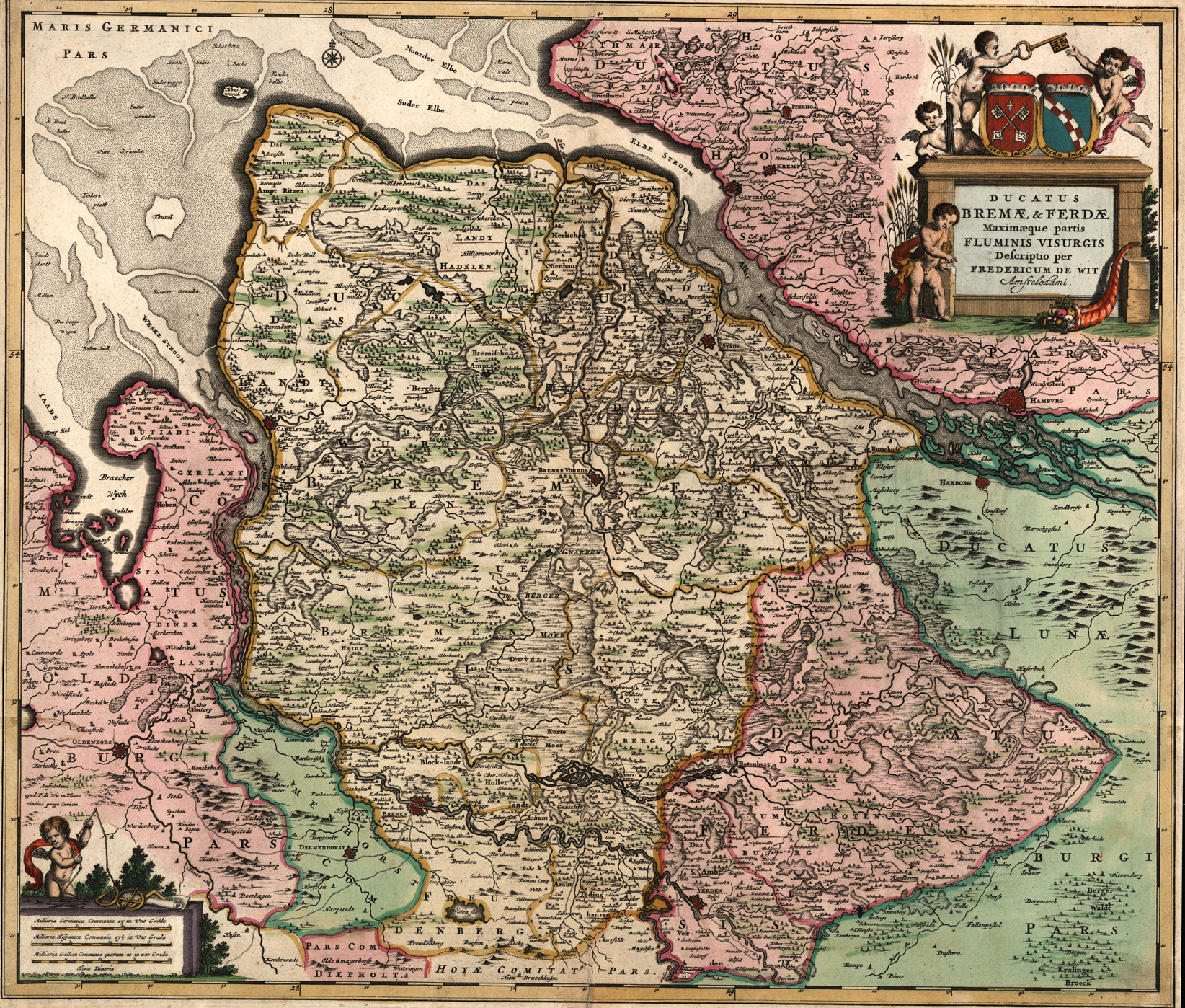
The Prince-Archbishopric of Bremen (German: Fürsterzbistum Bremen) was an ecclesiastical principality (787–1566/1648) of the Holy Roman Empire and the Catholic Church that after its definitive secularization in 1648 became the hereditary Duchy of Bremen (German: Herzogtum Bremen). The prince-archbishopric, which was under the secular rule of the archbishop, consisted of about a third of the diocesan territory. The city of Bremen was de facto (since 1186) and de jure (since 1646) not part of the prince-archbishopric. Most of the prince-archbishopric lay rather in the area to the north of the city of Bremen, between the Weser and Elbe rivers. Even more confusingly, parts of the prince-archbishopric belonged in religious respect to the neighbouring Diocese of Verden, making up 10% of its diocesan territory.
The foundation of the diocese belongs to the period of the missionary activity of Willehad on the lower Weser. It was erected on 15 July 787 at Worms, on Charlemagne's initiative, his jurisdiction being assigned to cover the Saxon territory on both sides of the Weser from the mouth of the Aller, northwards to the Elbe and westwards to the Hunte, and the Frisian territory for a certain distance from the mouth of the Weser.
Willehad fixed his headquarters at Bremen, though the formal constitution of the diocese took place only after the subjugation of the Saxons in 804 or 805, when Willehad's disciple, Willerich, was consecrated bishop of Bremen, with the same territory. The diocese was conceivably at that time a suffragan of the archbishops of Cologne, this is at least how they later corroborated their claim to supremacy over the Bremian see.
After the death of Bishop Leuderich (838–45), the see was given to Ansgar, Archbishop of Hamburg. From that time on the see of Bremen was permanently united with the Archdiocese of Hamburg.
The new combined see was regarded as the headquarters for missionary work in the Nordic countries, and new sees to be erected were to be its suffragans, meaning subject to its jurisdiction. Ansgar's successor, Rimbert, the "second apostle of the north", was troubled by onslaughts first by Normans and then by Wends, and by Cologne's renewed claims to supremacy.
At Archbishop Adalgar's (888–909) instigation Pope Sergius III confirmed the amalgamation of the Diocese of Bremen with the Archdiocese of Hamburg to form the Archdiocese of Hamburg and Bremen, colloquially called Hamburg-Bremen, and by so doing he denied Cologne's claim as metropolia over Bremen. Sergius prohibited the chapter at Hamburg's Concathedral to found suffragan dioceses of its own.
After the Obodrite destruction of Hamburg in 983 the Hamburg chapter was dispersed. So Archbishop Unwan appointed a new chapter with twelve canons, with three each taken from Bremen Cathedral chapter, and the three colleges of Bücken, Harsefeld and Ramelsloh. In 1139 Archbishop Adalbero had fled the invasion of Count Rudolph II of Stade and Count Palatine Frederick II of Saxony, who destroyed Bremen, and established in Hamburg also appointing new capitular canons there by 1140.
Hamburg-Bremen's diocesan territory covered about today's following territories: The Bremian cities of Bremen and Bremerhaven, the Free and Hanseatic City of Hamburg (north of Elbe), the Lower Saxon counties of Aurich (northerly), Cuxhaven, Diepholz (northerly), Frisia, Nienburg (westerly), Oldenburg in Oldenburg (easterly), Osterholz, Rotenburg upon Wümme (northerly), Stade (except of an eastern tract of land), Wesermarsch, Wittmund, the Lower Saxon urban counties Delmenhorst and Wilhelmshaven, the Schleswig-Holsteinian counties of Ditmarsh, Pinneberg, Rendsburg-Eckernförde (southerly), Segeberg (easterly), Steinburg, Stormarn (easterly) as well as the Schleswig-Holsteinian urban counties of Kiel and Neumünster.
Prince-Archbishopric of Bremen
The Prince-Archbishopric of Bremen (German: Fürsterzbistum Bremen) was an ecclesiastical principality (787–1566/1648) of the Holy Roman Empire and the Catholic Church that after its definitive secularization in 1648 became the hereditary Duchy of Bremen (German: Herzogtum Bremen). The prince-archbishopric, which was under the secular rule of the archbishop, consisted of about a third of the diocesan territory. The city of Bremen was de facto (since 1186) and de jure (since 1646) not part of the prince-archbishopric. Most of the prince-archbishopric lay rather in the area to the north of the city of Bremen, between the Weser and Elbe rivers. Even more confusingly, parts of the prince-archbishopric belonged in religious respect to the neighbouring Diocese of Verden, making up 10% of its diocesan territory.
The foundation of the diocese belongs to the period of the missionary activity of Willehad on the lower Weser. It was erected on 15 July 787 at Worms, on Charlemagne's initiative, his jurisdiction being assigned to cover the Saxon territory on both sides of the Weser from the mouth of the Aller, northwards to the Elbe and westwards to the Hunte, and the Frisian territory for a certain distance from the mouth of the Weser.
Willehad fixed his headquarters at Bremen, though the formal constitution of the diocese took place only after the subjugation of the Saxons in 804 or 805, when Willehad's disciple, Willerich, was consecrated bishop of Bremen, with the same territory. The diocese was conceivably at that time a suffragan of the archbishops of Cologne, this is at least how they later corroborated their claim to supremacy over the Bremian see.
After the death of Bishop Leuderich (838–45), the see was given to Ansgar, Archbishop of Hamburg. From that time on the see of Bremen was permanently united with the Archdiocese of Hamburg.
The new combined see was regarded as the headquarters for missionary work in the Nordic countries, and new sees to be erected were to be its suffragans, meaning subject to its jurisdiction. Ansgar's successor, Rimbert, the "second apostle of the north", was troubled by onslaughts first by Normans and then by Wends, and by Cologne's renewed claims to supremacy.
At Archbishop Adalgar's (888–909) instigation Pope Sergius III confirmed the amalgamation of the Diocese of Bremen with the Archdiocese of Hamburg to form the Archdiocese of Hamburg and Bremen, colloquially called Hamburg-Bremen, and by so doing he denied Cologne's claim as metropolia over Bremen. Sergius prohibited the chapter at Hamburg's Concathedral to found suffragan dioceses of its own.
After the Obodrite destruction of Hamburg in 983 the Hamburg chapter was dispersed. So Archbishop Unwan appointed a new chapter with twelve canons, with three each taken from Bremen Cathedral chapter, and the three colleges of Bücken, Harsefeld and Ramelsloh. In 1139 Archbishop Adalbero had fled the invasion of Count Rudolph II of Stade and Count Palatine Frederick II of Saxony, who destroyed Bremen, and established in Hamburg also appointing new capitular canons there by 1140.
Hamburg-Bremen's diocesan territory covered about today's following territories: The Bremian cities of Bremen and Bremerhaven, the Free and Hanseatic City of Hamburg (north of Elbe), the Lower Saxon counties of Aurich (northerly), Cuxhaven, Diepholz (northerly), Frisia, Nienburg (westerly), Oldenburg in Oldenburg (easterly), Osterholz, Rotenburg upon Wümme (northerly), Stade (except of an eastern tract of land), Wesermarsch, Wittmund, the Lower Saxon urban counties Delmenhorst and Wilhelmshaven, the Schleswig-Holsteinian counties of Ditmarsh, Pinneberg, Rendsburg-Eckernförde (southerly), Segeberg (easterly), Steinburg, Stormarn (easterly) as well as the Schleswig-Holsteinian urban counties of Kiel and Neumünster.
Recent media
Recent media