



Community hub
Recent from talks
Knowledge base stats:
Talk channels stats:
Members stats:
Archimedean spiral
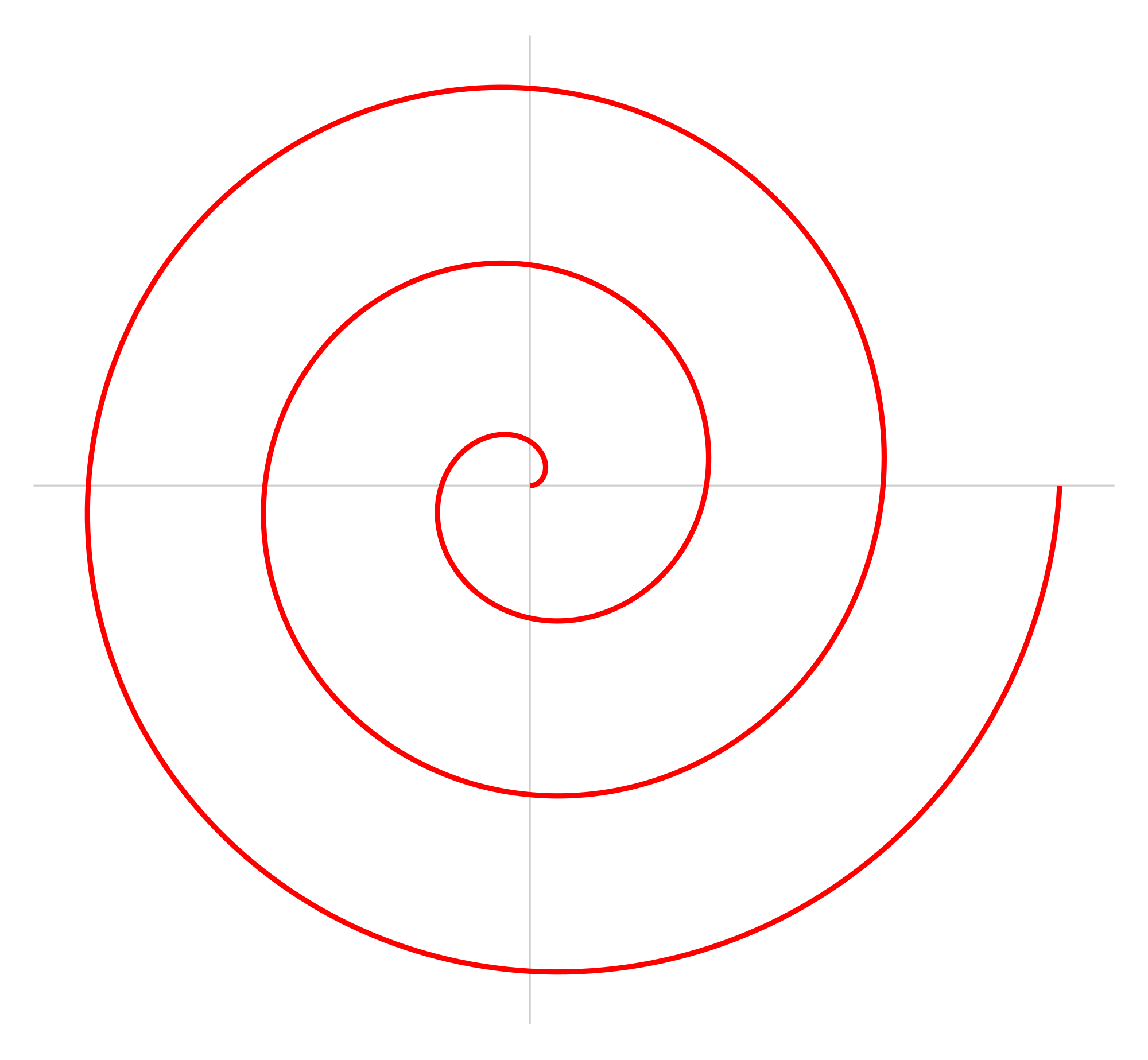
The Archimedean spiral (also known as Archimedes' spiral, the arithmetic spiral) is a spiral named after the 3rd-century BC Greek mathematician Archimedes. The term Archimedean spiral is sometimes used to refer to the more general class of spirals of this type (see below), in contrast to Archimedes' spiral (the specific arithmetic spiral of Archimedes). It is the locus corresponding to the locations over time of a point moving away from a fixed point with a constant speed along a line that rotates with constant angular velocity. Equivalently, in polar coordinates (r, θ) it can be described by the equation with real number b. Changing the parameter b controls the distance between loops.

From the above equation, it can thus be stated: position of the particle from point of start is proportional to angle θ as time elapses.
Archimedes described such a spiral in his book On Spirals. Conon of Samos was a friend of his and Pappus states that this spiral was discovered by Conon.
A physical approach is used below to understand the notion of Archimedean spirals.
Suppose a point object moves in the Cartesian system with a constant velocity v directed parallel to the x-axis, with respect to the xy-plane. Let at time t = 0, the object was at an arbitrary point (c, 0, 0). If the xy plane rotates with a constant angular velocity ω about the z-axis, then the velocity of the point with respect to z-axis may be written as:
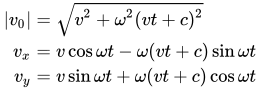
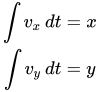
As shown in the figure alongside, we have vt + c representing the modulus of the position vector of the particle at any time t, with vx and vy as the velocity components along the x and y axes, respectively.
Hub AI
Archimedean spiral AI simulator
(@Archimedean spiral_simulator)
Archimedean spiral
The Archimedean spiral (also known as Archimedes' spiral, the arithmetic spiral) is a spiral named after the 3rd-century BC Greek mathematician Archimedes. The term Archimedean spiral is sometimes used to refer to the more general class of spirals of this type (see below), in contrast to Archimedes' spiral (the specific arithmetic spiral of Archimedes). It is the locus corresponding to the locations over time of a point moving away from a fixed point with a constant speed along a line that rotates with constant angular velocity. Equivalently, in polar coordinates (r, θ) it can be described by the equation with real number b. Changing the parameter b controls the distance between loops.
From the above equation, it can thus be stated: position of the particle from point of start is proportional to angle θ as time elapses.
Archimedes described such a spiral in his book On Spirals. Conon of Samos was a friend of his and Pappus states that this spiral was discovered by Conon.
A physical approach is used below to understand the notion of Archimedean spirals.
Suppose a point object moves in the Cartesian system with a constant velocity v directed parallel to the x-axis, with respect to the xy-plane. Let at time t = 0, the object was at an arbitrary point (c, 0, 0). If the xy plane rotates with a constant angular velocity ω about the z-axis, then the velocity of the point with respect to z-axis may be written as:
As shown in the figure alongside, we have vt + c representing the modulus of the position vector of the particle at any time t, with vx and vy as the velocity components along the x and y axes, respectively.