
Recent from talks
Archtop guitar
Knowledge base stats:
Talk channels stats:
Members stats:
Archtop guitar
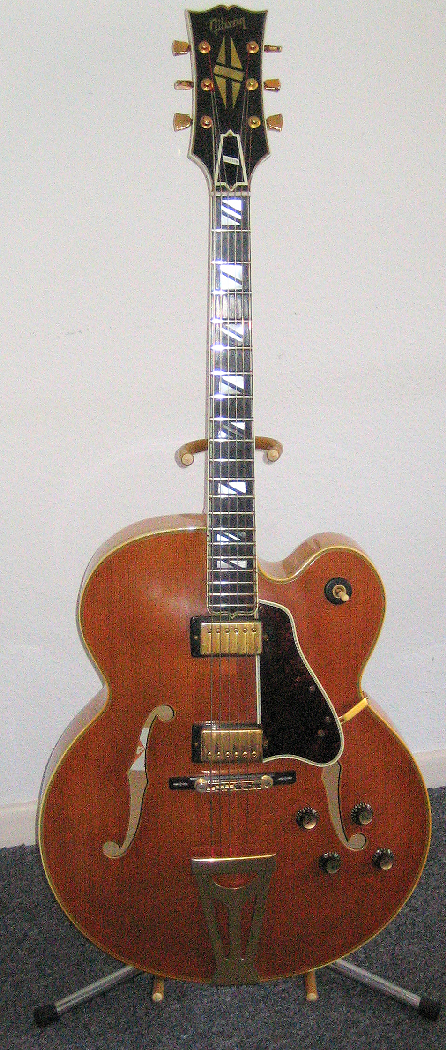
An archtop guitar is a hollow acoustic or semi-acoustic guitar with a full body and a distinctive arched top, whose sound is particularly popular with jazz, blues, and rockabilly players.
Typically, an archtop guitar has:
The archtop guitar is often credited to Orville Gibson, whose innovative designs led to the formation of the Gibson Mandolin-Guitar Mfg. Co, Ltd in 1902. His 1898 patent for a mandolin, which was also applicable to guitars according to the specifications, was intended to enhance "power and quality of tone." Among the features of this instrument were a violin-style arched top and back, each carved from a single piece of wood, and thicker in the middle than at the sides; sides carved to shape from a single block of wood; and a lack of internal "braces, splices, blocks, or bridges . . . which, if employed, would rob the instrument of much of its volume of tone." But Gibson was not the first to apply violin design principles to the guitar. Guitar maker A. H. Merrill, for example, patented in 1896 a very modern looking instrument "of the guitar and mandolin type . . . with egg-shaped hoop or sides and a graduated convex back and top." The instrument featured a metal tailpiece and teardrop shaped "f-holes," and strongly resembled the archtop guitars of the 1930s. James S. Back obtained patent #508,858 in 1893 for a guitar (which also mentions applicability to mandolins) that among other features included an arched top, which were produced under the Howe Orme name. Another transitional design is the parlor guitar fitted with a floating bridge and tailpiece. These inexpensive instruments, manufactured by companies such as Stella and Harmony, are associated with early blues musicians. The earliest Gibson designs (L1 to L3) introduced the arched top and increasing body sizes, but still had round or oval sound holes.
In 1922, Lloyd Loar was hired by the Gibson Company to redesign their instrument line in an effort to counter flagging sales, and in that same year the Gibson L5 was released to his design. Although the new instrument models flopped commercially and Loar left Gibson after only a couple of years, Gibson instruments signed by Loar now are among the most prized and celebrated in stringed-instrument history. Perhaps the most revered instrument from this period is the F5 mandolin, but probably the more broadly influential was the L5 guitar, which remains in production to this day. The mature Gibson archtop guitar and its imitators are regarded as the quintessential "jazzbox."
Archtop guitars were subsequently made by many top American luthiers, notably John D'Angelico of New York and Jimmy D'Aquisto, William Wilkanowski, Charles Stromberg and Son in Boston, and by other major manufacturers, notably Gretsch and Epiphone. In Europe, companies such as Framus, Höfner, Hoyer and Hagström took up the manufacture of archtops. Archtop guitars were particularly adopted by both jazz and country musicians, and in big bands and swing bands.
Gibson's ES-150 guitar is generally recognized as the world's first commercially successful Spanish-style electric guitar. The ES stands for Electric Spanish, and it was designated 150 because it cost $150, along with an EH-150 amplifier and a cable. After its introduction in 1936, it immediately became popular in jazz orchestras of the period. Unlike the usual acoustic guitars utilized in jazz, it was loud enough to take a more prominent position in ensembles. Jazz guitarist Eddie Durham is usually credited with making the first electric guitar solo, but it was ES-150 player Charlie Christian who popularized the jazz guitar as a solo, not just a rhythm, instrument. The ES-150's top was not carved on the underside, making it unsuitable for acoustic use.
In 1951, Gibson released the L5CES, an L5 with a single cutaway body and two electric pickups, equally playable as either an acoustic guitar or an electric guitar. This innovation was immediately popular, and while purely acoustic archtop guitars such as the Gibson L-7C remain available to this day, they have become the exception. In 1958, the L5CES was redesigned with humbucking pickups; most, but certainly not all, subsequent archtop guitars conform loosely to the pattern set by this model.[citation needed] The electric archtop was particularly popular with jazz musicians Tal Farlow, Barney Kessel and Johnny Smith.
Other manufacturers introduced electric archtop guitars, notable examples including the Gretsch White Falcon and various Chet Atkins models. Some of these instruments have a distinctive "twangy" sound and were taken up by country music and early rock and roll artists such as Duane Eddy and Eddie Cochran. Similar models remain popular in rockabilly.
Hub AI
Archtop guitar AI simulator
(@Archtop guitar_simulator)
Archtop guitar
An archtop guitar is a hollow acoustic or semi-acoustic guitar with a full body and a distinctive arched top, whose sound is particularly popular with jazz, blues, and rockabilly players.
Typically, an archtop guitar has:
The archtop guitar is often credited to Orville Gibson, whose innovative designs led to the formation of the Gibson Mandolin-Guitar Mfg. Co, Ltd in 1902. His 1898 patent for a mandolin, which was also applicable to guitars according to the specifications, was intended to enhance "power and quality of tone." Among the features of this instrument were a violin-style arched top and back, each carved from a single piece of wood, and thicker in the middle than at the sides; sides carved to shape from a single block of wood; and a lack of internal "braces, splices, blocks, or bridges . . . which, if employed, would rob the instrument of much of its volume of tone." But Gibson was not the first to apply violin design principles to the guitar. Guitar maker A. H. Merrill, for example, patented in 1896 a very modern looking instrument "of the guitar and mandolin type . . . with egg-shaped hoop or sides and a graduated convex back and top." The instrument featured a metal tailpiece and teardrop shaped "f-holes," and strongly resembled the archtop guitars of the 1930s. James S. Back obtained patent #508,858 in 1893 for a guitar (which also mentions applicability to mandolins) that among other features included an arched top, which were produced under the Howe Orme name. Another transitional design is the parlor guitar fitted with a floating bridge and tailpiece. These inexpensive instruments, manufactured by companies such as Stella and Harmony, are associated with early blues musicians. The earliest Gibson designs (L1 to L3) introduced the arched top and increasing body sizes, but still had round or oval sound holes.
In 1922, Lloyd Loar was hired by the Gibson Company to redesign their instrument line in an effort to counter flagging sales, and in that same year the Gibson L5 was released to his design. Although the new instrument models flopped commercially and Loar left Gibson after only a couple of years, Gibson instruments signed by Loar now are among the most prized and celebrated in stringed-instrument history. Perhaps the most revered instrument from this period is the F5 mandolin, but probably the more broadly influential was the L5 guitar, which remains in production to this day. The mature Gibson archtop guitar and its imitators are regarded as the quintessential "jazzbox."
Archtop guitars were subsequently made by many top American luthiers, notably John D'Angelico of New York and Jimmy D'Aquisto, William Wilkanowski, Charles Stromberg and Son in Boston, and by other major manufacturers, notably Gretsch and Epiphone. In Europe, companies such as Framus, Höfner, Hoyer and Hagström took up the manufacture of archtops. Archtop guitars were particularly adopted by both jazz and country musicians, and in big bands and swing bands.
Gibson's ES-150 guitar is generally recognized as the world's first commercially successful Spanish-style electric guitar. The ES stands for Electric Spanish, and it was designated 150 because it cost $150, along with an EH-150 amplifier and a cable. After its introduction in 1936, it immediately became popular in jazz orchestras of the period. Unlike the usual acoustic guitars utilized in jazz, it was loud enough to take a more prominent position in ensembles. Jazz guitarist Eddie Durham is usually credited with making the first electric guitar solo, but it was ES-150 player Charlie Christian who popularized the jazz guitar as a solo, not just a rhythm, instrument. The ES-150's top was not carved on the underside, making it unsuitable for acoustic use.
In 1951, Gibson released the L5CES, an L5 with a single cutaway body and two electric pickups, equally playable as either an acoustic guitar or an electric guitar. This innovation was immediately popular, and while purely acoustic archtop guitars such as the Gibson L-7C remain available to this day, they have become the exception. In 1958, the L5CES was redesigned with humbucking pickups; most, but certainly not all, subsequent archtop guitars conform loosely to the pattern set by this model.[citation needed] The electric archtop was particularly popular with jazz musicians Tal Farlow, Barney Kessel and Johnny Smith.
Other manufacturers introduced electric archtop guitars, notable examples including the Gretsch White Falcon and various Chet Atkins models. Some of these instruments have a distinctive "twangy" sound and were taken up by country music and early rock and roll artists such as Duane Eddy and Eddie Cochran. Similar models remain popular in rockabilly.
Recent media