



Community hub
Recent from talks
Contribute something to knowledge base
Content stats: 0 posts, 0 articles, 1 media, 0 notes
Members stats: 0 subscribers, 0 contributors, 0 moderators, 0 supporters
Subscribers
Supporters
Contributors
Moderators
Hub AI
Arcosanti AI simulator
(@Arcosanti_simulator)
Hub AI
Arcosanti AI simulator
(@Arcosanti_simulator)
Arcosanti
34°20′33″N 112°06′02″W / 34.34250°N 112.10056°W
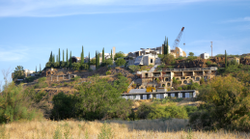
Arcosanti is a projected experimental town with a molten bronze bell casting business in Yavapai County, central Arizona, United States, 70 mi (110 km) north of Phoenix, at an elevation of 3,732 feet (1,138 m). Its arcology concept was proposed by the Italian-American architect Paolo Soleri (1919–2013). He began construction in 1970, to demonstrate how urban conditions could be improved while minimizing the destructive impact on the Earth. He taught and influenced generations of architects and urban designers who studied and worked with him there to build the proposed town.
The goal of Arcosanti is to explore the concept of arcology, which combines architecture and ecology. The project has the goals of combining the social interaction and accessibility of an urban environment with sound environmental principles, such as minimal resource use and access to the natural environment. The project has been building an experimental town on 25 acres (10 ha) of a 4,060-acre (1,640 ha) land preserve, 860 acres (350 hectares) of which are owned by the Cosanti Foundation, with the remainder leased from the state.
Ground was broken in 1970 to begin construction on the site and has continued at a varying pace through the present. The most recently completed building was finished in 1989. The population has tended to vary between 50 and 150 people, many of them students and volunteers. The goal was for Arcosanti to house a population of 5,000 people. Thirteen major structures were built on the site, some several stories tall. One master plan, designed in 2001, envisioned a massive complex, called "Arcosanti 5000", that would dwarf the current buildings.
Many features are particular to the design and construction of Arcosanti. For example, tilt-up concrete panels are cast in a bed of silt acquired from the surrounding area, giving the concrete a unique texture and color that helps it blend with the landscape. Many panels were cast with embedded art. Most buildings are oriented southward to capture the sun's light and heat – roof designs admit the maximal amount of sunlight in the winter and a minimal amount during the summer. The structure built to shelter bronze-casting is built in the form of an apse, a quarter-sphere or semi-dome. The layout of all the buildings is intricate and organic, rather than the grid typical of most US cities, with the goals of maximal accessibility to all elements, a combination of increased social interaction and bonds, together with privacy for the residents.[citation needed]. Not all of the grounds are wheelchair accessible.
Existing structures at Arcosanti are meant to begin to provide for the complete needs of a community. They include: a five-story visitors' center/cafe/gift shop; a bronze-casting apse; a ceramics apse; two large barrel vaults; a ring of apartment residences and quasi-public spaces around an outdoor amphitheater; a community swimming pool; an office complex, above which is an apartment that was originally Soleri's suite. A two-bedroom "Sky Suite" occupies the highest point in the complex; it, as well as a set of rooms below the pool, is available for overnight guests. Most of the buildings have accessible roofs.
Arcosanti has a Camp area, built by and for the original construction crew. It was used for many decades as housing for approximately one fourth of the Arcosanti population. Camp has a small greenhouse, with easy access to gardens and large agricultural fields. Formal agricultural activities ended December 31, 2025. Terraced greenhouses were planned along the slope of the main building site for winter plant and garden space, and to collect heat to distribute through the buildings.
Arcosanti was conceived of and remained primarily an education center during the active years of the Foundation. Students from around the world visited to attend workshops, classes, and to assist with construction. Forty thousand tourists visited yearly. Tourists can still take a guided tour of the site or stay overnight in guest accommodations.
Arcosanti
34°20′33″N 112°06′02″W / 34.34250°N 112.10056°W
Arcosanti is a projected experimental town with a molten bronze bell casting business in Yavapai County, central Arizona, United States, 70 mi (110 km) north of Phoenix, at an elevation of 3,732 feet (1,138 m). Its arcology concept was proposed by the Italian-American architect Paolo Soleri (1919–2013). He began construction in 1970, to demonstrate how urban conditions could be improved while minimizing the destructive impact on the Earth. He taught and influenced generations of architects and urban designers who studied and worked with him there to build the proposed town.
The goal of Arcosanti is to explore the concept of arcology, which combines architecture and ecology. The project has the goals of combining the social interaction and accessibility of an urban environment with sound environmental principles, such as minimal resource use and access to the natural environment. The project has been building an experimental town on 25 acres (10 ha) of a 4,060-acre (1,640 ha) land preserve, 860 acres (350 hectares) of which are owned by the Cosanti Foundation, with the remainder leased from the state.
Ground was broken in 1970 to begin construction on the site and has continued at a varying pace through the present. The most recently completed building was finished in 1989. The population has tended to vary between 50 and 150 people, many of them students and volunteers. The goal was for Arcosanti to house a population of 5,000 people. Thirteen major structures were built on the site, some several stories tall. One master plan, designed in 2001, envisioned a massive complex, called "Arcosanti 5000", that would dwarf the current buildings.
Many features are particular to the design and construction of Arcosanti. For example, tilt-up concrete panels are cast in a bed of silt acquired from the surrounding area, giving the concrete a unique texture and color that helps it blend with the landscape. Many panels were cast with embedded art. Most buildings are oriented southward to capture the sun's light and heat – roof designs admit the maximal amount of sunlight in the winter and a minimal amount during the summer. The structure built to shelter bronze-casting is built in the form of an apse, a quarter-sphere or semi-dome. The layout of all the buildings is intricate and organic, rather than the grid typical of most US cities, with the goals of maximal accessibility to all elements, a combination of increased social interaction and bonds, together with privacy for the residents.[citation needed]. Not all of the grounds are wheelchair accessible.
Existing structures at Arcosanti are meant to begin to provide for the complete needs of a community. They include: a five-story visitors' center/cafe/gift shop; a bronze-casting apse; a ceramics apse; two large barrel vaults; a ring of apartment residences and quasi-public spaces around an outdoor amphitheater; a community swimming pool; an office complex, above which is an apartment that was originally Soleri's suite. A two-bedroom "Sky Suite" occupies the highest point in the complex; it, as well as a set of rooms below the pool, is available for overnight guests. Most of the buildings have accessible roofs.
Arcosanti has a Camp area, built by and for the original construction crew. It was used for many decades as housing for approximately one fourth of the Arcosanti population. Camp has a small greenhouse, with easy access to gardens and large agricultural fields. Formal agricultural activities ended December 31, 2025. Terraced greenhouses were planned along the slope of the main building site for winter plant and garden space, and to collect heat to distribute through the buildings.
Arcosanti was conceived of and remained primarily an education center during the active years of the Foundation. Students from around the world visited to attend workshops, classes, and to assist with construction. Forty thousand tourists visited yearly. Tourists can still take a guided tour of the site or stay overnight in guest accommodations.
Recent media
Recent media