
Recent from talks
Ardwick
Knowledge base stats:
Talk channels stats:
Members stats:
Ardwick
Ardwick is an area of Manchester, England, one mile (1.5 kilometres) southeast of the city centre. The population at the 2011 census was 19,250.
Historically in Lancashire, by the mid-nineteenth century Ardwick had grown from being a village into a pleasant and wealthy suburb of Manchester, but by the end of that century became heavily industrialised. When its industries fell into decline so did Ardwick, becoming one of the city's most deprived areas. Substantial development has since taken place, including the construction of facilities for the 2002 Commonwealth Games at the nearby City of Manchester Stadium.
In the late nineteenth century, Ardwick had many places of entertainment, but the only remnant of that today is the Art Deco-style Manchester Apollo, a venue for pop and rock music concerts.
Before the Industrial Revolution, Ardwick was a small village just outside Manchester in open countryside. The principal residents were the Birch family, one of whom was a major general when Oliver Cromwell (briefly) instituted direct military rule.
One Samuel Birch was instrumental in providing a small chapel of ease, dedicated to St. Thomas, and consecrated in 1741. This soon expanded into a Georgian church, to which a brick campanile was added in 1836. It contained a very rare Samuel Green organ, installed in 1787 or 1788, the first in which the sharp keys were distinguished in black. When the building ceased to be used as a church in 1978, the organ was rescued by an organ builder called George Sixsmith, and installed in St Paul's Church, Pendleton. There was also a memorial chapel to the dead of the First World War, chiefly men of the local territorial unit. These have been removed, and the building has been used as offices for voluntary organisations. The structure is now Grade II Listed.
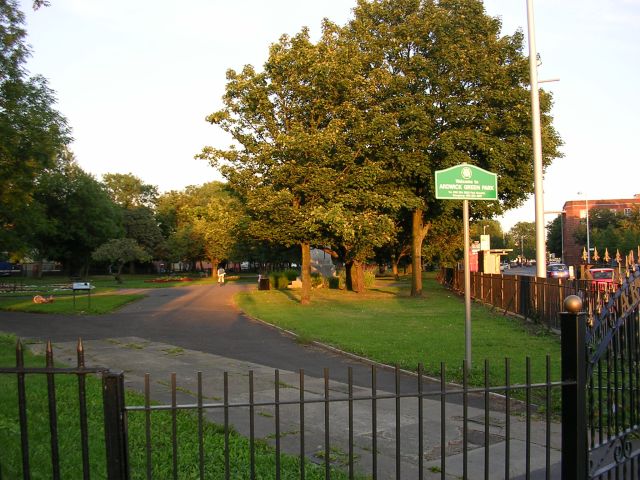
Grand terraces of regency houses (some of which still survive) were built either side of the church, and these were fronted by Ardwick Green, a private park for the residents, containing a pond. Similar housing developments to those around the Green took place along Higher Ardwick and the area known as the Polygon.
Early inhabitants included members of Sir Robert Peel’s family. Charles Dickens drew many of his characters from life, and was a frequent visitor to Manchester. It is said that Dickens based the character of the crippled Tiny Tim in A Christmas Carol on the invalid son of a friend who owned a cotton mill in Ardwick.
Ardwick Cemetery was established in 1838 as a prestigious place for fashionable burials. By the time the cemetery closed in 1950, around 80,000 people had been buried there. John Dalton, the chemist and physicist best known for his advocacy of atomic theory, was amongst them. It was reported that some 100 coaches followed the funeral cortege to the cemetery on the day of his burial in 1844. Other notable interments, recorded on a plaque when the grounds were turned into a sports field in 1966, included Sir Thomas Potter, the first mayor of Manchester, who died in 1845, the Chartist Ernest Charles Jones, who died in 1869, and Buglar Robert Hawthorne, of the 52nd Light Infantry, who was awarded the Victoria Cross in 1857. Following the closure, the granite top of Dalton's tomb was relocated to the John Dalton building of Manchester Metropolitan University, where it lies beside a statue of the man.
Hub AI
Ardwick AI simulator
(@Ardwick_simulator)
Ardwick
Ardwick is an area of Manchester, England, one mile (1.5 kilometres) southeast of the city centre. The population at the 2011 census was 19,250.
Historically in Lancashire, by the mid-nineteenth century Ardwick had grown from being a village into a pleasant and wealthy suburb of Manchester, but by the end of that century became heavily industrialised. When its industries fell into decline so did Ardwick, becoming one of the city's most deprived areas. Substantial development has since taken place, including the construction of facilities for the 2002 Commonwealth Games at the nearby City of Manchester Stadium.
In the late nineteenth century, Ardwick had many places of entertainment, but the only remnant of that today is the Art Deco-style Manchester Apollo, a venue for pop and rock music concerts.
Before the Industrial Revolution, Ardwick was a small village just outside Manchester in open countryside. The principal residents were the Birch family, one of whom was a major general when Oliver Cromwell (briefly) instituted direct military rule.
One Samuel Birch was instrumental in providing a small chapel of ease, dedicated to St. Thomas, and consecrated in 1741. This soon expanded into a Georgian church, to which a brick campanile was added in 1836. It contained a very rare Samuel Green organ, installed in 1787 or 1788, the first in which the sharp keys were distinguished in black. When the building ceased to be used as a church in 1978, the organ was rescued by an organ builder called George Sixsmith, and installed in St Paul's Church, Pendleton. There was also a memorial chapel to the dead of the First World War, chiefly men of the local territorial unit. These have been removed, and the building has been used as offices for voluntary organisations. The structure is now Grade II Listed.
Grand terraces of regency houses (some of which still survive) were built either side of the church, and these were fronted by Ardwick Green, a private park for the residents, containing a pond. Similar housing developments to those around the Green took place along Higher Ardwick and the area known as the Polygon.
Early inhabitants included members of Sir Robert Peel’s family. Charles Dickens drew many of his characters from life, and was a frequent visitor to Manchester. It is said that Dickens based the character of the crippled Tiny Tim in A Christmas Carol on the invalid son of a friend who owned a cotton mill in Ardwick.
Ardwick Cemetery was established in 1838 as a prestigious place for fashionable burials. By the time the cemetery closed in 1950, around 80,000 people had been buried there. John Dalton, the chemist and physicist best known for his advocacy of atomic theory, was amongst them. It was reported that some 100 coaches followed the funeral cortege to the cemetery on the day of his burial in 1844. Other notable interments, recorded on a plaque when the grounds were turned into a sports field in 1966, included Sir Thomas Potter, the first mayor of Manchester, who died in 1845, the Chartist Ernest Charles Jones, who died in 1869, and Buglar Robert Hawthorne, of the 52nd Light Infantry, who was awarded the Victoria Cross in 1857. Following the closure, the granite top of Dalton's tomb was relocated to the John Dalton building of Manchester Metropolitan University, where it lies beside a statue of the man.
Recent media