Hubbry Logo
Honda CenterHonda CenterMain
Open search
Honda Center
Community hub
Honda Center
logo
8 pages, 0 posts
0 subscribers
Be the first to start a discussion here.
Honda Center
Honda Center
from Wikipedia

Honda Center (formerly known as the Arrowhead Pond of Anaheim) is an indoor arena located in Anaheim, California. The arena is home to the Anaheim Ducks of the National Hockey League. It was finished in the year 1993 as the Arrowhead Pond of Anaheim.

Key Information

Originally named the Anaheim Arena during construction, it was completed in 1993 at a cost of US$123 million. Locally based Arrowhead Water paid $15 million for the naming rights over 10 years in October 1993.[5] In the short period of time after the Mighty Ducks franchise was awarded and before the naming rights deal with Arrowhead, Disney referred to the Arena as the Pond of Anaheim.[6] In October 2006, Honda, whose American headquarters are based in Torrance, paid $60 million for the naming rights over 15 years,[7] and renewed the deal for another decade in 2020.[8]

History

[edit]
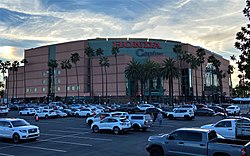
A panorama of Honda Center's exterior
Panorama of Honda Center's interior before a 2007 playoff hockey game
Honda Center in its basketball configuration before an NCAA basketball game
The New Scoreboard at Honda Center as seen from Section 438 during the 2016 Stanley Cup Play-offs on April 27, 2016

The idea for a large indoor arena in Anaheim emerged from entertainment attorney Neil Papiano, who in 1987 randomly selected two of the city's councilmen from the telephone directory to sell them his idea. They approved of the concept, and one year later following location surveys, the placement was chosen at a seven-acre parcel at Douglass Road and Katella Avenue, that at the time was owned by the German social group Phoenix Club. Papiano also managed to get financial backing from two New York-based firms, Ogden Corporation and Nederlander Organization.[9] Even if there was a dispute to build an arena in Orange County with a Santa Ana project led by Spectacor, and there were discussions of feasibility of the arena given the National Basketball Association and National Hockey League were at the time unwilling to expand to the area,[10] the city of Anaheim pushed forward to build the Hellmuth, Obata & Kassabaum, Inc.-designed arena,[11] which broke ground in November 1990.[9] A tenant was finally found in 1992, as The Walt Disney Company had just been awarded an NHL franchise for Anaheim, entering negotiations to lease the arena.[12] Once the deal was broken, the arena's final cost ended at $121 million, as $18 million were added to finance hockey franchise fees and facility improvement.[9]

The arena opened on June 19, 1993, with a Barry Manilow concert as its first event.[13] The then-Arrowhead Pond's first NHL game was also the Mighty Ducks of Anaheim season opener on October 8, 1993, against the Detroit Red Wings, preceded by a 20-minute pregame show at the cost of $450,000. The Ducks lost 7–2.[14] Since then, the arena has been host to a number of events, such as the 2003 and 2007 Stanley Cup Finals.[13] On June 6, 2007, the Anaheim Ducks defeated the Ottawa Senators, 6–2, in game five of the Final at Honda Center to clinch the franchise's first Stanley Cup championship.[15]

Honda Center has hosted several UFC events, starting with UFC 59 in 2006.[16] It hosted the 2005 IBF World Championships for badminton in 2005.[17]

From 1994 to 1999, it served as a second home for the NBA's Los Angeles Clippers. It was the home arena for the Anaheim Bullfrogs of Roller Hockey International from 1994 to 1999 and for the Anaheim Piranhas of the Arena Football League from 1996 to 1997.[18]

This arena has also hosted a PBR Bud Light Cup (later Built Ford Tough Series) event annually since 1998.[19] Since 1994, the arena has hosted the annual Wooden Legacy basketball tournament.[20] In April 2000, it played host to the WWE's 16th annual WrestleMania supercard event.

In 2011, the arena began hosting the Big West Conference Men's and Women's Basketball tournaments.[21] The arena has also hosted the NCAA men's basketball tournament seven times, as the West Regional site – 1998, 2001, 2003, 2008, 2011, 2014, 2016 and 2019. It even hosted the Frozen Four, the semifinals and final of the NCAA Men's Ice Hockey Championship, in 1999, underscoring the popularity of hockey in the region.[13]

On December 6, 2000, music legend Tina Turner played her last concert at the arena for the record breaking Twenty Four Seven Tour, but after popular demand, Turner returned to the arena before a sellout crowd on October 14, 2008, for her Tina!: 50th Anniversary Tour.

Honda Center lies northeast across California State Route 57 from Angel Stadium (the home stadium of Major League Baseball's Los Angeles Angels) and roughly 3 miles (4.8 km) from Disneyland Park. It is also across the street from Anaheim Regional Transportation Intermodal Center with service by Amtrak (Pacific Surfliner), Metrolink (Orange County Line), Anaheim Resort Transit, Orange County Transportation Authority and private transportation companies.

The arena seats up to 17,174 for its primary tenant, the Ducks. It takes only five hours to convert Honda Center from a sporting arena to an 8,400-seat amphitheater. There are 84 luxury suites in the building, which has hosted 17.5 million people, as of 2003. In 2005, the arena became the first in the U.S. to have two full levels of 360° ribbon displays installed. Daktronics of Brookings, South Dakota, designed, manufactured and installed the 1,800 feet (550 m) of full-color LED technology. Outside the venue, the marquee was upgraded with two large video displays measuring 8 feet (2.4 m) high by 21 feet (6.4 m), and a new marquee was built with more LED video displays.[22]

Broadcom chairman Henry Samueli owns the company that operates the arena, Anaheim Arena Management, LLC, and the arena's primary tenant, the Ducks, giving him great flexibility in scheduling events and recruiting new tenants. AAM was founded in 2003 to take over operations of the arena from the bankrupt Ogden Corp.,[23] which had already sold the arena's concession deal to Aramark in 2000 - [24] who remained providing foods and drinks until 2013, when concessions became an in-house operation.[25]

During the 2014–2015 NHL Season, it was announced that Honda Center would get a new scoreboard that will replace the one that was in place since its opening in 1993. The new scoreboard made its debut in a Ducks pre-season game against the Los Angeles Kings.[26]

In March 2020, the arena would lose all its scheduled events because of the COVID-19 pandemic.[27] For the rest of the year, Honda Center would instead host charity events, such as blood drives, food bank distributions, and a collective wedding, along with serving as a drive-through voting location for the 2020 United States presidential election.[28] The Ducks would only play again in the arena once the following NHL season started in January 2021, with a reduced audience of 2,000 being allowed to attend the final five games of the season, starting with an April 17 matchup with the Vegas Golden Knights.[29]

In April 2025, it was announced that Honda Center would undergo a major $1 billion renovation that would be complete by 2027, one year before the 2028 Summer Olympics. The renovations will create a brand new entrance on the southern part of the arena, add escalators and club suites, and increase parking as part of the larger mixed use OC Vibe project taking place near the arena.[30]

Notable events

[edit]
Interior of Honda Center in 2021

Ice hockey

[edit]

Combat sports

[edit]

Concerts

[edit]

Honda Center has the second highest gross ticket sales from special events on the West Coast, following only Crypto.com Arena.[34] These events have included the following over the years:

Other

[edit]

The pond became the setting for the climax game in D2: The Mighty Ducks

As part of the Walt Disney Company's biennal D23 convention in 2024, the Disney Entertainment showcase, Disney Experiences showcase, and Disney Legends award ceremony were hosted at Honda Center, with 12,000 fans in attendance.[39][40][41]

Honda Center and OCVIBE will host the final rounds of FIVB Women’s World Championship 2027.[42]

The arena will host indoor volleyball during the 2028 Summer Olympics.[43]

Capacity

[edit]

Largest Crowds

[edit]
Hockey Basketball
# Date Opponent Score Attendance # Date Opponent Score Attendance
 1  Oct. 14, 2025 Penguins at Ducks 4–3, ANA 17,622 (102.61%)  1  Mar. 12, 1998 Lakers at Clippers 108–85, LAL 18,521 (101.76%)
 2  Mar. 20, 2013 Blackhawks at Ducks 4–2, ANA 17,610 (102.54%)  2  Feb. 4, 1997 Lakers at Clippers 108–86, SD 18,462 (101.44%)
 3  Feb. 26, 2012 Blackhawks at Ducks 3–1, ANA 17,601 (102.49%)  3  Feb. 25, 1999 Lakers at Clippers 115–100, LAL 18,456 (101.41%)
 4  May 12, 2009 Red Wings at Ducks 6-3, DET 17,601 (102.49%)  4  Dec. 2, 1995 Bulls at Clippers 104–98, CHI 18,321 (100.66%)
 5  Jan. 2, 2009 Flyers at Ducks 5–4, PHI (SO) 17,597 (102.46%)  5  Apr. 12, 1997 Nuggets at Clippers 116–94, SD 18,211 (100.06%)

See also

[edit]

References

[edit]
[edit]
Revisions and contributorsEdit on WikipediaRead on Wikipedia
from Grokipedia
The Honda Center is an indoor multi-purpose arena in , that opened on August 1, 1993, originally as the Arrowhead Pond of Anaheim. It serves as the home venue for the National Hockey League's , with a hockey-specific of 17,732, and also accommodates games (18,609 seats), concerts, and other events with capacities up to 19,578 for center-stage setups. Renamed in October 2006 through a 15-year, $60 million agreement with American Honda Motor Co., the deal was extended in 2020 to run through 2031. Owned by the City of Anaheim and operated by Anaheim Arena Management, the facility has hosted over 2,300 events and entertained more than 23 million attendees, contributing significantly to the region's sports and entertainment landscape. Notable for its role in the Ducks' 2007 victory and upcoming selection as a venue for the —marking the first instance of a corporate-named arena retaining its branding during Olympic events—it exemplifies modern arena design with recent upgrades including a new .

History

Planning and Construction

The City of Anaheim initiated for a multi-purpose arena in the late to bolster local sports and entertainment infrastructure, aiming to attract professional franchises amid growing regional demand. In May 1991, the city selected Huber, Hunt & Nichols as the general contractor for the project, originally budgeted at $103 million. The facility, provisionally named Anaheim Arena, was designed by the architectural firm Hellmuth, Obata & Kassabaum (HOK) with features including arched entryways and a capacity oriented toward and concerts. Construction broke ground in June 1991 on a site adjacent to the along East Katella Avenue. The project, financed primarily through public bonds and city revenues, faced cost overruns typical of large-scale venue developments, culminating in a final expenditure of $123 million upon completion in early 1993. Ownership remained with the City of Anaheim, which partnered with private operators for management. The arena's design prioritized versatility, with a steel-framed structure supporting up to 17,500 seats for hockey and expandable configurations for other events, positioning it to host the NHL's newly awarded expansion team, the Disney-owned of Anaheim, starting in the 1993–94 season.

Opening and Early Operations

The Anaheim Arena opened on June 17, 1993, following construction that began in June 1991 at a total cost of $103 million. Its inaugural event was a sold-out by on June 19, 1993. Owned by the City of Anaheim and managed by Anaheim Arena Management, LLC, the venue was designed to host a variety of sports and entertainment events, including plans for symphonic music performances and exhibitions in its initial months. On September 29, 1993, the arena was renamed the Pond of Anaheim under a 10-year, $15 million agreement with Arrowhead Spring Water, which also positioned the company as a sponsor for the incoming hockey team. This deal marked one of the early corporate sponsorships in NHL-affiliated venues, reflecting the arena's rapid integration into the local entertainment ecosystem. The Arrowhead Pond hosted its first National Hockey League game on October 8, 1993, as the home opener for the expansion of Anaheim, owned by , against the . During the 1993–94 season, the Ducks played all 41 home games at the arena, drawing consistent crowds despite finishing last in the Western Conference with a 27–43–14 record. Early operations emphasized diverse programming, blending with high-profile concerts to build attendance and establish the venue as a key regional destination for live events.

Renaming and Sponsorship Changes

The arena was initially known as Anaheim Arena during its planning and construction phases, opening on June 17, 1993. In October 1993, shortly after opening, it was renamed under a naming rights agreement with , a local company, which paid $15 million for a 10-year deal. This sponsorship aligned with the venue's early association with the NHL's of Anaheim, whose inaugural game occurred there under the new name. The Arrowhead Pond name persisted until July 2006, when Anaheim Arena Management (AAM) announced a new partnership with American Motor Co., Inc., effective October 1, 2006, rebranding the venue as Honda Center. agreed to a 15-year deal valued at approximately $60 million, reflecting the growing trend of corporate sponsorships for sports arenas to offset operational costs. The change coincided with the NHL team's rebranding from to following Disney's sale of the franchise. In February 2020, AAM and extended the naming rights agreement for an additional 10 years, securing the Honda Center name through at least 2031 and emphasizing the venue's ongoing role as a premier entertainment destination in . This extension, announced amid stable corporate partnerships, has maintained naming consistency without further changes as of 2025, distinguishing the arena from peers that frequently cycle sponsors.

Modern Era and Expansions

In April 2012, the Anaheim City Council approved the Honda Center Enhancement Project, which permitted an increase in annual events from 200 to 225, alongside physical upgrades to the arena structure, including interior modifications, an exterior expansion, and rezoning of approximately 22.5 acres of the surrounding 42.5-acre site to support additional development. This initiative also introduced the Grand Terrace, a 15,000-square-foot indoor-outdoor entertainment venue featuring a 250-seat full-service to enhance non-event-day usage and revenue streams. By June 2020, the arena's owners, Henry and Samueli, unveiled a $3 billion master plan for an encircling the Honda Center, aimed at transforming the adjacent area into a year-round destination with mixed-use developments, though implementation has proceeded incrementally amid broader regional planning efforts like OCVibe. The most significant modern transformation began in 2025 with the privately funded Honda Center Encore project, a $1 billion full-venue renovation—the first in the arena's —slated for completion by late 2027 to coincide with preparations for the . Led by Ducks owner , the overhaul includes renovated luxury suites, new opera box suites on the Plaza Level, expanded hospitality amenities, three additional parking garages adding 6,000 spaces, and a new five-story south-side entrance, all executed while keeping the venue operational to minimize disruption. Early phases, highlighted during the Anaheim ' 2024 home opener, have already improved fan experiences through targeted multimillion-dollar updates.

Ownership and Operations

Ownership Structure

The Honda Center is owned by the City of Anaheim, which financed and constructed the arena as a public facility opening in 1993. Operations and day-to-day are handled by Anaheim Arena Management, LLC (AAM LLC), pursuant to a and agreement with the city that grants AAM LLC control over venue programming, maintenance, and revenue generation. AAM LLC has been owned by Henry and Susan Samueli since 2005, when they acquired both the management entity and the NHL franchise, the arena's primary tenant. This structure aligns management interests with the Ducks' operations, as the team holds leasing rights for and related events, while non-team events fall under AAM LLC's broader oversight. In 2018, the city extended the management agreement with AAM LLC through at least 2048, incorporating commitments for Ducks tenancy, acquisitions, and revenue-sharing mechanisms that allocate portions of net revenues to the city after operational costs. The Samueli family's control over AAM LLC has facilitated significant private investments in the city-owned asset, including a $1 billion renovation initiative announced in 2025—branded as Honda Center Encore—fully funded by the owners without public subsidies, aimed at modernizing facilities ahead of events like the 2028 Olympics. This arrangement reflects a hybrid model common in U.S. venues, where municipal ownership provides public infrastructure benefits and tax incentives, while private operators bear operational risks and invest in upgrades to maximize utilization.

Management and Tenants

The Honda Center is owned by the City of Anaheim, which acquired the property in conjunction with the arena's construction and opening on June 17, 1993. The venue is managed and operated by Anaheim Arena Management, LLC, a company acquired in 2005 by , co-founder and chairman of , and his wife Susan Samueli, who also own the . Anaheim Arena Management handles day-to-day operations, including event booking, food and beverage services, and facility maintenance, under a long-term agreement with the city that allocates 47.5% of arena revenues to the management company. The primary tenant is the Anaheim Ducks of the National Hockey League (NHL), operated by Anaheim Ducks Hockey Club, LLC, which has held home games at the arena continuously since its inaugural season as the Mighty Ducks of Anaheim in October 1993. The Ducks' lease was extended in November 2018 through at least 2048, securing the team's residency amid discussions of facility upgrades and surrounding development. No other professional sports teams currently hold resident tenancy status, though the arena hosts a variety of non-tenant events such as concerts and temporary exhibitions.

Design and Infrastructure

Architectural Features

The Honda Center was designed by the architectural firm Hellmuth, Obata & Kassabaum (now Populous), with structural engineering by and project management by . The arena's exterior features a facade accented by large green-glass archways, contributing to its distinctive appearance in Anaheim. Inside, the facility includes over 200,000 square feet of lining the concourses and walls, enhancing the interior aesthetic across its total 650,000 square feet of space. A key structural element is the , spanning 329 by 444 feet and engineered with minimal steel to balance aesthetic goals, load-bearing capacity, and seismic resilience required in .

Capacity and Configuration

The Honda Center features a variable seating capacity tailored to event types, with configurations optimized for sports and entertainment. For ice hockey, including Anaheim Ducks games, the arena holds 17,732 spectators, utilizing a setup that surrounds the rink on multiple sides while accommodating ice installation and player benches. Basketball configurations expand capacity to 18,609 by adjusting the floor for a full court and repositioning lower-level sections for optimal viewing angles around the perimeter. Concert setups further adapt the venue: center-stage arrangements, often resembling in-the-round formats, reach 19,578 attendees, whereas end-stage productions, with the stage at one end and tiered seating focused forward, seat 13,793. These variations rely on modular flooring, retractable seating in the lower bowl, and adjustable barriers to convert between , hard , and open stage areas. Floor seating or standing areas for general admission can supplement fixed seats during high-demand shows, though exact totals depend on production specifics.

Amenities and Upgrades

The Honda Center features 80 luxury suites, each equipped with furnishings including a sofa, cocktail table, flat-screen television, , and , providing premium viewing and hospitality options for events. Club level seating offers access to exclusive lounges, in-seat food and beverage service via a , and priority entry through dedicated VIP entrances. Concession stands throughout the arena provide diverse options such as rolls, hand rolls, nigiri, and specialty items at venues like the Old No. 7 Club, with six new concession concepts introduced for the 2024-25 season to enhance fan dining experiences. Ongoing renovations under the Honda Center Encore project, a privately funded initiative exceeding $1 billion launched in fall 2024 and extending through 2027, include phased updates to all 80 luxury suites and the addition of new opera box suites on the Plaza Level to modernize hospitality amenities while the arena remains operational. Back-of-house improvements, costing nearly $70 million, encompass an expanded underground and upgraded rigging and trusses to support larger productions. Parking capacity is increasing by nearly 60 percent, with two new general parking garages scheduled to open in October , improving accessibility for attendees. These enhancements aim to boost event hosting capabilities and integrate with surrounding developments like OC Vibe.

Sports Events

Ice Hockey

The Honda Center has served as the primary venue for professional ice hockey in the region since its opening, hosting the Anaheim Ducks of the National Hockey League as its anchor tenant. Originally constructed as the Anaheim Arena and opened on June 17, 1993, the facility was renamed the Arrowhead Pond of Anaheim shortly thereafter and hosted the Ducks' inaugural home game in October 1993 during their expansion season. The Ducks, then known as the Mighty Ducks of Anaheim, have conducted all regular-season home games at the arena since, with the venue rebranded as Honda Center in 2007 following a sponsorship agreement. Configured for ice hockey, the arena seats 17,732 spectators, supporting the Ducks' schedule of 41 home games per NHL season. The team clinched its sole Stanley Cup championship on June 6, 2007, defeating the Ottawa Senators 6–2 in Game 5 of the Finals before an attendance of 17,372; this marked the first such title for a California-based NHL franchise. The Honda Center also hosted Stanley Cup Finals games in 2003, when the Ducks advanced but fell to the New Jersey Devils, underscoring its role in major playoff events. Beyond Ducks contests, the arena has accommodated collegiate and other hockey events, including the 1999 NCAA Division I Men's Ice Hockey Championship (Frozen Four), where the University of Maine defeated the University of New Hampshire in the final on April 3, 1999. These occurrences highlight the venue's adaptability for high-level amateur competitions, though professional Ducks games remain the dominant ice hockey activity.

Combat Sports and Wrestling

The Honda Center has served as a prominent venue for events, particularly those sanctioned by the (UFC). occurred on September 22, 2007, drawing 14,087 spectators for bouts including defeating in the main event. took place on January 22, 2022, with defending his heavyweight title against in front of 17,387 attendees. More recently, was held on February 17, 2024, headlined by Alexander Volkanovski's featherweight title defense against . Under a multi-year deal with , the UFC commits to hosting at least three events per year at the arena through 2028. The venue has also accommodated cards. A notable example is the July 6, 2024, matchup between and , contested over 10 rounds in a format. Other promotions, such as , have staged bouts there, including events in February 2025. In , the Honda Center—originally Arrowhead Pond—has hosted major spectacles since the mid-1990s, including on March 31, 1996, featuring the main event between and . followed on April 2, 2000, with a four-way elimination match for the WWF Championship involving , The Rock, , and . The arena routinely accommodates WWE television tapings like Monday Night Raw and live tours, with a Raw episode scheduled for October 27, 2025.

Other Athletic Competitions

The Honda Center has hosted numerous tournaments and championships, serving as a key venue for regional and conference competitions in . It was the site for the NCAA Men's West Regional in 1998, 2001, 2003, 2011, 2014, and 2016, accommodating games that advanced teams to the . Additionally, the arena served as the primary host for the men's and women's tournaments from 2011 through 2019, drawing teams from universities such as UC Irvine and Long Beach State for semifinal and championship matchups. These events typically featured capacities exceeding 17,000 spectators, highlighting the venue's adaptability for configurations with lowered basketball courts and elevated seating. High school basketball has also been prominent, with the Honda Center hosting the Ford Championships for boys' and girls' Open Division and Division 1 finals annually, including events in February such as the 2025 edition. These championships culminate seasons for top prep teams, emphasizing the arena's role in youth and amateur athletics beyond professional leagues. In arena football, the Honda Center was the home venue for the of the from 2014 to 2016, hosting regular-season games and playoffs for the team owned by rock band members and . The Kiss played their inaugural home game there on April 5, 2014, against the San Antonio Talons, drawing crowds with themed halftime shows and rock-infused presentations. The team suspended operations after the 2016 season due to league financial issues, marking the end of AFL affiliation at the arena. No other major team sports like soccer or have been regularly hosted, though the venue's floor configuration supports occasional exhibition or invitational events in these disciplines when demand arises.

Entertainment and Cultural Events

Concerts and Performances

The Center's inaugural event was a sold-out by on June 19, 1993, as part of his Greatest Hits … and Then Some Tour. Early concerts established the venue's reputation for high attendance, including George Strait's performance on April 29, 1994, which drew 18,739 spectators and holds the single-show record. The arena has hosted extended runs by prominent artists, such as Barbra Streisand's six shows in June and July 1994—with the final performance filmed for an special that earned —and ' three consecutive sold-out concerts in June 1996, later matched by another trio in September 2016. Other major acts include U2's three sold-out dates in April 2001, Paul McCartney's appearances in 2002 and 2005, Tina Turner's farewell concert in December 2000 followed by a return in 2008, and ' shows in 2013 featuring guests like and . achieved the fastest sell-out in venue history with their April 1–2, 2017, performances. Gwen Stefani, an Anaheim native formerly of —which headlined local shows including May 31–June 1, 1997—performed a headline set for the arena's 30th anniversary in September 2023. In recent years, center-stage concerts have filled the 19,578 capacity for acts including , , , and . events have set successive records, with Peso Pluma's August 22, 2024, show initially marking the year's highest attendance and the venue's most-attended Latin concert, a milestone surpassed by Fuerza Regida's sold-out September 28, 2024, performance.

Family and Miscellaneous Shows

The Honda Center has regularly hosted family-oriented ice skating productions, particularly shows, which feature Disney characters performing on ice to popular storylines and music. These events draw large crowds with multiple performances over several days, such as the 2025 presentation of presents Magic in the Stars, showcasing tales from , , , and , alongside contemporary favorites. Historical iterations include : Toy Story 3 in December 2011 and Disney's High School Musical: The Ice Tour on December 31, 2008, emphasizing interactive elements like character meet-and-greets and pre-show experiences for children. Circus performances have also been a staple, with Ringling Bros. and Barnum & Bailey Circus returning to the venue for multi-day runs, as seen in the August engagement promoted as The Greatest Show On Earth, complete with , animal acts, and routines tailored for audiences. A 2009 Ringling Bros. event highlighted high-energy spectacles that excited young attendees with elements like snow cones and amplified music, underscoring the arena's suitability for such immersive, multi-sensory shows. Other miscellaneous family events include exhibitions by the , known for comedic basketball routines and trick shots, and figure skating tours featuring professional skaters in themed performances. These offerings complement the venue's broader event calendar, providing accessible entertainment with ticket prices starting around $50 for ice shows and circus admissions varying by seating.

Records and Impact

Attendance Milestones

The Honda Center has hosted over 46 million guests across more than 4,700 events since its opening in 1993. In hockey, the arena set a franchise record for Anaheim Ducks home game attendance on October 14, 2025, with 17,622 fans for a 4–3 over the , surpassing the previous high of 17,610 from March 20, 2013, against the . A women's international hockey milestone occurred on February 8, 2020, when the women's national team defeated 4–3 in before a record crowd of 13,320—the largest attendance for a U.S. women's national team game on American soil at the time. For concerts, established attendance benchmarks in the venue's early years by drawing record crowds for three consecutive shows on two separate occasions, first in 1995 and again in 1998. More recently, Peso Pluma's August 22, 2024, performance marked the highest-attended Latin concert and the largest concert crowd of that year at the arena. Additionally, member Jin's July 2025 shows achieved the venue's highest concert attendance to date, including the first two-night sellout by a Korean soloist in the same weekend. In its 30th anniversary year ending June 2023, the Honda Center welcomed 1.2 million fans across 113 events, underscoring sustained high demand.

Economic and Community Contributions

The Honda Center anchors the OC Vibe mixed-use in Anaheim, a $4 billion privately financed project approved by the City Council in September 2022, which encompasses 100 acres of retail, dining, offices, residential units, and public spaces surrounding the arena. This development is projected to produce an annual economic output exceeding $400 million, including recurring revenue for city services through increased , sales taxes, and property values, while creating and permanent jobs without direct taxpayer funding. The arena's events, such as NHL games and concerts, draw regional visitors, bolstering adjacent hospitality and transportation sectors, as evidenced by its selection as a venue for the indoor , anticipated to yield additional transient economic benefits for local hotels and vendors. In 2025, OC Sports & Entertainment, operators of the Honda Center, announced a $1 billion privately funded renovation led by Ducks owner , set to unfold through 2027 while keeping the venue operational; this investment aims to modernize facilities, sustain event hosting capacity, and amplify long-term economic contributions via enhanced attendance and ancillary spending. On the community front, the Honda Center and collaborate on philanthropy, directing charitable contributions toward youth, education, health, and family support organizations in Orange County. Since 2005, the annual Center Ice Party has raised $1.5 million for the Orangewood Foundation, aiding foster youth programs. The Ducks Foundation's Fly Together Grant Program funds local nonprofits, supplemented by in-kind donations like event tickets via the Community Corner initiative, which prioritizes 501(c)(3) groups with demonstrated attendance. Additional efforts include partnerships with Second Harvest Food Bank for hunger relief and annual events like Go Orange for Orangewood, held March 1, 2025, to spotlight child welfare. These activities extend the arena's role beyond revenue generation to tangible social support, with grants, auctions, and volunteer hours distributed to verified charities.

References

Add your contribution
Related Hubs
User Avatar
No comments yet.