Hubbry Logo
List of UFC eventsList of UFC eventsMain
Open search
List of UFC events
Community hub
List of UFC events
logo
8 pages, 0 posts
0 subscribers
Be the first to start a discussion here.
List of UFC events
List of UFC events
from Wikipedia

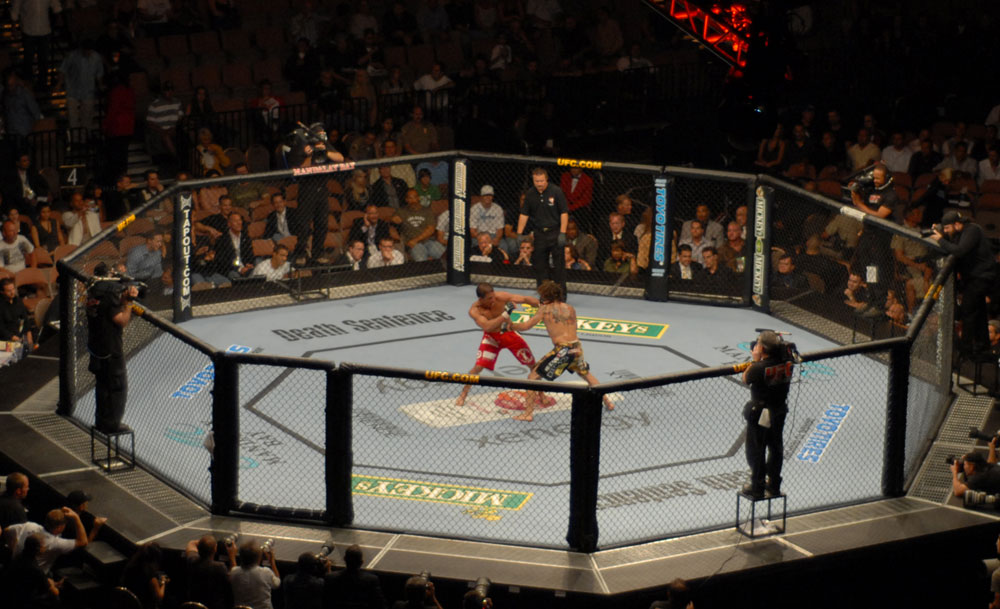
All UFC bouts take place inside the Octagon.

List of UFC events is a list of events held and scheduled by the Ultimate Fighting Championship (UFC), a mixed martial arts promotion based in the United States. UFC's first event, UFC 1, took place on November 12, 1993. Each UFC event contains several fights. Traditionally, every event starts off with a preliminary card followed by a main card, with the last fight being known as the main event.

Overview

[edit]

UFC events are separated into nine different formats:

  • "Numbered" events, currently airing on pay-per-view, with some exceptions
  • "Fight Night" events, currently airing on ESPN+, formerly aired on Spike, Fox Sports 1, Fox Sports 2 or UFC Fight Pass.
  • "The Ultimate Fighter Finale" events, currently airing on ESPN+, formerly aired on Spike, FX, Fox Sports 1 or UFC Fight Pass.
  • "UFC on ABC" events, currently airing on ABC
  • "UFC on ESPN" events, currently airing on ESPN or ESPN2
  • "UFC on Fox" events, formerly aired on Fox
  • "UFC on FX" events, formerly aired on FX
  • "UFC on Fuel TV" events, formerly aired on Fuel TV
  • "UFC Live" events, formerly aired on Versus

Most of the "numbered" events have taken place on pay-per-view, though there have been a few exceptions for reasons such as tape-delay. Events such as UFC 72, which took place in Belfast, Northern Ireland, were sold on pay-per-view, but due to tape-delay, purchase rates were not as high as events that aired at a traditional starting time.[1] As such, events taking part in significantly different time zones, including UFC 70, UFC 75, UFC 89, UFC 95, UFC 105, UFC 120, UFC 122, and UFC 138, were given a same-night airing in U.S. prime time on Spike.[2]

Historically, the UFC has also aired preliminary fights prior to the main fight cards, either on television via Spike, FX, and Fuel TV, or online via Facebook and YouTube. Beginning in August 2013, starting with UFC Fight Night: Shogun vs. Sonnen, the UFC began airing non-PPV events on either Fox Sports 1 or Fox Sports 2.[3] In January 2014, as part of the organization's global expansion, the UFC began airing various international events exclusively on their subscription-based digital network, UFC Fight Pass.[4]

In July 2009, the UFC held its unofficial 100th "numbered event"; however, officially, despite being called UFC 100, it was actually the 101st numbered event (not to mention the 133rd event overall). The UFC signed a deal with Fox Sports Net, after Fox agreed to broadcast one fight in June 2002, during its "All-Star Summer" that month.[5] UFC 37 and 38 had already been scheduled and promoted, but as UFC 38 was the promotion's debut in the United Kingdom, they created UFC 37.5; an event that featured the first ever mixed martial arts fight available on cable television.[5]

As of UFC Fight Night: Tsarukyan vs. Hooker, which took place on November 22, 2025, there have been 756 UFC events held in 169 cities in 32 countries.

Other events

[edit]

In May 2017, the UFC announced White would hold Dana White's Tuesday Night Contender Series weekly on UFC Fight Pass (becoming, from January 2019 on, exclusive content on ESPN+ in the United States). As with the earlier web series Looking for a Fight, the goal of the series is for White to scout talent for the UFC.[6][7] It was stated ahead of the license being approved that “this is not the UFC, this is not the UFC brand,” but instead a promotion that will allow up and coming fighters the chance to showcase their talents in hopes that one day they may compete in the UFC.[8]

Scheduled events

[edit]

Past events

[edit]

Number of events by year

[edit]
Number of Events by Year
Year Number of Events Yearly Difference
2024 42 −1
2023 43 +1
2022 42 −1
2021 43 +2
2020 41 0
2019 41 +2
2018 39 0
2017 39 −2
2016 41 0
2015 41 −5
2014 46 +13
2013 33 +2
2012 31 +4
2011 27 +3
2010 24 +4
2009 20 0
2008 20 +1
2007 19 +1
2006 18 +8
2005 10 +5
2004 5 0
2003 5 −2
2002 7 +2
2001 5 −1
2000 6 0
1999 6 +3
1998 3 −2
1997 5 0
1996 5 +1
1995 4 +1
1994 3 +2
1993 1

Event locations

[edit]
United States (total: 530)

Brazil (total: 41)

Canada (total: 36)

United Kingdom (total: 30)

United Arab Emirates (total: 22)

Australia (total: 20)

Japan (total: 9)

China (total: 8)

Mexico (total: 8)

Germany (total: 6)

Singapore (total: 6)

Sweden (total: 6)

France (total: 4)

Ireland (total: 3)

New Zealand (total: 3)

Russia (total: 3)

Netherlands (total: 2)

Poland (total: 2)

Saudi Arabia (total: 2)

South Korea (total: 2)

Argentina (total: 1)

Azerbaijan (total: 1)

Chile (total: 1)

Croatia (total: 1)

Czech Republic (total: 1)

Denmark (total: 1)

Philippines (total: 1)

Puerto Rico (total: 1)

Qatar (total: 1)

Al Rayyan (1)

Uruguay (total: 1)

See also

[edit]

References

[edit]
[edit]
Revisions and contributorsEdit on WikipediaRead on Wikipedia
from Grokipedia
The List of UFC events is a chronological catalog of all mixed martial arts (MMA) competitions organized by the Ultimate Fighting Championship (UFC), the world's leading MMA promotion, commencing with its debut tournament, UFC 1: The Beginning, held on November 12, 1993, at the McNichols Sports Arena in Denver, Colorado. This inaugural event featured an eight-man single-elimination tournament to determine the first UFC champion, marking the start of a format that evolved from no-holds-barred fights to regulated bouts under the Unified Rules of MMA beginning with UFC 28 in 2000. As of November 2025, the UFC has hosted 755 events across 31 countries, encompassing approximately 8,580 professional fights in various weight classes, from flyweight to heavyweight, with events broadcast to nearly 950 million households in over 210 countries. These events are broadly divided into two main types: numbered pay-per-view (PPV) events, which are flagship cards typically headlined by world title defenses or high-profile matchups and numbered sequentially from UFC 1 onward (reaching UFC 323 by late 2025), and UFC Fight Night events, which serve as non-PPV cards often broadcast on linear television like ESPN and featuring rising stars or veteran contenders. Additional formats, such as The Ultimate Fighter Finale events and international series like Road to UFC, have also contributed to the roster, reflecting the promotion's expansion from domestic tournaments to a global enterprise. The UFC's event history underscores its transformation of MMA into a mainstream sport, with landmark cards like UFC 100 (2009) and UFC 229 (2018) drawing record attendances exceeding 20,000 fans and generating millions in PPV buys, while recent events continue to break viewership barriers through digital streaming and international partnerships. This list not only documents fight outcomes, bonuses, and attendance figures but also highlights the promotion's role in crowning champions, fostering rivalries, and influencing the sport's regulatory standards worldwide.

Overview

Event History and Evolution

The Ultimate Fighting Championship (UFC) was founded on November 12, 1993, by Art Davie and Rorion Gracie, with the inaugural event, UFC 1: The Beginning, held at McNichols Sports Arena in Denver, Colorado, to determine the most effective martial art through real combat. The event featured an eight-man single-elimination tournament format with minimal rules—prohibiting only biting, eye gouging, and small joint manipulation—and no weight classes, time limits, or rounds, allowing fights to continue until submission, knockout, or referee stoppage. Royce Gracie emerged victorious by submitting all three opponents, highlighting Brazilian jiu-jitsu's effectiveness and earning a $50,000 prize, but the raw, no-holds-barred style sparked immediate controversies, including criticism for excessive brutality, the provocative slogan "There Are No Rules," and subsequent bans on pay-per-view distribution in several markets due to legal and public backlash. By 1994, the UFC transitioned to a consistent numbered event series, beginning with UFC 2, which maintained the tournament structure but began incorporating gradual rule refinements, such as the introduction of judges' decisions for non-finishes and weight classes to address safety concerns. International expansion accelerated in the early 2000s, with the first UFC event outside North America being UFC Brazil in São Paulo, Brazil, on October 16, 1998, and further expansion including UFC 38: Lands of the Midnight Sun in London, England, on July 13, 2002, marking the promotion's entry into global markets and setting the stage for events in over 17 countries by the 2020s. Major regulatory milestones facilitated this growth, including New Jersey's sanctioning of mixed martial arts in 2000—the first U.S. state to do so—prompted by figures like Jeff Blatnick, who advocated for rebranding the sport and helped formulate the Unified Rules of Mixed Martial Arts, leading Nevada to follow suit in 2001 and paving the way for legalization across all 50 U.S. states by 2016. The UFC's event frequency evolved dramatically from one event in 1993 and 1-2 annually in the mid-1990s to 5 events in 2000, with further growth to 12 events annually by 2007, driven by ownership changes under Zuffa LLC in 2001 and increasing mainstream acceptance. This trajectory accelerated with the 2018 partnership with ESPN, a five-year, $1.5 billion broadcasting deal that enhanced visibility and distribution, contributing to over 40 events per year by the late 2010s. This growth continued with the 2023 formation of TKO Group Holdings through the merger of UFC and WWE, enhancing event distribution and international reach. The COVID-19 pandemic disrupted this momentum in 2020, prompting the postponement of multiple events due to travel restrictions and gathering bans, but the UFC adapted by hosting its first card at the UFC Apex facility in Las Vegas on May 30, 2020, enabling a return to action with strict health protocols and smaller crowds.

Event Formats and Types

UFC events are primarily categorized into pay-per-view (PPV) and Fight Night formats, each serving distinct roles in showcasing mixed martial arts competitions. PPV events, also known as numbered events, form the cornerstone of the promotion's high-stakes offerings, typically featuring 10-13 bouts structured around a main card of five fights and preliminary cards. These events are headlined by championship defenses or marquee matchups involving top-ranked fighters, with main events and title bouts consisting of five five-minute rounds, while non-title fights are limited to three rounds. In contrast, Fight Night events comprise non-PPV cards, usually with 10-12 fights, emphasizing mid-tier contests and opportunities for emerging athletes to gain visibility, often without title implications and adhering to the standard three-round format for most bouts. Beyond these core types, UFC incorporates specialized formats to support talent development and global expansion. The Ultimate Fighter (TUF) Finale events conclude seasons of the reality competition series by featuring tournament final bouts alongside additional undercard fights, providing a platform for contract-winning prospects to debut or compete professionally. International Fight Night cards extend the format to regions outside North America, such as Asia and Europe, maintaining the standard 10-12 fight structure but tailored to local audiences and time zones to foster worldwide growth. Special events occasionally deviate from routine structures, incorporating unique elements like heightened security protocols following high-profile incidents, though they generally align with PPV or Fight Night templates. The evolution of UFC card structures reflects a shift from experimental origins to standardized professionalism. Early events in 1993 adopted a one-night tournament format, where eight fighters competed in elimination bouts to determine a single champion, often involving multiple fights per participant without fixed round limits. Following the 2001 acquisition by Zuffa, the promotion transitioned to regulated, multi-bout cards under unified rules, eliminating tournaments in favor of linear matchmaking with 3-5 round structures to prioritize fighter safety and event pacing. This modern framework, now producing over 40 annual events, supports a consistent progression from preliminary undercards to climactic main events. Broadcast and monetization strategies differentiate these formats significantly, aligning with their audience draw. PPV events are distributed via premium platforms like ESPN+ in the United States, requiring an additional purchase—typically around $80 per event—beyond a base subscription, enabling the UFC to generate substantial revenue from high-profile fights that have collectively contributed to over $1 billion in annual company earnings. Fight Night events, conversely, are ad-supported and included in standard ESPN or ESPN+ subscriptions, focusing on accessibility to build fan engagement and scout talent without the PPV gate. This model, evolving from earlier free-to-air deals, underscores PPV's role in funding marquee productions while Fight Nights sustain weekly momentum.

Scheduled Events

UFC event start times are typically announced in Eastern Time (ET). For viewers in the United Kingdom, approximate UK local times can be obtained by adding 5 hours to the listed ET times during British Summer Time (BST) or 4 hours during Greenwich Mean Time (GMT). Due to potential variations in daylight saving time observance and local broadcast requirements, the most accurate and up-to-date information, including current or next event times, is available on the official UFC website at ufc.com/events or ufc.com/schedule.

Events in 2025

The Ultimate Fighting Championship (UFC) hosted 42 events in 2025, encompassing a mix of numbered pay-per-view (PPV) spectacles and Fight Night cards broadcast on ESPN platforms, continuing the organization's expansion into international markets and diverse venues. This schedule reflected a balanced calendar with 29 Fight Nights and 13 PPVs, emphasizing title defenses in multiple weight classes and high-profile rematches to drive fan engagement. As of November 20, 2025, all events from January through November 15 have concluded without major disruptions, while the November 22 Fight Night in Doha is upcoming; no cancellations or significant date shifts have been announced for the remainder of the year.
DateEventVenueLocationMain Event
November 22, 2025UFC Fight Night: Tsarukyan vs. HookerABHA ArenaDoha, QatarArman Tsarukyan vs. Dan Hooker
December 6, 2025UFC 323: Dvalishvili vs. Yan 2T-Mobile ArenaLas Vegas, Nevada, USAMerab Dvalishvili (c) vs. Petr Yan 2 (Bantamweight title)
December 13, 2025UFC Fight Night: Royval vs. KapeUFC ApexLas Vegas, Nevada, USABrandon Royval vs. Manel Kape
The UFC successfully hosted all 42 scheduled events in 2025 without cancellations. Key thematic highlights of the 2025 schedule included several championship defenses and trilogy bouts that underscored ongoing rivalries, such as the bantamweight rematch between champion Merab Dvalishvili and Petr Yan at UFC 323, building on their 2021 encounter, and the third clash between Max Holloway and Dustin Poirier at UFC 318, reigniting a storied featherweight rivalry. Notable debuts featured rising prospects like Reinier de Ridder in multiple high-stakes matchups, including against Robert Whittaker and Brendan Allen, marking his transition from ONE Championship to UFC's middleweight division. The year also emphasized global reach, with events in 15 countries, including Azerbaijan, China, and Qatar, to broaden the promotion's international appeal.

Events in 2026 and Beyond

As of late 2025, the Ultimate Fighting Championship (UFC) has announced plans for 44 events in 2026, marking an ambitious expansion under a new broadcasting agreement. This schedule includes the promotion's first major pay-per-view event on Paramount, tentatively set as UFC 324 on January 24, 2026, at T-Mobile Arena in Las Vegas, Nevada, though no headliners have been confirmed. Additionally, a UFC Fight Night is scheduled to return to Macao, China, in 2026, highlighting the organization's intent to revive Asian markets. Beyond these, specific dates, venues, and matchups for the remaining events remain unannounced, with further details expected in early 2026. UFC's expansion into new markets will accelerate in 2026, building on 2025 announcements for increased presence in the Middle East and Europe. Saudi Arabia, a key partner since 2024, is poised for additional high-profile events, potentially including numbered pay-per-views, as part of ongoing collaborations with local authorities. In Europe, the promotion plans to host more frequent shows, reducing reliance on the UFC Apex in Las Vegas to prioritize international venues like those in the United Kingdom and Scandinavia. These efforts align with broader Middle East growth initiatives, including a regional Contender Series to develop local talent in Saudi Arabia and the Gulf states. Several factors will shape UFC's 2026 scheduling, including the transition from its ESPN partnership, which expires at the end of 2025, to a seven-year, $7.7 billion domestic rights deal with Paramount Global. This agreement will stream all events on Paramount+ and broadcast select cards on CBS, potentially influencing event frequency and global accessibility, with explorations for international rights. Fighter dynamics, such as retirements among aging champions and contract negotiations, could alter headliners, while global touring commitments—driven by venue availability and regulatory approvals—may lead to adjustments in international slots. Historically, UFC has maintained a pattern of 40 or more events per year since 2020, with a growing emphasis on international diversification to capture global audiences. By 2026, projections suggest over 10 events outside the United States, up from eight in 2025, reflecting a strategic shift toward 20 annual international cards to broaden market reach. This trend supports sustained revenue growth, as international events have consistently drawn larger crowds in emerging regions like Asia and the Middle East.

Past Events

Numbered Pay-Per-View Events

The Ultimate Fighting Championship (UFC) has hosted numbered pay-per-view (PPV) events since its inception in 1993, marking these as the promotion's flagship offerings with high-stakes bouts, often featuring title fights or marquee matchups. These events evolved from tournament-style formats in the early years to structured cards emphasizing superfights and divisional rivalries, consistently drawing significant viewership and revenue through PPV sales. By November 2025, the UFC had conducted over 320 such events, with buy rates peaking in the millions for blockbuster cards driven by star power like Conor McGregor. Key milestones in UFC PPV history include the inaugural UFC 1, which established the promotion's no-holds-barred roots, and UFC 100, a landmark anniversary event that showcased multiple title defenses and set a then-record for buys. The introduction of superfights, beginning with early cross-division clashes like the Superfight Championship at UFC 5 in 1995 between Ken Shamrock and Royce Gracie, revolutionized the format by pitting elite champions against each other to boost appeal. Later examples, such as UFC 194's featherweight title unification between Jose Aldo and McGregor in 2015, amplified global interest and PPV numbers. The 300th numbered event in 2024, UFC 300, highlighted the promotion's maturity with a stacked card of title bouts and returns, achieving record attendance and gate revenue. Record-breaking buy rates were epitomized by UFC 229 in 2018, where Khabib Nurmagomedov's lightweight title defense against McGregor generated 2.4 million purchases amid intense rivalry. UFC PPV events typically feature 11-12 fights per card, blending preliminary and main card bouts to build toward climactic main events, a structure that has remained consistent since the mid-2000s to maximize viewer engagement. Revenue trends shifted notably from traditional cable PPV dominance in the 1990s and 2000s—where events like UFC 100 relied on providers like DirecTV—to streaming platforms like ESPN+ starting in 2018, enabling broader accessibility but altering direct buy metrics through bundled subscriptions. Gate revenue highlights include UFC 300's $16.5 million haul from 20,067 attendees, underscoring the economic impact of live events in major arenas.
Event NumberDateVenueLocationMain EventBuy Rate (millions)Notable Outcomes
UFC 1November 12, 1993McNichols Sports ArenaDenver, Colorado, USARoyce Gracie vs. Gerard Gordeau (Tournament Final)0.086Inaugural tournament; Gracie's submission victory popularized Brazilian jiu-jitsu in MMA.
UFC 5April 7, 1995Expo CenterCharlotte, North Carolina, USAKen Shamrock vs. Royce Gracie (Superfight Championship)0.250First superfight title bout; Gracie's armbar win set PPV record for over a decade.
UFC 100July 11, 2009Mandalay Bay Events CenterLas Vegas, Nevada, USABrock Lesnar vs. Frank Mir (Heavyweight Title)1.600Anniversary spectacle with multiple rematches; Lesnar's loss drew peak mainstream attention.
UFC 194December 12, 2015MGM Grand Garden ArenaLas Vegas, Nevada, USAJose Aldo vs. Conor McGregor (Featherweight Title)1.200McGregor's 13-second KO upset; propelled his stardom and UFC's global expansion.
UFC 205November 12, 2016Madison Square GardenNew York, New York, USAEddie Alvarez vs. Conor McGregor (Lightweight Title)1.300First UFC event in NY; McGregor's win made him simultaneous two-division champion.
UFC 229October 6, 2018T-Mobile ArenaLas Vegas, Nevada, USAKhabib Nurmagomedov vs. Conor McGregor (Lightweight Title)2.400Record buys; post-fight brawl led to suspensions, highlighting rivalry's intensity.
UFC 257January 23, 2021Etihad ArenaAbu Dhabi, United Arab EmiratesDustin Poirier vs. Conor McGregor 2 (Non-Title)1.500McGregor's leg injury loss; Dustin's comeback win amid pandemic-era international hosting.
UFC 300April 13, 2024T-Mobile ArenaLas Vegas, Nevada, USAAlex Pereira vs. Jamahal Hill (Light Heavyweight Title)~1.000 (est.)Milestone card with 10 title bouts/finals; record attendance of 20,067 and $16.5M gate.

Fight Night and Other Non-Numbered Events

UFC Fight Night and other non-numbered events form the foundational backbone of the Ultimate Fighting Championship's live programming, offering frequent opportunities for fighters to compete in high-stakes bouts broadcast primarily on linear television or streaming platforms. These events, which began in 2005, differ from numbered pay-per-view spectacles by emphasizing accessibility and volume, often serving as testing grounds for roster expansion and international growth. As of November 2025, the UFC had conducted over 450 such non-PPV events, accounting for 70-80% of its annual schedule and enabling a steady pipeline of talent to the organization's premier cards. The series debuted with UFC Fight Night 1 on August 6, 2005, at the Cox Pavilion in Las Vegas, Nevada, headlined by a welterweight clash between Diego Sanchez and Kenny Florian, and aired live on Spike TV as part of a burgeoning partnership to broaden MMA's audience. Subsequent events rapidly increased in frequency, transitioning through various broadcast homes including Versus, Fuel TV, Fox Sports, and ESPN starting in 2019, with main events typically featuring rising contenders or veteran matchups in non-title scenarios. These cards have hosted thousands of fights, contributing to the UFC's evolution into a global enterprise while maintaining a focus on competitive depth over marquee hype. Notable sub-series within non-numbered events include The Ultimate Fighter Live cards from 2012 to 2014, a collaboration with FX that produced seven live broadcasts tied to the reality show's seasons, such as The Ultimate Fighter 15 Finale on June 1, 2012, at The Pearl in Las Vegas, headlined by Charles Oliveira vs. Nik Lentz. International expansions highlighted events like UFC Fight Night: Machida vs. Anders on March 21, 2018, at Jeunesse Arena in Rio de Janeiro, Brazil, where Lyoto Machida defeated Kelvin Gastelum in the main event, broadcast on ESPN. Post-2020, the compact UFC Apex facility in Las Vegas became a staple for over 50 Fight Night cards amid pandemic restrictions and ongoing efficiency needs, exemplified by UFC Fight Night: Overeem vs. Volkov on February 6, 2021, drawing 5,501 virtual attendees.
Year RangeExample EventDateVenue/LocationMain EventBroadcast Network
2005-2010UFC Fight Night 18: Condit vs. KampmannApril 1, 2009Sommet Center, Nashville, Tennessee, USACarlos Condit vs. Martin Kampmann (Welterweight)Versus
2011-2015UFC Fight Night 30: Machida vs. MuñozOctober 26, 2013Phones 4u Arena, Manchester, England, UKLyoto Machida vs. Mark Muñoz (Middleweight)Fox Sports 1
2016-2020UFC Fight Night: Covington vs. LawlerAugust 3, 2019Bankers Life Fieldhouse, Indianapolis, Indiana, USAColby Covington vs. Robbie Lawler (Welterweight)ESPN+
2021-2024UFC Fight Night: Sandhagen vs. FontAugust 5, 2023Etihad Arena, Abu Dhabi, UAECory Sandhagen vs. Rob Font (Bantamweight)ESPN+
These non-numbered events play a crucial role in talent development, acting as proving grounds where prospects can secure contracts, build records, and attract fan attention through highlight-reel performances. Fighters like Sean O'Malley, who debuted on December 1, 2017, at The Ultimate Fighter 26 Finale in Las Vegas—defeating Terrion Ware by unanimous decision—leveraged multiple Fight Night appearances to showcase their skills, culminating in title contention by 2023. Similarly, rising stars such as Khamzat Chimaev gained momentum via undefeated runs on these cards, including his debut submission win at UFC Fight Night on July 15, 2020 (UFC Fight Island 1), accelerating their path to PPV headliners. By prioritizing volume and variety, these events have nurtured over 70% of the UFC's current roster, fostering long-term sustainability in a competitive sport.

Event Statistics

Events by Year

The Ultimate Fighting Championship (UFC) has hosted an increasing number of events each year since its inception, transitioning from sporadic pay-per-view spectacles to a robust schedule of weekly programming that includes both numbered pay-per-view (PPV) events and non-numbered Fight Night cards. This expansion underscores the promotion's growth from a niche tournament-style format in the 1990s to a global mainstream sports entity by the 2020s, with total events rising from 1 in 1993 to 42 in 2024 and approximately 40 more in 2025 as of November. Official UFC statistics track this progression, highlighting how event volume has been shaped by ownership changes, broadcasting partnerships, and external challenges. The following table summarizes the annual totals from 1993 to 2025 (partial for 2025), including breakdowns by event type and approximate average attendance derived from reported figures across events. PPVs refer to numbered events (UFC 1 and subsequent), while Fight Nights encompass non-numbered cards such as UFC Fight Night series and The Ultimate Fighter finales. Early years featured exclusively PPVs, with Fight Nights emerging in 2005. Average attendance reflects reported paid figures where available, excluding no-spectator events or APEX arena shows with limited capacity; peaks often occurred at major PPVs like UFC 129 (55,724 in 2011). Data is compiled from UFC records and industry reports.
YearTotal EventsPPVsFight NightsAverage Attendance (approx.)
19931107,800
19943304,500
19954405,200
19965506,100
19974405,800
19983304,900
19995506,300
20006607,000
20015506,500
20027707,200
20035507,800
20045508,100
200510648,900
2006181089,500
20071913610,200
20082013710,800
20092015511,200
20102416811,500
201127161112,300
201231151612,800
201333132013,100
201441132813,400
201541132813,700
201640132713,900
201736122414,200
201839142514,500
201941122914,800
20204111300 (most events closed-door due to COVID-19)
202143133012,900 (return to full capacity mid-year)
202242123015,100
202343123115,400
202442123015,600
202540 (partial, as of Nov)1228N/A
Event growth accelerated after Zuffa LLC's acquisition of the UFC in 2001, with a notable surge post-2005 as the company stabilized finances and introduced Fight Night events to build a regular TV presence, increasing from 10 events in 2005 to 20 by 2009. The 2010s saw a plateau around 30-40 events annually, driven by consistent broadcasting but limited by production capacity, before surging to over 40 per year in the 2020s through expanded weekly ESPN programming that enabled more Fight Nights alongside 11-14 PPVs. This shift prioritized volume and accessibility, with total events reaching a peak of 43 in 2021 and 2023, and continuing strongly into 2025 with 40 events by November. Key influencing factors include strategic acquisitions, such as the 2011 purchase of Strikeforce, which integrated additional talent and justified more frequent events to showcase the roster, and major media deals like the 2011 Fox Sports partnership (boosting to 24 events in 2010-2011) and the 2018 ESPN agreement (enabling 39 events in 2018). Disruptions, notably the COVID-19 pandemic in 2020, led to the cancellation of early-year events and a shift to closed-door productions at the UFC Apex, yet the promotion still delivered 41 events by adapting to virtual formats. Looking ahead, the UFC plans to maintain over 40 events annually into 2025 and beyond, continuing the high-volume model with a mix of international PPVs and domestic Fight Nights to capitalize on global fan engagement. In 2025, events have included high-profile PPVs like UFC 322 and Fight Nights in locations such as Las Vegas and Abu Dhabi.

Events by Location and Venue

The Ultimate Fighting Championship (UFC) has hosted events in over 30 countries across six continents since its inception in 1993, with the vast majority occurring in the United States due to established infrastructure and regulatory frameworks. As of November 2025, the organization has conducted 755 events worldwide, reflecting a strategic balance between domestic strongholds and international outreach to tap into diverse fan bases. This distribution underscores the UFC's evolution from a primarily North American promotion to a global enterprise, where venue selection prioritizes accessibility, capacity, and economic viability.
CountryTotal Events (up to 2024)Notable Cities and Venues
United States500+Las Vegas (T-Mobile Arena, MGM Grand Garden Arena, UFC Apex); New York (Madison Square Garden)
Brazil50+Rio de Janeiro (Jeunesse Arena); São Paulo (Ibirapuera Arena)
Canada30+Montreal (Bell Centre); Edmonton (Rogers Place)
United Arab Emirates20+Abu Dhabi (Etihad Arena)
United Kingdom15+London (The O2 Arena)
Australia15+Sydney (Qudos Bank Arena); Melbourne (Rod Laver Arena)
This table highlights the concentration of events in key markets, with the United States accounting for approximately 70% of all UFC happenings through 2024, driven by venues in Las Vegas that have become synonymous with major pay-per-view cards. In 2025, the U.S. continues to dominate with over 25 events as of November, primarily in Las Vegas. Among the most frequently utilized venues, the MGM Grand Garden Arena in Las Vegas has hosted approximately 43 UFC events since 2001, serving as the backdrop for numerous historic title fights and establishing itself as the promotion's premier destination for high-stakes bouts. The T-Mobile Arena, opened in 2016, has hosted approximately 33 events as of 2024 (and additional in 2025), benefiting from its central location and modern facilities that accommodate large crowds and broadcast requirements. The UFC Apex, a compact 1,300-seat facility in Las Vegas introduced in 2019, has conducted over 118 events as of late 2025, primarily Fight Night cards, offering a controlled environment ideal for television production during periods of travel restrictions. Internationally, the Etihad Arena in Abu Dhabi has emerged as a cornerstone with over 20 events since 2019, leveraging state-of-the-art acoustics and capacity for up to 18,000 spectators. These venues exemplify the UFC's preference for established arenas that ensure logistical efficiency and fan engagement. The UFC's international expansion began modestly outside the United States, with the first event in Japan occurring in 1997 at the Yokohama Arena for UFC Japan: Ultimate Japan 1, marking the promotion's entry into Asia amid growing interest in martial arts. The United Kingdom hosted its inaugural UFC event in 2002 with UFC 38: Lands of the Midnight Sun at the Royal Albert Hall in London, capitalizing on Europe's burgeoning MMA scene. Brazil's debut came in 2010 with UFC 134: Rio at the HSBC Arena in Rio de Janeiro, a pivotal moment that tapped into the country's rich jiu-jitsu heritage and passionate fan base. In the Middle East, UFC 112: Invincible in 2010 at the Ferrari World in Abu Dhabi represented the first event in the region, fostering a long-term partnership that has since hosted dozens of cards. By 2025, the UFC had reached over 30 countries, with first-time events in additional markets like Australia (2010) and Mexico (2010), illustrating a deliberate timeline of geographic diversification, including ongoing series in 2025. Selection of locations and venues is influenced by several key factors, including regulatory approvals that vary by jurisdiction—such as sanctioning bodies in the U.S. and international athletic commissions—ensuring compliance with safety and combat sports laws. Fan base size plays a critical role, with markets like Brazil and the UK chosen for their dedicated audiences that drive attendance and viewership, often exceeding 15,000 per event in those regions. Revenue considerations, including site fees paid by host cities and broadcast deals, further guide decisions; for instance, Las Vegas venues account for about 40% of events due to superior infrastructure, tax incentives, and proximity to UFC headquarters, maximizing profitability from ticket sales and sponsorships. These elements collectively enable the promotion to balance global reach with financial sustainability.

References

Add your contribution
Related Hubs
User Avatar
No comments yet.