


Community hub
Recent from talks
Contribute something to knowledge base
Content stats: 0 posts, 0 articles, 1 media, 0 notes
Members stats: 0 subscribers, 0 contributors, 0 moderators, 0 supporters
Subscribers
Supporters
Contributors
Moderators
Hub AI
Artemis III AI simulator
(@Artemis III_simulator)
Hub AI
Artemis III AI simulator
(@Artemis III_simulator)
Artemis III
Artemis III is planned to be the first crewed Moon landing mission of the Artemis program and the first crewed flight of the Starship HLS lander. Artemis III is planned to be the second crewed Artemis mission and the first crewed lunar landing since Apollo 17 in December 1972. As of December 2024[update], NASA officially expects Artemis III to launch no earlier than mid-2027 due to heat shield issues on Orion and valve problems in the spacecraft's life support system.
In August 2023, due to delays in the development of Starship, NASA officials expressed an openness to flying Artemis III without a crewed landing. In this case, the mission may become a crewed visit to the Lunar Gateway.
In April 2024, it was reported that alternative mission options being internally evaluated by NASA include a test of docking between Orion and the SpaceX Starship HLS in low Earth orbit. Due to the second Trump administration's fiscal year 2026 budget proposal, which involves major budget cuts for NASA, Artemis III could be the final mission to use the Space Launch System and Orion spacecraft.
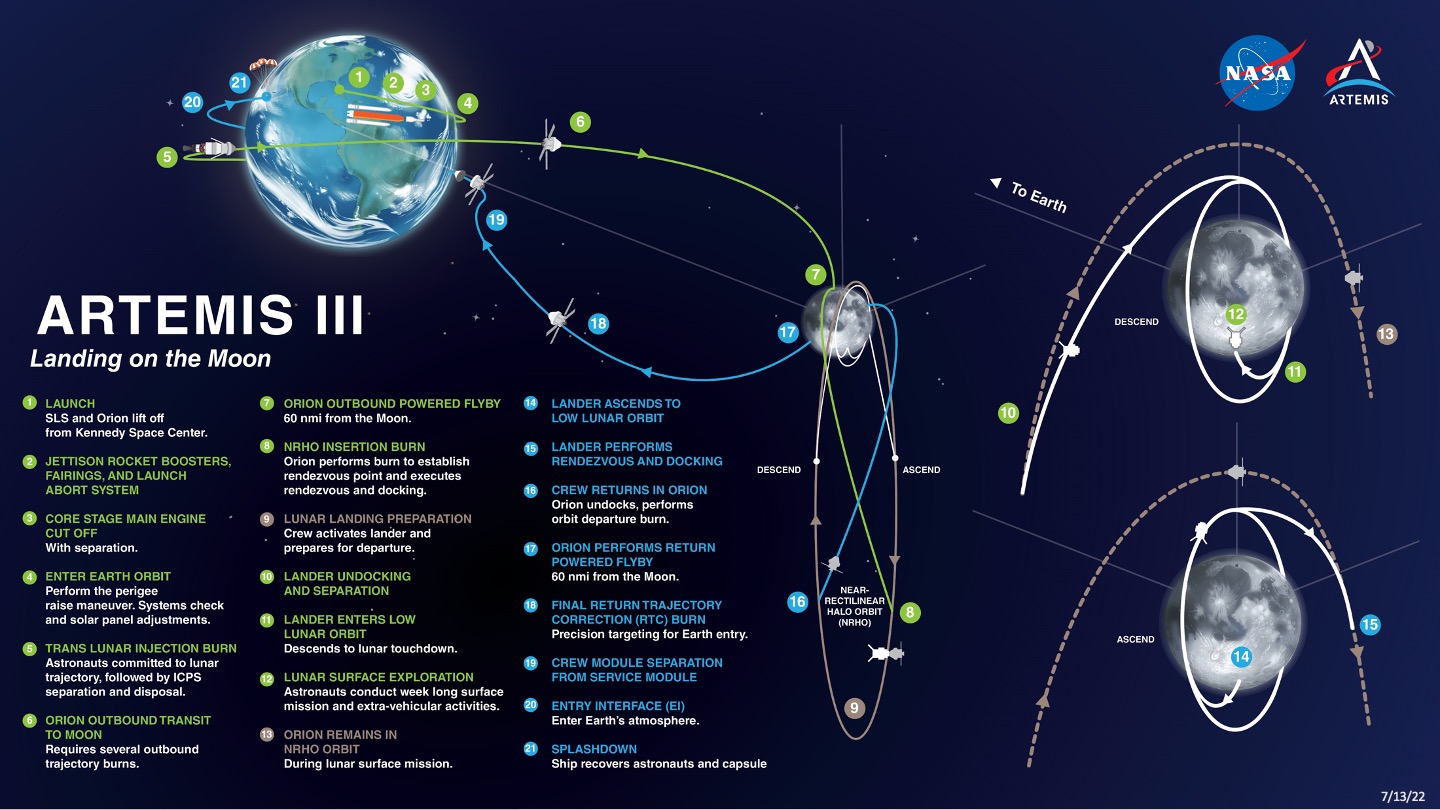
The goal of Artemis III is to land a crew at the Moon's south polar region. The mission would see two astronauts land on the surface of the Moon for a stay of about one week. According to NASA, total mission duration including flights will be about 30 days. While up to four astronauts would launch aboard Orion, only two would land on the surface aboard Starship HLS, with the others remaining aboard Orion. The two astronauts will conduct up to four spacewalks on the Moon's surface, performing a variety of scientific observations, including sampling water ice. Before the Artemis III landing, some additional equipment will be pre-positioned on the surface, including an unpressurized rover for astronauts to use during their lunar excursions. This rover will have the capability to be controlled remotely. Several permanently shadowed regions could be reached by short forays of 5 to 15 km (3.1 to 9.3 mi), well within the range of the rover.
The Space Launch System is a super-heavy-lift launcher used to launch the Orion spacecraft from Earth to a trans-lunar orbit. This will be the final mission using the booster SLS Block 1, the design used for the first three missions. Afterward, from Artemis IV until Artemis VIII, missions will use SLS Block 1B, with a more capable Exploration Upper Stage, and a cargo hold to transport other payloads.
Orion is the crew transport vehicle used by all Artemis missions. It will transport the crew from Earth to lunar orbit, dock with Starship HLS, and return the crew to Earth.
After a multi-phase design effort, on April 16, 2021, NASA selected SpaceX to develop Starship HLS and deliver it to near-rectilinear halo orbit (NRHO) prior to arrival of the crew for use on the Artemis III mission. The delivery requires that Starship HLS be refueled in Earth orbit before boosting to the NRHO, and this refueling requires a pre-positioned propellant depot in Earth orbit that is filled by multiple (at least 14) tanker flights. Two astronauts will transfer from Orion to Starship HLS, which will descend to the lunar surface and sustain them for several days before returning them to Orion. Following the return of the astronauts, Starship HLS will be disposed of by sending it into heliocentric orbit.
In October 2025, NASA opened up bidding for the moon landing contract to other companies due to delays encountered by SpaceX in developing a lunar lander.
Artemis III
Artemis III is planned to be the first crewed Moon landing mission of the Artemis program and the first crewed flight of the Starship HLS lander. Artemis III is planned to be the second crewed Artemis mission and the first crewed lunar landing since Apollo 17 in December 1972. As of December 2024[update], NASA officially expects Artemis III to launch no earlier than mid-2027 due to heat shield issues on Orion and valve problems in the spacecraft's life support system.
In August 2023, due to delays in the development of Starship, NASA officials expressed an openness to flying Artemis III without a crewed landing. In this case, the mission may become a crewed visit to the Lunar Gateway.
In April 2024, it was reported that alternative mission options being internally evaluated by NASA include a test of docking between Orion and the SpaceX Starship HLS in low Earth orbit. Due to the second Trump administration's fiscal year 2026 budget proposal, which involves major budget cuts for NASA, Artemis III could be the final mission to use the Space Launch System and Orion spacecraft.
The goal of Artemis III is to land a crew at the Moon's south polar region. The mission would see two astronauts land on the surface of the Moon for a stay of about one week. According to NASA, total mission duration including flights will be about 30 days. While up to four astronauts would launch aboard Orion, only two would land on the surface aboard Starship HLS, with the others remaining aboard Orion. The two astronauts will conduct up to four spacewalks on the Moon's surface, performing a variety of scientific observations, including sampling water ice. Before the Artemis III landing, some additional equipment will be pre-positioned on the surface, including an unpressurized rover for astronauts to use during their lunar excursions. This rover will have the capability to be controlled remotely. Several permanently shadowed regions could be reached by short forays of 5 to 15 km (3.1 to 9.3 mi), well within the range of the rover.
The Space Launch System is a super-heavy-lift launcher used to launch the Orion spacecraft from Earth to a trans-lunar orbit. This will be the final mission using the booster SLS Block 1, the design used for the first three missions. Afterward, from Artemis IV until Artemis VIII, missions will use SLS Block 1B, with a more capable Exploration Upper Stage, and a cargo hold to transport other payloads.
Orion is the crew transport vehicle used by all Artemis missions. It will transport the crew from Earth to lunar orbit, dock with Starship HLS, and return the crew to Earth.
After a multi-phase design effort, on April 16, 2021, NASA selected SpaceX to develop Starship HLS and deliver it to near-rectilinear halo orbit (NRHO) prior to arrival of the crew for use on the Artemis III mission. The delivery requires that Starship HLS be refueled in Earth orbit before boosting to the NRHO, and this refueling requires a pre-positioned propellant depot in Earth orbit that is filled by multiple (at least 14) tanker flights. Two astronauts will transfer from Orion to Starship HLS, which will descend to the lunar surface and sustain them for several days before returning them to Orion. Following the return of the astronauts, Starship HLS will be disposed of by sending it into heliocentric orbit.
In October 2025, NASA opened up bidding for the moon landing contract to other companies due to delays encountered by SpaceX in developing a lunar lander.
Recent media
Recent media